
The Full Financial Picture of Dementia Care: What Families Need to Know About Memory Care Costs and Payment Pathways
Most families dramatically overpay for memory care because they are unaware of programs that could substantially reduce out-of-pocket spending. This guide provides a comprehensive financial roadmap covering VA benefits, Medicaid waivers, long-term care insurance, and tax strategies for dementia care.
The first memory care quote has a way of making the room go quiet. In 2026, the national median cost for memory care is $8,019 a month, with reported state medians running from $5,538 in South Dakota to $14,399 in Hawaii.[1] That number is not just rent with meals. It reflects secure supervision, dementia-trained staffing, help with daily activities, and the higher oversight that Alzheimer’s disease and related dementias usually require.
It is also not the whole bill. Care level fees, medication management, incontinence supplies, transportation, move-in fees, and private-duty help during transitions can sit outside the figure a family first hears on the phone. Memory care commonly costs 15% to 25% more than standard assisted living, while the national median for assisted living is $5,676 a month and in-home care is $35 an hour.[1][2] For families still comparing whether round-the-clock home support or residential memory care makes more sense, that comparison belongs beside the monthly quote, not after the deposit is due. A deeper placement comparison is available in the guide to 24-hour home care versus memory care costs.

The question families need to ask early is not only, “Can we afford this month’s rate?” It is, “Which part of this cost must come from us, and which part might be covered, reimbursed, deducted, delayed, or planned around?” That is where many households lose money. They start writing checks from savings while Medicare is misunderstood, Medicaid is assumed to be impossible, a VA benefit is never explored, or a long-term care insurance claim sits half-filed.
Why Dementia Care Changes the Financial Math
Dementia care is financially different because it often lasts long enough to wear down a household that looked stable on paper. The Alzheimer’s Association estimates the lifetime cost of care for a person living with dementia at $405,262, with families bearing 70% of that cost.[3] That family share is the number to sit with. It explains why a spouse can start with what looked like adequate retirement savings and still end up rationing choices after months or years of supervision needs.
The national figures are large enough to numb people: the Alzheimer’s Association estimates $409 billion in health and long-term care payments for dementia in 2026, plus $446.3 billion in unpaid family care.[3] Another 2026 estimate puts the U.S. cost at $818 billion when quality-of-life reductions and unpaid care are included.[4] Those figures use different methods and answer different questions. For a family looking at a move-in packet, the practical point is smaller and more urgent: unpaid caregiving and paid supervision often overlap until the family is exhausted financially and physically.
That overlap is not evenly distributed. A Place for Mom reported that 41% of dementia caregivers have household incomes of $50,000 or less, based on a September 2025 survey of 1,029 caregivers.[5] For those families, one wrong assumption about coverage can consume months of income. Even for middle-income families, the damage often comes from sequence: private pay first, questions later.
The Medicare Assumption Families Need to Correct First
Medicare is usually the first card families reach for, and it is the one most likely to disappoint them in memory care planning. Medicare may cover up to 100 days of skilled nursing care under specific conditions, but it does not pay for long-term custodial memory care.[6] Custodial care means help with bathing, dressing, eating, toileting, safety monitoring, and daily supervision. Those are often the very services that make memory care necessary.
The distinction matters because a person with dementia can have a serious medical diagnosis and still need care that Medicare treats as non-covered custodial support. A hospital stay, rehabilitation order, or medication change may open short-term skilled coverage if the rules are met. It does not turn a secure memory care apartment into a Medicare-paid residence.
This is where families lose planning time. Someone says, “Medicare should cover this because Alzheimer’s is a disease,” and the family waits for a payment source that will not arrive. By the time they understand the rule, they may already be choosing from the few communities with immediate availability, not the ones that fit both care needs and finances.
For narrower coverage questions, it helps to separate home help, companion care, skilled home health, and residential care. The guides on whether Medicare covers companion care and paying for home help can help with those boundaries. For memory care placement, the working assumption should be plain: Medicare may help with limited medical episodes, not the ongoing residential bill.
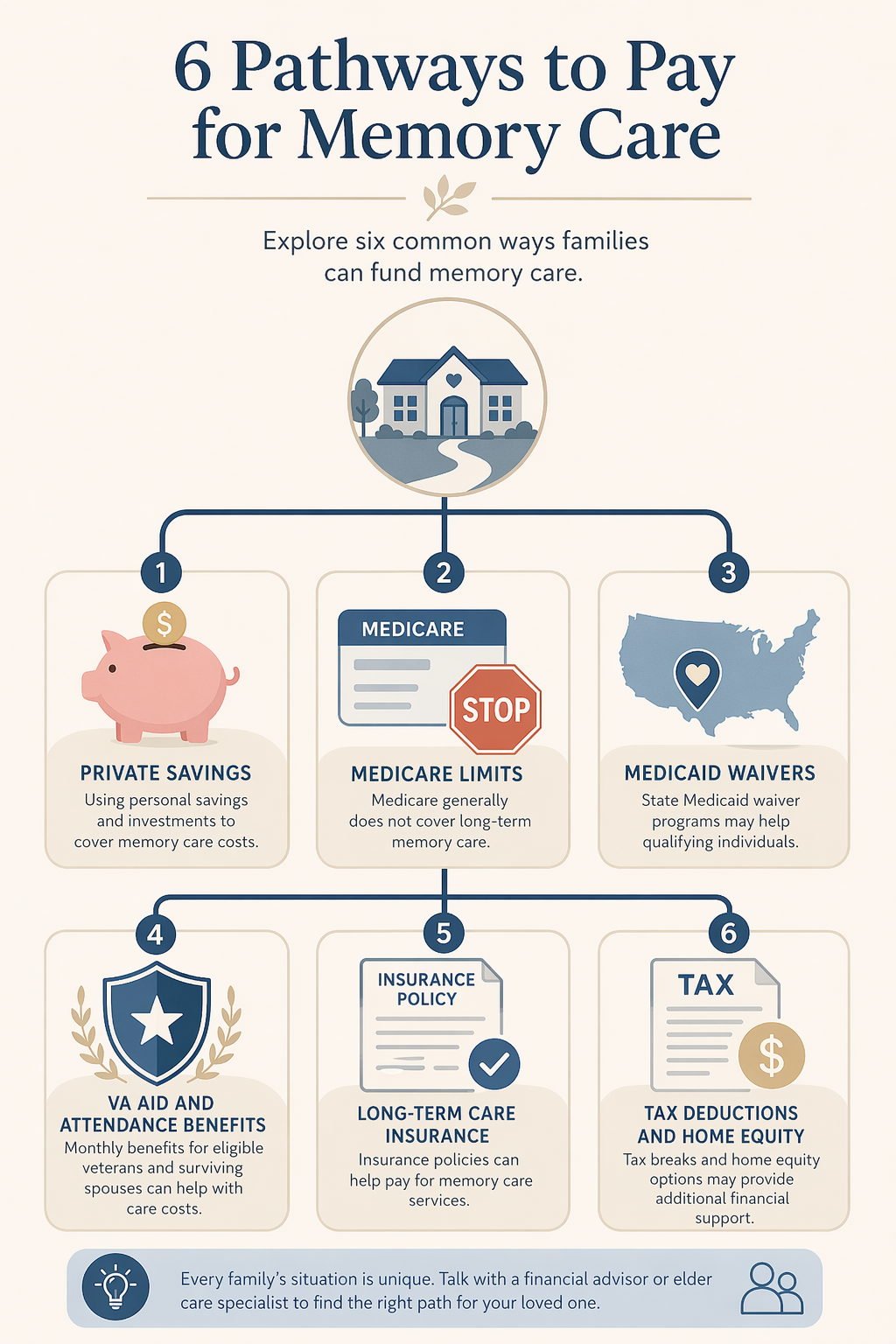
Build the Roadmap Before the Checking Account Becomes the Plan
Private savings are not a strategy by themselves. They are the default when nobody has mapped the other routes. In many families, the first payments come from a joint checking account, then a brokerage account, then retirement funds, and only after that does someone ask whether a veteran’s benefit, Medicaid waiver, insurance policy, or tax deduction should have been part of the plan from the beginning.
A useful dementia care roadmap starts with documents, not guesses. Families should gather the memory care quote, care assessment, diagnosis records, medication list, income sources, bank and investment statements, insurance policies, military discharge papers if applicable, tax returns, powers of attorney, trust documents, home mortgage information, and any denial or approval letters already received. The person making calls should keep a dated log of who said what, because coverage and eligibility conversations become hard to reconstruct after a crisis move.
| Pathway | What it may help with | What to verify before relying on it |
|---|---|---|
| Private savings and income | Immediate deposits, monthly fees, care-level charges, uncovered services | How long funds last after taxes, spouse’s living expenses, and likely rate increases |
| Medicare | Limited skilled nursing or medical episodes when rules are met | Whether the need is skilled care or custodial memory care |
| Medicaid and waivers | Some long-term care costs, depending on state rules and setting | State eligibility, waiver availability, spend-down rules, estate recovery, and facility participation |
| VA Aid and Attendance | Additional pension support for eligible veterans or surviving spouses who need help with daily activities | Service history, income and asset rules, care documentation, and application timing |
| Long-term care insurance | Reimbursement or indemnity payments if the policy is active and triggers are met | Elimination period, benefit amount, inflation protection, covered settings, and claim documentation |
| Tax deductions | Possible medical expense deduction when qualified costs exceed the federal threshold | Whether memory care costs qualify and whether total deductible medical expenses exceed 7.5% of adjusted gross income |
| Home equity | Cash flow through sale, rental, home equity borrowing, or reverse mortgage structures | Spousal housing needs, Medicaid consequences, debt costs, taxes, and legal authority to act |
Private Pay: Use It Deliberately, Not Automatically
Most memory care communities are prepared to discuss private pay because it is straightforward for admission. The family pays the deposit, signs the residence agreement, and covers the monthly bill. That may be necessary, especially when placement is urgent. It should still be treated as a bridge while other paperwork is underway.
The first private-pay calculation should include more than the posted monthly rate. Ask the community for a written fee schedule showing base rent, care levels, medication fees, incontinence charges, move-in fees, community fees, respite or trial-stay rates if relevant, transportation charges, and discharge or notice rules. Then calculate how many months the family can pay while preserving the spouse’s housing, food, medical, and emergency funds. Savings that belong to a married couple are not just a payment source; they are also the well spouse’s future rent, prescriptions, roof repair, and heat bill.
Families comparing broader senior care financing options can use a general guide such as How to Pay for Senior Care in 2026. For dementia care, the added discipline is timing: every month spent private-paying without checking benefits is a month that cannot be recovered unless a program or policy allows retroactive payment.
Medicaid: State Rules Decide the Real Answer
Medicaid can be the most important long-term care payer for some families, but it is also the easiest to oversimplify. There is no single national answer to whether Medicaid will pay for a particular memory care setting. Eligibility rules, income limits, asset treatment, waiver availability, waiting lists, spend-down rules, estate recovery, and participating facilities vary by state.
That variation changes the order of decisions. A family should not sell a house, transfer money, cash out accounts, or sign a long private-pay contract on the assumption that Medicaid will work the same way it did for a cousin in another state. Even within the same state, one community may accept Medicaid waiver residents while another does not, or may accept them only after a private-pay period. Those facility policies need to be put in writing.
Spend-down deserves particular care. Families often hear the phrase and think it means simply using assets until little is left. In practice, spend-down planning can affect the spouse at home, eligibility timing, penalty periods, funeral planning, debt payment, and whether past transfers create problems. Estate recovery also needs to be discussed before assumptions are made about the house. This is where a Certified Elder Law Attorney is not a luxury add-on. It is the person who can read state rules against the family’s actual accounts, home, marriage status, and documents.
VA Aid and Attendance: The Benefit Families Often Miss
If the person with dementia is a veteran, or the surviving spouse of a veteran, VA Aid and Attendance should be checked early. It is not automatic, and it is not the same as Medicare, Medicaid, or standard retirement income. It is an additional pension benefit for eligible veterans or surviving spouses who need help with activities of daily living, are housebound, or meet other care-related criteria.
The practical mistake is failing to ask. A daughter may be busy comparing room rates while an old discharge paper sits in a file cabinet. A surviving spouse may not think of herself as connected to VA benefits because the veteran died years earlier. The community’s sales packet may mention “veterans benefits,” but that does not mean the application has been filed correctly or that the family has gathered the medical and service records needed to support it.
The family should confirm military service dates, discharge status, marital status, income, assets, unreimbursed medical expenses, and the level of help needed with daily activities. They should also ask how the benefit interacts with Medicaid planning before moving assets or changing accounts. A benefit that arrives late can still help, but it cannot fix months of avoidable private-pay spending if nobody knew to start the file.
Long-Term Care Insurance: Read the Policy Before the Crisis
Long-term care insurance can be valuable for memory care, but only if there is already a policy in force and the claim is handled correctly. It is usually not a last-minute product for a person who already needs dementia care. One industry summary reported that 78% of long-term care insurance policies are purchased between ages 50 and 69, that waiting 10 years increases costs by 49.9%, and that 47% of people age 70 and older are denied long-term care insurance because of health concerns.[7] Those figures speak to timing, not guaranteed usefulness.
For an existing policy, the family needs the actual contract, not just a billing statement. Look for the daily or monthly benefit amount, lifetime maximum, inflation protection, elimination period, covered settings, cognitive impairment language, activities-of-daily-living triggers, licensed-care requirements, prior authorization rules, and whether the policy reimburses actual expenses or pays a set cash benefit.
The claim file should match the policy language. If the policy requires evidence that the person needs substantial supervision because of cognitive impairment, a vague note saying “memory problems” may not be enough. Ask the doctor, community nurse, or care manager for documentation that describes supervision needs, safety risks, and help with daily activities. Keep invoices itemized. Track the elimination period. If the insurer denies or delays the claim, ask for the denial reason in writing and compare it with the contract before accepting the answer.
Tax Deductions: Not a Payment Source, but Still Worth Checking
Tax deductions will not solve an $8,019 monthly bill, but they can reduce the after-tax burden for some families. Qualified medical expenses may be deductible to the extent they exceed 7.5% of adjusted gross income. For memory care, the key question is whether the resident’s costs qualify as medical expenses and how much of the facility charge is attributable to care rather than ordinary living costs.
This is a document problem. Families should keep the care plan, physician letters, diagnosis records, invoices, medication charges, mileage logs for medical transportation, insurance reimbursement statements, and any facility breakdown of medical versus nonmedical charges. If an adult child is paying costs for a parent, dependency and support rules may matter. A tax professional should review the facts before the family assumes the deduction is available.
Home Equity: Useful, but Not Neutral
For many older adults, the house is the largest asset left. It may also be the spouse’s home, the disabled adult child’s residence, the intended source of future Medicaid recovery, or the one thing siblings feel emotional about before they understand the monthly care bill. Home equity can help through a sale, rental, home equity loan, line of credit, or reverse mortgage arrangement, but each option changes the family’s risk.
Before using the house to pay for memory care, families should confirm who legally owns it, who has authority to sign, whether a spouse or dependent still lives there, whether Medicaid planning is likely, what taxes or debt would follow a sale, and whether the person with dementia has capacity to sign documents. If capacity is already impaired and powers of attorney are missing or weak, the family may be forced into court involvement before they can access the asset at all.
What to Ask Before Signing a Memory Care Agreement
The admission agreement is not just a move-in form. It is the contract that decides what the family owes, when rates can change, what happens after hospitalization, how discharge works, and whether outside payment sources can be used. Families should slow down long enough to ask questions in writing, even when placement feels urgent.
- What is included in the base monthly rate, and which services are billed separately?
- How are care levels assessed, priced, and reassessed?
- How much notice is required before a rate increase?
- Does the community accept Medicaid waiver payment now, later, or not at all?
- Is any private-pay period required before Medicaid participation is considered?
- Will the facility provide itemized invoices for long-term care insurance and tax documentation?
- What happens if the resident needs one-on-one supervision, hospice, hospital care, or a higher level of nursing support?
- What are the refund rules if the resident moves out, dies, or is hospitalized shortly after payment?
A family that asks these questions is not being difficult. It is trying to avoid finding out in month three that the quoted price was only the starting line.
A Sensible Order of Operations
When a move is close, families rarely have the luxury of perfect planning. They can still choose a better order than panic spending. The first step is to stabilize the care decision: confirm that memory care is the right level of supervision, compare realistic alternatives, and get the community’s full written pricing. The middle-stage Alzheimer’s decision timeline may help families who are still trying to understand when home care stops being enough.
Next, assign one person to build the payment file. That person does not have to make every decision, but someone needs to track documents, deadlines, benefit calls, policy numbers, facility invoices, and professional advice. In families with siblings, this job should be acknowledged as work. The person doing it is often spending lunch breaks on hold with insurers, county offices, VA contacts, and facility billing departments.
- Get the full written memory care quote, including care-level fees and add-ons.
- Correct the Medicare assumption: identify any short-term skilled coverage, but do not count on Medicare for custodial memory care.
- Check for VA eligibility before dismissing it, especially for surviving spouses.
- Find every long-term care insurance policy and read the claim triggers before filing.
- Consult state-specific Medicaid guidance before spending down or moving assets.
- Ask a tax professional whether memory care costs may qualify as deductible medical expenses.
- Review home equity only after confirming legal authority, spouse needs, Medicaid effects, and tax consequences.
Cost-cutting has a place, but it should not replace benefit checks. Negotiating move-in fees, comparing room types, or timing a move can help; so can the broader strategies in cutting senior care costs without cutting quality. But dementia care needs a benefits-first review because the biggest savings may come from a pathway the family did not know existed.
Where Professional Help Is Worth Paying For
Some parts of memory care payment planning are paperwork-heavy but manageable: requesting invoices, finding policies, calling the facility billing office, and keeping a care log. Other parts can permanently change eligibility, taxes, ownership, or a spouse’s security. Those deserve qualified review before action.
- Use a Certified Elder Law Attorney for Medicaid planning, spend-down questions, estate recovery, powers of attorney, trusts, home ownership issues, and spousal protection.
- Use a tax professional for medical expense deductions, dependency questions, home sale consequences, retirement account withdrawals, and who can claim which expense.
- Use a licensed insurance professional or claims advocate for long-term care insurance policy interpretation, especially after a denial or unclear request for records.
- Use an accredited veterans service officer or qualified VA benefits resource for Aid and Attendance applications and documentation.
The point is not to hire a roomful of advisers. It is to avoid making irreversible decisions with half the rules missing.
The Roadmap Will Not Remove the Burden, but It Can Stop Blind Spending
Memory care is expensive because dementia care is supervision-heavy, emotionally demanding, and often long-lasting. A financial roadmap will not make that reality painless. What it can do is keep the family from treating private savings as the only available answer before checking the rules that matter.
Before crisis placement, families should document the full memory care price, correct Medicare expectations, check VA Aid and Attendance, read long-term care insurance policies, confirm state Medicaid rules, preserve tax records, and get legal or tax advice where the answer depends on individual facts. That sequence will not spare every dollar. It can keep families from paying blindly while benefits, deductions, and protections sit unused in the paperwork pile.
References
- The Cost of Memory Care in 2026, SeniorLiving.org
- Senior Living Occupancy Rate Continues Rising as Baby Boomers Move In, NIC
- 2026 Alzheimer’s Disease Facts and Figures, Alzheimer’s Association
- Dementia will cost the US $818 billion in 2026, McKnight’s Senior Living
- Caregiver Statistics, A Place for Mom
- Tips for Caregivers and Families of People With Dementia, Alzheimers.gov
- Long-Term Care Statistics, Amplify Life
Related reading
Noticed something outdated or inaccurate on this page? Flag a correction. We review every report against CDC, NIA, and AARP HomeFit guidance before updating a page.
Part of the Fall Prevention section.