
Clinical term
Assisted Living Levels of Care: How Tiered Pricing Works and What It Really Costs
Why Assisted Living Pricing Is So Confusing — and Why It Matters
You have toured a few assisted living communities. The marketing materials all quoted a base monthly rate that felt manageable — perhaps around the national median of $6,200 per month (CareScout 2025 survey). But then the sales director mentioned "Level 2 care" and an additional fee, and suddenly the monthly number you had in your head no longer applied to your parent's situation.
This is the most common budget surprise families encounter when moving a loved one into assisted living. The base rate covers the apartment and a defined set of services, but the moment a resident needs help with bathing, dressing, or medication management — which is the entire reason most people move into assisted living — the monthly cost climbs. The National Institute on Aging confirms that "a few levels of care are offered, and residents pay more if they need extra services or special care."
The problem is that there is no industry-wide standard for what each level includes. One community's "Level 1" may cover only medication reminders, while another's "Level 1" includes full bathing assistance. Understanding how tiered pricing works — and how to compare it across facilities — is essential to avoid signing a lease for a community you cannot afford six months from now.
What Are "Levels of Care" in Assisted Living? The Three-Tier System Explained
Most assisted living communities organize their care services into three tiers, though some use four or five. These tiers are typically labeled "Basic" (or "Level 1"), "Intermediate" ("Level 2"), and "Advanced" ("Level 3"). The tier a resident is assigned to depends on how much help they need with the six core Activities of Daily Living (ADLs):
- Bathing
- Dressing
- Toileting
- Transferring (moving from bed to chair, or in and out of a wheelchair)
- Continence management
- Eating
The National Institute on Aging defines ADLs as "everyday activities, also called activities of daily living, such as bathing, dressing, grooming, using the toilet, eating, and moving around." Assisted living communities use these same ADLs as the basis for their level-of-care assessments.
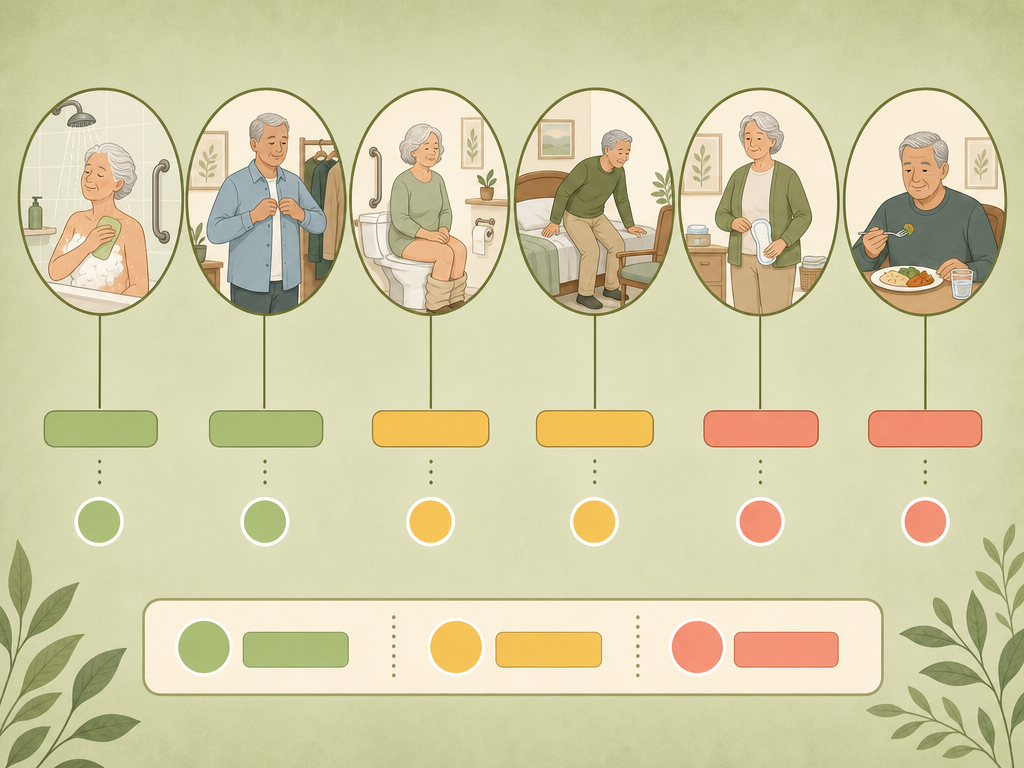
The table below shows a typical mapping of ADL dependencies to care levels. Remember: this is a representative example, not a universal standard.
| Care Level | Typical ADL Dependencies | What Care Looks Like |
|---|---|---|
| Level 1 (Basic) | 0–1 ADL dependencies, usually medication management or minimal bathing assistance | Staff reminds resident to take medications; occasional help with grooming or shower setup |
| Level 2 (Intermediate) | 2–3 ADL dependencies, typically bathing and dressing, possibly toileting assistance | Daily hands-on help with bathing and dressing; staff escorts to meals; medication administration |
| Level 3 (Advanced) | 4+ ADL dependencies, including transfer assistance and/or continence care | Two-person transfers; full toileting and incontinence care; feeding assistance; close supervision |
Some communities also factor in Instrumental Activities of Daily Living (IADLs) — tasks like managing finances, cooking, and transportation — when determining a level. The New LifeStyles article notes that "determining the right level of care starts with assessing a senior's ability to perform daily tasks," and that a clear assessment of both ADLs and IADLs is essential for creating a realistic care plan and budget.
How Care Assessments Work: Who Evaluates, What They Measure, and How Reassessments Happen
Before move-in, the community's nurse or care director conducts a formal assessment of the prospective resident. This assessment measures the resident's ability to perform each of the six ADLs independently, with minimal assistance, or with full assistance. The results determine the initial level of care and the corresponding monthly fee.
The assessment typically covers:
- How much help is needed with bathing (standby assist, partial, or full)
- Whether the resident can dress independently or needs help with buttons, zippers, or selecting clothes
- Toileting frequency and whether the resident needs help with hygiene or transfer onto the toilet
- Transfer ability — can the resident get out of bed or a chair without help?
- Bladder and bowel continence, and the level of assistance needed for management
- Eating — whether the resident can feed themselves or needs encouragement or physical help
Reassessments happen on a regular schedule — typically every six months — and can also be triggered by a change in condition, such as a fall, a hospitalization, or a noticeable decline in function. If the reassessment shows that the resident now needs help with more ADLs, the level of care (and the monthly fee) will increase.
If you are unsure whether your parent's current needs warrant a formal assessment, our guide on When Is It Time for Long-Term Care? provides a structured framework for evaluating ADL dependencies and making the decision to seek care.
The Real Cost of Moving Up a Level: How Monthly Fees Increase by Tier
The financial impact of moving from one level to the next is substantial. Monthly fees typically increase by $200 to $1,500 or more per tier, depending on the community and geographic region. A resident who enters at Level 1 and progresses to Level 3 over two or three years could see their monthly cost rise by $3,000 or more — on top of any annual rent increases.
To put this in perspective, the national median monthly cost for assisted living is $6,200 (CareScout 2025 survey), which equates to $74,400 annually. But that median figure typically reflects a resident at a basic or intermediate level of care. A resident requiring advanced care could easily pay $8,000 or more per month.

Some communities offer level-of-care rate caps or "life care" contracts that limit how much the monthly fee can increase when a resident moves to a higher level. These protections are not always volunteered during a tour, so you must ask. Other communities may offer a flat-rate model where all care is included in one monthly fee — but those communities typically have higher base rates.
| Pricing Model | How It Works | Best For | Risk |
|---|---|---|---|
| Tiered (most common) | Base rate + additional fee per level of care | Residents with stable, predictable needs | Costs can escalate significantly as needs increase |
| Flat-rate / all-inclusive | One monthly fee covers all care services | Residents with high or unpredictable needs | Higher base rate; you may pay for care you do not yet need |
| Modified flat-rate | Base rate covers up to a certain level; additional fees beyond that | Residents who want some predictability but may need more care later | Still subject to increases if needs exceed the included level |
The Non-Standardization Problem: Why One Facility's "Level 2" Is Another's "Level 3"
Here is the single most important thing to understand about assisted living pricing: there is no industry-wide standard for what each level includes. One community may define "Level 1" as requiring assistance with one ADL, while another defines "Level 1" as requiring assistance with up to three ADLs. A facility that calls its highest tier "Level 3" may actually provide less care than another facility's "Level 2."
This non-standardization makes direct price comparisons misleading. You cannot simply compare the monthly cost of "Level 2" at Community A with "Level 2" at Community B and assume you are comparing equivalent services. The only reliable way to compare is to ask: "Which specific ADLs are covered at each price point?"
Here is a practical framework for standardizing comparisons across facilities:
- Ignore the level labels entirely. Focus on what each level actually includes in terms of ADL support.
- Create a simple spreadsheet with columns for each facility and rows for each ADL. Mark whether each ADL is covered at the base rate, at Level 2, at Level 3, or not covered at all.
- Ask for the exact dollar amount for each level, not just the percentage increase over the base rate.
- Request a written breakdown of what triggers a move to the next level. Is it based on a specific number of ADL dependencies, or is it at the community's discretion?
For a structured approach to evaluating facilities during tours, use our Senior Care Facility Tour Checklist, which includes specific questions about tiered pricing and level-of-care definitions.

Medicare and Medicaid Implications for Level Classification
It is important to understand that Medicare does not pay for assisted living. The National Institute on Aging explicitly states that "Medicare does not pay for assisted living." Medicare may cover some short-term skilled nursing or therapy services received while living in an assisted living community, but the room and board and daily care services are not covered.
Medicaid is a different story — but it varies significantly by state. The NIA notes that "Medicaid may provide coverage for some aspects of assisted living, depending on the state." Some states offer Medicaid waivers that cover assisted living costs for eligible low-income seniors, and the level-of-care classification can affect whether a resident qualifies for these waivers.
For a comprehensive overview of payment options, including Medicaid waivers, VA benefits, and long-term care insurance, see our guide on How to Pay for Senior Care in 2026.
Key Questions to Ask Every Assisted Living Community About Their Levels of Care
Use this checklist during tours and follow-up calls to ensure you have a complete picture of how tiered pricing works at each community you are considering.
- "What are your levels of care, and which specific ADLs are covered at each level? Can you provide a written breakdown?"
- "How is the initial level of care determined? Who conducts the assessment, and can we be present during it?"
- "How often are reassessments conducted? What triggers an unscheduled reassessment?"
- "What is the exact dollar amount for each level above the base rate? Are there any additional fees for services not included in the level?"
- "Do you offer level-of-care rate caps or life care contracts that limit how much the fee can increase when moving to a higher level?"
- "What is the process for notifying families when a level change is recommended? Can we request a second assessment?"
- "Do you accept Medicaid? If so, how does the level-of-care classification affect Medicaid eligibility?"
Browse more in the Glossary.