
How to Evaluate Senior Care Facilities: A Tour-Based Checklist for Families
A systematic protocol for adult children comparing senior care facilities — covering pre-tour research, a 10-question framework, unannounced visits, and contract review — so you can evaluate options fairly and avoid common comparison mistakes.
Why Most Facility Comparisons Are Misleading
When families begin touring senior care facilities, the instinct is to see as many options as possible and compare them side by side. But there is a structural problem with this approach: most families compare facilities across different care levels rather than within the same level. Comparing the amenities of an independent living community against the staffing ratios of a memory care unit is not a fair evaluation — it is an apples-to-oranges exercise that leads to confused priorities and poor decisions.
The single most common mistake families make is comparing options across different care levels, according to multiple senior care advisors. A facility that looks "better" on tour may simply be serving a different population with different needs. The goal is not to find the "best" facility in absolute terms — it is to find the best match for your parent's current care level and anticipated future needs.
This article provides a systematic tour protocol designed to eliminate the information asymmetry between families and facility sales staff. It covers pre-tour research, a three-visit protocol, a 10-question framework for every tour, environmental red flags, contract review, and a decision framework for weighing trade-offs. Use it as your field guide.
Pre-Tour Research: What to Look Up Before You Visit
Walking into a facility tour without advance research puts you at a disadvantage. Sales staff are trained to present the best version of their community. Your job is to arrive with data that levels the playing field. The following research steps should be completed before you set foot in any facility.
Medicare Care Compare
For any Medicare- or Medicaid-certified nursing home, the federal government's Medicare Care Compare tool provides inspection reports, staffing data, and quality ratings. You can see the facility's most recent health inspection results, the number of substantiated complaints, and whether staffing levels meet federal minimums. This is the single most powerful pre-tour resource available to families.
The National Institute on Aging explicitly directs families to use Medicare's Care Compare tool as a first step in the evaluation process. If the facility you are considering is not Medicare- or Medicaid-certified, you will need to request its most recent state inspection report directly from the state health department.
State Inspection Reports
Every licensed senior care facility is subject to state inspections. These reports are public records and can typically be requested from your state's health department or department of aging services. Look for patterns: a single deficiency may be minor, but repeated citations for the same issue — especially staffing, medication management, or infection control — signal systemic problems.
Joint Commission Accreditation
The Joint Commission offers voluntary accreditation for senior care facilities, including a specific Memory Care Certification. Facilities that pursue this certification must meet higher standards for dementia care, including staff training, safety protocols, and person-centered care planning. You can verify a facility's accreditation status through the Joint Commission's Quality Check tool. While accreditation is not a guarantee of quality, its absence is worth noting.
Eldercare Locator
The Eldercare Locator, operated by the U.S. Administration on Aging, can connect you with your local Area Agency on Aging. These agencies often maintain lists of licensed facilities, complaint histories, and consumer feedback that are not available through national databases. A quick call can surface information that would otherwise require hours of research.
- Check Medicare Care Compare for inspection reports, staffing data, and quality ratings.
- Request state inspection reports from your state health department.
- Verify Joint Commission accreditation, especially Memory Care Certification.
- Contact your local Area Agency on Aging via the Eldercare Locator.
The Three-Visit Tour Protocol
A single scheduled tour is not enough to evaluate a facility. The Alzheimer's Association and the National Institute on Aging both recommend multiple visits, including at least one unannounced visit at a different time of day. The three-visit protocol below gives you a complete picture.
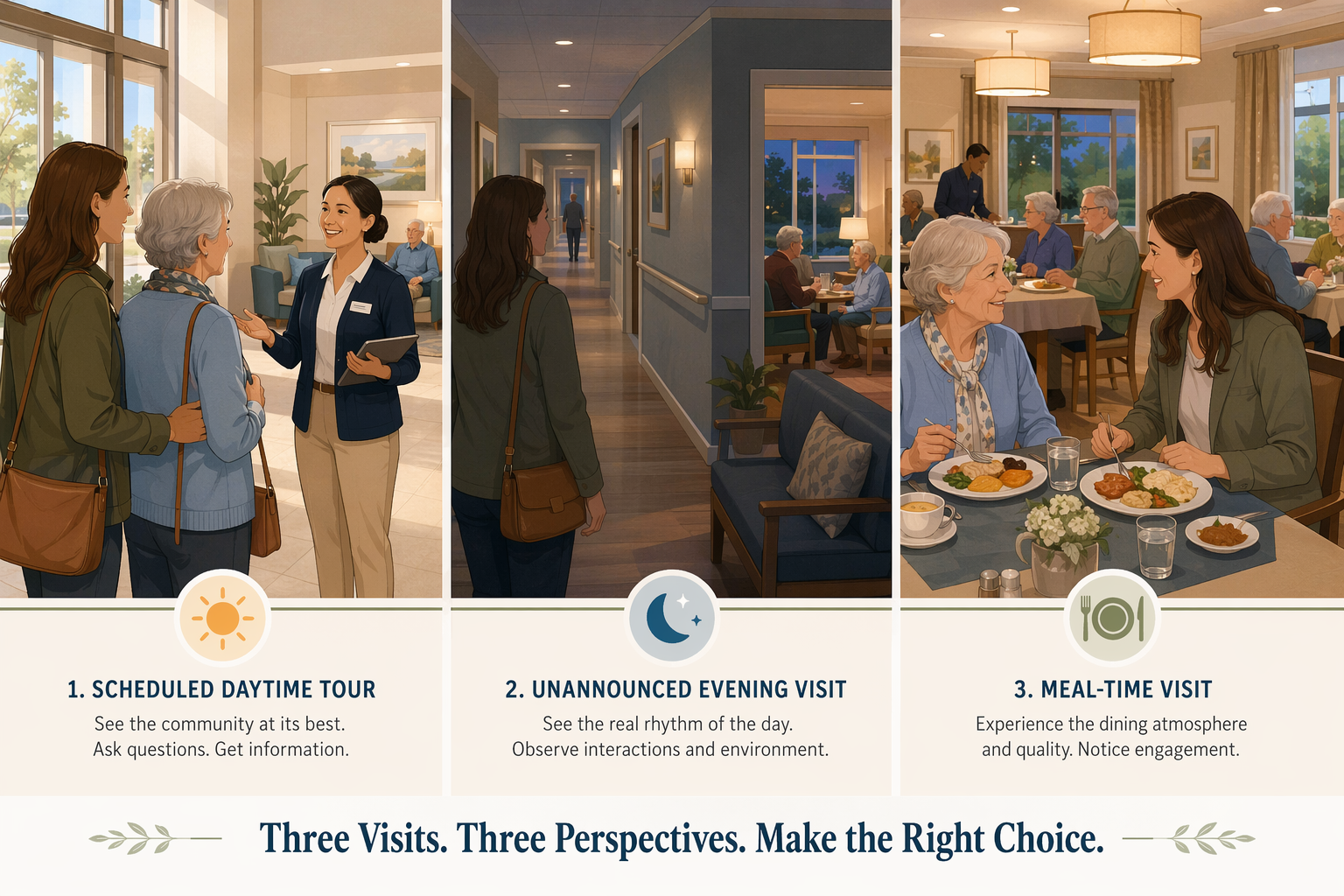
Visit 1: The Scheduled Tour
This is the standard intake interview and facility walk-through. Use this visit to gather information, ask the 10 questions in the framework below, and observe the physical environment. Take notes. Take photos (with permission). Ask for a copy of the resident agreement and fee schedule to review later. This visit is about collecting data, not making a decision.
Visit 2: The Unannounced Visit
This is the most important visit. Return on a different day of the week and at a different time — especially in the evening or on a weekend, when staffing levels are typically lower. The Alzheimer's Association recommends making one or two unannounced visits to see what the facility looks like when it is not expecting you. During this visit, observe: Are staff visible and engaged? Do residents look clean and comfortable? Is the atmosphere calm or chaotic? An unannounced visit reveals the facility's true operating state.
Visit 3: The Meal-Time Visit
Schedule a visit during a meal, ideally lunch or dinner. Observe the dining room: Is the food appetizing? Are residents who need assistance being helped? Is the atmosphere pleasant or rushed? The National Institute on Aging specifically recommends visiting at mealtime to observe food quality and staff-resident interactions. This visit also gives you a chance to see how the facility handles a high-activity period.
- Visit 1: Scheduled tour — collect information and ask questions.
- Visit 2: Unannounced visit — observe the facility's true operating state.
- Visit 3: Meal-time visit — evaluate food quality and dining atmosphere.
The 10-Question Framework for Every Tour
Ask these 10 questions at every facility you tour. Record the answers in a notebook or spreadsheet so you can compare facilities side by side. The questions are designed to surface differences in cost structure, staffing quality, and care philosophy — the factors that actually determine quality of life for residents.
| Question | Why It Matters |
|---|---|
| What is the base monthly fee, and what services are not included? | Many facilities advertise a low base fee but charge separately for medication management, incontinence care, and other essential services. |
| How do you assess a resident's changing care needs, and how is the care plan updated? | A facility without a structured reassessment process may miss declining health or fail to adjust care appropriately. |
| What are the staff-to-resident ratios during the day, at night, and on weekends? | Ratios often drop significantly on nights and weekends. Low ratios are linked to slower response times and lower care quality. |
| What is the annual staff turnover rate? | High staff turnover is one of the strongest predictors of care quality issues. Frequent staff changes disrupt continuity of care. |
| How long has the current administrator been in this role? | Frequent administrator turnover can signal instability or management problems. |
| What dementia-specific training do staff members receive, and how often is it updated? | For memory care, staff training in dementia communication and behavior management is essential. The Alzheimer's Association emphasizes this. |
| Can you share the facility's most recent inspection report and any deficiency history? | A facility with repeated citations for the same issue — especially staffing or medication management — should raise concerns. |
| Does the facility accept Medicaid, and if so, what is the process for transitioning from private pay to Medicaid? | If your parent's savings may eventually be depleted, a facility that does not accept Medicaid could require a disruptive move. |
| Under what circumstances can a resident be discharged or transferred to a higher level of care? | Some facilities discharge residents when their care needs exceed a certain threshold. Understanding this policy upfront prevents surprises. |
| Can you provide contact information for current residents' families who have agreed to speak with prospective families? | References from current families provide the most honest assessment of daily life in the facility. |
Environmental Red Flags to Watch For
During your tours — especially the unannounced visit — keep an eye out for environmental red flags. These observable signs can reveal systemic problems that no amount of polished marketing can hide.
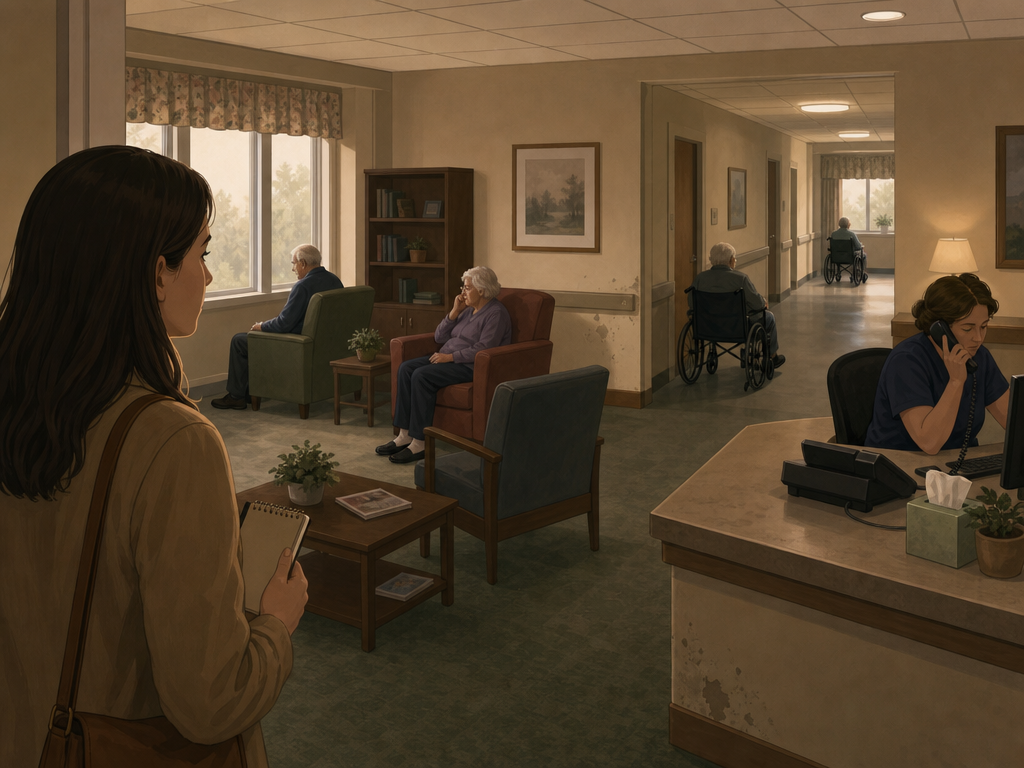
- Unpleasant odors: Urine, feces, or strong chemical air fresheners can indicate inadequate cleaning or incontinence care.
- Residents not engaged or dressed: Residents sitting alone in hallways, in nightclothes during the day, or staring at walls without interaction suggests understaffing or lack of activities.
- No visible activities: An empty activity calendar or a common room with no scheduled programming is a sign that the facility prioritizes containment over engagement.
- Poor meal quality: Unappetizing food, residents not being helped with eating, or a rushed dining atmosphere are red flags.
- Locked units without clear protocols: For memory care, locked doors are necessary for safety, but the facility should have clear, humane protocols for managing access — not simply locking residents in.
- Minimal staff presence: If you cannot see staff members interacting with residents during your visit, that is a problem. Staff should be visible, engaged, and responsive.
Contract Review: What to Look For Before You Sign
The resident agreement is a legally binding contract. Before signing, review it carefully or have an elder law attorney review it. The following elements are critical.
Entrance Fees and Refundability
Some facilities charge a non-refundable community fee. Others offer a partially refundable entrance fee. Understand the terms: Is any portion refundable if the resident moves out or passes away within a certain period? What happens to the fee if the resident is discharged?
Tiered Pricing and Rate Increase History
Most facilities use tiered pricing: a base fee covers room and board, and additional fees are charged for higher levels of care. Ask for the current rate sheet and the history of annual rate increases over the past three to five years. Facilities that raise rates significantly year over year may become unaffordable over time.
What Triggers a Transfer to Higher Care
The contract should specify the criteria for transferring a resident to a higher level of care — either within the same facility or to an external skilled nursing facility. Understand what happens if your parent's needs increase beyond what the facility can handle. Some facilities have a "aging in place" policy that allows residents to remain as their needs change; others require a move.
What Medicare, Medicaid, and VA Benefits Cover
Medicare does not cover custodial care or room and board in senior living facilities. It only covers short-term skilled nursing care after a qualifying hospital stay. Medicaid may cover long-term care for those who meet financial eligibility criteria, but not all facilities accept Medicaid. The VA Aid and Attendance benefit provides up to $2,424 per month for single veterans, $2,874 per month for married veterans, and $1,558 per month for surviving spouses (2026 figures). Understanding what each program covers — and what it does not — is essential for financial planning.
Making the Final Decision: Weighing Trade-Offs
No facility is perfect. Every choice involves trade-offs between cost, location, care quality, and the ability to meet future needs. The goal is not to find a flawless facility — it is to find the best match for your parent's current care level and anticipated trajectory.
Use the following framework to weigh your options:
- Care quality first: Staff turnover rate, inspection history, and staff-to-resident ratios are the most objective indicators of quality. Prioritize facilities with low turnover and clean inspection records.
- Cost sustainability: Can your family sustain the monthly cost for the expected duration of care? Factor in annual rate increases and the potential need for higher care tiers.
- Location and accessibility: Proximity to family members who will visit regularly matters for resident well-being and caregiver involvement.
- Future needs: Does the facility have a clear policy for handling residents whose care needs increase? Can they age in place, or will a move be required?
- Gut check after multiple visits: After your scheduled tour, unannounced visit, and meal-time visit, how did each facility feel? Trust your cumulative observations over any single impression.
Choosing a senior care facility is one of the most consequential decisions a family can make. A systematic tour protocol — grounded in pre-tour research, multiple visits, a structured question framework, and careful contract review — replaces guesswork with evidence. Use this guide as your field reference, and trust the process you have built.
Related reading
Noticed something outdated or inaccurate on this page? Flag a correction. We review every report against CDC, NIA, and AARP HomeFit guidance before updating a page.
Part of the Fall Prevention section.