
Glossary entry
CAPS vs. General Contractor: A Decision Guide for Aging-in-Place Home Modifications
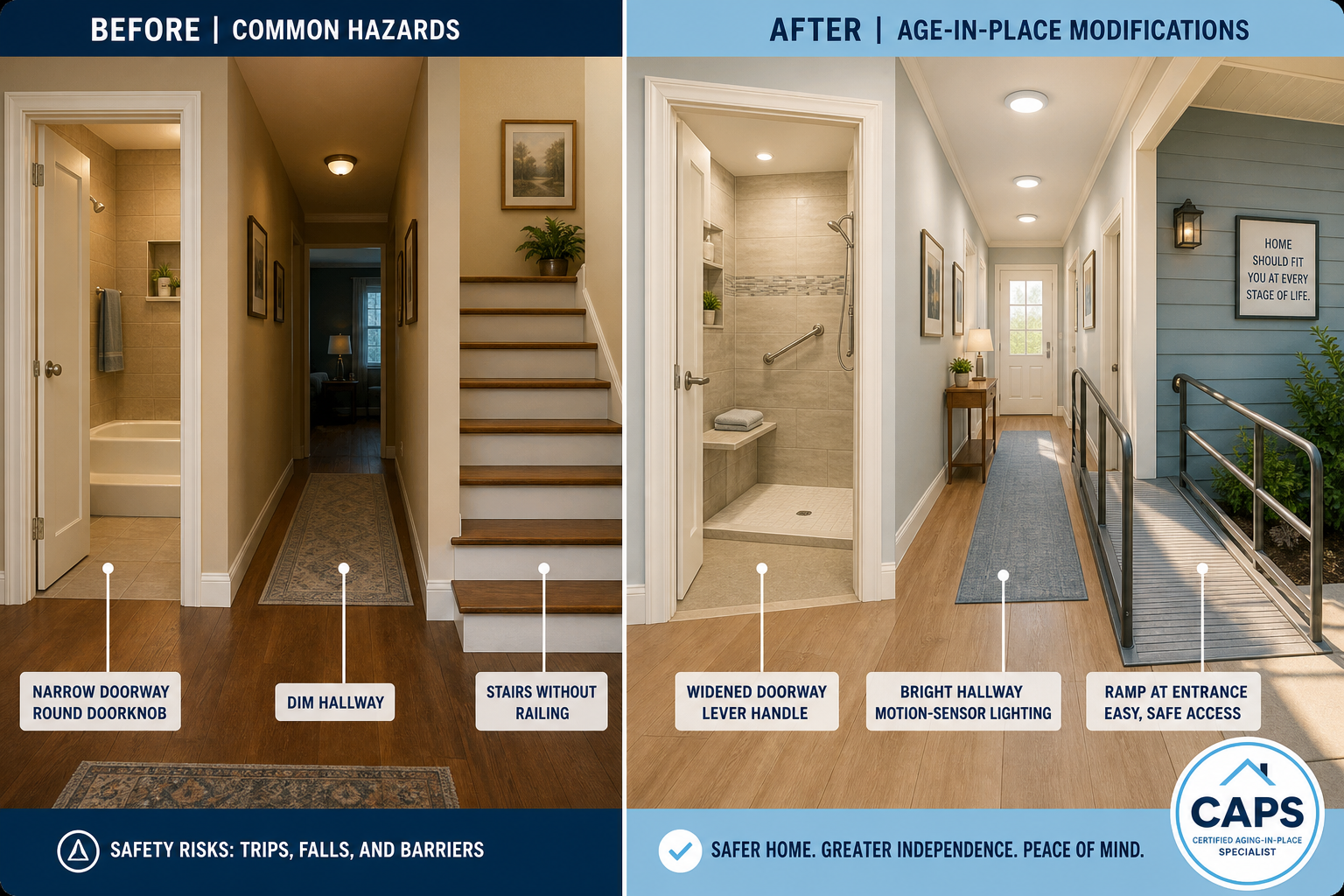
The Core Difference: General Remodeler vs. CAPS Professional
At first glance, a general contractor and a Certified Aging-in-Place Specialist (CAPS) may seem interchangeable. Both can install grab bars, widen doorways, and remodel a bathroom. But the difference lies in how they approach the project — and what happens six months or two years later when your parent's needs change.
A standard general contractor is trained to execute a specific scope of work: you tell them what you want, they build it. Their expertise is in construction methods, materials, and project management. They will follow your instructions precisely, but they are not trained to anticipate how a person's mobility might decline over time or to design for future adaptability.
A CAPS-certified professional, on the other hand, has completed a specialized curriculum offered by the National Association of Home Builders (NAHB) that covers universal design, fall prevention strategies, and client communication for aging-in-place projects. They are trained to look at a home not just as a structure, but as an environment that must adapt to changing physical and cognitive abilities. This means they ask different questions from the start: "Will this doorway accommodate a walker in six months?" "Is this bathroom layout safe for a caregiver to assist with transfers?" "What happens if your parent needs a wheelchair next year?"
| Dimension | General Contractor | CAPS Professional |
|---|---|---|
| Primary training | Construction methods, building codes, project management | Universal design, fall prevention, client communication, future-need planning |
| Approach to modifications | Executes specified scope; builds what you request | Assesses current and anticipated needs; recommends adaptable solutions |
| Design philosophy | Standard residential construction | Visitability and aging-in-place principles |
| Client communication | Standard contractor-client relationship | Trained to work with older adults and family caregivers on sensitive decisions |
| Post-project adaptability | Modifications are built to current specifications; future changes require new construction | Modifications are designed with future adaptability in mind (e.g., blocking for future grab bars) |
This distinction matters because the stakes are high. According to a University of Michigan National Poll on Healthy Aging cited by Care.com, 88% of adults aged 50 and older prefer to remain in their homes for as long as possible. Yet Census Bureau data indicates that only about 10% of U.S. homes are considered "aging-ready." A CAPS professional is specifically trained to close that gap.
What CAPS Training Covers (And Why It Matters for Safety)
The CAPS credential, offered by the NAHB, requires completion of three courses. Each course addresses a different layer of the aging-in-place challenge, and together they form a comprehensive framework that a general contractor's standard training does not cover.
- CAPS I — Marketing & Communicating with the Aging in Place Client: This course covers how to assess a client's current and future needs, communicate effectively with older adults and their families, and manage the emotional and logistical complexity of aging-in-place projects. It is not about sales — it is about understanding the human context of the renovation.
- CAPS II — Design Concepts for Livable Homes & Aging in Place: This course covers universal design principles, barrier-free layouts, and how to create spaces that work for people at all levels of mobility. Topics include turning radii for wheelchairs, optimal lighting placement, and non-slip flooring selection.
- CAPS III — Details & Solutions for Livable Homes & Aging in Place: This course dives into specific construction details: grab bar blocking and reinforcement, curbless shower installation, ramp slope calculations, and doorway widening techniques. It is the technical execution layer that ensures the design concepts from CAPS II are built correctly.
After completing all three courses, candidates apply for the CAPS credential and must sign a code of ethics pledge. To maintain the credential, they must complete 4 hours of continuing education each year and pay an annual renewal fee of $65 for NAHB members or $95 for non-members. This ongoing education requirement means a CAPS professional's knowledge stays current with evolving best practices, building codes, and product innovations — something a general contractor is not obligated to maintain.
CAPS professionals come from diverse backgrounds. According to the Steve Hoffacker CAPS FAQ, the program attracts general contractors, remodelers, occupational therapists, physical therapists, nurses, architects, interior designers, and real estate agents. This diversity means that when you hire a CAPS, you may be working with someone who brings clinical insight (an OT or nurse) or design expertise (an architect or interior designer) in addition to construction skills.
Cost Comparison: CAPS Premium vs. Cost of Mistakes
The most common question families ask is straightforward: "How much more will a CAPS cost?" The answer is nuanced, but the data provides a clear framework for the decision.
According to the Aging in Place Directory, a CAPS home safety assessment typically costs between $300 and $1,000, depending on the specialist's experience and geographic location. Hourly consultation rates range from $75 to $200 per hour. These fees are higher than what a general contractor typically charges for a consultation, but they include the specialized assessment and design work that a standard contractor does not provide.
The real cost comparison, however, is not between the CAPS fee and the contractor's fee. It is between the CAPS fee and the cost of redoing incorrectly installed modifications. Consider the following common modification costs:
| Modification | Typical Cost Range (Installed) | Cost of Redoing Incorrect Installation |
|---|---|---|
| Grab bar (single) | $100 – $300 | $200 – $600 (repair drywall + reinstall with proper blocking) |
| Wheelchair ramp | $1,500 – $5,000 | $3,000 – $10,000 (if slope is too steep or foundation is inadequate) |
| Walk-in tub | $5,000 – $15,000 | $7,000 – $20,000 (if plumbing or floor reinforcement is insufficient) |
| Stairlift | $3,000 – $5,000 | $4,000 – $8,000 (if track installation damages stairs or railings) |
| Full bathroom renovation | $10,000 – $50,000+ | $15,000 – $70,000+ (if layout does not accommodate wheelchair or transfer needs) |
A grab bar installed into drywall without blocking behind it will pull out under pressure — potentially causing a fall rather than preventing one. A ramp built at the wrong slope is unusable and must be demolished and rebuilt. A bathroom renovated without considering future wheelchair access may need to be gutted and redone entirely. In each case, the cost of redoing the work far exceeds the premium paid for a CAPS professional who would have gotten it right the first time.
When Hiring a CAPS Is Worth the Premium
Not every home modification project requires a CAPS. But there are specific scenarios where the specialized training and assessment make a meaningful difference in safety, usability, and long-term cost.
- Complex multi-room modifications: If you are planning modifications across multiple rooms — bathroom, kitchen, entryway, and bedroom — a CAPS can create a cohesive plan that accounts for how your parent will move between spaces. A general contractor might optimize each room individually without considering the overall flow.
- Progressive conditions (Parkinson's, ALS, multiple sclerosis, advanced arthritis): When a condition is expected to worsen over time, modifications must be designed for future needs, not just current ones. A CAPS can build in "future-proofing" elements — like blocking for grab bars that will be installed later, or a bathroom layout that can accommodate a ceiling lift if needed.
- Wheelchair accessibility planning: A CAPS understands the specific dimensional requirements for wheelchair maneuverability, including the recommended 5-foot by 5-foot turning radius in bathrooms and kitchens. A general contractor may not be familiar with these specifications.
- Uncertain future needs: If you are unsure what your parent will need in two or five years, a CAPS can design modifications that are adaptable — for example, a shower that can later be converted to a roll-in design, or a doorway that is already wide enough for a wheelchair even if one is not needed yet.
- Fall prevention as a primary goal: If your parent has already experienced a fall or has a high fall risk due to balance issues, medication side effects, or muscle weakness, a CAPS can conduct a comprehensive home safety assessment that identifies hazards a general contractor might overlook.
When a General Contractor Suffices
For simple, one-off projects that do not involve structural changes or future-need planning, a qualified general contractor is often sufficient. The key is to match the project's complexity to the contractor's expertise.
- Installing a single grab bar: If the location is straightforward and the wall has proper blocking (or you are installing into a stud), a general contractor can handle this. Just ensure they use the correct anchors and load ratings.
- Adding motion-sensor lighting: This is a standard electrical task that does not require specialized design knowledge.
- Replacing round doorknobs with lever handles: A simple hardware swap that any handyman or contractor can complete.
- Installing non-slip flooring in a single room: If the flooring choice is already made and no structural changes are needed, a general contractor can handle the installation.
- Simple bathroom upgrades that do not require layout changes: Replacing a standard toilet with a comfort-height model, or swapping a faucet for a lever-handle version, are straightforward tasks.
If you decide a general contractor is the right choice for a simple bathroom upgrade, our contractor's guide to a fall-prevention bathroom remodel provides a checklist of features that should be included to ensure basic safety.
How to Verify CAPS Credentials and What to Ask Before Hiring
If you decide a CAPS professional is the right choice, the next step is to verify their credentials and ensure they are a good fit for your specific project. Here is a practical checklist:
- Verify the credential via the NAHB directory: The NAHB maintains an online directory of active CAPS professionals. Check that the individual's credential is current and has not lapsed. A lapsed credential means the professional has not completed the required continuing education.
- Confirm renewal status: CAPS credentials must be renewed annually. Ask the professional for their renewal date and verify it against the NAHB directory. If the credential has been lapsed for more than one year, a $50 reinstatement fee applies, but the professional may not have maintained current knowledge.
- Ask about experience with similar projects: Not all CAPS professionals have the same background. Some are general contractors who added the credential; others are occupational therapists or designers who subcontract construction. Ask for examples of projects similar to yours, especially those involving the same type of modification (bathroom, kitchen, entryway) and the same condition (mobility limitation, dementia, fall risk).
- Request references: Ask for contact information for at least two recent clients who had similar projects. Call them and ask about the professional's communication, attention to safety, and whether the modifications have held up well over time.
- Verify insurance and licensing: If the CAPS professional is a remodeler or contractor, they must provide proof of liability insurance and workers' compensation insurance, as well as a valid business license if required by your state. This is a requirement for NAHB credentialing.
- Ask about their design process: A good CAPS professional will conduct a thorough home assessment before providing a quote. They should ask about your parent's current mobility, anticipated changes, daily routines, and caregiver involvement. If they give you a quote without visiting the home or asking these questions, that is a red flag.
Making the Final Decision: A Summary Framework
The decision between a CAPS professional and a general contractor comes down to three factors: project complexity, the senior's current and anticipated needs, and your budget for both the initial work and potential future rework.
| Factor | Choose a CAPS If... | A General Contractor May Suffice If... |
|---|---|---|
| Project complexity | Multi-room modifications, structural changes, or whole-home planning | Single, simple modification (one grab bar, one light fixture) |
| Senior's condition | Progressive condition (Parkinson's, ALS, dementia), wheelchair use, or high fall risk | Stable condition with no anticipated decline in mobility |
| Future needs | Uncertain; you want modifications that can adapt over time | Current needs are clear and unlikely to change |
| Budget for rework | You cannot afford to redo work that was done incorrectly | You have budget flexibility if the first attempt needs adjustment |
| Design expertise needed | You need guidance on what to modify, not just how to build it | You already know exactly what you want and just need it built |
If you are still uncertain, consider starting with a CAPS home safety assessment. For $300 to $1,000, you get a professional evaluation of your parent's home and a prioritized list of recommended modifications. You can then decide whether to hire the CAPS for the full project or use the assessment as a roadmap for a general contractor to follow. Either way, the assessment provides a layer of safety expertise that a standard contractor consultation does not.
The broader context is worth keeping in mind: the gap between the desire to age in place and the reality of home readiness is wide. Our guide on the aging-in-place gap explores why 92% of older adults want to stay home but only 10% of homes are ready. Choosing the right professional — whether a CAPS or a general contractor — is one of the most important steps in closing that gap for your own family.
Browse more in the Glossary.