
Room checklist
11 Red-Flag Signs Your Parent Needs a CAPS Specialist: A Room-by-Room Self-Assessment for Families
Most families call a CAPS specialist after a fall or crisis. This room-by-room self-assessment helps adult children identify 11 specific, observable red flags — from room avoidance to near-misses — and provides a scoring guide to decide when to monitor, schedule a consultation, or act urgently.
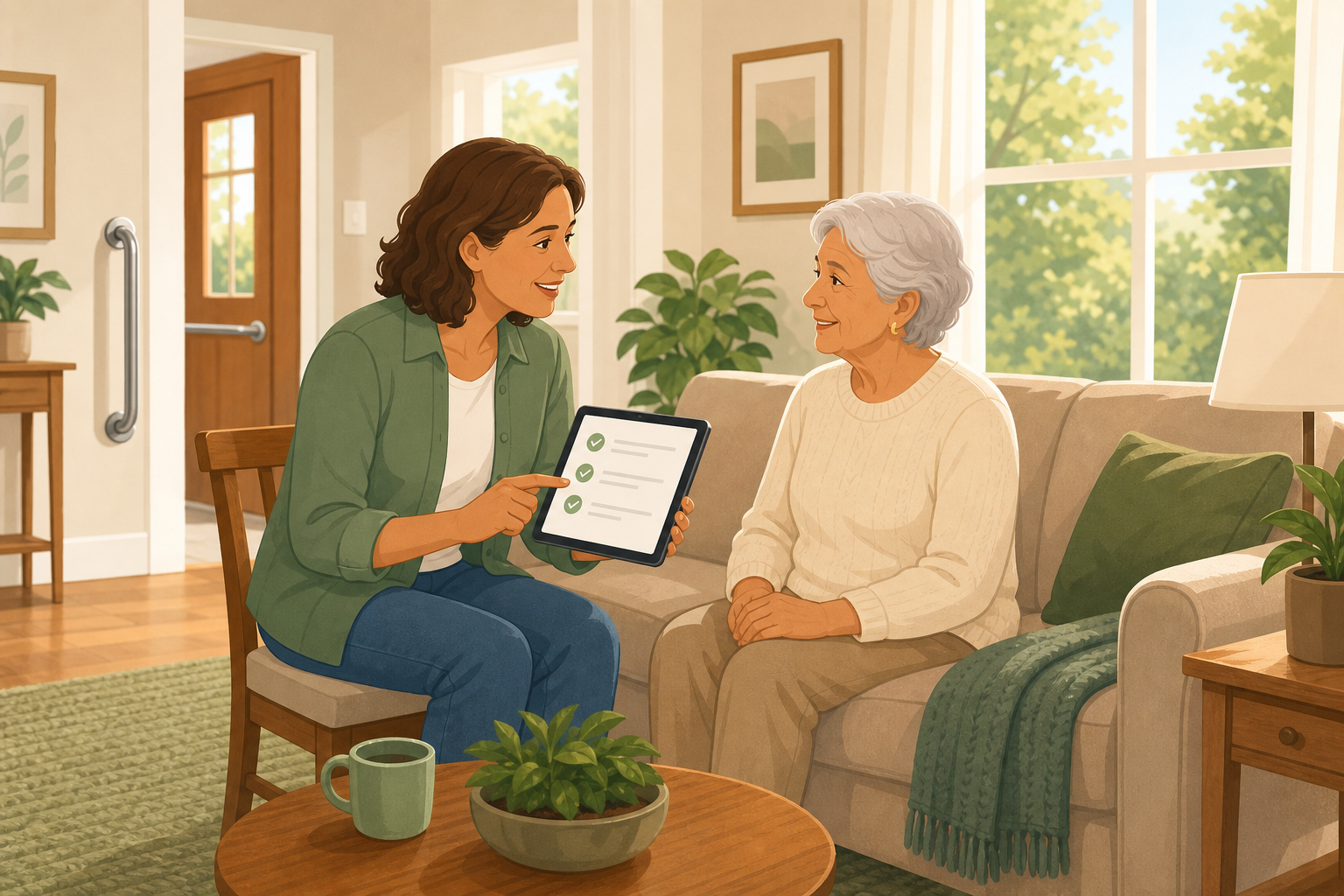
Why Most Families Call a CAPS Specialist Too Late
The typical sequence goes like this: an older adult takes a fall, maybe breaks a hip, spends a week in the hospital, and then the family scrambles to install grab bars and a shower chair before discharge. The call to a Certified Aging-in-Place Specialist (CAPS) happens in crisis mode — after the injury, after the hospitalization, after the preventable costs have already piled up.
The numbers explain why this pattern is so damaging. According to the CDC, more than one in four older adults (65+) falls each year, yet less than half tell their doctor. The age-adjusted fall death rate rose 21% from 64.7 per 100,000 older adults in 2018 to 78.4 per 100,000 in 2024 (provisional data). The National Safety Council reports that 43,020 individuals aged 65 and older died from preventable falls in 2024 alone — a 51% increase over the past decade.
The tragedy is that most of these falls are predictable — and preventable. A 2017 randomized controlled trial by Stark et al. found that home modifications reduced falls by 39% compared to a control group. A 2019 study by Carnemolla & Bridge showed that home modifications reduced weekly care hours by 42%. Yet 87% of adults 65 and older say they want to age in place, while only 10% of U.S. homes are adequately designed for their needs.
This article gives you a different path. Instead of waiting for a crisis, you can use 11 specific, observable red flags — organized room by room — to decide whether your parent needs a CAPS evaluation. You will find a self-assessment checklist, a scoring guide that tells you exactly when to monitor, schedule, or act urgently, and a cost-of-inaction argument that makes the decision clearer.
If a fall has already happened, start with the post-fall safety walkthrough first, then return here for the proactive assessment.
The 11 Red Flags: Observable Signs It's Time for a CAPS Evaluation
These are not the same as a general fall-hazard checklist. A hazard checklist asks: "Are there loose rugs?" A red-flag assessment asks: "Has your parent stopped walking through the living room because of the loose rugs?" The distinction matters. Behavioral changes — room avoidance, activity cessation, near-misses — are earlier and more reliable signals that the home environment has crossed a threshold your parent can no longer compensate for.
Below are the 11 red flags organized by room. Each one is something you can observe during a visit or ask about in a phone call. You do not need to be a professional to spot them.
Bathroom (4 Red Flags)
- Red Flag #1: Hasn't used the upstairs bathroom in 3 months or more. If your parent has a bathroom on the main floor and one upstairs, and you notice they have effectively abandoned the upstairs bathroom, that is a mobility signal. They may be avoiding stairs, struggling with balance on the landing, or unable to navigate the doorway. A CAPS assessment can identify whether a stair lift, relocated bathroom, or doorway widening is needed.
- Red Flag #2: Has stopped bathing independently. This can show up as skipping showers, bathing only when a family member is present, or using sponge baths instead of the shower or tub. The bathroom is the most dangerous room in the house — a systematic review by Cha (2025) found that bathroom modifications and grab bars are the single most impactful intervention for fall prevention, with 13 of 20 studies confirming their effectiveness.
- Red Flag #3: Grab bars are clearly needed but absent. If your parent uses a towel rack, soap dish, or sink edge to steady themselves when getting in or out of the shower or off the toilet, that is a near-miss waiting to become a fall. The NIA recommends grab bars near the toilet and on both the inside and outside of the tub or shower. If they are not installed, the need is already present.
- Red Flag #4: Near-falls on wet floors. If your parent mentions slipping in the shower, catching themselves on the sink, or feeling unsteady stepping out of the tub, that is not a minor event. It is a documented near-miss. The CDC notes that falling once doubles the chances of falling again. A near-fall is a warning shot.
Kitchen (3 Red Flags)
- Red Flag #5: Stopped cooking due to reaching or balance issues. If your parent has shifted to microwave meals, takeout, or skipping meals entirely because they cannot safely reach upper cabinets, bend to lower shelves, or stand at the stove without holding the counter, the kitchen layout is failing them. The AARP aging-in-place checklist recommends storing frequently used items within easy reach and preparing food while seated to prevent fatigue and loss of balance.
- Red Flag #6: Burned pots, pans, or food left unattended. This can signal cognitive or physical difficulty managing the stove. A CAPS specialist can recommend appliances with safety features — such as automatic shut-off, front-mounted controls, or stove guards — that reduce fire risk without requiring your parent to give up cooking entirely.
- Red Flag #7: Appliances, cabinets, or countertops are at the wrong height. If your parent uses a step stool to reach the microwave, strains to see into pots on the back burners, or cannot open the refrigerator door fully because of a nearby wall, the kitchen was designed for a younger, more mobile body. These are structural mismatches that a CAPS evaluation can identify and address.
Bedroom (2 Red Flags)
- Red Flag #8: Moved sleeping to the couch or a recliner. This is one of the most telling red flags. If your parent has abandoned their bed for the living room couch, it usually means the bedroom is on a different floor they can no longer navigate, or the bed itself is too high, too low, or too difficult to get in and out of. The NIA recommends a bed that is easy to get into and out of, with a clear path to the bathroom and a nightlight along the way.
- Red Flag #9: Falls or near-falls getting out of bed at night. Nighttime bathroom trips are a high-risk activity. If your parent has stumbled, grabbed the nightstand, or fallen while getting out of bed in the dark, the bedroom-to-bathroom path needs evaluation. A CAPS specialist can assess lighting placement, bed height, pathway width, and the need for a bedside commode or transfer aid.
Entryways and Stairs (2 Red Flags)
- Red Flag #10: Has stopped using the stairs entirely. If your parent confines themselves to one floor of the house — sleeping on the main floor, avoiding the basement laundry, skipping the upstairs bathroom — they are adapting to a home that no longer works for them. The NIA recommends handrails on both sides of stairs, good lighting with switches at the top and bottom, and non-slip strips on each step. If these are absent or your parent is still avoiding the stairs, a stair lift or a first-floor reconfiguration may be necessary.
- Red Flag #11: No handrails, poor lighting, or unsafe entry conditions. If the front steps lack a handrail, the porch light is burned out, or the pathway from the driveway is cracked and uneven, your parent is navigating an obstacle course every time they leave or enter the home. A CAPS specialist can recommend ramps, handrails, improved lighting, and non-slip materials for outdoor stairways.
Room-by-Room Self-Assessment Checklist
Use this checklist during your next visit. For each question, answer Yes or No based on what you observe — not what your parent tells you. Observation is more reliable than self-reporting, especially for older adults who may minimize their difficulties.
| Room | Question | Yes (Red Flag) | No |
|---|---|---|---|
| Bathroom | Has your parent stopped using a specific bathroom (e.g., upstairs) in the past 3 months? | 1 | 0 |
| Bathroom | Does your parent skip showers or bathe only when someone is present? | 1 | 0 |
| Bathroom | Are grab bars absent near the toilet and inside/outside the shower or tub? | 1 | 0 |
| Bathroom | Has your parent mentioned slipping, stumbling, or catching themselves in the bathroom? | 1 | 0 |
| Kitchen | Has your parent stopped cooking meals and shifted to microwave or takeout food? | 1 | 0 |
| Kitchen | Have you noticed burned pots, scorched pans, or food left unattended on the stove? | 1 | 0 |
| Kitchen | Does your parent use a step stool or strain to reach cabinets, appliances, or countertops? | 1 | 0 |
| Bedroom | Has your parent moved their sleeping location to a couch, recliner, or different room? | 1 | 0 |
| Bedroom | Has your parent fallen or nearly fallen getting out of bed, especially at night? | 1 | 0 |
| Entryways / Stairs | Does your parent avoid using stairs and confine themselves to one floor? | 1 | 0 |
| Entryways / Stairs | Are handrails missing, lighting poor, or outdoor pathways uneven or cracked? | 1 | 0 |
How to Interpret Your Results: The Scoring Guide
Add up the number of Yes answers. Your total score falls into one of three zones. Each zone has a clear next step.
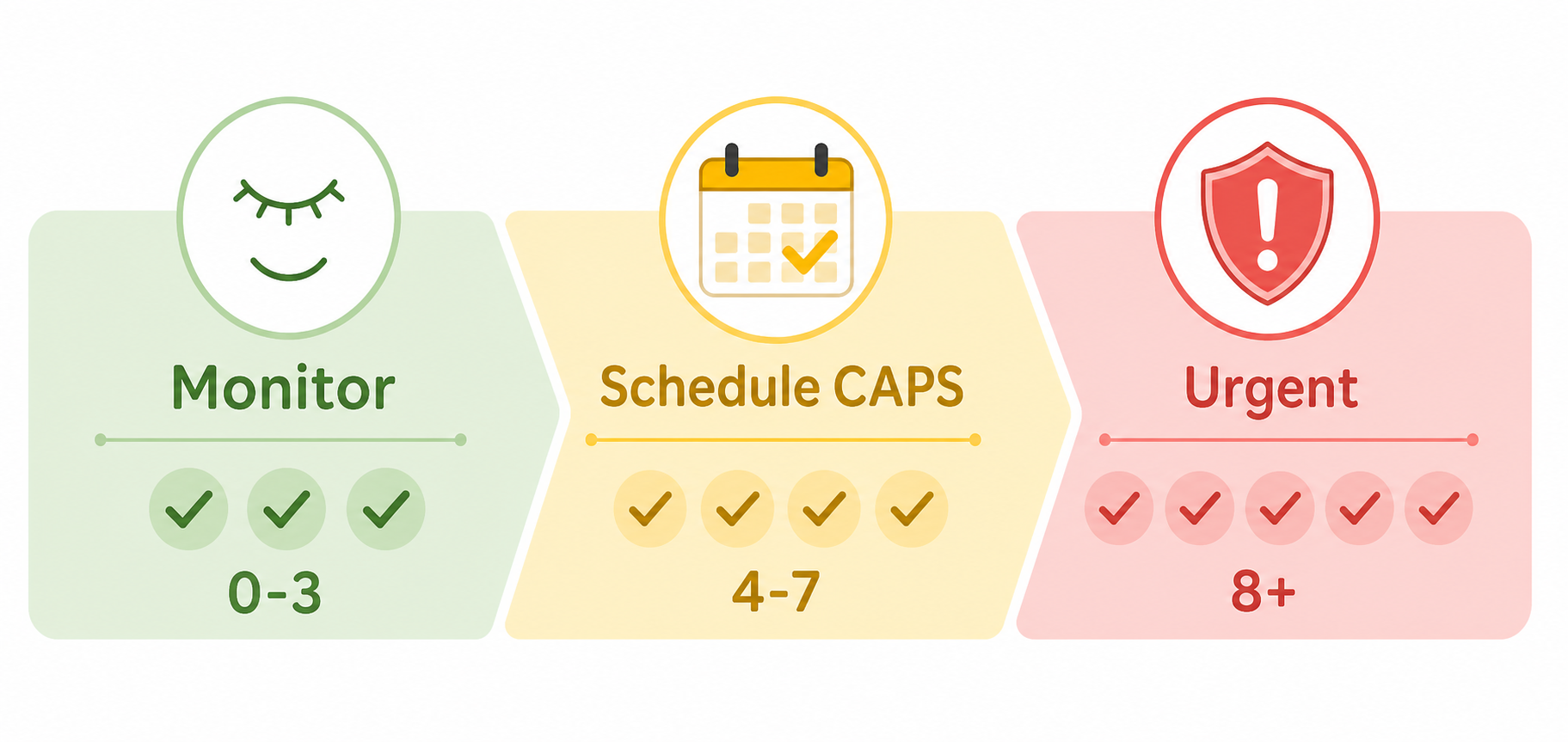
Score 0–3: Monitor and Revisit in 3 Months
Your parent's home is likely still functional for their current mobility level, but a few early warning signs are present. Do not ignore them. Print this checklist, schedule a family walk-through next weekend, and set a calendar reminder to repeat the assessment in three months. If any new red flags appear before then, move to the next zone.
Score 4–7: Schedule a CAPS Assessment
Multiple behavioral red flags indicate that the home environment is actively working against your parent's safety and independence. This is the ideal time to call a CAPS specialist — before a fall forces the issue. A CAPS home assessment typically costs between $300 and $1,000 (industry estimate) and includes a walk-through, measurements, and a prioritized list of recommendations. Once you decide to call, here is exactly what happens during the home visit.
Score 8+: Urgent Evaluation Needed
Your parent is actively adapting their life around a home that no longer supports them. Room avoidance, activity cessation, and near-falls are all present. The risk of a serious fall injury is high. Call a CAPS specialist this week. If a fall has already occurred, use the post-fall safety walkthrough immediately and then schedule the CAPS assessment.
The Cost of Waiting: $200 vs. $18,658
The most common objection to calling a CAPS specialist is cost. But the real cost is the cost of waiting.
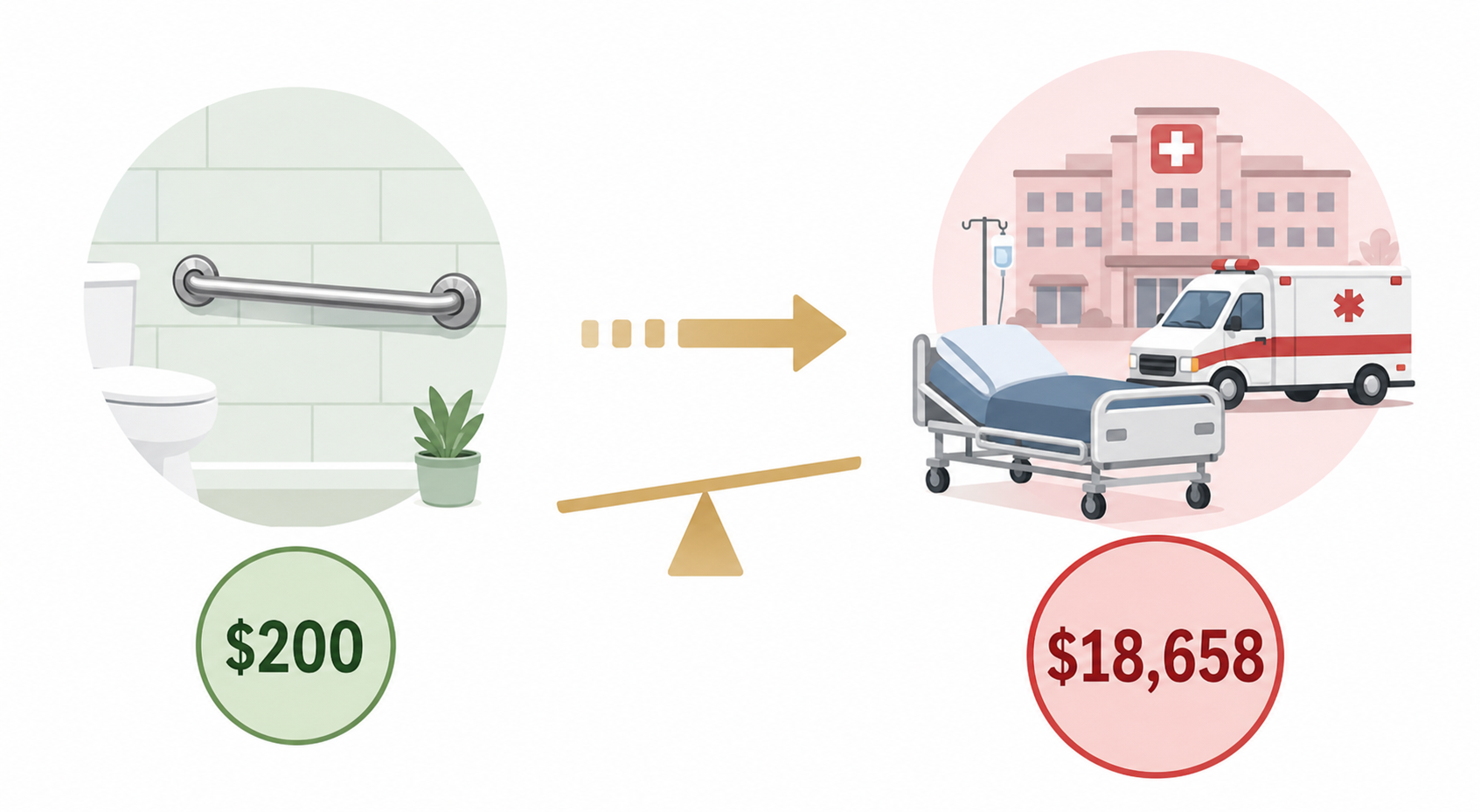
A grab bar installation costs roughly $200. A walk-in shower costs $6,000 to $12,000. A stair lift runs $2,500 to $8,000 installed. These are real expenses, but they are one-time investments.
Compare that to the cost of a single fall injury. Reider et al. (2023), using 2016–2018 national data, found that the average inpatient cost per fall injury for older adults is $18,658 (95% CI: $18,491–$18,823). The average emergency department visit cost is $1,112. Combined, fall injuries among older adults generate an estimated $19.8 billion in acute care costs annually in the United States.
Beyond the direct medical costs, 61.6% of older adults hospitalized for injurious falls are discharged to a skilled nursing facility or other intermediate care setting. That means weeks or months of facility costs, loss of independence, and a recovery that may never return them to their previous functional level.
The evidence is clear: home modifications reduce falls by up to 39% (Stark et al., 2017) and reduce weekly caregiving hours by 42% (Carnemolla & Bridge, 2019). A $200 grab bar is not an expense — it is an investment with a guaranteed return if it prevents even one trip to the emergency room. For a deeper look at the research, see the evidence-based case for home modifications.
What Happens When You Call a CAPS Specialist
If your score falls in the 4–7 or 8+ range, the next step is to schedule a CAPS home assessment. Here is what that involves at a high level:
- A walk-through of the entire home. The CAPS specialist will observe how your parent moves through each room, how they use the bathroom, kitchen, and stairs, and where they have already made adaptations (like using a towel rack for balance).
- Measurements and documentation. Doorway widths, step heights, hallway clearances, and bathroom dimensions are measured to determine what modifications are feasible and which codes apply.
- A prioritized recommendation list. Not everything needs to be done at once. The specialist will rank modifications by urgency and impact — starting with the highest-risk areas (usually the bathroom and entryways) and working toward longer-term improvements.
- Cost estimates and funding guidance. The assessment typically includes rough cost ranges for each recommended modification and may identify potential funding sources such as VA grants, Medicaid waivers, or local nonprofit programs.
The entire assessment usually takes one to two hours. You do not need to commit to any modifications during the visit. The purpose is to get expert eyes on the home and a clear, written plan you can evaluate on your own timeline.
Your Next Steps: From Assessment to Action
You now have a tool that turns vague concern into a specific score and a clear next step. Here is what to do based on your result:
- Score 0–3: Print this checklist. Schedule a family walk-through next weekend. Set a calendar reminder to repeat the assessment in three months. If any new red flags appear before then, move to the next zone.
- Score 4–7: Call a CAPS specialist this month. The assessment fee ($300–$1,000 industry estimate) is a fraction of the cost of a single emergency department visit. Use the assessment to get a prioritized plan you can implement over time.
- Score 8+: Call a CAPS specialist this week. The behavioral red flags indicate that your parent is already at high risk. If a fall has occurred, use the post-fall walkthrough immediately and then schedule the CAPS assessment.
The difference between a proactive family and a reactive one is about 11 red flags. You now know what to look for. The next step is yours to take.
Related reading
Need a professional assessment?
Find a CAPS-credentialed professional or local aging services through our outbound resource list — we never name or rank individual contractors.
Find Local HelpNoticed something outdated or inaccurate on this page? Flag a correction. We review every report against CDC, NIA, and AARP HomeFit guidance before updating a page.