
What Is 'Medical for Seniors'? A Complete Glossary Guide to Healthcare Services, Providers, and Coverage for Older Adults
clinicalThis glossary-style guide helps adult children and new caregivers understand the distinct ecosystem of senior medical care — from geriatricians and home health to Medicare, chronic conditions, and care coordination — so you can navigate healthcare decisions with confidence.
Introduction: Why Senior Medical Care Is Different
When an aging parent begins to need regular medical attention, the healthcare system they enter looks different from the one you navigate for yourself or your children. Senior medical care is not simply adult care delivered to an older person. It is a distinct ecosystem built around a different set of providers, a higher prevalence of chronic conditions, a separate insurance architecture, and a greater need for coordination across multiple specialists and services.
For a new caregiver — especially an adult child in their 40s or 50s who has just stepped into this role — the landscape can feel overwhelming. You are suddenly expected to understand terms like geriatrician, Medicare Part D, skilled nursing facility, and home health aide — often while also managing a full-time job and your own family. This guide is designed as a reference anchor: a place to come when you encounter an unfamiliar term or need to understand how the pieces of senior medical care fit together.
Key Healthcare Providers and Specialists for Seniors
The first challenge many families face is simply knowing which type of provider to call. A geriatrician, for example, is not the same as a general internist, and a geriatric care manager plays a very different role from a home health aide. Below is a breakdown of the providers you are most likely to encounter.
Geriatricians
A geriatrician is a medical doctor with specialized training in the care of older adults. Unlike a general internist or family practitioner, a geriatrician focuses on the complex interactions between multiple chronic conditions, age-related changes in how the body processes medications, and the functional and cognitive challenges that often accompany aging. Geriatricians are trained to look beyond individual symptoms and consider the whole person — including their living situation, social support, and ability to perform daily activities.
Finding a geriatrician can be difficult in some areas because the supply of these specialists has not kept pace with the aging population. If a geriatrician is not available locally, a primary care provider with experience treating older adults is a reasonable alternative.
Geriatric Care Managers (Aging Life Care Experts)
A geriatric care manager — also called an aging life care expert — is typically a licensed nurse or social worker who specializes in geriatrics. Their role is to assess your parent's needs, create a comprehensive care plan, coordinate medical appointments and services, and act as a liaison, especially for long-distance families. They can evaluate the home environment for safety risks, arrange hired caregivers, and help identify community resources.
Geriatric care managers charge by the hour, typically between $75 and $200 per hour depending on location and the complexity of the case. Initial assessments are now largely conducted in person again, and a thorough evaluation can reveal details — such as tripping hazards or medication mismanagement — that family members living far away might miss.
Home Health Nurses and Therapists
Home health care is a broad category that includes skilled nursing care (wound dressing, ostomy care, intravenous therapy, medication administration, pain management), physical therapy, occupational therapy, and speech therapy — all delivered in the home. These services are typically ordered by a physician and provided by Medicare-certified home health agencies. Medicare covers home health services only on a short-term basis for people who meet specific criteria: they must be homebound, need skilled care on an intermittent basis, and receive services from a Medicare-certified agency.
Home health aides, who help with bathing, dressing, and walking, are a separate category. Their services may be covered under Medicare home health if they are part of a skilled care plan, but Medicare does not cover long-term custodial care — the kind of ongoing assistance with daily activities that many older adults eventually need.
Other Key Providers
- Physical therapists: Help improve mobility, balance, and strength — critical for fall prevention.
- Occupational therapists: Focus on adapting the home environment and teaching techniques to make daily activities (dressing, cooking, bathing) safer and more manageable.
- Medical social workers: Provide counseling, help locate community resources, and assist with advance care planning.
- Pharmacists with geriatric training: Can review medication regimens to identify drugs that may be inappropriate for older adults or that interact dangerously.
Common Medical Conditions Affecting Older Adults
Understanding the most prevalent health conditions among older adults helps you know what to watch for and why certain specialists or services may be needed. According to data published in 2025 by the National Council on Aging (NCOA) and the CDC, 93% of adults age 65 and older have at least one chronic condition, and 79% have two or more. The table below shows the most common conditions and their prevalence.
| Condition | Prevalence Among Adults 65+ |
|---|---|
| High blood pressure (hypertension) | 61% |
| High cholesterol | 55% |
| Arthritis | 51% |
| Obesity | 40% |
| Diabetes | 24% |
| Cancer | 20% |
| Heart disease | 16% |
| Depression | 15% |
| COPD (chronic obstructive pulmonary disease) | 12% |
| Asthma | 9% |
Among adults age 85 and older, the pattern shifts slightly: high blood pressure affects 67%, arthritis affects 56%, and high cholesterol affects 46%. Hearing loss, while not always classified as a chronic disease, affects about one-third of older adults according to the National Institute on Aging.
Types of Medical Services for Seniors
Senior medical care spans a spectrum from routine prevention to intensive skilled care. Understanding the categories helps you match services to your parent's current needs and anticipate what may be needed as their health changes.

- Preventive care: Annual wellness visits, vaccinations (flu, pneumonia, shingles), cancer screenings (mammograms, colonoscopies), and fall risk assessments. Medicare Part B covers many preventive services at no cost to the patient.
- Chronic disease management: Ongoing care for conditions like diabetes, hypertension, and heart disease. This includes regular monitoring, medication management, and lifestyle counseling. Medicare covers chronic care management services for beneficiaries with two or more chronic conditions.
- Acute care: Hospitalization for sudden illness, injury, or exacerbation of a chronic condition. This is typically covered by Medicare Part A, though deductibles and coinsurance apply.
- Home health care: Skilled nursing, physical therapy, occupational therapy, and speech therapy delivered at home. Medicare covers these services on a short-term basis for homebound patients. For a deeper dive, see our article on Medicare Home Health Care in 2026.
- Palliative care: Specialized medical care focused on relieving symptoms, pain, and stress for people with serious illness. It can be provided alongside curative treatment and is not limited to end-of-life situations.
- Hospice care: A specific type of palliative care for people with a terminal illness who are expected to live six months or less. Hospice focuses on comfort and quality of life rather than curative treatment. Medicare Hospice Benefit covers this comprehensively.
- Skilled nursing facility (SNF) care: Short-term rehabilitation or skilled nursing care following a hospital stay. Medicare Part A covers up to 100 days per benefit period under specific conditions. For a detailed breakdown of SNF terms, see our SNF Medicare Coverage Glossary.
Insurance and Coverage Landscape
The insurance system for older adults is layered and can be confusing even for experienced caregivers. The core of the system is Medicare, but Medicare alone does not cover everything. Understanding the parts of Medicare and the options for supplemental coverage is one of the most important things you can do to avoid unexpected bills and gaps in care.
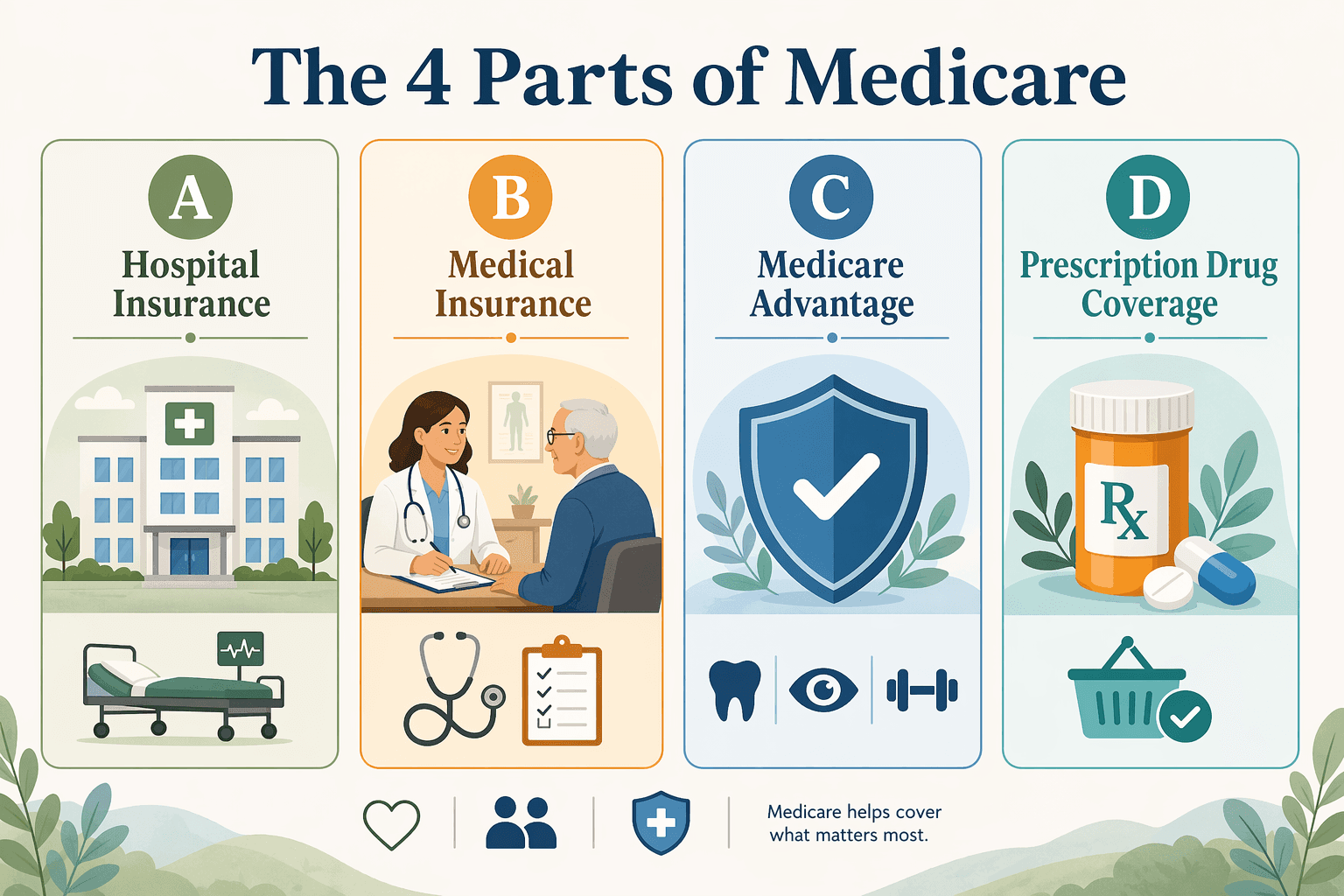
| Medicare Part | What It Covers | Key Consideration |
|---|---|---|
| Part A (Hospital Insurance) | Inpatient hospital stays, skilled nursing facility care (limited), hospice, some home health care | Most people get Part A premium-free if they or their spouse paid Medicare taxes while working |
| Part B (Medical Insurance) | Doctor visits, outpatient care, preventive services, medical equipment (DME) | Requires a monthly premium; covers 80% of approved costs after the deductible |
| Part C (Medicare Advantage) | All Part A and Part B services, often includes Part D and extra benefits (dental, vision, hearing) | Private insurance alternative to Original Medicare; network restrictions may apply |
| Part D (Prescription Drug Coverage) | Prescription medications | Requires a separate monthly premium; formularies vary by plan; the "donut hole" coverage gap has been narrowed but still exists |
Beyond Original Medicare (Parts A and B), families often consider:
- Medigap (Medicare Supplement Insurance): Private policies that cover some of the out-of-pocket costs that Original Medicare does not, such as copayments, coinsurance, and deductibles. Medigap policies are standardized and labeled by letter (Plan A, Plan B, etc.).
- Medicare Advantage (Part C): An alternative to Original Medicare offered by private insurance companies. These plans must cover everything Original Medicare covers but often include additional benefits like dental, vision, and hearing. However, they typically have network restrictions and may require prior authorization for certain services.
- Medicaid: A joint federal and state program that covers health care costs for people with limited income and assets. For older adults, Medicaid can cover long-term custodial care that Medicare does not, including nursing home care and some home- and community-based services (HCBS). Eligibility rules vary significantly by state.
- VA benefits: Veterans and their surviving spouses may be eligible for health care through the Department of Veterans Affairs, including geriatric care, home health services, and nursing home care. Eligibility depends on service history, disability status, and income.
Care Coordination: Geriatric Care Managers and Discharge Planners
One of the most difficult aspects of senior medical care is simply keeping track of everything. A parent may see a primary care provider, a cardiologist, an endocrinologist, a physical therapist, and a home health nurse — all of whom may prescribe different medications, recommend different diets, and send reports to different offices. Without someone coordinating the flow of information, critical details can fall through the cracks.
This is where care coordination comes in. Two roles are especially important:
Geriatric Care Managers
As described earlier, a geriatric care manager (aging life care expert) is a licensed nurse or social worker who specializes in geriatrics. They act as a private advocate and guide for the family. Their services typically include:
- Conducting a comprehensive in-home assessment of the older adult's medical, functional, cognitive, and social needs
- Developing a written care plan with specific recommendations
- Coordinating medical appointments and acting as a liaison between specialists
- Identifying and arranging community resources, such as meal delivery, transportation, or adult day programs
- Evaluating and monitoring hired caregivers
- Providing ongoing support and advocacy, especially for long-distance families
Geriatric care managers charge by the hour, typically $75–$200 per hour. Neither Medicare nor Medicaid pays for these services, and most private insurance does not cover them either. Long-term care insurance may cover some costs, but most families pay out of pocket.
Hospital Discharge Planners
When an older adult is hospitalized, a discharge planner (often a social worker or nurse) is responsible for planning the transition out of the hospital. Their job is to arrange follow-up care — whether that means home health services, a short stay in a skilled nursing facility, or outpatient therapy. Discharge planning is a critical moment: mistakes or oversights at this stage can lead to readmissions, medication errors, or unsafe home situations.
As a family caregiver, you should be actively involved in discharge planning. Ask questions, request written instructions, and make sure you understand what services will be in place on the day your parent returns home. If the situation is complex, consider hiring a geriatric care manager to participate in discharge planning meetings.
Building a Senior Healthcare Team
You do not need to assemble the entire team at once. The most practical approach is to start with a foundation and add layers as needs emerge. Here is a step-by-step framework:
- Start with a primary care provider. If your parent does not already have a primary care provider who understands geriatric issues, finding one is the first priority. A geriatrician is ideal, but a family practitioner or internist with experience treating older adults is a good alternative. This provider will be the hub of the healthcare wheel — the person who coordinates referrals, reviews medications, and monitors overall health.
- Add specialists as specific conditions arise. If your parent has diabetes, they need an endocrinologist or a primary care provider comfortable managing diabetes. If they have heart disease, a cardiologist. If they have arthritis, a rheumatologist or an orthopedic specialist. The primary care provider should help determine which specialists are needed and when.
- Consider a geriatric care manager for complex cases. If your parent has multiple chronic conditions, cognitive impairment, or a complicated medication regimen — or if you live far away — a geriatric care manager can be invaluable. They can conduct an initial assessment, create a care plan, and coordinate the team. Even a one-time consultation can provide clarity.
- Engage home health services when needed. If your parent is recovering from a hospitalization or has a condition that requires skilled nursing or therapy at home, ask their provider to order home health services through a Medicare-certified agency. Remember that Medicare covers these services only on a short-term basis.
- Plan for palliative or hospice care when appropriate. If your parent has a serious illness, palliative care can improve quality of life at any stage. If the illness is terminal, hospice care provides comprehensive comfort-focused support. These conversations are difficult, but having them early allows your parent to express their preferences and ensures that care aligns with their values.
Throughout this process, your role as the family caregiver is to be the information hub. Keep a notebook or digital file with your parent's medical history, medication list, provider contact information, and insurance details. Attend appointments when you can, or ask if you can join by phone or video. Ask questions until you understand the answers. You do not need to become a medical expert, but you do need to be an informed advocate.
The senior medical care system is complex, but it is navigable. Each term you learn, each provider you identify, and each service you understand reduces the uncertainty and helps you make better decisions for the person you care for.
See This Term in Context
- Is It Time for Long-Term Care? A Practical Assessment Guide for Family Caregivers
This guide helps adult children recognize the observable signs that an aging parent may need long-term care, using a five-domain assessment framework and the ADL litmus test to evaluate the situation and start planning before a crisis.
- Senior Care Options by Level of Need: A Decision Framework for Families
This guide helps adult children match their parent's functional abilities (ADL/IADL deficits) to the appropriate care type — from aging in place to skilled nursing — with cost ranges, transition warning signs, and decision flowcharts for common scenarios.
- Hospice and Palliative Care Glossary: Key Terms for Family Caregivers
A thematically organized, plain-language reference of 40-plus hospice and palliative care terms — grouped by the decisions families actually face, from understanding care types and Medicare eligibility through legal documents, the care team, end-of-life signs, and grief — so caregivers can decode clinical language and advocate effectively at every stage of the hospice journey.
Comments
Join the discussion with an anonymous comment.