
Clinical term
Senior Health Care Services: A Glossary Guide to Clinical Care vs. Non-Medical Senior Care
What Are Senior Health Care Services? (And How They Differ from Senior Care)
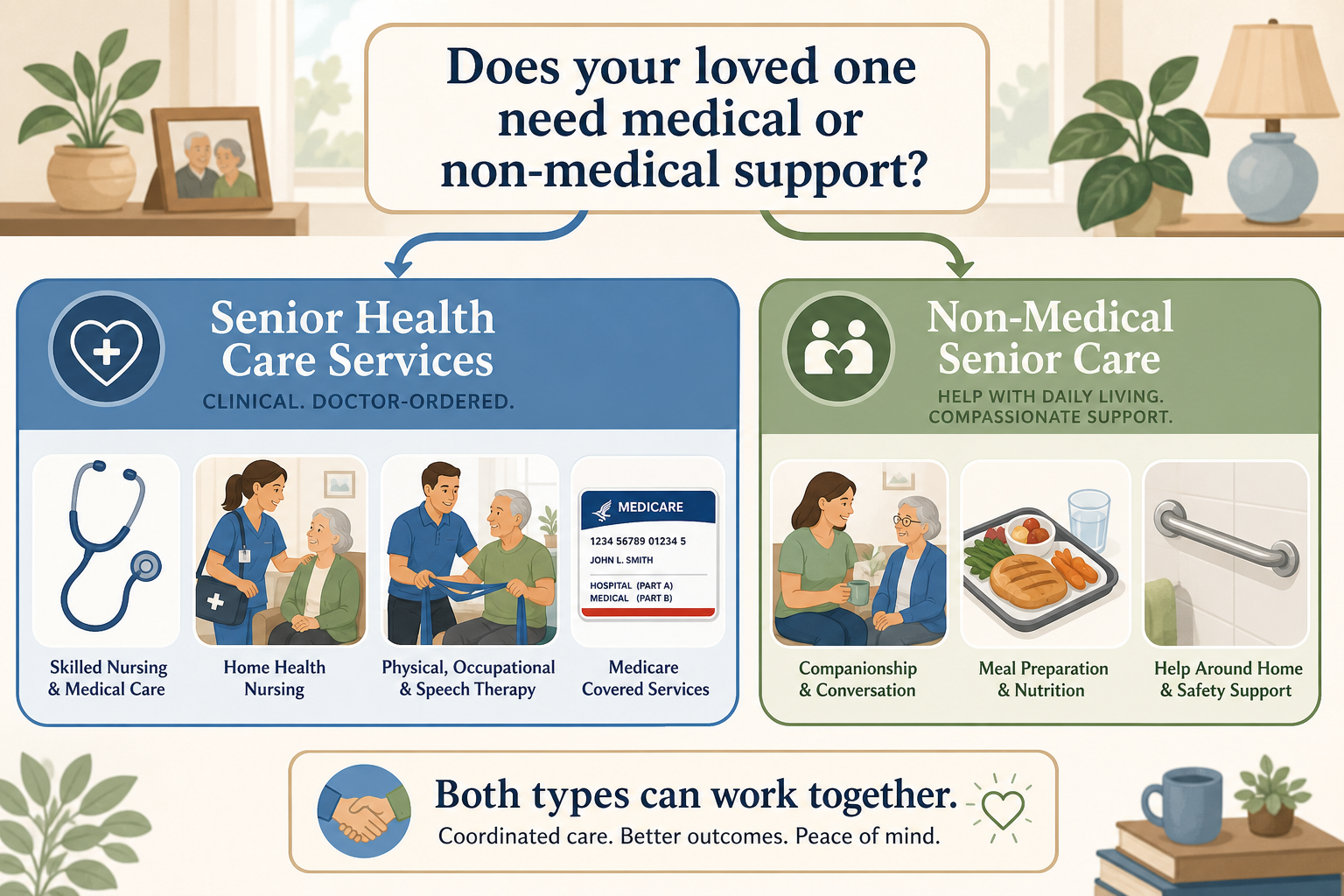
When a family first begins navigating care for an aging parent, the terms "senior health care services" and "senior care" are often used interchangeably. In practice, they refer to two fundamentally different categories of support, and confusing them can lead to costly mistakes in both care planning and payment.
Senior health care services are clinically oriented, doctor-ordered services delivered by licensed medical professionals. They include skilled nursing, physical therapy, wound care, medication management, and hospice care. These services treat or manage a medical condition and require a physician's authorization to begin.
Senior care, by contrast, refers to non-medical assistance with the activities of daily living — bathing, dressing, meal preparation, companionship, and light housekeeping. This is often called custodial care or personal care. It does not require a doctor's order and is typically provided by home care aides or companions rather than licensed nurses or therapists.
| Dimension | Senior Health Care Services (Clinical) | Senior Care (Non-Medical) |
|---|---|---|
| Who provides it | Licensed professionals: RNs, LPNs, physical therapists, occupational therapists, speech-language pathologists | Home care aides, companions, personal care attendants (no license required) |
| Is a doctor's order required? | Yes — services must be prescribed by a physician | No — families arrange directly with agencies or individuals |
| What it includes | Wound care, medication administration, injections, medical tests, pain management, rehabilitative therapies, skilled nursing observation | Bathing, dressing, toileting, meal preparation, light housekeeping, transportation, companionship |
| Typical setting | Home (with a certified home health agency), skilled nursing facility, hospital, hospice facility | Home, assisted living, adult day care center |
| Medicare coverage | Covers under specific conditions (post-hospital, part-time, intermittent, doctor-ordered) | Does not cover custodial care |
The National Institute on Aging defines home health care services as clinical services that may include medications, wound care, medical equipment, and physical therapy, provided for a few hours each day or around the clock. This is distinct from the non-medical home care that most families initially encounter.
For a broader view of how these categories fit into the full long-term care continuum, see the Long-Term Care for the Elderly reference guide.
Why the Medical vs. Non-Medical Distinction Matters
This distinction is not academic. It determines three things for every family: what services are available, who is qualified to provide them, and — most critically — how they are paid for.
Medicare, for example, will cover the cost of a skilled nurse to change a surgical wound dressing at home, but it will not pay for a home care aide to help with bathing or meal preparation. The National Institute on Aging states that Medicare coverage of home health service costs is limited, requiring services to be short-term and provided by Medicare-certified agencies. Medicaid coverage varies by state, and most private health insurance plans do not cover these costs.
Understanding this boundary early allows families to plan realistically. If a parent needs only non-medical help with daily tasks, the family should expect to pay privately, explore Medicaid waiver programs, or look into long-term care insurance. If a parent has a medical need — recovering from surgery, managing a chronic condition, or requiring skilled observation — Medicare may cover a portion of those services, but only if the provider is certified and the services are ordered by a physician.
Types of Senior Health Care Services: A Catalog
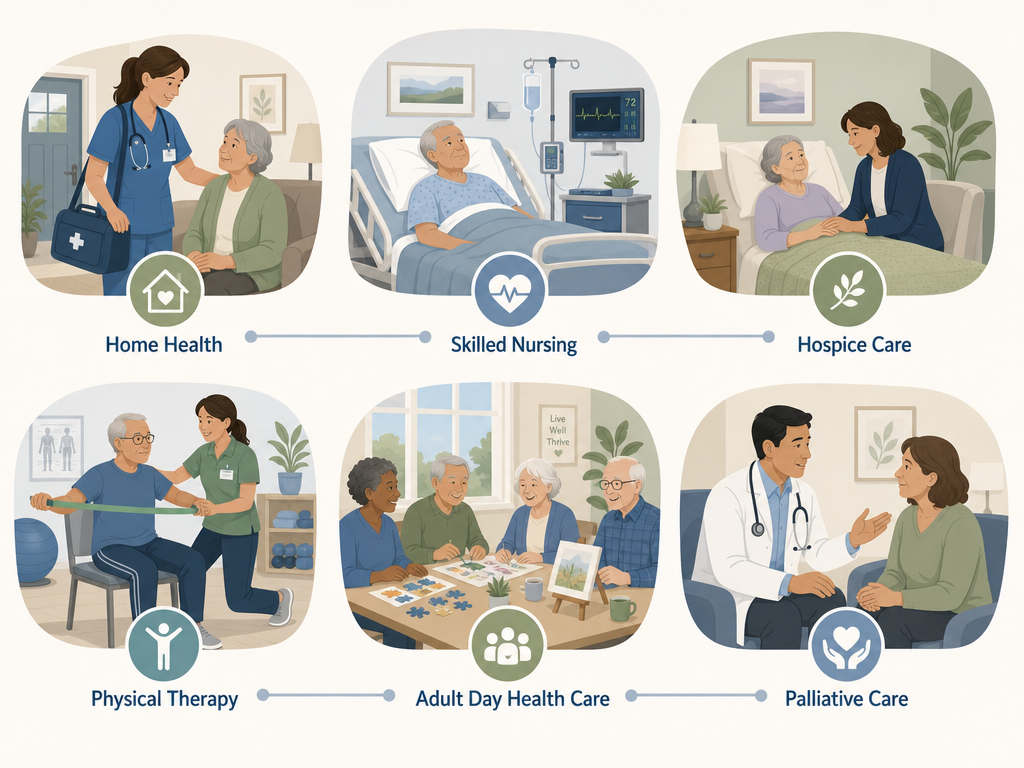
The following are the major categories of clinical senior health care services. Each involves licensed medical professionals and requires a physician's order.
Home Health Care
Home health care brings skilled medical services into a person's home. It is prescribed by a doctor and provided by a Medicare-certified home health agency. Services may include skilled nursing (wound care, medication management, catheter care), physical therapy, occupational therapy, and speech-language pathology. The National Institute on Aging notes that these services can be provided for a few hours each day or up to 24/7, depending on the care plan.
Typical scenario: An older adult is discharged from the hospital after a stroke and needs daily nursing visits to monitor blood pressure and adjust medications, plus physical therapy to regain mobility.
For a step-by-step guide on arranging this type of care, see How to Set Up In-Home Nursing Care for an Elderly Parent.
Skilled Nursing Facility Care
A skilled nursing facility (SNF) — often called a nursing home — provides 24-hour medical care and assistance for seniors with serious health conditions. Care is supervised by licensed nurses and often includes physical, occupational, and speech therapy. Medicare may cover a short-term stay in a skilled nursing facility after a qualifying inpatient hospital stay, but it does not cover long-term custodial care in a nursing home.
Typical scenario: A senior who has had a major surgery or a serious infection requires round-the-clock nursing care and rehabilitation before they can return home safely.
For help distinguishing between short-term rehabilitation and long-term nursing home care, see the Short-Term Care vs. Long-Term Care for Seniors decision framework.
Hospice Care
Hospice care is a specialized form of medical care focused on comfort and quality of life for people in the final stages of a serious illness. It is provided by an interdisciplinary team that includes physicians, nurses, social workers, and chaplains. The National Institute on Aging explains that for individuals receiving hospice care, Medicare covers most of the cost, including up to five consecutive days of respite care in a hospital or skilled nursing facility.
Typical scenario: A senior with advanced cancer has chosen to stop curative treatment and wants to remain at home with pain management and emotional support for both themselves and their family.
Physical, Occupational, and Speech Therapy
These rehabilitative therapies are prescribed by a doctor to help seniors regain function after an illness, injury, or surgery. Physical therapy focuses on mobility, strength, and balance. Occupational therapy helps seniors relearn daily activities like dressing, cooking, and bathing. Speech therapy addresses communication difficulties and swallowing disorders. These services can be provided at home, in an outpatient clinic, or in a skilled nursing facility.
Typical scenario: After a hip replacement, a senior receives physical therapy at home to learn to walk safely with a walker, and occupational therapy to practice getting in and out of the shower independently.
Adult Day Health Care
Adult day health care centers provide a safe, supervised environment during daytime hours for seniors who need medical monitoring or personal care. The National Institute on Aging describes these programs as offering trained staff, social activities, exercise, meals, personal care, and basic health care services. Medicare does not pay for adult day care, but Medicaid may provide coverage in some states. According to CareScout's 2025 Cost of Care survey cited by U.S. News, adult day services cost a national median of $95 per eight-hour day.
Typical scenario: A working adult child cares for a parent with early-stage dementia. The parent attends an adult day health center three days a week for structured activities and medication management while the caregiver is at work.
Palliative Care
Palliative care is specialized medical care focused on relieving pain, symptoms, and stress of a serious illness. Unlike hospice, palliative care can be provided at any stage of an illness, alongside curative treatment. It is delivered by a team of doctors, nurses, and social workers who work with the patient's primary care team. The goal is to improve quality of life for both the patient and the family.
Typical scenario: A senior with congestive heart failure continues to see a cardiologist for treatment but also receives palliative care to manage shortness of breath, fatigue, and anxiety.
How to Access Senior Health Care Services
Unlike non-medical senior care, which families can arrange directly, clinical senior health care services follow a structured access pathway. Understanding this process helps families avoid delays in care.
- Physician's order. A doctor must prescribe the service. This is often called a "certificate of medical necessity" or a referral for home health care, skilled nursing, or therapy.
- Clinical assessment. A nurse or therapist evaluates the patient to determine what level of care is needed and how often services should be provided.
- Referral to a certified provider. The physician or hospital discharge planner refers the patient to a Medicare-certified home health agency, skilled nursing facility, or therapy provider. The provider must be certified to bill Medicare or Medicaid.
- Care plan development. The provider creates a plan of care that specifies the type, frequency, and duration of services. The plan is reviewed and signed by the physician.
- Ongoing recertification. Medicare-covered home health services require recertification by a physician every 60 days to confirm that the patient continues to meet eligibility criteria.
Brief Payment Overview: Who Pays for What
Payment for senior health care services depends on the type of service, the setting, and the patient's insurance coverage. The following is a high-level overview; for a comprehensive treatment of payment options, see the How to Pay for Senior Health Care Services family guide.
- Medicare Part A and Part B: Cover home health care, skilled nursing facility care (short-term, after a qualifying hospital stay), hospice care, and therapy services — but only when services are doctor-ordered, provided by Medicare-certified agencies, and meet specific eligibility criteria. Medicare does not cover custodial care.
- Medicare Advantage (Part C): Plans may offer additional benefits beyond Original Medicare, such as adult day care or expanded home health coverage. Benefits vary by plan.
- Medicaid: Covers some senior health care services for eligible low-income individuals, but coverage varies significantly by state. Some states offer home and community-based services waivers that cover personal care.
- Private insurance: Most private health insurance plans do not cover long-term custodial care. Some plans cover limited home health or therapy services. Long-term care insurance policies may cover both clinical and custodial care, depending on the policy.
- VA benefits: Veterans may qualify for home health care, skilled nursing, and hospice through the VA health system. The VA Aid and Attendance benefit can also help cover the cost of personal care services.
For families facing out-of-pocket costs for home health care, the Medicare Home Health Care Gap guide offers strategies for planning ahead.
When to Use Each Service Type: A Quick Reference
The following table matches common care scenarios to the most appropriate senior health care service type. Use it as a starting point for discussion with your parent's doctor or a hospital discharge planner.
| Care Scenario | Most Likely Service Type | Key Consideration |
|---|---|---|
| Recovering from surgery at home with a need for wound care and medication management | Home health care (skilled nursing + therapy) | Must be doctor-ordered and provided by a Medicare-certified agency |
| Needing 24/7 medical supervision after a major illness or injury | Skilled nursing facility (short-term rehab) | Medicare covers up to 100 days per benefit period under specific conditions |
| End-of-life comfort care with pain management and family support | Hospice care | Medicare covers most costs; patient must have a terminal diagnosis with 6 months or less to live |
| Regaining mobility, strength, or balance after a fall or stroke | Physical and occupational therapy | Can be provided at home, in an outpatient clinic, or in a facility |
| A senior with dementia who needs supervision and social engagement during the day while family works | Adult day health care | Medicare does not cover; Medicaid may cover in some states; average cost is $95 per day |
| Managing chronic pain or symptoms while continuing curative treatment | Palliative care | Can be provided at any stage of illness, alongside active treatment |
Key Terms Glossary
The following terms are used throughout this article and are essential for understanding the senior health care landscape.
- ADLs (Activities of Daily Living): The basic self-care tasks that people perform every day — bathing, dressing, toileting, transferring (walking or moving), continence, and eating. Assessment of ADLs is used to determine the level of care a person needs. See the full ADL glossary entry for a deeper explanation.
- IADLs (Instrumental Activities of Daily Living): More complex daily tasks that support independent living, including managing finances, handling transportation, shopping, meal preparation, housekeeping, managing medications, and using communication devices.
- Skilled nursing: Medical care provided by a licensed nurse (RN or LPN) under a doctor's order. Includes wound care, medication administration, injections, catheter care, and patient education.
- Custodial care: Non-medical assistance with ADLs such as bathing, dressing, eating, and toileting. Also called personal care. Medicare does not cover custodial care.
- Home health aide: A trained aide who provides personal care and some health-related services under the supervision of a nurse or therapist. Unlike a home care aide, a home health aide works as part of a Medicare-certified home health agency and may take vital signs or assist with exercises.
- Durable medical equipment (DME): Medical equipment prescribed by a doctor for home use, such as walkers, wheelchairs, hospital beds, oxygen equipment, and commodes. Medicare Part B covers DME when prescribed by a doctor and supplied by a Medicare-enrolled provider.
- Care plan: A written document that outlines the type, frequency, and duration of medical services a patient will receive. It is developed by the provider, reviewed by the physician, and updated as the patient's condition changes.
Browse more in the Glossary.