
Clinical term
Senior Care at Home Services: A 3-Variable Decision Framework for Families

Why Hourly Rates Mislead Families — The Three Variables That Actually Matter
When a parent begins to struggle at home, the first number most families reach for is the hourly rate for a home care aide. It is a natural instinct — compare prices, pick the affordable option, move on. But that single number, by itself, leads to bad decisions. The national median hourly rate for a nonmedical home caregiver in 2026 is $34 to $35 per hour, depending on the source. That sounds manageable until you multiply it by the actual number of hours a senior needs — and that number depends on two other variables most families never formally assess.
The decision between keeping a parent at home with paid help and moving to a facility is not a binary choice. It is a three-variable equation:
- The senior's ADL (Activities of Daily Living) dependency level, which determines the minimum number of paid care hours required per week.
- The home environment's safety and accessibility, which determines whether the home can support aging in place even with adequate staffing.
- The total monthly cost of providing adequate in-home care at that hour level, compared against the all-in monthly cost of assisted living or a nursing home.
Focusing on hourly rates without assessing these three variables together is how families end up paying for 24/7 home care at $20,000–$24,000 per month when assisted living would have cost $4,500–$5,500, or, conversely, moving a parent to a facility when a modest 15 hours per week of home care would have been sufficient and cheaper. This framework walks through each variable so you can make the decision with your eyes open.
Variable 1: Assessing ADL Dependency to Determine Minimum Care Hours
The most common mistake families make is underestimating how many hours of care a parent actually needs. A parent who can still walk and feed themselves may seem fine for a few hours alone, but difficulty with just two Activities of Daily Living — especially bathing and transferring — typically means they need personal care assistance, not just companion care. And personal care requires more hours.
The standard framework uses six ADLs (bathing, dressing, toileting, transferring, continence, feeding) and eight IADLs (transportation, shopping, meal preparation, housekeeping, medication management, phone use, finances, laundry). A detailed walkthrough of how to assess each one is available in our Senior Care Options by Level of Need guide. Here, we focus on translating those assessment results into a concrete care-hours estimate.
Use the following general thresholds as a starting point. These are estimates — actual needs vary by individual — but they provide a realistic baseline for the cost comparison in Variable 3.
| ADL/IADL Dependency Level | Typical Care Needs | Estimated Weekly Hours | Care Type |
|---|---|---|---|
| 0–1 ADL difficulty, some IADL help needed | Companionship, transportation, light housekeeping, meal reminders | 7–15 hours/week | Companion care |
| 2 ADLs difficult (especially bathing, dressing), multiple IADLs | Personal care assistance, medication supervision, meal preparation, mobility help | 15–30 hours/week | Personal care / home health aide |
| 3+ ADLs difficult (including transferring or toileting), most IADLs | Full personal care, transfer assistance, toileting, continence care, medication management | 30–44 hours/week | Personal care / home health aide |
| All or most ADLs require assistance, 24-hour supervision or safety risk | Round-the-clock personal care, frequent repositioning, feeding assistance, safety monitoring | 168 hours/week (24/7) | 24/7 home care or facility |
A critical distinction: difficulty with bathing and transferring (getting in and out of bed, on and off the toilet) almost always signals a need for personal care, not just companion care. Companion care ($25–$30/hr) covers socialization and light housekeeping. Personal care ($30–$35/hr) involves hands-on assistance with ADLs and is typically provided by a home health aide (HHA) or certified nursing assistant (CNA). If your parent needs help with bathing or toileting, you are in personal care territory, and the hourly rate will be at the higher end of the range.
Variable 2: The Home Safety Audit — When the Home Itself Is the Problem
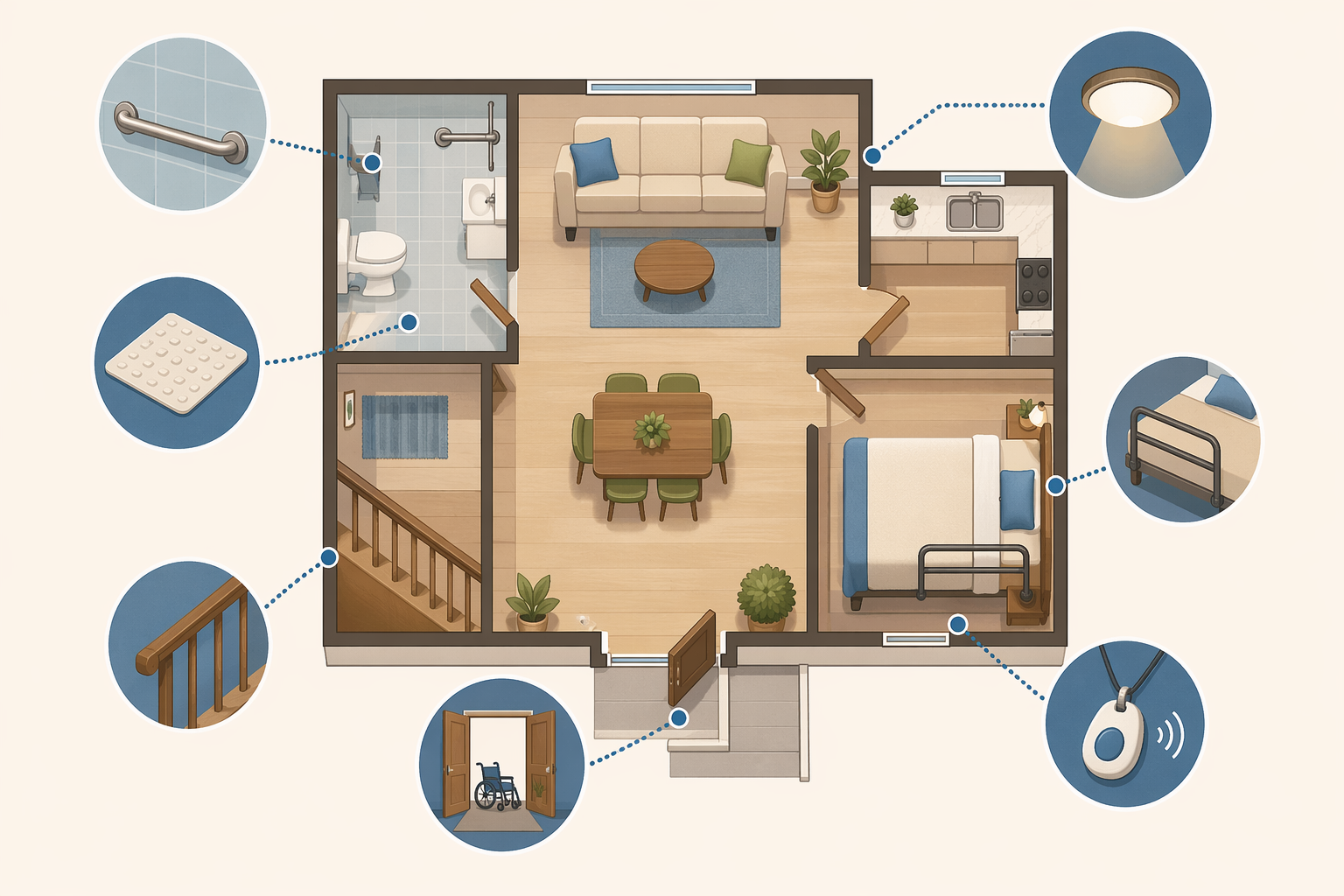
Even with adequate care hours, an unsafe or inaccessible home can make aging in place dangerous. This is the variable families most often overlook. A parent with moderate ADL needs might be perfectly safe in a single-story home with a walk-in shower, grab bars, and wide doorways. The same parent could be at serious fall risk in a two-story home with a step-in tub, narrow doorways, and poor lighting.
Conduct a basic home safety audit covering these areas:
- Bathroom: Is there a step-in tub or shower? Are grab bars installed near the toilet and in the shower? Is the floor non-slip? Can a shower chair fit? The bathroom is the most dangerous room in the house for falls.
- Bedroom: Is the bed accessible without climbing over furniture? Is there a clear path to the bathroom? Is a bedside commode or urinal feasible if mobility declines?
- Entry and exit: Are there steps at the front or back door? Can a walker or wheelchair pass through doorways? Is there a ramp or alternative accessible entrance?
- Kitchen: Are frequently used items within easy reach? Is the stove safe (auto-shutoff, front-mounted controls)? Can the senior prepare a simple meal or heat food safely?
- Stairs: Are there grab rails on both sides? Is the lighting adequate? Can the senior navigate stairs safely, or would a stair lift or main-floor bedroom be necessary?
- Social isolation: Is the home in a walkable area? Can the senior get outside safely? Is there a risk of loneliness or depression that paid care hours alone cannot address?
If the home fails on multiple safety dimensions, you have two options: invest in modifications to make it safe, or consider a facility where the environment is already designed for mobility and safety. For families who choose to pursue modifications, our Aging in Place Services: A 6-Step Guide for Families After a Crisis provides a step-by-step roadmap.
Variable 3: Total Monthly Cost Comparison — Home Care vs. Assisted Living vs. Nursing Home

Once you have an estimate of required care hours and a sense of whether the home is safe, the third variable is cost. The table below compares monthly costs at different home care hour levels against assisted living and nursing home medians. All figures are 2026 national medians.
| Care Option | Monthly Cost (National Median) | Best For |
|---|---|---|
| Home care — 7 hrs/week | $875 – $1,050 | Seniors who need companionship, transportation, and light help; mostly independent in ADLs |
| Home care — 15 hrs/week | $1,950 – $2,208 | Seniors needing daily personal care assistance but not full-day coverage |
| Home care — 30 hrs/week | $3,900 – $4,416 | Seniors needing substantial daily personal care; often cheaper than assisted living |
| Home care — 44 hrs/week | $5,700 – $6,673 | Near-full-day care; comparable to or slightly above assisted living costs |
| Assisted living | $4,500 – $5,500 | Seniors who need moderate personal care and a safe, social environment |
| Memory care | $6,000 – $7,500 | Seniors with dementia who need a secure, specialized environment |
| Nursing home (semi-private room) | $8,500 – $9,581 | Seniors with high medical needs, 24/7 skilled nursing, or advanced dementia |
| Home care — 24/7 (168 hrs/week) | $20,000 – $25,479 | Seniors who need round-the-clock supervision; almost always more expensive than a facility |
The table reveals the counterintuitive pattern clearly. For seniors needing less than 30 hours per week of care, home care is typically cheaper than assisted living. At 44 hours per week, the costs are roughly comparable. But at the 24/7 level, home care becomes dramatically more expensive — two to four times the cost of assisted living and roughly double the cost of a nursing home.
A deeper, cost-only analysis is available in our separate article: Home Care vs. Assisted Living vs. Nursing Home: Which Is Actually Cheaper in 2026?. That article includes state-by-state breakdowns and a more detailed discussion of hidden costs like housing, utilities, and meals.
Regarding payment: most home care is paid out of pocket. Medicare covers only short-term skilled home health care (nursing, therapy) through Medicare-certified agencies — it does not cover personal care or companionship. Medicaid Home and Community-Based Services (HCBS) waivers may cover personal care, but eligibility and coverage vary significantly by state. The Veterans Administration offers Aid and Attendance benefits for qualifying veterans. Long-term care insurance policies may cover home care, but the terms vary widely. For a full overview of payment options, see our How to Pay for Senior Health Care Services: A Family Guide.
The Inflection Point: When 24/7 Home Care Costs More Than a Facility
There is a clear inflection point in the cost comparison. For seniors needing fewer than 40–50 hours of care per week, home care is generally more affordable than assisted living. But once the need crosses into round-the-clock supervision — 168 hours per week — the math flips decisively.
At the national median rate of $34–$35/hr, 24/7 home care costs between $20,000 and $25,479 per month. That is roughly four to five times the cost of assisted living ($4,500–$5,500/mo) and more than double the cost of a semi-private nursing home room ($8,500–$9,581/mo). Even with a live-in caregiver (a single aide who sleeps overnight), the cost typically ranges from $20,000 to $24,000 per month — still far above facility costs.
This does not mean 24/7 home care is never the right choice. Some seniors have strong preferences about remaining at home, and some families can afford the premium. But it does mean that families should not assume home care is always cheaper. For a detailed discussion of the 24/7 scenario, including payment strategies and when it makes financial sense, see our dedicated guide: 24/7 Home Care Costs in 2026: A Financial Decision Framework for Families Facing Round-the-Clock Care.
Realistic Decision Scenarios: Applying the Three Variables Together
The three variables — ADL dependency, home safety, and total monthly cost — do not exist in isolation. They interact. The following scenarios show how the framework works in practice.
Scenario A: Moderate ADL Needs + Safe Home = Home Care Is Viable
A 78-year-old widow has difficulty with bathing and dressing (2 ADLs) and needs help with transportation, shopping, and medication management (3 IADLs). She lives in a single-story home with a walk-in shower, grab bars, and no stairs. Her daughter lives 20 minutes away and can check in daily.
Estimated care hours: 15–20 hours per week for personal care and IADL support. At $35/hr, that is $2,100–$2,800 per month — well below the $4,500–$5,500 assisted living median. The home is safe. The daughter is nearby. Home care is the clear winner here, both financially and emotionally.
Scenario B: High ADL Needs + Unsafe Home = Facility Likely More Cost-Effective
An 85-year-old man has difficulty with bathing, dressing, transferring, and toileting (4 ADLs) and needs help with all IADLs. He lives alone in a two-story home with a step-in tub, narrow doorways, and a steep staircase to the only bathroom. He has had two falls in the past six months.
Estimated care hours: 30–44 hours per week for personal care and supervision. At $35/hr, that is $4,200–$6,478 per month — comparable to or slightly above assisted living. But the home is unsafe even with care: the step-in tub and stairs create fall risks that a caregiver cannot fully mitigate. Modifications (stair lift, bathroom remodel, doorway widening) would cost $10,000–$30,000. In this scenario, assisted living at $4,500–$5,500 per month is likely the safer and more cost-effective choice.
Scenario C: Low ADL Needs + Unsafe Home + Social Isolation = Home Care May Still Be Unsafe
A 75-year-old man has no significant ADL difficulties but lives in a third-floor walk-up apartment with no elevator. He is socially isolated — his friends have moved away or passed on — and he rarely leaves the apartment. He is cognitively intact but depressed.
Estimated care hours: 7–10 hours per week for companionship, transportation, and light housekeeping. At $35/hr, that is $1,050–$1,400 per month — very affordable. But the home itself is the problem: the third-floor walk-up is a fall risk and a barrier to social engagement. Even with a companion, the senior is still isolated in an unsafe environment. In this case, an independent living community or a ground-floor apartment with social programming might be a better solution than home care alone.
Warning Signs That Home Care Is No Longer Sufficient
Even with a well-designed care plan and adequate hours, there are clear warning signs that home care is no longer safe or sufficient. If you observe any of the following, it is time to reassess the three variables and consider a facility transition:
- Frequent falls: One fall is a warning. Two falls in six months, or any fall resulting in a fracture or head injury, is a red flag that the home environment or care plan is not adequate.
- Caregiver burnout: If the primary family caregiver is showing signs of exhaustion, irritability, or declining health, the current arrangement is not sustainable. Paid care hours may need to increase, or a facility may be necessary.
- Wandering or safety risks: If the senior has dementia and is wandering, leaving the stove on, or engaging in other unsafe behaviors, home care may not provide the 24/7 supervision required. Memory care or a secured dementia unit may be safer.
- Rapid functional decline: A significant decline in ADL independence over a few months — for example, going from needing help with 2 ADLs to needing help with 4 — suggests that the care plan needs to be re-evaluated, and the home may no longer be appropriate.
- Social isolation and depression: If the senior is spending most of their time alone despite paid care hours, and shows signs of depression, loneliness, or withdrawal, the social environment of a facility may be beneficial.
- Inability to manage medications: Missed doses, double-dosing, or confusion about medication schedules — even with caregiver supervision — can indicate that the level of oversight needed exceeds what home care can reliably provide.
Next Steps: Making the Decision and Taking Action
The three-variable framework gives you a structured way to think about the decision, but it does not make the decision for you. Here are the concrete next steps:
- Perform the ADL/IADL assessment. Use the detailed guide in our Senior Care Options by Level of Need article to assess your parent's functional level. Be honest about what they can and cannot do — wishful thinking leads to understaffing.
- Conduct the home safety audit. Walk through each room with the checklist above. Take photos. Note every hazard. If the home fails on multiple dimensions, get quotes for modifications before deciding.
- Run the cost comparison. Use the table above as a starting point, then get actual quotes from local home care agencies and facilities. Remember to factor in housing costs (mortgage/rent, utilities, property taxes) if comparing home care to facility care.
- Discuss the findings with the senior and their primary care provider. The senior's preferences matter, but so does their safety. A primary care provider or geriatric care manager can provide an objective perspective.
- If you need a broader overview of all senior care options — including independent living, continuing care retirement communities, and hospice — see our Senior Care Options: A Practical 3-Step Decision Framework for Families Facing a Crisis.
The decision between home care and a facility is one of the most consequential a family will make. It is also one of the most emotionally charged. The three-variable framework cannot remove the emotion, but it can replace guesswork with a clear, data-informed structure. Use it as a starting point, not a final answer — and revisit it as your parent's needs evolve.
Browse more in the Glossary.