
STEADI: Assess
How Biological Age Differs From Chronological Age
Biological age reflects how the body is actually aging, not just the years lived. Simple home checks — walking speed, grip strength, chair stands, and timed up-and-go — give older adults and caregivers a practical, no-lab way to estimate it, and a flagged result points to fall-prevention steps and a follow-up clinician visit.
Chronological age is the easy number: how many years a person has been alive. Biological age is different. It is an estimate of how the body’s cells, tissues, organs, and functional systems are actually aging. Two people can both be 78 on a birth certificate and still look very different when one rises easily from a low chair, crosses a parking lot at a steady pace, and catches balance after turning, while the other hesitates at each of those steps.
That is why an explanation of biological age vs. chronological age for seniors cannot stop at a lab result or a longevity headline. For an older adult at home, the useful question is narrower: which signs tell you whether the body is aging in a way that threatens walking, balance, transfers, fall risk, and independence?

DNA methylation clocks, blood-based aging panels, and organ-aging theories are part of the reason seniors and caregivers are hearing the term more often. They are interesting, and some may become more clinically useful over time. But there is still no single validated biological-age test, and different organs can age at different rates, so one number should not be treated as a verdict on the whole person.[1]
The hopeful part is that biological aging is not fixed in the same way a birthday is fixed. In a NHANES-based analysis comparing U.S. adults in 1988–1994 with those in 2007–2010, measured biological age improved over time, with the largest gains among adults ages 60–79.[2] That does not mean every individual can reverse every risk. It does mean function deserves attention before a family quietly decides that slower movement is “just age.”
The most useful biological-age clues are often functional
For fall prevention, the practical version of biological age is not how young a test says someone is. It is whether the person can produce strength, maintain speed, recover balance, and keep moving through ordinary spaces without being one bad turn away from the floor.
| Home-observable check | What it can reveal | Why caregivers should notice |
|---|---|---|
| Walking speed | Endurance, balance confidence, leg power, and the ability to move safely in real-world time | A person who slows dramatically may struggle with crosswalks, parking lots, store aisles, and getting to the bathroom in time |
| Grip strength | Overall muscle strength and reserve, not just hand strength | Weak grip can travel with difficulty using railings, opening doors, carrying groceries, or steadying after a stumble |
| Timed up-and-go | The sequence of standing, starting, walking, turning, returning, and sitting | This resembles daily fall-risk moments more closely than a single strength test |
| Chair stands | Leg strength, transfer control, and fatigue | Trouble rising from a chair often shows up before someone admits they feel unsafe |
| Frailty signs | Accumulated loss of reserve across weight, energy, strength, speed, and activity | Several small changes together can matter more than one dramatic problem |
None of these checks diagnose a disease at the kitchen table. They are signals. A signal is still valuable if it helps a family move from vague reassurance to a specific next step.
Walking speed: the daily-life version of reserve
Walking speed is not just about being “fast.” It reflects whether the body can coordinate vision, balance, leg strength, endurance, attention, and confidence while moving. A senior may look fine standing in the kitchen and still become unsteady when the hallway is dim, the floor changes from carpet to tile, or someone turns to answer a question while walking.
At home, watch the pattern more than the stopwatch. Does the person shorten steps? Drift toward furniture? Slow sharply at thresholds? Stop walking in order to talk? Reach for walls during turns? Those details matter because falls often happen during transitions, not during a perfect straight-line walk prepared in advance.
Grip strength: a small test with whole-body implications
Grip strength is easy to underestimate because it sounds like a hand issue. In aging research and clinical screening, low grip strength is commonly used as a marker of reduced physical reserve. The caregiver version is noticing whether someone has more trouble opening containers, holding a railing firmly, carrying a light bag, pushing up from chair arms, or managing a door while stepping through it.
If there is a hand injury, arthritis flare, stroke history, or one-sided weakness, grip observations need clinical interpretation. The point is not to rank someone by hand power. It is to notice whether strength loss is beginning to affect safe movement.
Timed up-and-go: one check that combines several fall-risk moments
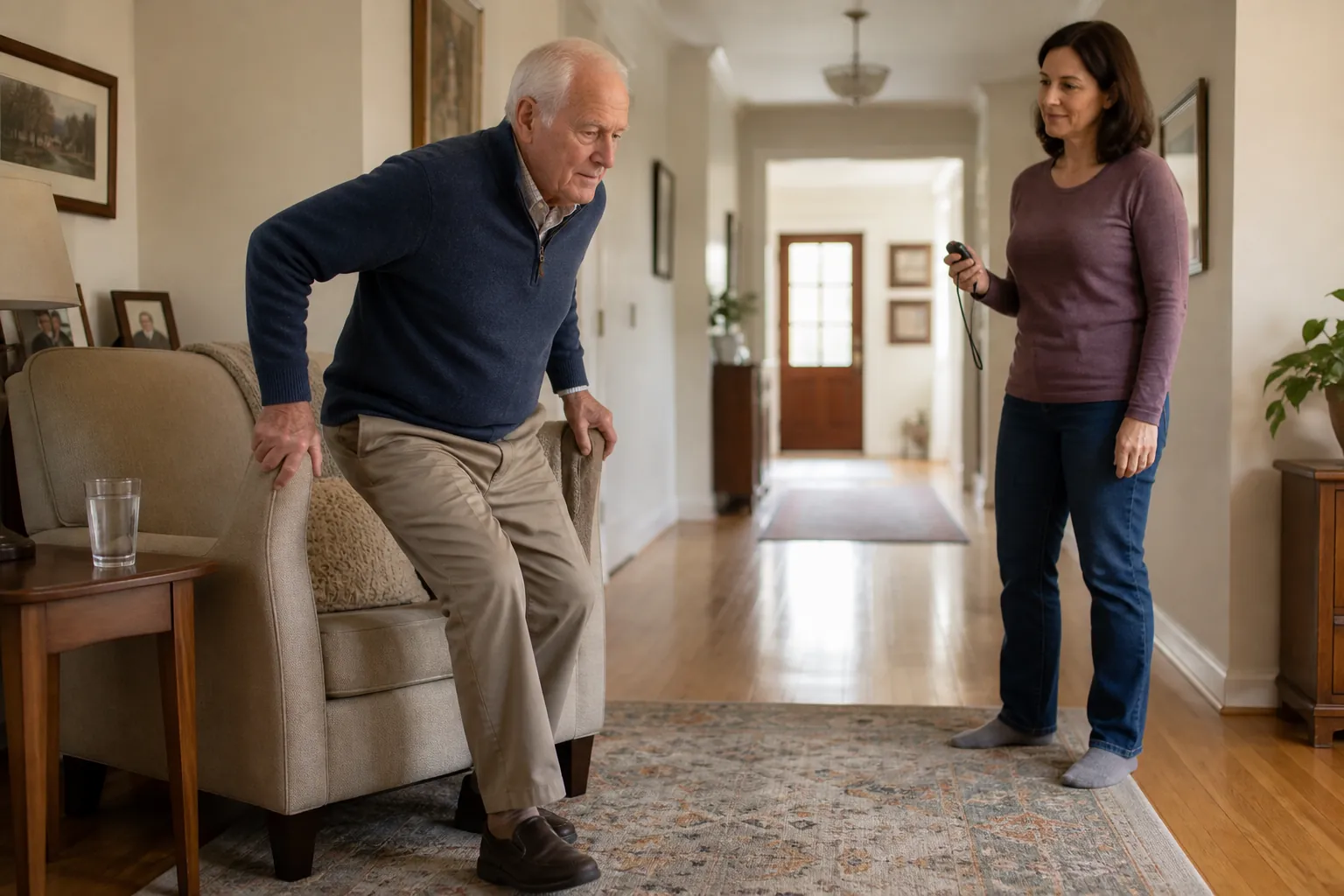
The timed up-and-go idea is useful because it resembles a real errand inside the house: stand up, start walking, turn, come back, and sit down. It asks the body to shift from rest to movement, manage direction changes, and control the descent back into a chair.
A family does not need to turn this into a high-pressure test. The safer home version is observational: choose a clear, well-lit path; use the person’s usual shoes and assistive device; have someone nearby but not pulling; and stop if there is dizziness, chest pain, unusual shortness of breath, new confusion, or near loss of balance. Write down what happened, not just how long it took.
- Notice whether the first stand requires several tries.
- Watch whether the person pauses before starting to walk.
- Look closely at the turn, where instability often appears.
- Notice whether sitting is controlled or more like dropping into the chair.
- Record whether the person used furniture, walls, or another person for support.
Chair stands: leg strength shows up before a fall
Getting out of a chair is one of the most revealing ordinary movements in later life. It requires ankle and hip mobility, thigh and hip strength, trunk control, balance, and enough confidence to move the body’s weight forward without grabbing at the nearest object.
A low, soft chair can make almost anyone work harder, so use judgment. What matters is change: a parent who used to stand smoothly but now rocks several times, pushes heavily with both arms, avoids certain chairs, or asks someone to “give me a hand” may be showing a functional decline that deserves attention. That decline affects toileting, bathing, getting into cars, and recovering after a stumble.
Frailty signs connect biology to what families can actually see
Frailty is often misunderstood as an insult. Clinically, it is better understood as reduced reserve: the body has less margin when illness, stress, medication changes, poor sleep, or a minor trip challenge it. Researchers have described the frailty index, based on the proportion of accumulated health deficits, as a simple way to quantify biological age and as currently the best predictor of mortality in the oldest old.[3]
That does not make frailty a label to apply casually at the dinner table. It does make the signs worth watching, especially when several appear together.
The Fried frailty phenotype uses five criteria: unintentional weight loss of more than 10 lb in the past year, self-reported exhaustion, low grip strength, slow gait speed, and low physical activity. In that framework, three or more criteria indicate frailty as a screening concern.[3]
- Unintentional weight loss: clothes fit looser, meals are skipped, or the person says food no longer appeals. This can reflect medical, dental, medication, mood, swallowing, or access problems, so it needs follow-up rather than blame.
- Exhaustion: the person repeatedly says ordinary tasks feel draining, cancels usual activities, or needs much longer recovery after errands.
- Low grip strength: jars, doors, railings, walkers, and chair arms become harder to manage safely.
- Slow gait speed: walking becomes cautious, interrupted, or dependent on furniture and walls.
- Low physical activity: the person’s world shrinks from walks, errands, visits, or hobbies to mostly sitting, often before anyone names it as a health change.
A single sign can have many explanations. Several signs together should shift the family’s posture from “probably fine” to “let’s get this assessed.”
What fitness-age research adds — and what it does not prove
One reason functional checks deserve attention is that they show up in biological-aging research, not only in caregiver common sense. In a 2023 exploratory study of 176 adults ages 51–80, timed up-and-go time and handgrip strength contributed strongly to an estimated “fitness age.” That estimate correlated strongly with a validated mortality risk score, with r = 0.90, and the “unfit” group had roughly a 5% higher estimated 10-year probability of death or a cardiovascular event than the “fit” group.[4]
That is useful evidence for the importance of function. It is not a universal cutoff for your father’s hallway. The study was a single exploratory cohort from Sardinia, and the authors noted that cutoffs need validation in larger populations.[4] A caregiver should not use one timed walk or one grip attempt to predict death, classify a parent as “unfit,” or decide that help is pointless.
The better use is practical: if standing, walking, turning, gripping, or activity level looks worse than it used to, treat that as a reason to ask for a fall-risk and medical review.
Where consumer biological-age tests fit
A mail-in biological-age test may satisfy curiosity. It may also start a useful conversation about sleep, exercise, nutrition, medications, smoking, alcohol, stress, or chronic disease management. But if the result says someone is “younger” while that person is grabbing walls on the way to the bathroom, the wall-grabbing matters more for fall prevention.
The reverse is also true. A discouraging biological-age number should not make a senior feel sentenced. Lab estimates do not replace a physical exam, medication review, vision check, balance assessment, strength testing, or a look at the home environment. For independence, the most actionable information is often the part everyone can observe but no one has written down.
If a home check raises concern, move from watching to planning
A flagged home check should lead to a clinician visit, not a family diagnosis. Bring specific notes: “She needed three tries to stand from the armchair,” “He slowed and grabbed the wall during the turn,” “She has lost weight without trying,” or “He stopped walking outside after the last near fall.” Specific observations are easier to act on than “Mom seems older lately.”

If the older adult has Medicare, the Annual Wellness Visit is a natural place to raise falls, balance, walking, and home-safety concerns. The site’s guide to Medicare wellness visits and fall prevention can help families prepare the right questions before the appointment.
From there, the next step is usually not one product or one exercise. It is a fall-prevention plan that matches the risks found: strength and balance work, medication review, vision care, safer footwear, assistive-device review, home modifications, and follow-up when symptoms suggest something medical is changing. A STEADI-based fall-prevention action plan is a practical way to organize those pieces instead of reacting only after the next fall.
The home itself should be reviewed at the same time. Loose rugs, poor lighting, cluttered pathways, missing grab bars, unstable chairs, and hard-to-reach items can turn a modest functional decline into an injury. The CDC STEADI home fall-prevention checklist is a useful companion to the movement observations above.
If weakness, balance loss, unsafe transfers, or difficulty with daily activities are part of the picture, ask whether physical therapy or occupational therapy is appropriate. The explainer on Medicare fall-prevention services and PT/OT coverage can help families understand what to discuss after a flagged result.
Some signs should move faster than routine planning. New one-sided weakness, fainting, chest pain, sudden confusion, repeated unexplained falls, new severe dizziness, or a major change in walking should be treated as a medical red flag. For a caregiver-friendly way to separate “watch closely” from “call now,” use the red-flag safety checklist for elderly parents. For broader fall-prevention basics, the fall prevention FAQ is a good starting point.
The useful hierarchy
Chronological age still matters. It helps clinicians interpret screening needs, medication risk, disease patterns, and recovery expectations. Biological age adds another layer: it asks how the body is actually holding up.
For seniors at home, the most practical expression of biological age is functional status. Walking speed, grip strength, timed up-and-go, chair stands, and frailty signs give families something more useful than a vague impression and more actionable than a consumer test result.
Home checks can reveal concerns early, but they do not diagnose frailty, predict death for an individual, or replace a clinician’s assessment. If walking, strength, transfers, activity level, weight, or exhaustion raise concern, use that as the reason to start fall-prevention planning and medical follow-up.
Medical-safety note: This article is educational and is not a substitute for medical advice, diagnosis, or treatment. Seek urgent medical care for sudden weakness, fainting, chest pain, severe shortness of breath, sudden confusion, head injury, or a fall with possible fracture. Last verified: August 25, 2026.
References
- What is biological age? — Max Planck Institute for Biology of Ageing — https://www.age.mpg.de/what-is-biological-age
- Is 60 the New 50? Examining Changes in Biological Age Over the Past Two Decades — Demography — https://pmc.ncbi.nlm.nih.gov/articles/PMC5897168/
- Frailty and Biological Age — Annals of Geriatric Medicine and Research — https://pmc.ncbi.nlm.nih.gov/articles/PMC8497950/
- Manca et al. 2023 study on fitness age, timed up-and-go, grip strength, and mortality risk — Frontiers in Physiology — 2023 — https://www.frontiersin.org/journals/physiology/articles/10.3389/fphys.2023.1164943/full
Related reading
Noticed something outdated or inaccurate on this page? Flag a correction. We review every report against CDC, NIA, and AARP HomeFit guidance before updating a page.
Part of the Fall Prevention section.