
STEADI: assess
Which E. coli Symptoms in Older Adults Need a Doctor?
A caregiver-focused guide to E. coli symptoms in adults 65 and older: what to watch for, when to call the doctor, and when to head to urgent care or the ER. It explains why dehydration and HUS — not the diarrhea itself — are the real dangers, and why age 65 changes the stakes.
Here are the E. coli symptoms in an older adult that should change what you do next. For a parent or spouse age 65 or older, the decision is less about whether diarrhea is “usually” self-limited and more about duration, fever, blood, urine output, hydration, and alertness. CDC names adults 65 and older as a group at increased risk for E. coli infection and serious illness, and it also notes that adults 60 and older are more likely to become seriously ill or develop hemolytic uremic syndrome, or HUS, after E. coli infection.[1]
Use the conservative CDC threshold first: call a doctor if diarrhea or vomiting lasts more than 2 days, if there is bloody poop or pee, if fever is higher than 102°F, or if there are signs of dehydration or HUS.[2]
| What you see in a 65+ adult | What to do next | Why it matters |
|---|---|---|
| Diarrhea or vomiting lasting more than 2 days | Call the doctor the same day. | CDC uses more than 2 days as a call-the-doctor threshold for E. coli symptoms.[2] |
| Bloody stool or blood in urine | Call now; do not wait for the next routine appointment. | Blood in poop or pee is one of CDC’s listed reasons to contact a doctor during suspected E. coli illness.[2] |
| Fever higher than 102°F | Call the doctor. | A fever above this level changes the situation from routine home monitoring to medical guidance.[2] |
| Dizziness, lightheadedness, much less urine, dark urine, fainting, or trouble standing safely | Call the doctor; seek urgent help sooner if the person is fainting, cannot stand safely, or cannot keep fluids down. | These are dehydration warning signs, and dehydration can quickly turn a bathroom trip into a fall-risk moment in an older adult.[2] |
| Urinating less or not at all, blood in urine, pale cheeks or pale lower eyelids, unexplained bruising or tiny red spots, extreme tiredness or irritability, or decreased alertness | Treat as urgent. Call emergency services or go to the ER based on severity and local instructions. | These are CDC-listed HUS warning signs; people with HUS should be hospitalized.[3] |

Start with the thresholds, not the stomach-cramp story
If you are caring for an older adult tonight, the first useful question is not “Could this be E. coli?” It is: “Has this crossed a line where home watching is no longer enough?”
The line is crossed when diarrhea or vomiting lasts more than 2 days, fever is higher than 102°F, stool or urine is bloody, dehydration signs appear, or HUS signs appear.[2][3] That does not prove E. coli is the cause. It means the older adult’s body is showing a pattern that deserves medical input.
There is some threshold variation across reputable sources. CDC says to call for diarrhea or vomiting lasting more than 2 days.[2] NIDDK and Cleveland Clinic use a 3-day threshold for diarrhea, and NIDDK also flags six or more loose stools in one day as a reason to seek care right away.[4][5] For an adult 65 or older, using CDC’s more conservative more-than-2-days threshold is the safer home rule.
When blood appears
Bloody diarrhea is one of the E. coli symptoms caregivers tend to recognize as serious, but blood in urine belongs in the same escalation conversation. CDC lists bloody poop or pee as a reason to call a doctor during suspected E. coli illness.[2] If the person is also weak, pale, confused, or urinating much less than usual, do not treat the blood as an isolated bathroom finding.
When fever is above 102°F
A low fever can occur with E. coli illness, but a fever higher than 102°F is a CDC call-the-doctor threshold.[2] In an older adult, it is worth writing the number down with the time, because a clinician may ask whether the fever is rising, responding to medication, or occurring alongside dehydration, blood, or a change in alertness.
When the person seems less alert
Decreased alertness is not a “check again in the morning” symptom in this setting. CDC includes decreased alertness among HUS warning signs, along with urinating less or not at all, losing pink color in the cheeks and inside the lower eyelids, unexplained bruising or tiny red spots, blood in the pee, and feeling very tired or irritable.[3]
HUS is a medical emergency pathway, not a home hydration project. CDC states that people with HUS should be hospitalized.[3] If an older adult with diarrhea or recent suspected foodborne illness becomes unusually sleepy, hard to wake, confused, pale, or barely urinates, the caregiver’s job is to escalate, not to keep negotiating another sip of fluid.
Why age 65 changes the stakes
The danger is not that every older adult with diarrhea has a severe E. coli infection. The danger is that diarrhea and vomiting can dehydrate an older body faster than the family realizes, and serious E. coli complications are more consequential when there is less reserve.
CDC’s risk framing matters here: adults 65 and older are specifically named as being at increased risk for E. coli infection and serious illness.[1] That is why generic reassurance—“most people recover in about a week”—is incomplete for a caregiver trying to decide whether a parent should still be managed at home tonight.
There is also a denominator trap worth avoiding. CDC notes that, among people with diarrhea, HUS is most common in children younger than 5.[3] That does not cancel CDC’s separate warning that older adults are at increased risk for serious illness from E. coli.[1] For caregiving, the practical conclusion is simple: do not estimate HUS risk at home by age alone. Watch the HUS signs.
Dehydration is the part that can put someone on the floor
During suspected E. coli illness, hydration monitoring is not just about comfort. It is part of keeping an older adult upright on the way to the toilet, sink, bed, or hallway.
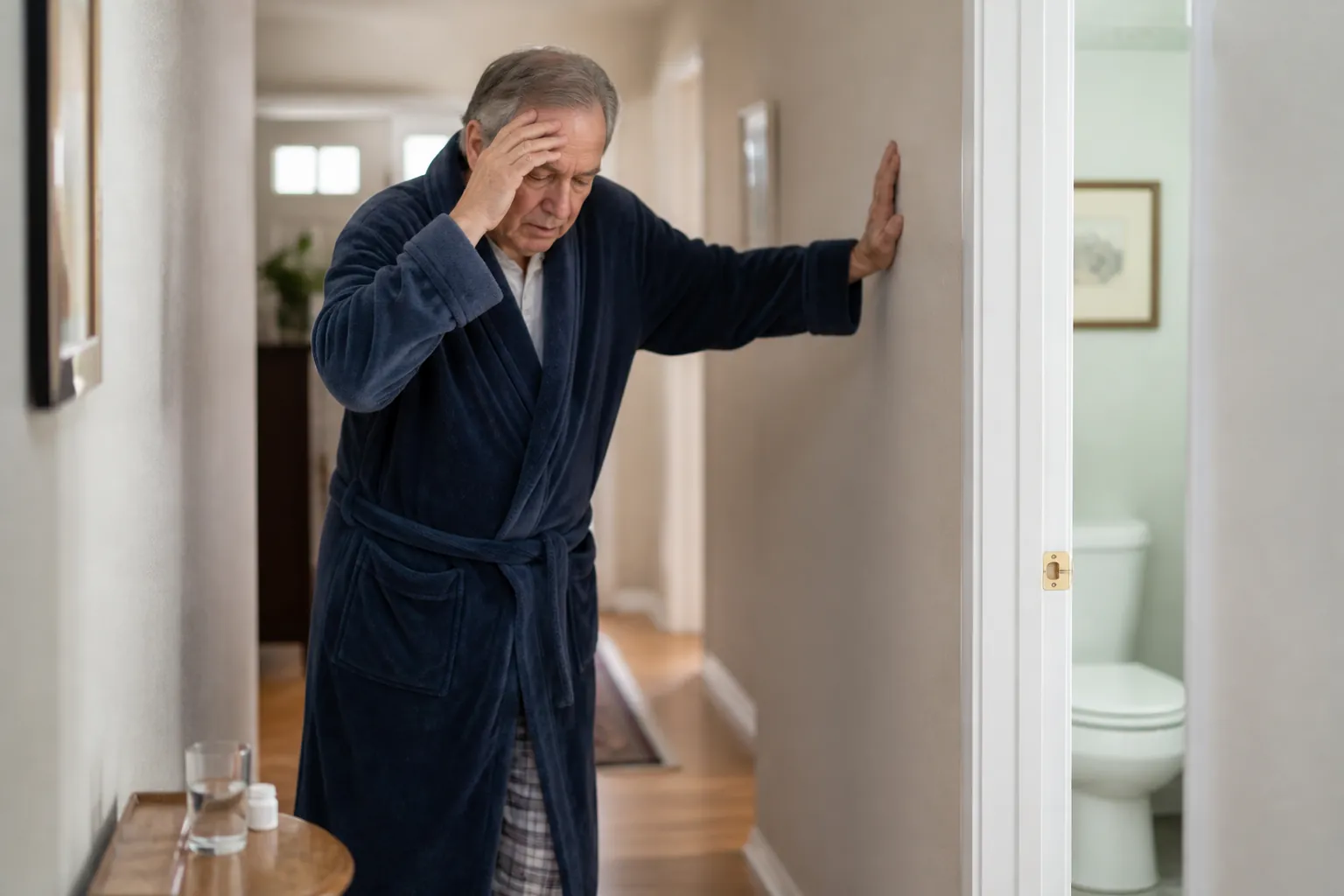
CDC lists dizziness or lightheadedness among dehydration signs to watch during E. coli illness.[2] NIDDK adds light-headedness, dizziness on standing, fainting, and dark-colored urine among dehydration symptoms in food poisoning.[4] Those are not abstract symptoms when the person is making repeated urgent trips to the bathroom.
Do not rely only on “Are you thirsty?” HealthInAging’s caregiver guidance notes that some older people have a decreased thirst sensation.[6] A parent can say they are fine and still be urinating less, standing up unsteadily, or getting lightheaded when they walk.
- Count bathroom trips and note whether urination is decreasing.
- Look at urine color when you can do so respectfully; dark urine can point toward dehydration.
- Ask about dizziness before the person stands, not after they are already halfway to the bathroom.
- Clear the path to the toilet, turn on lights, and stay close if the person is weak or lightheaded.
- Escalate if dizziness affects standing or walking, if fainting occurs, or if fluids will not stay down.
The fall connection should be stated carefully. The evidence does not show that E. coli directly causes falls. The defensible pathway is that diarrheal illness can lead to dehydration; dehydration can involve dizziness or fainting; and dizziness in an older adult can make bathroom and hallway movement more dangerous. In a cohort of 30,634 adults 65 and older, 37.9% were dehydrated at baseline, and dehydration was positively associated with falls, with an odds ratio of 1.13.[7] CDC also reports that 1 in 4 older adults falls each year and that falls are the leading cause of injury death for adults 65 and older.[8]
If you are already watching foodborne-illness symptoms after a recall, the same 72-hour household vigilance described in food recall safety for seniors applies here: keep the walking route safe while you watch the medical signs.
The ordinary E. coli symptom pattern, after the danger signs
The common symptom list is still useful, just not more important than the thresholds. Mayo Clinic describes E. coli symptoms as watery or bloody diarrhea, severe stomach cramps, and sometimes vomiting or a low fever. Symptoms usually begin 3 to 4 days after exposure, but they can start as soon as 1 day later or more than a week later.[9] Cleveland Clinic also notes that symptoms can appear up to 10 days after exposure.[5]
That timing can help when a caregiver is reconstructing meals, leftovers, restaurant food, undercooked meat, raw produce, unpasteurized products, or a known outbreak notice. It should not delay escalation. If the symptoms meet the CDC call threshold, the exact exposure source can wait for the clinician or public health instructions.
If the symptom picture looks like another foodborne illness, the home safety task is similar: prevent dehydration, prevent a rushed bathroom fall, and know when symptoms have crossed a medical threshold. For related comparisons, see salmonella prevention tips for seniors and cyclospora symptoms and fall risk in older adults.
Medicines to pause before using
Do not automatically give an anti-diarrheal medicine for suspected Shiga toxin-producing E. coli, often called STEC, unless a clinician directs it. Cleveland Clinic and WHO both warn against anti-diarrheal medicines and antibiotics for suspected STEC because they may increase the risk of HUS.[5][10]
That can feel counterintuitive when the person is exhausted and the bathroom cleanup has been going on for hours. Still, this is one of the places where “stop the diarrhea fast” is not the right home goal. The safer goal is to call when the thresholds are met, keep hydration and walking safety under watch, and ask the clinician what is appropriate for that person’s medication list and medical history.
Medication overlap can also muddy the picture. If an older adult is taking a drug that can cause nausea, vomiting, or diarrhea—such as a GLP-1 medication—do not assume the medication explains everything if there is blood, fever, reduced urination, or decreased alertness. The monitoring checklist in GLP-1 side effects that raise fall risk in seniors is useful for the dizziness-and-dehydration side of the problem, but it does not replace the E. coli escalation thresholds.
A watch pattern for tonight

Use a notepad or phone note. Track the details a nurse or doctor will actually need: when diarrhea or vomiting started, how often it is happening, the highest temperature, whether there is blood in stool or urine, whether urine output is dropping, whether urine is dark, whether the person is dizzy on standing, and whether alertness or behavior has changed.
For a 65+ adult, call the doctor when diarrhea or vomiting lasts more than 2 days, even though some other sources use 3 days. Call sooner for bloody stool or urine, fever higher than 102°F, dehydration signs, or inability to keep fluids down.[2][4][5]
Escalate urgently for decreased alertness, very low or absent urination, blood in urine, unexplained bruising or tiny red spots, marked fatigue or irritability, or loss of pink color in the cheeks or inside the lower eyelids.[3] If the person is too dizzy to walk safely, fainting, or confused, treat the bathroom trip itself as unsafe and get medical help rather than trying to manage one more trip alone.
If hospitalization becomes part of the path, bring the symptom notes, medication list, and timing of food exposures. At the bedside, the same practical tracking—urine output, alertness, dizziness, fluids, and who was told what—continues. For that stage, see how to protect your parent from hospital errors at the bedside.
This article is for education and home fall-safety planning, not diagnosis or treatment. Follow the clinician’s instructions for the person in front of you, and use emergency services when symptoms are severe or changing quickly.
References
- Risk and E. coli Infection — CDC
- Symptoms of E. coli Infection — CDC
- Signs of Hemolytic Uremic Syndrome — CDC
- Symptoms & Causes of Food Poisoning — NIDDK — June 2019
- E. coli Infection — Cleveland Clinic
- Caregiver Guide: Diarrhea — HealthInAging.org
- Association Between Dehydration and Falls — PMC — 2020
- Older Adult Fall Data — CDC
- E. coli: Symptoms and causes — Mayo Clinic
- E. coli — WHO — February 2018
Related reading
Noticed something outdated or inaccurate on this page? Flag a correction. We review every report against CDC, NIA, and AARP HomeFit guidance before updating a page.
Part of the Fall Prevention section.