
STEADI: Intervene
Flood Warning Preparedness Checklist for Seniors
A flood warning means flooding is imminent — the time to act is now, not later. This senior-specific checklist sequences the stay-or-go decision, medication and document staging, and mobility-aware evacuation before water arrives.
A flood warning is the action point
If the alert says flood warning or flash flood warning, treat it as an instruction to move now. The National Weather Service distinguishes the words plainly: a flood watch means conditions are favorable, a flood warning means flooding is imminent or already occurring, and the warning message is “Take Action!”[1]
That distinction matters more in a senior household because leaving is rarely one motion. Someone has to get the walker from the bedroom, find the hearing aids, load medications, unplug a phone charger, protect documents, and get an older adult through a doorway or down a hallway before the floor is wet or the power is out. Adults 50 and older accounted for 59% of U.S. flash and river flood deaths in 2024, according to AARP reporting that cites National Weather Service hazard statistics.[2]
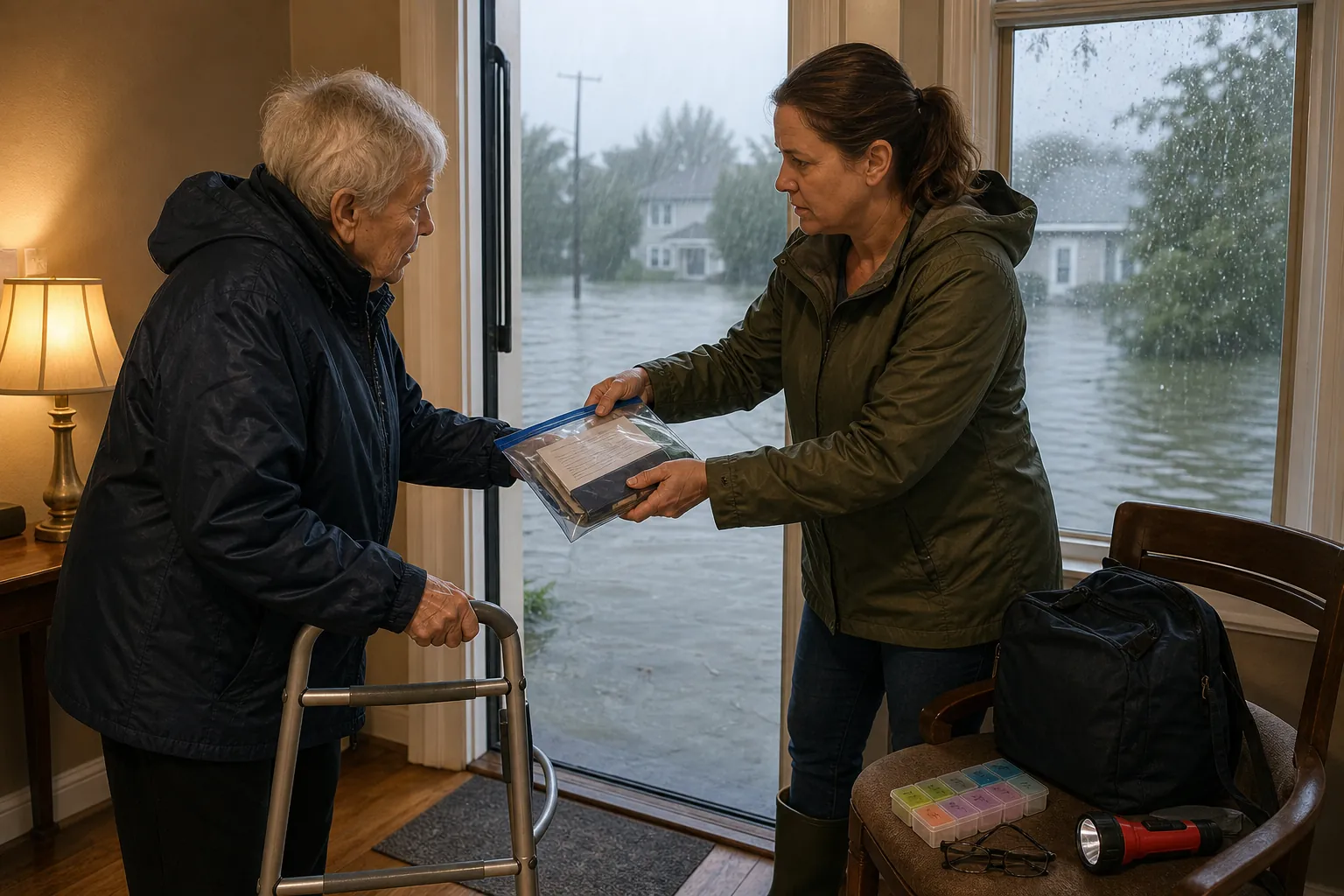
Use this checklist in order. The first question is not what to pack. The first question is whether the person can safely remain where they are for the next part of the event.
First: decide stay-or-go before staging the bag
If a local official orders evacuation for the address, the decision is made. Leave while the exit path still works. Do not wait for visible water at the doorstep; by then, the useful moving window may already be closing.
| If this is true | What to do now |
|---|---|
| The home is in an evacuation zone under an active order | Leave according to local emergency instructions. Call 911 only for immediate danger, not for routine transport questions. |
| The older adult is in a mobile home, RV, or manufactured home | Treat evacuation seriously and early; these housing types are specifically included in older-adult disaster guidance as situations that can force leaving.[3] |
| The person lives in a high-rise or depends on an elevator | Account for power loss before it happens. If the elevator stops, a walker, wheelchair, or oxygen setup may become trapped above ground level.[3] |
| The person uses electric medical equipment or refrigerated medication | Make the power plan part of the stay-or-go call. If backup power, cooling, or transport is uncertain, contact the clinician, pharmacist, utility medical-needs program, or local emergency management as appropriate. |
| The person uses a walker, wheelchair, scooter, rollator, or needs another person to leave | Favor leaving earlier, not later, when local orders or conditions point that way. A slow exit is still an exit only while the path is dry, lit, and passable.[3] |
| There is no evacuation order, but water is rising nearby or roads are closing | Follow local emergency updates and stage for either immediate departure or sheltering in the safest available place. Do not self-route through water. |
Shelter is not a generic answer. Special-needs shelters, evacuation-assistance registries, paratransit options, pet rules, and medical support vary by county or city. First Contact’s older-adult disaster guidance includes evacuation zones, high-rise elevator dependence, electric medical devices, mobility limitations, and special-needs shelter registration among the criteria caregivers should consider, but the actual shelter and assistance system is local.[3]
If the person cannot leave without help, call the local emergency management contact, registry number, non-emergency public safety line, building manager, or designated family helper early. A spouse who cannot lift a wheelchair alone should not discover that at the bottom of a dark stairwell.
Then stage only what must move with the person
Once the stay-or-go branch is clear, stage the items that protect medication access, identity, communication, and mobility. This is not the time to reorganize the whole emergency kit. It is the time to put the irreplaceable or hard-to-replace things within reach of the door or beside the person.
- Put shoes on the person, not beside the bag. Wet socks, loose slippers, and bare feet turn a manageable hallway into a fall hazard.
- Put glasses, hearing aids, dentures, and primary mobility aids on or with the person. If the older adult cannot see, hear, chew, stand, or transfer safely, the rest of the bag matters less.
- Gather current medications, the medication list, pharmacy contact, prescriber contact, and any dosing instructions. The Red Cross recommends that older adults keep at least a 30-day supply of medications and medical supplies for emergencies.[4] Other preparedness sources sometimes use shorter benchmarks, so treat supply as a planning conversation with the pharmacist or clinician, not as a reason to delay leaving during an active warning.
- Place IDs, insurance cards, medication lists, emergency contacts, advance directives if used, and key medical documents in a waterproof container. The Red Cross also recommends digital copies.[4]
- Pack the phone, charger, backup battery if available, hearing-aid batteries, flashlight, and a battery radio if one is already in the home.
- Attach a small waterproof pouch to the walker, wheelchair, scooter, or rollator when that is practical. Washington State Department of Health disaster tips for people with mobility disabilities recommend keeping an emergency kit attached to mobility equipment and storing backup mobility aids in secured locations.[5]
- If time and safety allow before leaving, take quick photos or video of the home and important rooms. Older-adult disaster guidance includes photographing the home before evacuation, but this is never more important than getting out safely.[3]
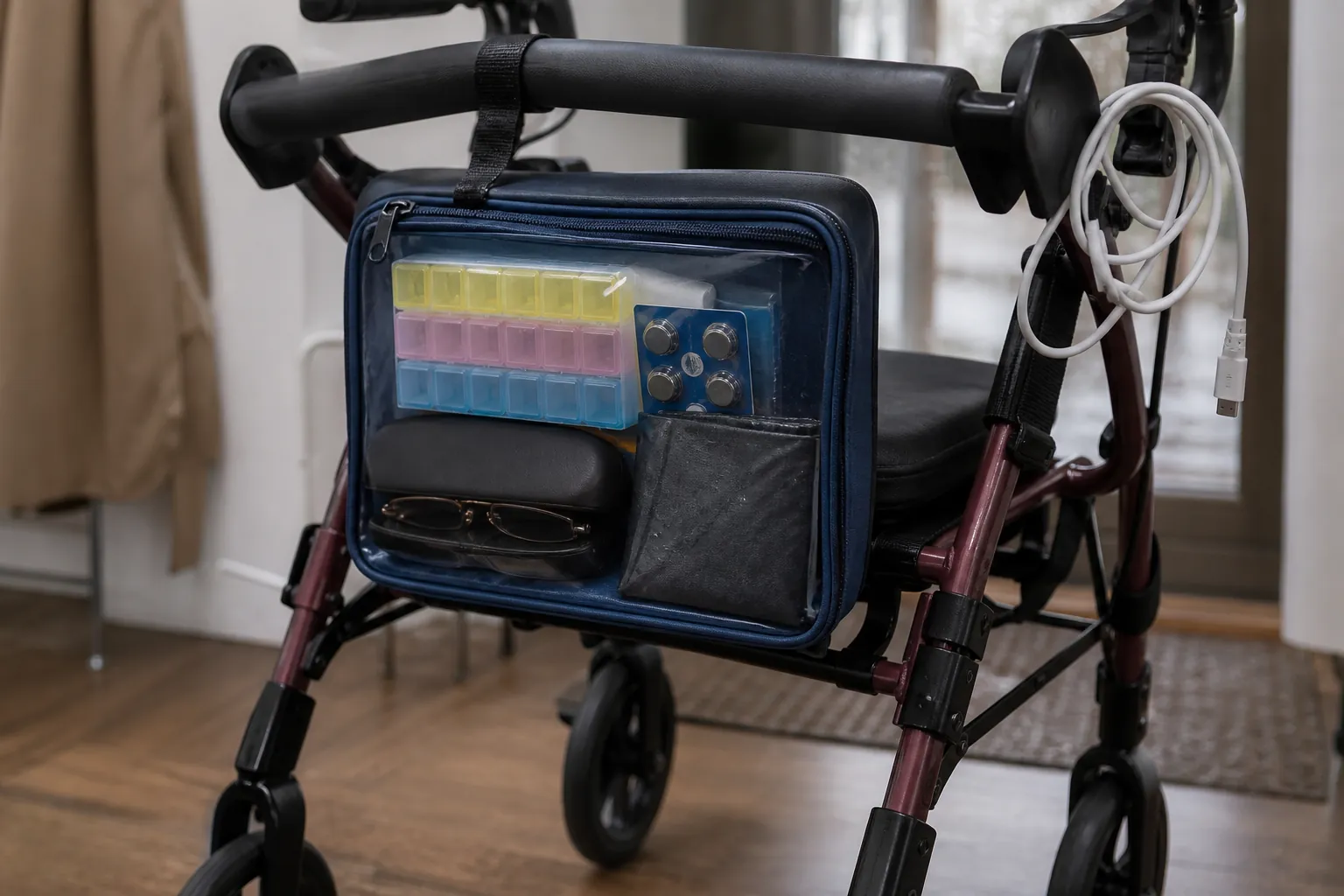
The mobility item is not a courtesy item. It is the person’s way out. If there is a second cane, folded walker, wheelchair cushion, transfer belt, spare glasses, or charged scooter battery, bring it if doing so does not slow departure. The Red Cross specifically names extra canes, glasses, and hearing-aid batteries in older-adult emergency preparedness guidance.[4]
For the exit path, remove throw rugs, shoes, pet bowls, cords, and boxes from the route between the person and the door. Turn on lights while there is power. Keep a flashlight in the hand of the helper, not buried under paperwork. If the household already has a power-loss fall plan, use it now; the same dark-hallway issues covered in power-outage fall-proofing become urgent during a flood warning.
Do not let “just give me five minutes” become the household plan. Five minutes can disappear into a missing wallet, a bathroom stop, a dead phone, or a walker folded behind a chair. If the person needs toileting, a coat, or a transfer, assign one helper to the person and one helper to the bag when possible.
Make water the hard stop
Floodwater is not a puddle to test. Ready.gov warns that six inches of moving water can knock a person down, and one foot of moving water can sweep a vehicle away. Its instruction is direct: never walk, swim, or drive through floodwater — “Turn Around, Don’t Drown.”[6]
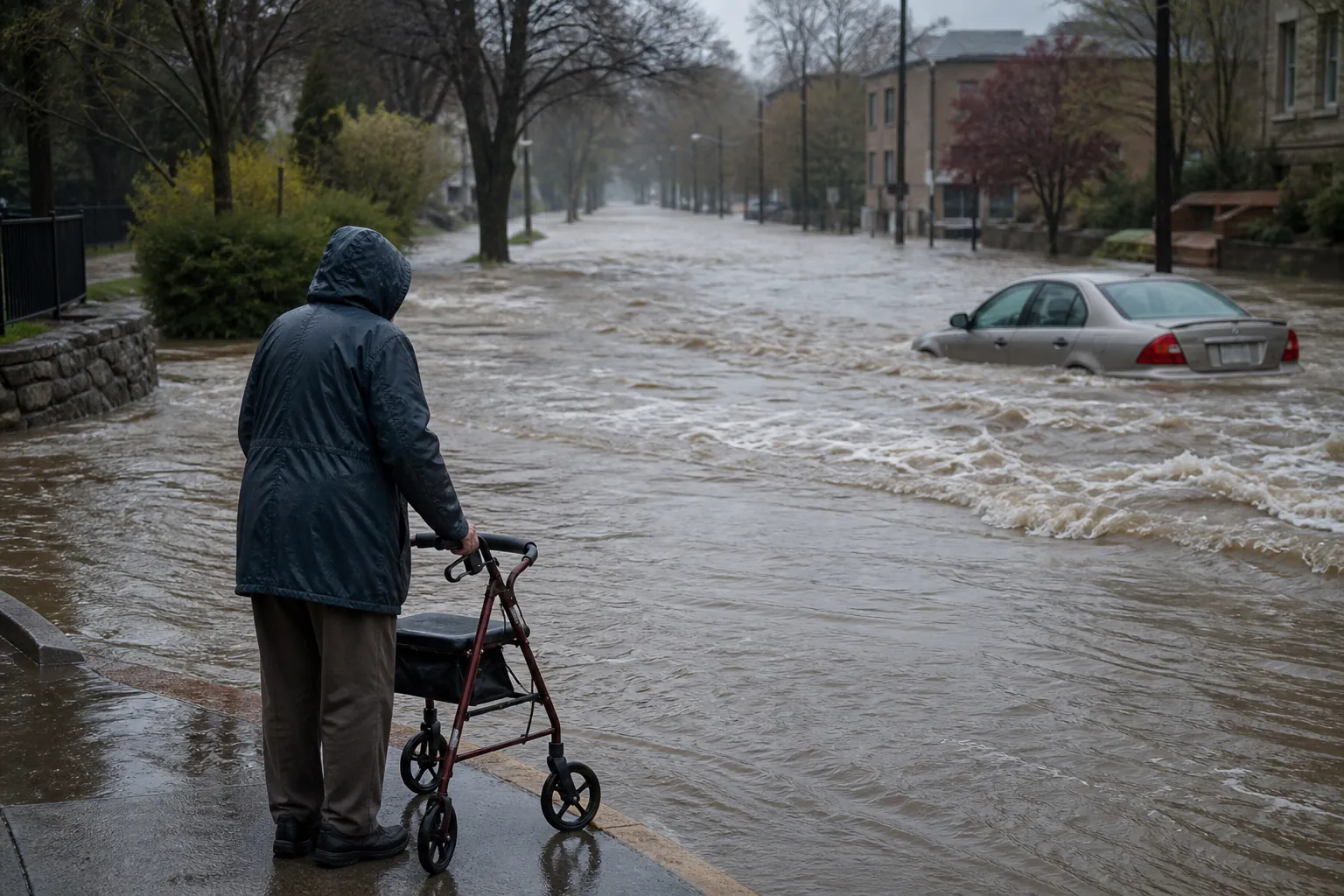
This rule is even stricter for someone using a walker, cane, wheelchair, scooter, prosthesis, or weak ankle. Moving water can take the support device first and the person second. Muddy water also hides curbs, storm drains, broken pavement, uneven steps, and debris.
- Do not wade across a driveway, parking lot, lobby entrance, or street because it looks shallow.
- Do not drive around barricades or through water covering the road.
- Do not ask an older adult to “hold on tight” while a helper pulls a walker through moving water.
- Do not move through a dark, wet stairwell unless local emergency instructions or immediate danger leave no safer alternative.
If floodwater is already between the person and the exit, stop and seek local emergency instructions. A caregiver across town should not tell a parent to cross water because the route looked safe an hour ago.
If staying in place for now, stage as if you may still have to move
Sometimes local authorities have not ordered evacuation, roads are already unsafe, or the safest available choice is to remain inside and follow local instructions. That is not a reason to unpack. Keep the person, mobility aid, medications, documents, phone, charger, flashlight, shoes, and water within the same reachable zone.
Keep the path to the bathroom and exit clear. Wet tile, loose rugs, low light, and hurried transfers are fall conditions. If a fall happens during a flood warning, the household now has two emergencies instead of one; the basics in the fall-prevention FAQ are worth knowing before the next alert.
Power loss changes medication, mobility, and heat risk. If the older adult uses refrigerated medication, powered oxygen equipment, a lift chair, an adjustable bed, a stair lift, or a charged mobility device, use the household’s power-grid plan immediately. Related planning is covered in power-grid emergency orders for older adults and heat-wave and power-loss medication planning.
Do not drink, cook with, or clean medical equipment with questionable water after flooding or a water-system alert. If a boil-water notice follows, switch to the instructions in a boil-water advisory checklist for elderly parents rather than guessing.
Keep communication local and redundant
During the warning, one person should monitor official local updates: emergency management, local government, NWS alerts, public safety messages, and building management if the older adult lives in an apartment, senior community, assisted-living building, or high-rise.
Ready.gov’s guidance for people with disabilities recommends signing up for local emergency alerts, knowing whether the community has evacuation-assistance registries, and having a NOAA Weather Radio or battery-powered radio in case phone or internet service fails.[7] Those are not tasks to start in the middle of water rising at the curb if they can be done earlier.
For a caregiver calling from across town, the check-in script should be concrete: “Are your shoes on? Is the walker next to you? Is your phone charging? Are your medications and documents in the waterproof pouch? Is there any water between you and the door?” A calm voice is useful. Vague reassurance is not.
Before the next warning, fix the parts that slowed you down
After this warning has passed and the household is safe, revise the plan while the weak spots are still obvious. The Red Cross recommends reviewing older-adult emergency plans and supplies every six months.[4] That review should include medication supply logistics, waterproof document storage, batteries, alert sign-ups, evacuation contacts, mobility-device backup, and who physically helps the older adult leave.
If evacuation involves stairs, narrow doors, vans, ramps, gangways, or assigned helpers, practice the movement before weather forces the issue. The same practical questions that apply when evacuating with mobility aids apply at home: who carries what, who steadies the person, which path is usable, and what happens when the usual route is blocked.
A flood warning does not ask whether the household is generally prepared. It asks whether the person can move safely now, with their medications, papers, communication tools, and mobility support still under control.
References
- Flood Warning VS. Watch, National Weather Service.
- Texas Flood Victims, AARP.
- Disaster Preparedness for Older Adults & Caregivers, First Contact.
- Older Adults Emergency Preparedness, American Red Cross.
- Mobility Disabilities: Disaster Tips, Washington State Department of Health.
- Floods, Ready.gov.
- People with Disabilities, Ready.gov.
Related reading
Noticed something outdated or inaccurate on this page? Flag a correction. We review every report against CDC, NIA, and AARP HomeFit guidance before updating a page.
Part of the Fall Prevention section.