
STEADI: Intervene
How to Prevent Tick Bites and Falls in Older Adults
Tickborne disease is a neglected, preventable fall-risk factor for older adults: Lyme and other tick infections can cause dizziness, fatigue, joint pain, and fainting. This guide lays out the before/during/after prevention routine — treated clothing, EPA-registered repellent, heat-drying clothes, showering, full-body checks, and removing ticks within 24 hours — and lists the symptoms that warrant a call to a provider.
Last verified: August 25, 2026. This guide is educational and is not a substitute for medical advice from a clinician who knows the older adult’s health history.
To understand how to prevent tick bites in older adults, start with the place many people least want to give up: the yard. In April 2026, CDC reported that weekly emergency department visit rates for tick bites were higher than usual — the highest for that time of year since 2017 in all U.S. regions except South Central. CDC also estimates that 31 million Americans are bitten by ticks each year and that about 476,000 people are treated for Lyme disease annually. [1]
Those numbers would matter on any health site. They matter here because tickborne illness can quietly interfere with the same things a fall-prevention plan tries to protect: steadiness, stamina, walking confidence, and the ability to notice when something feels off. A CDC analysis of Medicare data found that 88,485 adults age 65 and older were diagnosed and treated for Lyme disease during 2016–2019 — roughly seven times higher than official surveillance counts — and 57.8% of those diagnoses occurred from May through August. In high-incidence states, the median incidence was 346.9 per 100,000 Medicare beneficiaries. [2]

This is not a claim that CDC has proven a direct tick-bite-to-fall pathway. The fall-prevention connection is a practical synthesis: CDC identifies difficulty with walking and balance as modifiable fall-risk factors, and some tickborne illnesses can produce symptoms that make an older adult less steady or more likely to sit, stand, or walk unsafely. [3] Lyme carditis is the clearest warning sign in this context because CDC has described symptoms including lightheadedness, chest pain, palpitations, and fainting, and has reported that Lyme carditis is disproportionately more common among people age 75 and older. [4]
The exposure is often close to home
Tick prevention can sound like advice for hikers, campers, or people walking through deep woods. For many older adults, the more realistic exposure is a tomato bed, a shaded fence line, a dog route, or the chair at the edge of the lawn. CDC says tick exposure can happen year-round, ticks are most active during April through September, and many people get ticks in their own yard or neighborhood. [5]
That matters for caregivers because ordinary routines are easier to protect than they are to ban. If an older parent gardens every morning because it keeps them moving and calm, “stay inside” is not a plan. The better plan is to make the same outdoor habit safer before they go out, while they are outside, and as soon as they come back in.
A 2024 Emerging Infectious Diseases study from Ontario also shows how prevention can fail in real life. Among Lyme disease case-patients, only 25.5% reported using insect repellent and 32.3% reported checking for ticks; exposure around a primary or secondary residence was a dominant location pattern. [6] The lesson is not that people are careless. It is that yard exposure feels too familiar to trigger a safety routine.
A before, during, and after routine that fits an older adult’s day
The prevention routine works best when it is treated like putting on supportive shoes or checking the weather before a walk. It should happen in order, with the highest-friction step — the tick check after coming indoors — planned before the person is tired.
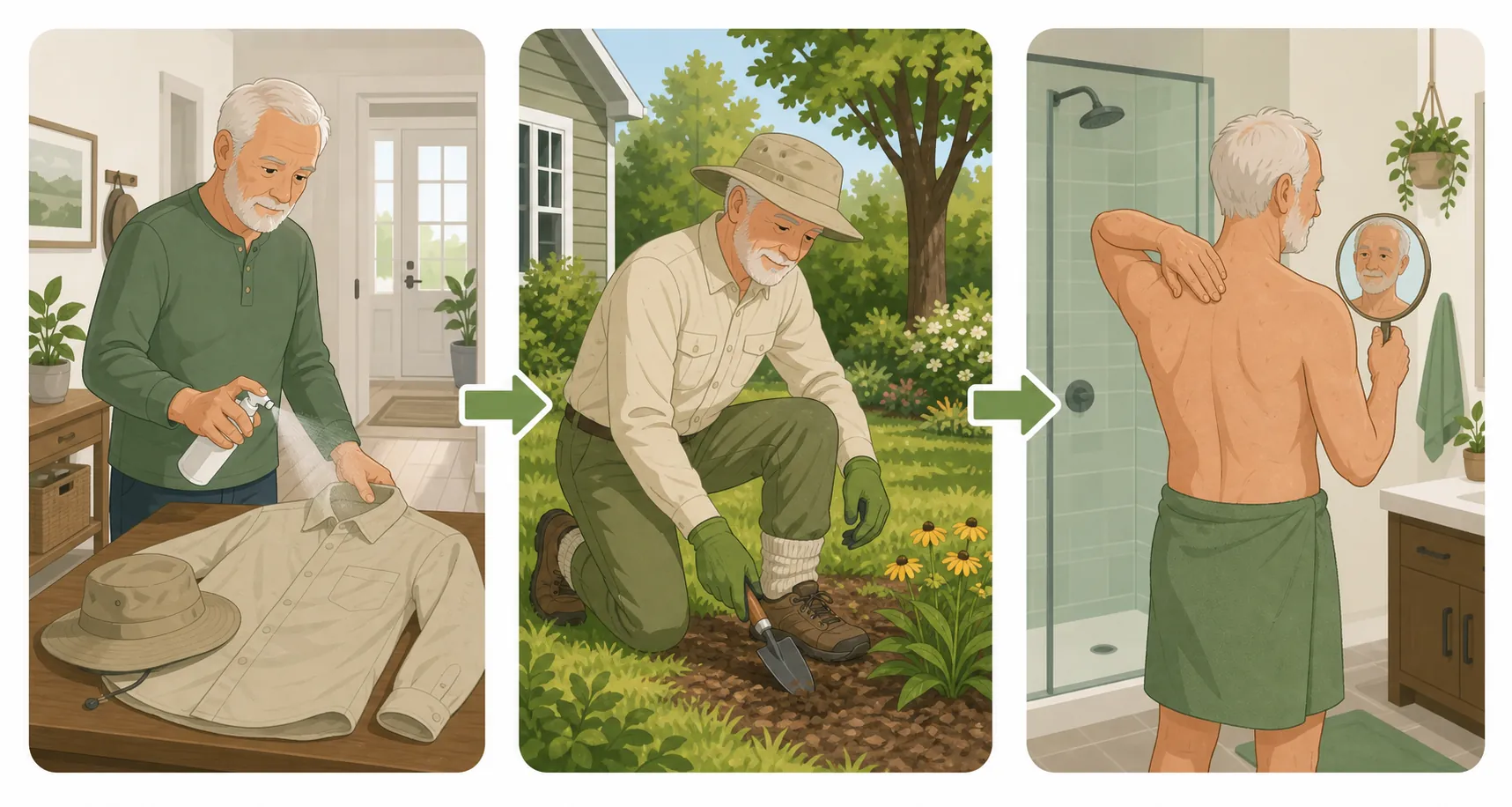
| When | What to do | Why it matters |
|---|---|---|
| Before going outside | Wear protective clothing; use 0.5% permethrin-treated clothing or gear; apply an EPA-registered repellent according to the label. [5] | Reduces the chance that a tick reaches skin during yard work, gardening, or pet walking. |
| While outside | Stay alert in grass, brush, leaf litter, fence lines, and shaded edges of the yard. [5] | Most people notice prevention advice at the trailhead, but many older adults are exposed at home. |
| After coming inside | Tumble-dry clothes on high heat for 10 minutes, shower within two hours, do a full-body tick check with a mirror, and remove attached ticks promptly. [5] | This is the step most likely to be skipped when the person comes in tired. |
Before: make the clothing do some of the work
For an older adult who gardens, walks a dog, or sits near shrubs, the best clothing is not complicated: long sleeves, long pants, socks, and shoes that are stable enough for uneven ground. Light-colored clothing can make ticks easier to see before they reach skin. Tucking pant legs into socks is not stylish, but it does close one of the easiest routes from grass to ankle to knee.
CDC recommends using products containing 0.5% permethrin to treat boots, clothing, and camping gear, and notes that some permethrin-treated clothing and gear may remain protective through several washings. CDC also recommends EPA-registered insect repellents and tells users to follow product instructions. [5] Harvard’s Lyme Wellness Initiative notes that 0.5% permethrin sprayed at home may last about six weeks or six washes, and it gives a clear safety boundary: permethrin is for clothing and gear, not skin. [7]
This is where caregivers can quietly lower the workload. A “yard outfit” can live near the back door: treated pants, treated socks, a long-sleeved shirt, gardening gloves, a hat, and shoes with enough grip for damp grass. The goal is not to dress someone for a wilderness expedition. It is to remove decision-making from a Tuesday morning when the person only plans to pull weeds for 20 minutes.
Repellent: choose an EPA-registered product and follow the label
Repellent does not need to become a chemistry debate at the kitchen table. The useful rule is simpler: use an EPA-registered product, apply it as directed, and do not assume yesterday’s application is still protecting today’s ankles and wrists. CDC’s tick-prevention guidance points readers to EPA-registered repellents and emphasizes following label directions. [5]
For older adults with sensitive skin, respiratory issues, memory problems, or medication-related dizziness, repellent should be part of a calm pre-outdoor routine, not something sprayed in a hurry while standing on the porch steps. Apply it where the label allows, let the person sit if balance is uncertain, and wash hands afterward so repellent does not get rubbed into eyes.
During: treat the yard edge like the risky place it is
The edge of the yard deserves more respect than it usually gets. Brush piles, leaf litter, tall grass, shaded stone borders, unmown fence lines, and the place where the dog cuts through shrubs are all easy to underestimate. Staying in the center of a mowed path, using a kneeler or raised bed instead of sitting directly in grass, and keeping gloves on while clearing leaves are small choices that fit naturally into gardening.
For someone with a known fall risk, do not add tick prevention in a way that creates a new hazard. Socks pulled over pant cuffs should not bunch under shoes. A hat should not block vision on steps. A repellent bottle should not be stored where the person has to climb, reach, or bend sharply to get it. Prevention that causes stumbling has missed the point.
After: finish the routine before rest takes over
The after-outdoors routine is the part most likely to break down. People come inside hot, tired, hungry, or proud that they finished the job. They put gloves on the counter, sit down “just for a minute,” and the tick check disappears. For an older adult, that skipped step matters because symptoms that show up later may be vague enough to be blamed on age, heat, arthritis, or a poor night’s sleep.
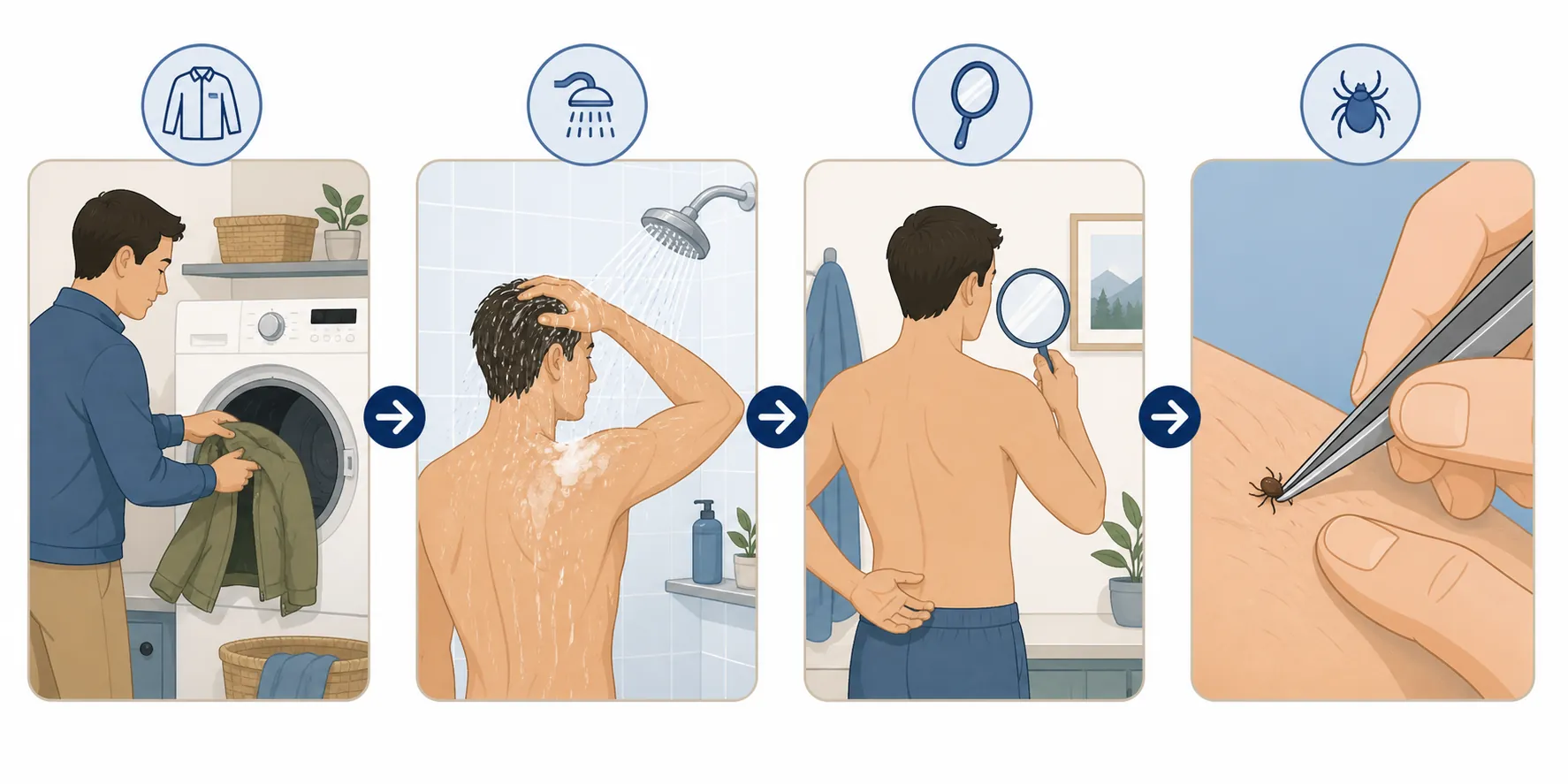
- Put outdoor clothes in the dryer first. CDC recommends tumble-drying clothes on high heat for 10 minutes to kill ticks on dry clothing; damp clothes may need more time. [5]
- Shower within two hours of coming indoors. CDC recommends showering soon after coming inside, both to wash off unattached ticks and to make a tick check more likely. [5]
- Check the whole body with a hand-held or full-length mirror. CDC specifically names under the arms, in and around the ears, inside the belly button, behind the knees, between the legs, around the waist, and in and around the hair as places to check. [5]
- Remove any attached tick promptly with fine-tipped tweezers. Johns Hopkins states that removing an attached tick within 24 hours dramatically reduces the risk of Lyme disease. [8]
For caregivers, privacy and dignity matter here. Many older adults will accept help checking a shoulder blade, scalp, or behind the knees if the task is framed like any other safety check after yard work. A mirror, bright bathroom lighting, a chair, and a small tick-removal kit make the process less awkward and less rushed.
Yard controls help, but they do not replace body checks
A safer yard does not have to become a landscaping project. CDC recommends clearing tall grasses and brush around homes and at the edge of lawns, mowing frequently, removing leaf litter, and placing a 3-foot-wide barrier of wood chips or gravel between lawns and wooded areas to restrict tick migration into recreational areas. [5]
Those steps are useful because they change the places an older adult already uses: the garden path, the dog’s route, the bench by the fence, the trash-bin walkway. They are not a reason to skip repellent or the after-outdoors check. Yard controls lower exposure; they do not prove the yard is tick-free.
Why older adults should not shrug off “just a tick bite”
Lyme disease gets most of the attention, but it is not the only reason prevention belongs in an older adult’s safety plan. CDC says older adults are at higher risk of neuroinvasive Powassan virus disease; about 10% of neuroinvasive cases are fatal, and roughly half of survivors have lasting neurologic deficits. [9] That does not mean every tick bite will lead to severe illness. It does mean the prevention routine is worth doing even when the yard feels familiar.
There is also no currently available human Lyme vaccine, so protection still depends on exposure reduction, repellent, treated clothing and gear, tick checks, and prompt removal. Harvard’s Lyme Wellness Initiative notes that the earlier human Lyme vaccine, LYMErix, was removed from the market in 2002. [7]
Symptoms that should trigger a provider call
After possible tick exposure, call a healthcare provider if an older adult develops dizziness, unusual fatigue, new or worsening joint pain, lightheadedness, chest pain, palpitations, fainting, fever, rash, facial drooping, severe headache, confusion, weakness, or other neurologic symptoms. Fainting, chest pain, or palpitations should not be treated as a normal part of aging or as “probably just the heat,” especially when there may have been a recent tick bite.
If the person has already fallen, the question changes from prevention to response. Use an urgent fall-response plan such as what to do after a parent falls on the sidewalk. For the broader pattern — illness, bites, heat, and outdoor activity quietly affecting balance — it may also help to read related hidden-risk guides on brown recluse bites and fall risk, salmonella symptoms in seniors, and hiking safety for seniors.
Tick prevention belongs beside other seasonal fall-prevention habits: ice planning, heat planning, medication review, footwear, lighting, and outdoor-route checks. The routine is small, but it has to be complete: prepare before going out, stay alert while outside, and finish the dryer-shower-check-removal sequence when coming back in.
References
- CDC data show weekly ER visits for tick bites higher than usual — CDC Newsroom, April 23, 2026.
- Lyme Disease Diagnosis and Treatment Among Medicare Beneficiaries, United States, 2016–2019 — Emerging Infectious Diseases, September 2024.
- Facts About Falls — CDC.
- Notes from the Field: Update on Lyme Carditis, Groups at High Risk, and Frequency of Associated Sudden Cardiac Death — United States — CDC MMWR, 2014.
- Preventing Tick Bites — CDC.
- Risk Factors for Lyme Disease, Ontario, Canada — Emerging Infectious Diseases, October 2024.
- Preventing Tick Bites — Harvard Lyme Wellness Initiative.
- 5 Tips for Preventing Tick Bites and Lyme Disease — Johns Hopkins Lyme Disease Research Center.
- Clinical Signs and Symptoms of Powassan Virus Disease — CDC.
Related reading
Noticed something outdated or inaccurate on this page? Flag a correction. We review every report against CDC, NIA, and AARP HomeFit guidance before updating a page.
Part of the Fall Prevention section.