
STEADI: Intervene
Your Parent's Power Is Out — What to Check First
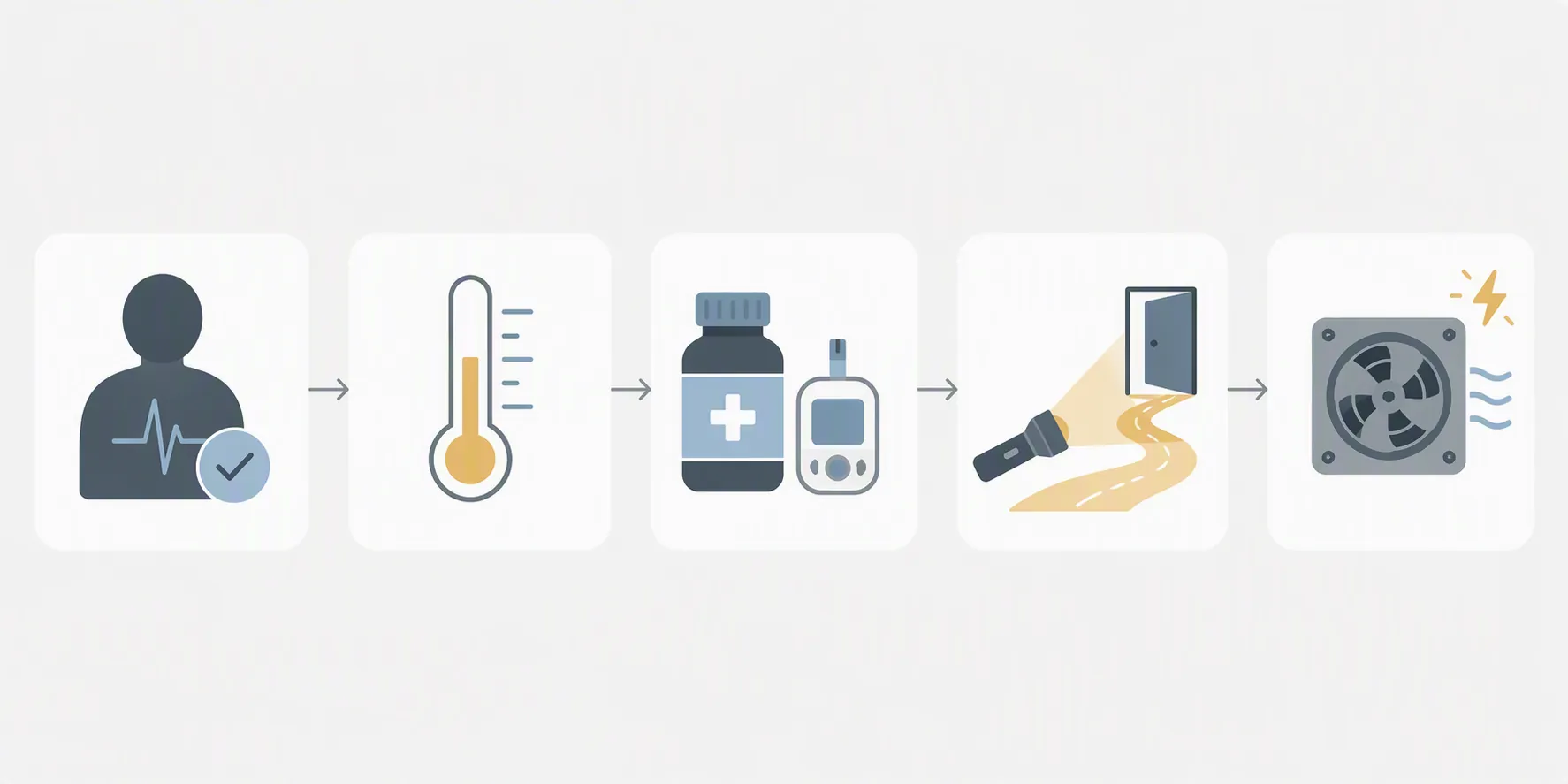
When a parent's power is already out, work through five checks in order: responsiveness and injury, indoor temperature, life-sustaining devices and refrigerated medication, a lit path to the bathroom, and carbon monoxide risk. Concrete temperature and medication thresholds show when a senior can safely stay home and when relocation or 911 is the right call.
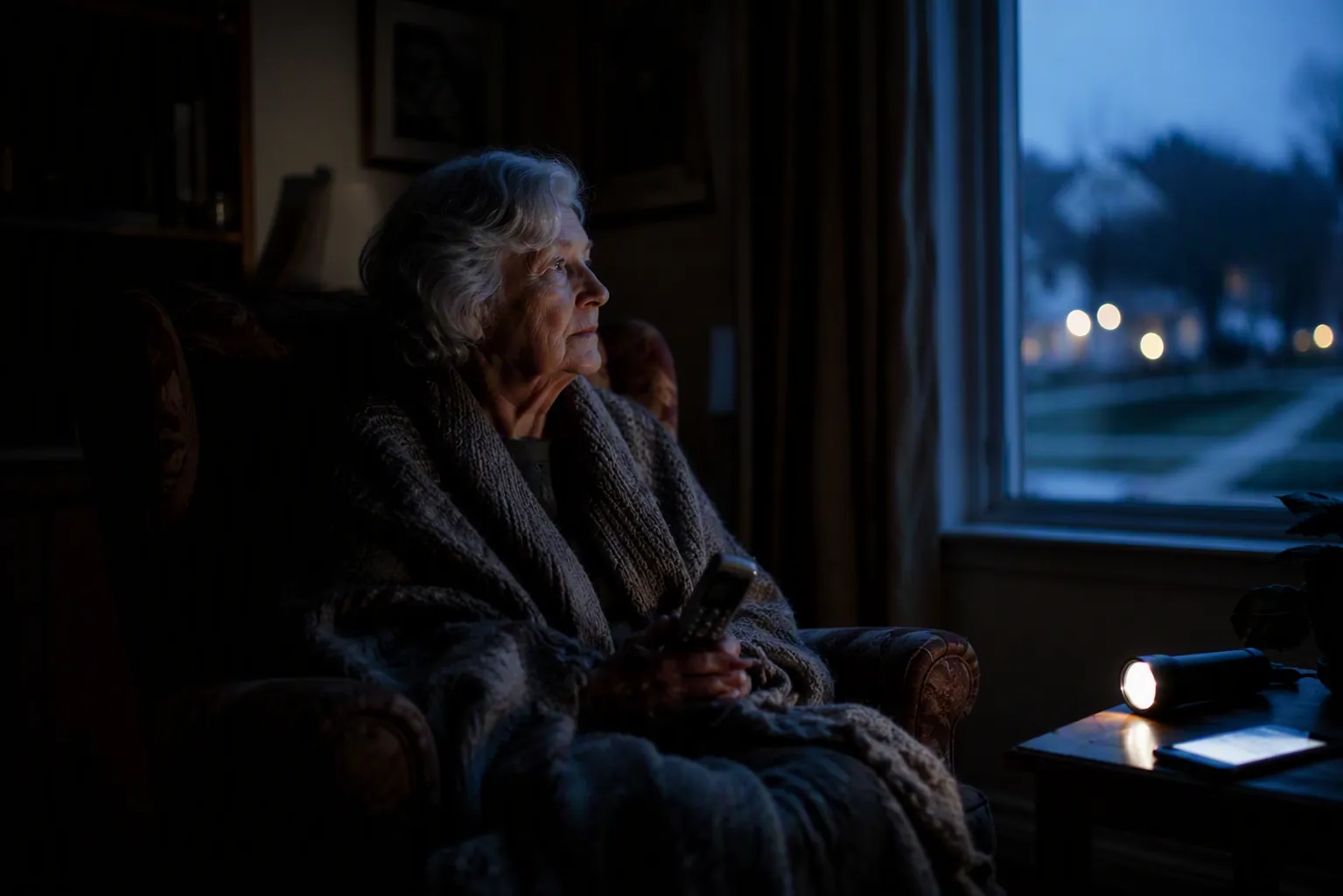
If your parent’s power is already out, the first question is not how big the outage is. The first question is whether the person in that dark house is safe enough to keep waiting. Older adults are not just inconvenienced by long outages: a PLOS Medicine study found that outages lasting more than 8 hours were associated with increased emergency hospitalizations for cardiovascular and respiratory disease among adults 65 and older, with an estimated 4,246 excess hospitalizations in 2018. [1]
This is not a diagnosis. If your parent has severe symptoms, has fallen and may be badly injured, cannot breathe normally, is confused in a new way, or you cannot confirm they are safe, call 911 first and keep working the details while help is on the way.
Start with the person on the phone
Get live contact if you can. Ask your parent to say where they are, whether they are sitting or standing, whether they have fallen, whether anything hurts, and whether they feel too hot, too cold, dizzy, short of breath, weak, nauseated, or confused. Listen to the voice. Slurred speech, unusual sleepiness, panic, breathlessness, or answers that do not make sense matter more than a reassuring “I’m fine.”
If they do not answer, try one more direct route: a neighbor, building staff, nearby relative, or local emergency dispatch for a welfare check. Do not spend an hour refreshing an outage map while an older adult may be on the floor, overheating, getting cold, or losing power to medical equipment.
| Check in this order | What you need to know | What changes the decision |
|---|---|---|
| 1. Responsiveness and injury | Are they awake, coherent, breathing normally, and uninjured? | New confusion, serious injury, chest pain, severe shortness of breath, or possible head/neck injury points to 911. |
| 2. Indoor temperature | Is the home becoming dangerously hot or cold? | Heat-stroke signs, hypothermia signs, or no safe way to warm/cool the room points to 911 or relocation. |
| 3. Medical devices and refrigerated medication | Does anything they depend on need power or cold storage? | No backup for life-sustaining equipment, unsafe oxygen situation, or uncertain medication storage may require relocation, prescriber/pharmacist help, or 911. |
| 4. Bed-to-bathroom lighting | Can they reach the bathroom without walking in darkness? | No safe lit route means they should stop improvising and wait for help, use safer nearby options if already set up, or relocate. |
| 5. Carbon monoxide risk | Is anyone using a generator, grill, camp stove, or car near the home? | CO symptoms or unsafe generator placement means leave the area and call 911 for severe symptoms. |
Responsiveness and injury: make the 911 decision early
Ask your parent to stay seated while you assess. A power outage is exactly when someone tries to “just check the breaker,” walks without a light, trips over a rug, and then feels embarrassed enough to minimize it. If they are on the floor, do not coach them to get up before you know whether they hit their head, hurt their neck or back, have hip pain, or feel faint.
Call 911 now if they have chest pain, severe shortness of breath, one-sided weakness, a possible stroke symptom, severe bleeding, a possible head or neck injury, a suspected broken hip, repeated fainting, or new confusion. If you are not in the home and cannot tell whether they are safe, treat that uncertainty as part of the risk.
If another person is present, have that person use a flashlight, not a candle, to look for obvious hazards and injuries. Keep your parent warm and still after a fall while emergency help is being arranged, especially if head, neck, back, or hip injury is possible.
Temperature is the stay-or-go check
Ask for the actual indoor temperature if there is a battery-powered thermostat, indoor thermometer, or medical device display that still works. If there is no number, ask about the body signs: shivering, sweating, clammy skin, dizziness, headache, nausea, sleepiness, confusion, and whether their speech sounds normal.
If the home is getting cold
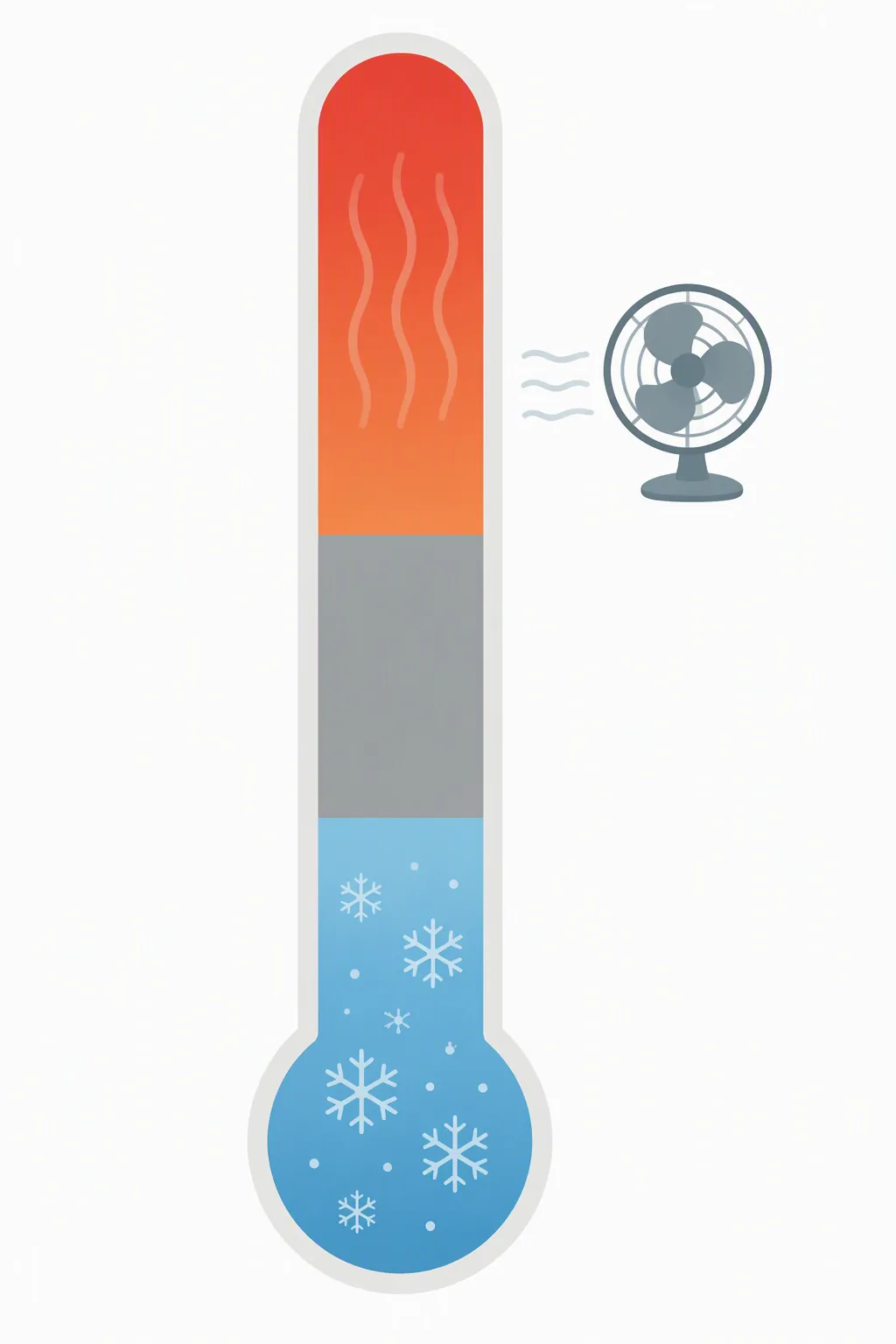
Hypothermia is a medical emergency when core body temperature drops below 95°F. Warning signs include shivering, confusion, slurred speech, and drowsiness. [2] You will usually not know your parent’s core temperature from a phone call, so do not wait for a thermometer reading if the symptoms are there.
- If they are confused, slurring speech, very drowsy, or hard to keep awake in a cold home, call 911.
- If they are shivering, cannot get warm, live alone, or cannot safely add layers and blankets without walking in the dark, arrange relocation before the house gets colder.
- If they use oxygen, avoid open flames and do not let “staying warm” turn into a fire or carbon monoxide problem.
If the home is getting hot
Heat stroke is a 911-level emergency. The CDC notes that heat stroke can push body temperature to 106°F or higher within 10 to 15 minutes. [3] In an older adult, new confusion, fainting, severe weakness, or inability to cool down during a hot outage should not be handled by waiting for the utility company’s next estimate.
Fans have a hard limit. The CDC says electric fans may help when indoor temperature is below 90°F, but above 90°F they can increase body temperature instead of cooling the person. [3] Adults 65 and older are at higher risk from heat because they may not adjust as well to sudden temperature changes and may have medical conditions or medications that affect heat response. [4]
- If the indoor temperature is near or above 90°F and there is no air conditioning, do not rely on a fan as the plan.
- If your parent is hot, confused, faint, vomiting, or unable to drink safely, call 911.
- If they are alert but the home is getting hotter and no cooling is available, move them to a cooling center, a neighbor’s cooled home, a friend’s home, or another safe powered location before symptoms become severe.
For a heat-specific plan after the immediate decision, use What to Do for Seniors on a Red Alert Heat Day and Keep Seniors Safe in a Heat Wave by Preventing Falls. Right now, the decision is simpler: if the room is too hot to cool safely, relocate or call 911 based on symptoms.
Medical devices and refrigerated medication need separate questions
Do not ask, “Do you have medicine?” Ask, “What in the house needs electricity or refrigeration for you to stay safe tonight?” Then slow down and separate devices from medication. They create different risks and different calls.
Powered medical equipment
Ask specifically about oxygen concentrators, ventilators, suction devices, home dialysis equipment, powered hospital beds, lift chairs, electric wheelchairs or scooters that need charging, and any monitor or pump that has a battery alarm. If a device supports breathing or another life-sustaining function and there is no working backup, the safe plan is not to wait in place.
Ready.gov and the Red Cross both advise relocating if the home is too hot or too cold or if power-dependent medical equipment cannot be used safely during the outage. [6][9] If your parent is already short of breath, has a device alarm that cannot be resolved, cannot transfer safely, or cannot be transported by family without risk, call 911.
Refrigerated medication
The medication question has three parts: what drug is refrigerated, how long it has been out of safe temperature range, and whether missing it could become dangerous before replacement is available. Call the prescriber or pharmacist as soon as you can. If the medication is life-sustaining and no replacement is immediately available, CDC guidance says to use it only until a new supply can be obtained. [5]
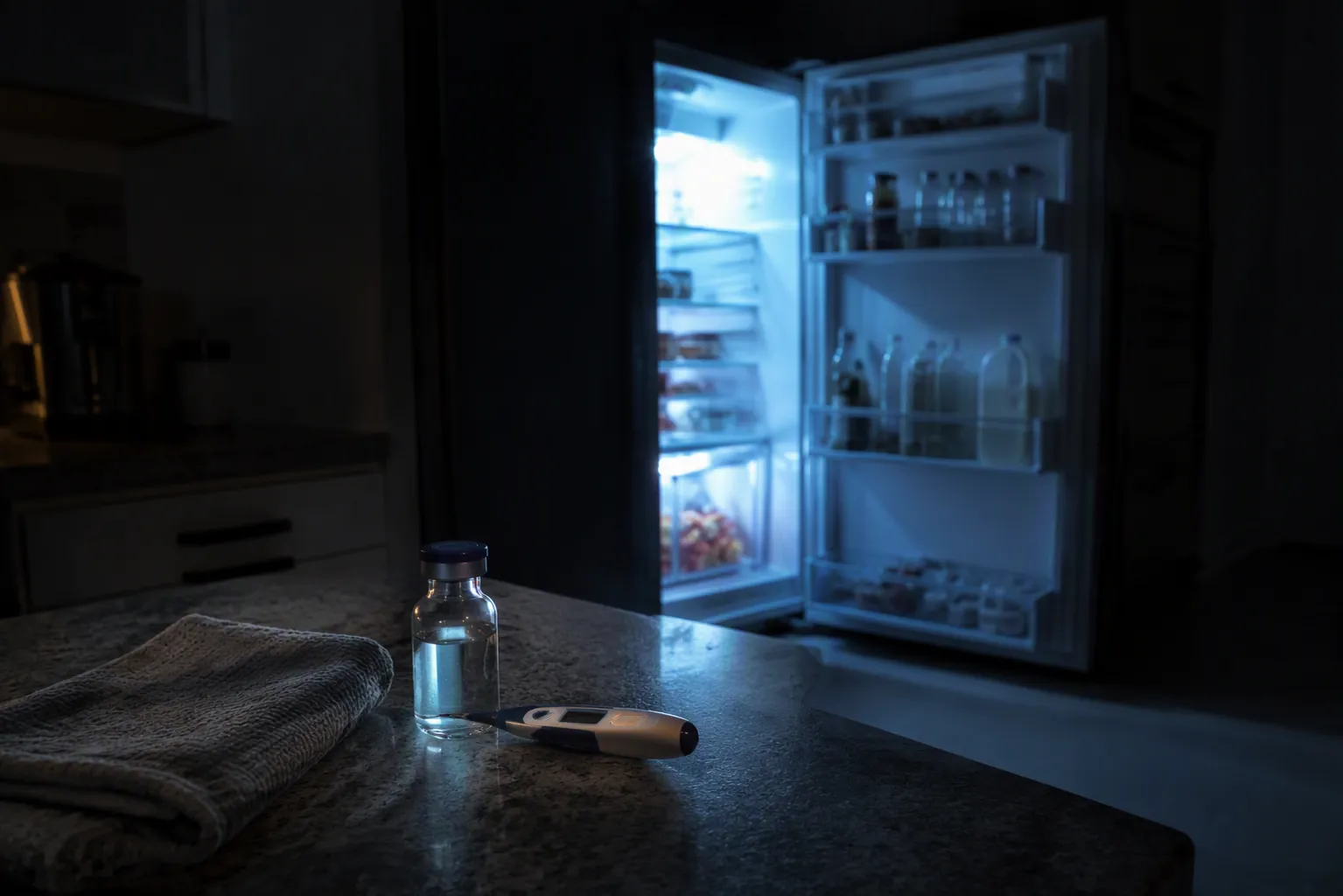
For refrigerated medicines in general, CDC and Ready.gov guidance says to discard them if the power has been out for a day or more unless the drug’s label says otherwise. [5][6] That is not permission to guess for a day; it is a discard rule. If the drug matters tonight, call the pharmacist, prescriber, on-call service, or emergency department for medication-specific instructions.
Insulin has its own emergency rule. The FDA says insulin products may be left unrefrigerated at 59°F to 86°F for up to 28 days and still work, but insulin should never be frozen. [7] The CDC gives the same 59°F to 86°F emergency storage range and 28-day limit. [8] If the home is hotter than that range, the insulin was frozen, the insulin looks abnormal, or blood glucose is not responding as expected, call the pharmacist or prescriber urgently; if severe symptoms are present, call 911.
Do not overtrust the refrigerator. Major emergency sources commonly say a closed refrigerator keeps food cold for about 4 hours during a power outage, while Marin HHS gives a shorter 2- to 3-hour window in its outage guidance. [5][6][9][10] That conflict is a reason to be conservative with medication: keep the door closed, do not open it to “just check,” and use the label, a thermometer reading if available, and a pharmacist’s advice rather than a hopeful estimate.
Make one lit route: chair or bed to bathroom
Falls do not need a dramatic setup during an outage. They need a dark hallway, urgency to use the bathroom, and a parent who does not want to bother anyone. Your immediate job is not to fall-proof the whole house. It is to stop your parent from walking an unlit route.
Have them put a flashlight or battery lantern within reach of the chair or bed, then light only the path they truly need: where their feet touch the floor, the route to the bathroom, the bathroom threshold, and the toilet area. If they cannot do that without walking in darkness, they should stay seated and wait for someone to help.
Choose flashlights over candles. Older adults are 3.5 times more likely to die in home fires, according to CPSC data cited by the National Council on Aging. [11] Lighting also has a measurable fall-prevention role: AARP cites a 2020 Innovation in Aging study in which lighting 10 times brighter was associated with 35% fewer falls. [12]
Once the immediate outage is controlled, use the deeper fall-prevention guides for the home setup: How to Fall-Proof a Senior’s Home Before a Power Outage, Power Outage Fall Prevention Checklist for Seniors, and Nighttime Fall Prevention: How to Make the Bed-to-Bathroom Route Safe for Older Adults. During the outage itself, keep the path short, lit, and non-negotiable.
Check carbon monoxide before anyone improvises power or heat
Carbon monoxide does not smell. A parent can be poisoned by a generator, grill, camp stove, or car exhaust before anyone realizes the “backup plan” is the danger. CDC and Ready.gov guidance says generators should never be used indoors and should be kept at least 20 feet from windows, doors, and vents. [5][6]
- Ask whether anyone has put a generator in a garage, basement, porch, breezeway, near a window, or near a door.
- Ask whether anyone is using a gas stove, oven, charcoal grill, camp stove, or vehicle to heat the home.
- Ask about headache, dizziness, weakness, nausea, vomiting, chest discomfort, confusion, or unusual sleepiness.
If carbon monoxide exposure is possible and symptoms are severe, call 911 and get the person into fresh air if it can be done safely. For non-severe exposure questions, Poison Control is available at 1-800-222-1222. Do not send your parent to “crack a window” near a running generator; the generator placement itself has to be fixed.
Decide: stay, relocate, or call 911
| Decision | Use it when | Next action |
|---|---|---|
| Call 911 | New confusion, severe breathing trouble, chest pain, heat-stroke signs, hypothermia signs, serious fall or possible head/neck/hip injury, severe CO symptoms, or failed life-sustaining equipment. | Keep your parent on the phone if possible. Do not move them after a serious fall unless there is immediate danger such as fire or fumes. |
| Relocate now | The home is becoming too hot or too cold, indoor heat is near or above 90°F without cooling, powered medical equipment has no safe backup, medication access cannot be maintained, or your parent cannot safely use the bathroom route. | Move them to a powered, climate-safe place: family, friend, neighbor, hotel, warming/cooling center, or shelter. Call 2-1-1 where available for local shelter information. |
| Stay with active monitoring | They are alert, uninjured, breathing normally, the indoor temperature is safe, devices have backup power or are not needed, medication is handled, the bathroom path is lit, and there is no CO risk. | Set a check-in time, keep the phone charged, keep the refrigerator closed, and repeat the temperature/device/lighting checks if the outage continues. |
If the power is still out but the immediate danger is controlled, switch from triage to outage management. Use the 72-Hour Power Outage Safety Checklist for Seniors for broader next steps during the outage, after restoration, and for next time. If the outage began with a warning or grid alert, What a Power Grid Emergency Order Means for Older Adults can help you understand the warning phase. Those are planning tools. Right now, the plan is to check the person, temperature, medical equipment and medication, lighting, and carbon monoxide risk—in that order.
References
- Power outages and hospitalizations among older adults in the United States: a case-crossover study, PLOS Medicine
- Preventing Hypothermia, Centers for Disease Control and Prevention
- About Heat and Your Health, Centers for Disease Control and Prevention
- Heat and Older Adults (Aged 65+), Centers for Disease Control and Prevention
- What to Do to Protect Yourself During a Power Outage, Centers for Disease Control and Prevention
- Power Outages, Ready.gov
- Information Regarding Insulin Storage and Switching Between Products in an Emergency, U.S. Food and Drug Administration
- Managing Insulin in an Emergency, Centers for Disease Control and Prevention
- Power Outage Safety, American Red Cross
- Managing Health Conditions & Food Safety During Power Outage, Marin Health and Human Services
- Hidden Home Hazards: Older Adults More Likely to Die from Falls and Fires, National Council on Aging
- 11 Fall-Prevention Tips, AARP
Related reading
Noticed something outdated or inaccurate on this page? Flag a correction. We review every report against CDC, NIA, and AARP HomeFit guidance before updating a page.
Part of the Fall Prevention section.