
STEADI: Intervene
Flood Watch? Here's the Senior Preparedness Checklist
A flood watch is the window to prepare before a warning is issued. This senior-specific checklist covers the readiness tasks to finish in those hours — emergency alerts, a 30-day medication supply, waterproofed documents, a staged go-bag, and a named evacuation helper.
An emergency preparedness checklist for seniors during a flood watch starts with one plain fact: a watch is preparation time. The National Weather Service uses a flood watch when conditions are favorable for flooding; a flood warning means flooding is imminent or already happening; a flash flood warning means move to higher ground immediately. [1]
That difference matters for an older adult because the slow tasks are usually the most important ones: finding the insurance card, charging the hearing-aid batteries, moving the walker near the exit, checking insulin storage, or making sure the person who promised to help evacuate actually has a key. Those jobs belong in the watch window, not after water is at the curb.
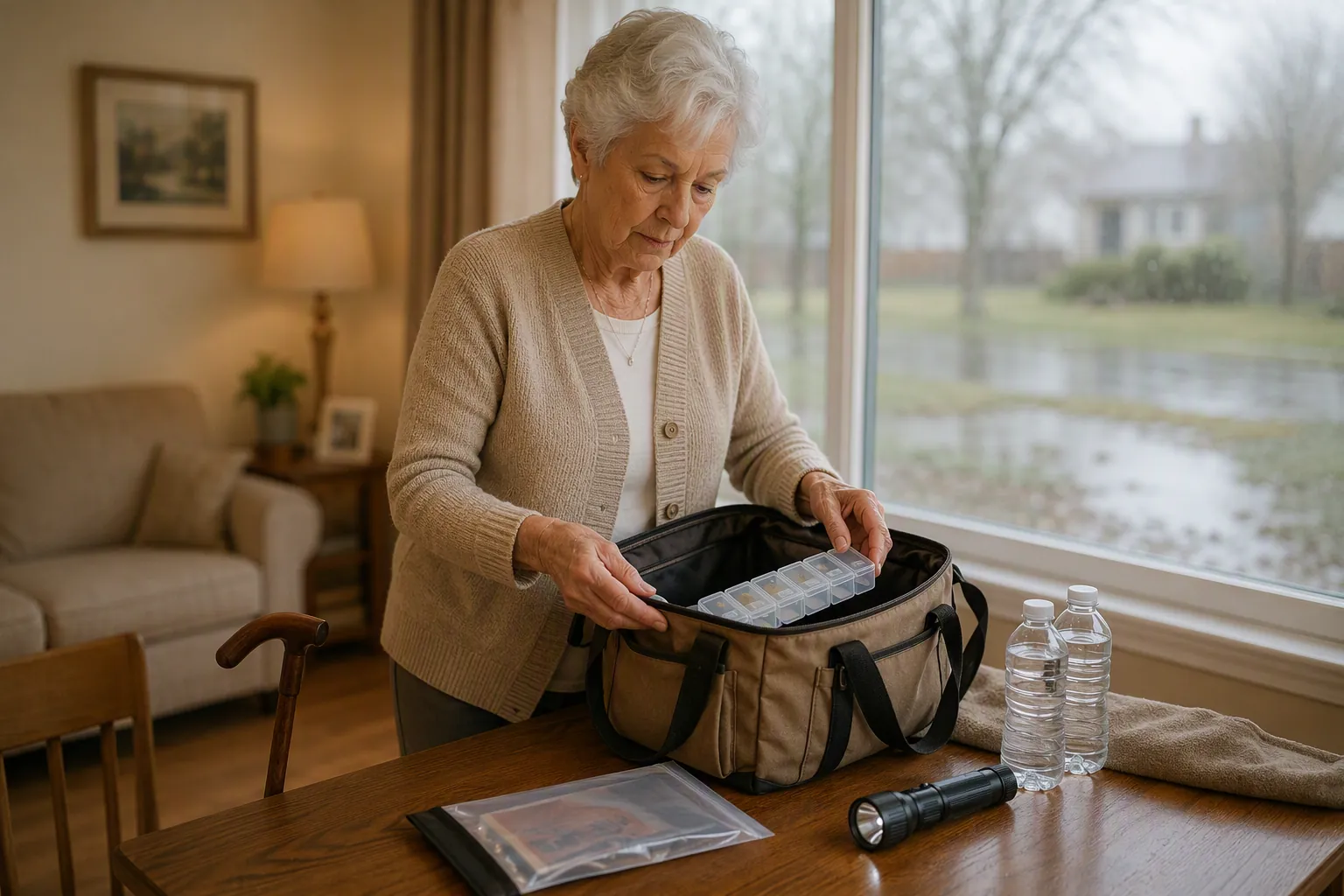
The need for a checklist is not because older adults are careless. It is because “feeling prepared” and having a complete plan are different things. In a 2023 AARP survey, roughly 60% of adults 50 and older said they felt prepared for a disaster, but fewer than 3 in 10 had a comprehensive emergency plan, and more than 1 in 3 lacked extra prescription medications. [2] A 2019 National Poll on Healthy Aging of 2,249 adults ages 50 to 80 found that less than half had signed up for community warning systems, less than a third had an emergency kit, and only about a quarter of those who relied on electric-powered health equipment had backup power. [3]
This article is educational planning guidance, not medical, legal, financial, or emergency advice. In immediate danger, call 911 and follow local officials. Medication plans, backup power for medical equipment, and evacuation decisions should be reviewed with the appropriate clinician, pharmacist, utility program, emergency manager, or a credentialed reviewer such as a geriatric nurse or occupational therapist.
The watch-window checklist
Use the watch window to remove decisions from the warning window. The point is not to pack every possible emergency item; it is to make sure that if the alert escalates, the older adult already knows who is coming, what is leaving with them, where the medicines are, and what route or shelter instruction local officials have given.
| Task | Done means |
|---|---|
| Confirm the alert level and sign up for local alerts | The older adult and at least one helper can receive warnings, not just watch TV or check the sky. |
| Name the evacuation helper | One specific person has agreed to help, has a key if needed, and knows where supplies, medicines, mobility aids, and equipment are kept. |
| Top off medications and supplies | Medications are moving toward a 30-day supply when possible, and refrigerated or temperature-sensitive medicines have a practical plan. |
| Waterproof the essential papers | Copies of Medicare, Medicaid, insurance, medication, allergy, doctor, and emergency-contact information are together and ready to take. |
| Stage the go-bag and mobility items | The bag is near the exit, and the cane, walker, glasses, hearing aids, chargers, batteries, and shoes are not scattered around the house. |
| Check water, food, light, batteries, and power needs | Basic supplies are reachable, flashlights work, devices are charged, and power-dependent needs have a backup or evacuation trigger. |
| Reduce flood and fall hazards at home | Drains, gutters, entryways, cords, rugs, and wet walking paths have been addressed as far as can be done safely during a watch. |
| Set the stop-preparing point | If a warning or flash flood warning is issued, the plan switches from gathering items to following officials, moving away from water, or evacuating. |
Start with alerts, not errands
A flood watch can feel uneventful at first. That is exactly why alert setup comes before shopping, cleaning, or trying to finish one more chore. If the older adult depends on a landline, keeps a phone in another room, sleeps without hearing aids, or does not use smartphone notifications, the warning may not reach the person who needs the extra time.
- Check the alert source: National Weather Service, local emergency management, local news, county alerts, or city notifications.
- Sign up for local emergency alerts if that has not already been done.
- Make sure at least one helper receives the same alerts, especially if the older adult may not hear a phone overnight.
- Set phones to charge before the weather worsens, and keep one charger in the go-bag if a spare is available.
- Write down the local non-emergency number and the emergency-contact chain in case the phone battery gets low or someone else needs to step in.
For a caregiver coordinating from work or another town, “I’ll keep an eye on it” is too vague. Say who is watching the alerts, who will call the older adult, who can physically get there, and what change triggers action.
Name the helper before anyone is nervous
The most useful support network is specific. Ready.gov advises older adults to build a network in which at least one person has an extra key, knows where emergency supplies are kept, and knows how to use lifesaving equipment or administer medicine if needed. [4] The American Red Cross also tells older adults to plan who will help with evacuation and to consider local registries where available. [5]
That turns “someone should check on Mom” into a plan that can actually happen:
- Angela has the spare key.
- Angela knows the weekly pill organizer is on the kitchen counter and the insulin is in the refrigerator.
- The walker is by the front door, not in the bedroom.
- If a flood warning is issued, Angela calls first, then comes if local travel is still safe and officials have not ordered people off the roads.
- If Angela cannot come, the backup person is named, not assumed.
If the household has a formal evacuation plan, pull it out now rather than rebuilding it in the middle of the storm. A more detailed evacuation planning worksheet belongs in an emergency evacuation plan checklist for elderly parents; this flood-watch checklist is the shorter version for the hours when the situation is still possible rather than happening.
Medication continuity is a watch-window job
Medication problems do not wait for dramatic flooding. They start when the pharmacy closes early, the road to the pharmacy floods, the pill bottle is nearly empty, or a caregiver realizes the medication list is out of date.
The Red Cross recommends that older adults keep at least a 30-day supply of medications and extra assistive items such as a cane or eyeglasses. [5] During a flood watch, that does not mean every prescription can magically be refilled. It means checking what is actually in the house, identifying what is low, calling the pharmacy before conditions worsen, and putting the medication list where a helper can find it.
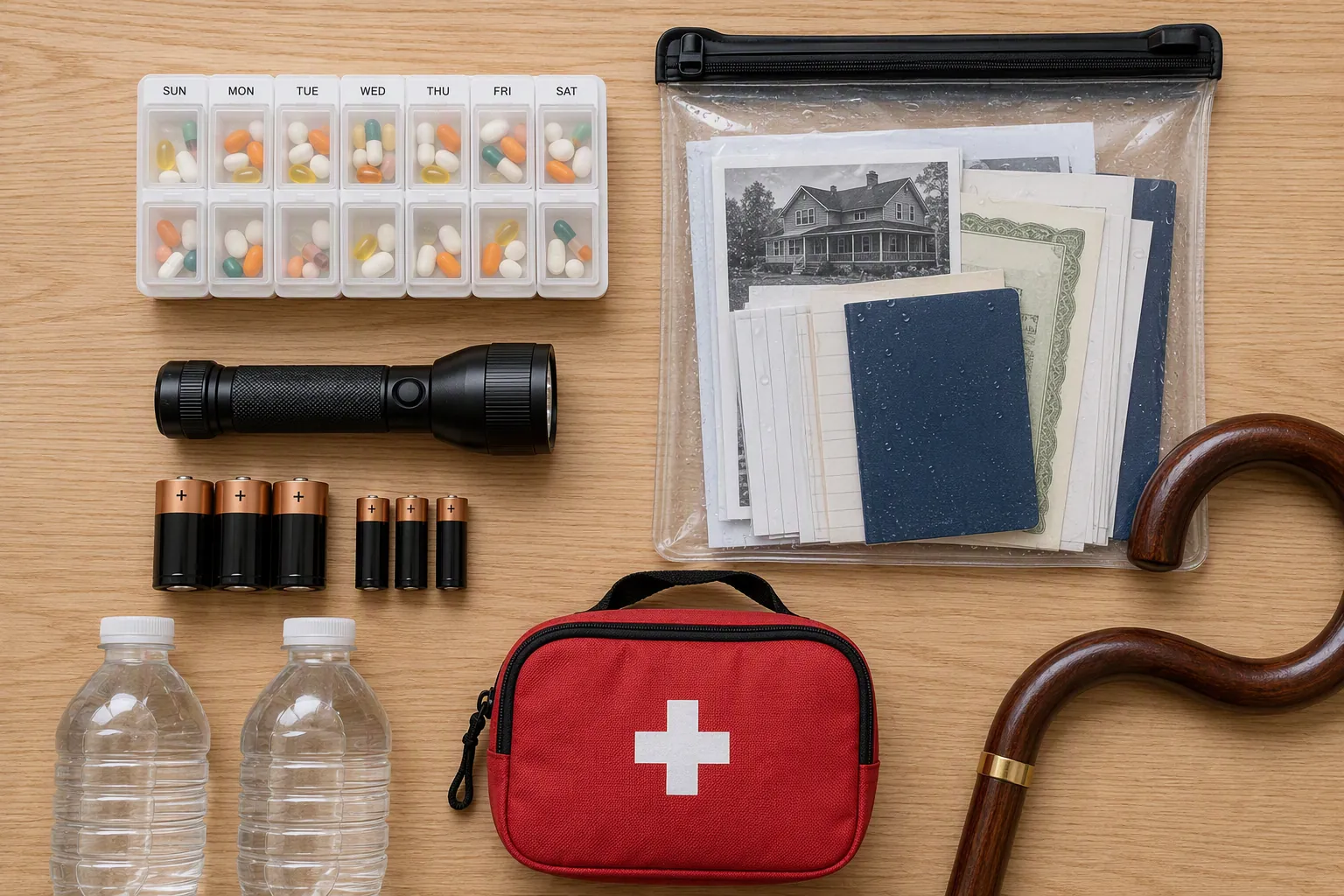
- Count prescription and over-the-counter medicines, including inhalers, eye drops, diabetes supplies, pain relievers, and wound-care items.
- Fill the weekly pill organizer if that is part of the normal routine, but keep original labeled containers available for evacuation.
- Write or print a current medication list with dose, schedule, prescribing clinician, pharmacy, allergies, and emergency contacts.
- Put the list in a waterproof pouch and save a photo of it on the older adult’s phone and the helper’s phone.
- If a medication is low, call the pharmacy now. Do not wait for the alert to become a warning.
Insulin needs special handling. CDC guidance says to keep insulin cool but never frozen because frozen insulin breaks down, and to keep it away from direct heat and sunlight. If insulin may have been stored above 86°F, the CDC advises monitoring blood sugar closely and telling shelter staff; after the emergency, insulin stored at room temperature or extreme temperatures should be discarded. The CDC also lists the storm assistance line 1-800-DIABETES, or 800-342-2382. [6]
A cooler, cold packs, a thermometer, and a written diabetes supply list are not small details for someone who uses insulin. They are the difference between leaving with a plan and arriving at a shelter needing urgent improvisation. If backup power, refrigeration, or medical-device charging is already a concern, the site’s guide on what seniors should do while waiting for power restoration can help with the power-continuity side.
Waterproof the papers that slow down care
Documents are easy to postpone because they are not heavy, wet, or blinking red on a phone. Then someone needs a medication name, insurance number, doctor’s office, or emergency contact while the older adult is tired, cold, or trying to leave.
Ready.gov advises older adults to make copies of Medicare, Medicaid, and insurance cards. [4] Ready.gov’s general kit guidance also includes important family documents among emergency supplies. [7] During a flood watch, collect the papers into one waterproof pouch or sealed bag.
- Photo ID
- Medicare, Medicaid, and insurance cards
- Medication list and allergy list
- Doctor, pharmacy, home-health agency, and emergency-contact information
- Copies of advance directives or health-care proxy documents, if the older adult uses them
- A short equipment note: walker, cane, wheelchair, oxygen, CPAP, hearing aids, glucose monitor, or other essential devices
- Pet information if evacuation plans include an animal
Paper still matters because batteries die, phones get wet, and a helper may be the person answering questions. A phone photo is useful; it should not be the only copy.
Stage the bag where the older adult can actually leave with it
A go-bag hidden in a closet is better than no bag, but it still creates a delay. Put it near the safest exit that would be used if local officials advise evacuation. If the older adult uses a cane or walker, stage the bag so it does not block the walking path or require bending over in a hurry.
- Medication list, document pouch, and copies of cards
- Current medications, when safe and practical to pack without disrupting the normal schedule
- Eyeglasses, hearing-aid batteries, dentures or denture supplies, and spare assistive items when available
- Phone charger, portable battery, and labeled charging cords
- Flashlight and batteries
- Change of clothing, socks, sturdy shoes, and a light blanket or layer
- Basic hygiene items, incontinence supplies if used, and masks or hand sanitizer if desired
- Small snacks that match the older adult’s dietary needs
Do not pack the cane, walker, or primary eyeglasses inside the bag if doing so makes the next few hours less safe. The watch-window move is to place them where the older adult can reach them and where a helper will see them immediately.
Check water, food, light, and power without turning it into a shopping marathon
CDC flood-preparation guidance says to store at least 1 gallon of water per person per day and at least a 3-day supply. [8] If that amount is already in the house, leave it accessible. If it is not, get as close as safely possible before travel conditions deteriorate.
For an older adult, access matters as much as inventory. Bottled water stacked in the garage may be useless to someone who cannot lift it, walk to it, or carry it in the rain. Move some supplies to waist height. Put a flashlight beside the bed, in the bathroom, and near the main walking route. Charge phones, medical-device batteries, power banks, and hearing aids while electricity is still on.
If the older adult uses electric-powered medical equipment, the watch window is also the time to decide what level of outage or flooding means leaving. Backup power is not just a gadget question; it is an evacuation trigger. If there is no safe way to keep essential equipment powered, the plan should shift earlier toward a location with reliable support, following local instructions.
Do the small home-hardening tasks that also prevent falls
A flood watch is not the time for risky repairs. It is the time for low-risk tasks that reduce water entry, protect walking routes, and keep the older adult from rushing over wet surfaces.
- Clear leaves from exterior drains if it can be done from safe, dry ground.
- Bring in lightweight outdoor items that could float, blow, or block a path.
- Move extension cords, loose rugs, shoes, pet bowls, and clutter away from evacuation paths.
- Put towels or absorbent mats at entries without creating a raised edge that catches a walker or cane.
- Place sturdy shoes by the bed and by the exit.
- Move valuables, documents, and backup supplies off the floor if flooding is possible.
- Keep the walker, cane, wheelchair, or rollator away from exterior doors where wind-driven rain can soak grips or wheels.
Longer-term flood mitigation is different from watch-window preparation. CDC guidance says a licensed electrician can raise electric switches and sockets at least 12 inches above the home’s projected flood elevation. [8] That is a planning note for later, not a task to start while weather is moving in.
For more detail on wet walkways, entries, and exterior fall hazards, use the home-modification guide Rainy Day Fall Prevention Starts Outside. Here, stay focused on what can be finished before the alert escalates.
Set the water rule before the water is in front of you
Floodwater turns ordinary movement into a fall risk. Ready.gov warns that 6 inches of moving water can knock a person down, and 1 foot of moving water can sweep a vehicle away. [9] The California Department of Aging’s flood tips similarly warn that 6 inches of moving water can make a person fall and advise walking only where water is not moving, using a stick to check ground firmness. [10]
The practical rule is simple: do not test moving water with an older adult’s balance, cane, walker, wheelchair, or car. If water is covering the route, the decision point has already passed. Call for help, follow local officials, and use the evacuation plan rather than trying to improvise a crossing.

If you are preparing for someone else, verify instead of assuming
Caregivers often lose time because everyone thought someone else had checked the obvious things. During a flood watch, make the calls short and concrete.
- “Do you have your phone on you, and is it charging?”
- “Where is your walker right now?”
- “How many days of your heart medicine/insulin/inhaler do you have?”
- “Is the document pouch on the table or still in the drawer?”
- “If the watch becomes a warning, who is the person coming to you?”
- “Does that person have the key?”
If the answer is vague, fix the vague part. A capable older adult preparing for themselves can use the same standard: the plan is not ready until another person could understand it without guessing.
This piece is the watch-window checklist. For flood conditions that are already underway, use the companion Elderly Flood Safety Checklist for Caregivers, which focuses on before, during, and after tasks for caregivers.
What changes when the watch becomes a warning
When a flood watch becomes a flood warning, stop treating the situation as a preparation drill. The National Weather Service defines a warning as flooding that is imminent or occurring. [1] Follow local officials, use the named helper and evacuation plan, and do not spend the warning window looking for paperwork, sorting medicines, or deciding who should come.
When a flash flood warning is issued, the National Weather Service instruction is to move to higher ground immediately. [1] If there is immediate danger, call 911. Avoid moving water, avoid flooded roads, and do not drive or walk through water to “see if it’s passable.” The work of the flood watch is that by this point, the older adult is executing a rehearsed plan, not making fresh decisions under pressure.
References
- Flood Warning VS. Watch — National Weather Service
- AARP Survey Reveals Opportunities for Older Adults to Increase Disaster Preparedness — AARP, August 30, 2023
- USA: Many older adults aren't fully prepared for emergency situations, poll finds — PreventionWeb / National Poll on Healthy Aging, 2019
- Older Adults — Ready.gov
- Emergency Preparedness for Older Adults — American Red Cross
- Managing Insulin in an Emergency — CDC Diabetes
- Build A Kit — Ready.gov
- Preparing for Floods | Floods — CDC
- Floods — Ready.gov
- Disaster Preparedness Tip Sheets for Seniors — California Department of Aging
Related reading
Noticed something outdated or inaccurate on this page? Flag a correction. We review every report against CDC, NIA, and AARP HomeFit guidance before updating a page.
Part of the Fall Prevention section.