
STEADI: Intervene
How to Build a Heat Wave Safety Plan for Elderly Parents
Because heat syncope, dehydration, and heat-sensitizing medications all raise the risk of fainting, a heat wave can turn into an older parent's fall or medical emergency. Learn how to act at each CDC HeatRisk level, run a twice-daily check-in routine, and recognize when to call 911.
Heat wave safety for elderly parents should start with the fall, not the forecast. The dangerous moment may be ordinary: getting up from a recliner, walking to the bathroom, answering the door, or taking a blood-pressure medication after a poor-fluid morning. Heat syncope is a recognized heat-related illness involving fainting or dizziness, often connected with standing too long or rising suddenly; dehydration and lack of acclimatization can contribute to it.[1] Add a medication that can lower blood pressure, deplete fluid, or cause sedation, and the heat problem becomes a fall-prevention problem very quickly.[2]
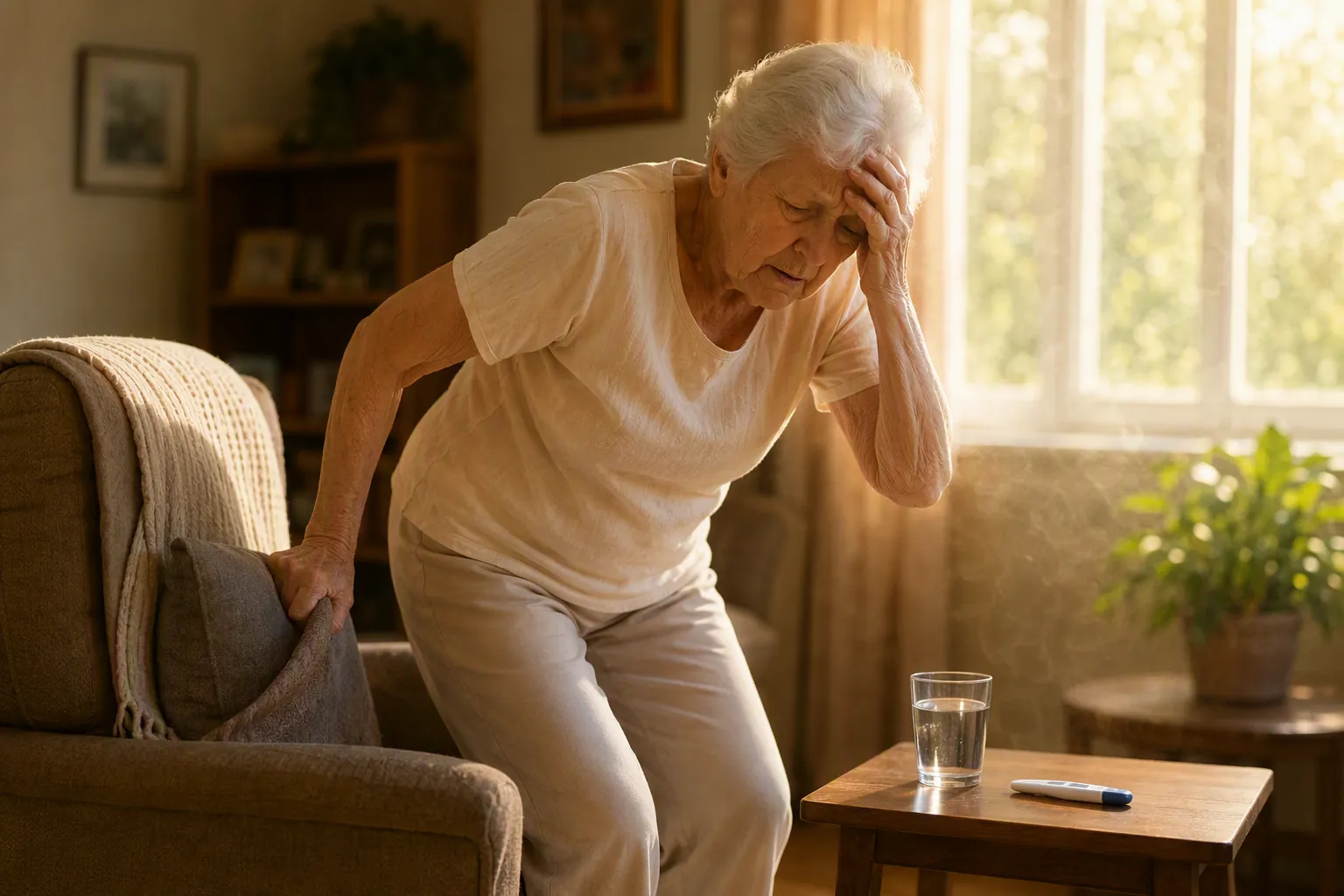
That is why “check the weather” is too thin as a plan. A caregiver needs to know whether this parent is heat-sensitive, what action starts at each CDC HeatRisk level, what gets checked twice a day, and when the situation has crossed from home monitoring into emergency care.
Why heat belongs in a fall-prevention plan
Older adults are not just uncomfortable in heat. CDC says people aged 65 and older adjust less well to sudden temperature changes, are more likely to have chronic medical conditions that affect heat response, and are more likely to take medicines that affect temperature control or sweating.[3] Those are not abstract risks when a parent already has a slow gait, uses a cane, has fallen before, or lives alone.
The mechanism matters because it tells you what to prevent. Heat can contribute to dehydration, blood-pressure drops, dizziness, faintness, confusion, and unsteadiness. CDC clinician guidance specifically names several heat-sensitizing medication classes — including diuretics, beta blockers, calcium channel blockers, ACE inhibitors and ARBs, tricyclic antidepressants, antipsychotics, opiates, and benzodiazepines — and links them to problems such as volume depletion, hypotension, and sedation “with increased risk of fainting and falls.”[2]
That does not mean heat is responsible for a known percentage of older-adult falls. The useful claim is narrower and stronger: heat creates several predictable routes into fainting or unsafe movement, and those routes can be managed before symptoms appear.
The stakes are serious enough to justify planning. A nationwide cohort study summarized by Harvard T.H. Chan School of Public Health included 73.7 million U.S. Medicare beneficiaries and found that each additional heat wave was associated with 8.83 extra deaths per 10,000 person-years among adults 65 and older, amounting to roughly 17,600 excess deaths across the contiguous United States from 2000 through 2018.[4] Mortality is not the daily operating metric for a daughter calling from work, but it is a reminder that heat is not a background inconvenience.
Build the parent’s heat risk profile before the forecast turns orange
The parent who needs the most help is not always the one who complains first. Many older adults do not feel thirsty reliably, do not want to leave home, or understate symptoms because they do not want to be fussed over. A risk profile keeps the plan from depending on persuasion in the hottest hour of the day.
| Risk factor to record | Why it changes the heat-wave plan | What the caregiver should know before the heat wave |
|---|---|---|
| Age 65+ | CDC identifies older adults as less able to adjust to sudden temperature changes and more likely to have conditions or medications that affect heat response.[3] | Age, usual activity level, and whether the parent has handled recent hot days well. |
| Chronic conditions | Heart, kidney, lung, endocrine, neurologic, and other chronic issues may change fluid needs, sweating, exertion tolerance, or blood-pressure stability. | Which clinician manages the condition, what symptoms are unusual for this parent, and whether the parent has been given heat-specific instructions. |
| Dehydration risk | Heat syncope and dizziness are more likely when fluid status is poor; dehydration is a contributor named by CDC/NIOSH for heat syncope.[1] | Usual fluid intake, barriers to drinking, bathroom fears, swallowing issues, and whether fluid limits have been prescribed. |
| Balance problems or recent falls | Dizziness that might be recoverable in a younger person can become a hip-fracture risk if the parent is already unsteady. | Last fall date, walking aid used, risky routes such as bathroom trips, and whether the parent can safely rise from bed or a chair. |
| Air conditioning access | At CDC HeatRisk orange and above, heat-sensitive people should use air conditioning or go to a cool location.[5] | Whether AC works, which room stays coolest, who can transport the parent, and which nearby cool place is acceptable. |
| Living alone | Symptoms may progress without anyone seeing confusion, fainting, or unsafe walking. | Who can check in locally, who has a key, and what time windows are most dangerous. |
| Heat-sensitizing medications | CDC clinician guidance links several medication classes to volume depletion, hypotension, sedation, impaired sweating, fainting, and falls.[2] | Medication list, dosing times, prescribing clinician, pharmacy phone number, and whether any medication needs temperature-controlled storage. |
| Refrigerated medications | CDC HeatRisk guidance notes that red and magenta levels bring power-outage concerns, including refrigerated medications.[5] | Which medications require refrigeration, backup storage options, and whom to call if power fails. |
| Medical devices and power dependence | Red and magenta HeatRisk days may include power-outage risk that affects medical devices.[5] | Device names, battery duration, charging plan, backup location, and emergency contacts. |
Medication belongs in the profile, but it is not a do-it-yourself adjustment project. Do not stop, skip, double, or change timing of a prescribed medication because a heat wave is coming unless the prescribing clinician tells you to. The useful caregiver move is to request a heat-season review, especially if the parent takes drugs tied to dehydration, low blood pressure, sedation, or fainting risk. If you need a broader structure for that conversation, use a fall-focused medication review as the companion task, not the center of the heat plan.
If dehydration has already become a pattern — dark urine, dizziness on standing, repeated “I forgot to drink,” or bathroom avoidance — treat that as a fall warning, not a nagging issue. The heat plan can sit beside a separate dehydration and senior fall-risk plan so fluids, toileting, and safe walking are handled together.
Use CDC HeatRisk as the action switch

CDC HeatRisk uses five levels, from green level 0 through magenta level 4, to show how much heat risk is expected and what protective actions are needed.[5] For an older parent, the important shift is not the exact outdoor temperature; it is when the plan changes from “keep an eye on it” to “make sure there is cooling, supervision, and a fallback if the power or AC fails.”
| CDC HeatRisk level | What the caregiver does | Fall-prevention check |
|---|---|---|
| Green / 0 | Confirm the risk profile, medication list, emergency contacts, AC status, and check-in schedule before hot weather escalates.[5] | Make sure walking routes are clear, night lights work, the phone is reachable, and the parent can get water without carrying a heavy pitcher. |
| Yellow / 1 | Start light heat precautions for a heat-sensitive parent: encourage cooler hours for errands, fluids as allowed by the clinician, and indoor rest breaks.[5] | Ask whether the parent felt dizzy when standing, skipped fluids, or avoided using a cane or walker indoors. |
| Orange / 2 | For heat-sensitive people, CDC says to use air conditioning or find a cool location; even a few hours in a cool place lowers risk.[5] | Do not rely on “I’m fine.” Verify the room is actually cool, the parent has water nearby, and bathroom trips are safe. |
| Red / 3 | Escalate to an active safety day: cool location, more frequent contact if needed, reduced exertion, and backup plans for AC or power problems.[5] | Watch for dizziness, faintness, confusion, weakness, unsteady walking, and unsafe attempts to go outside. |
| Magenta / 4 | Treat this as a rare, high-risk heat event. CDC notes red and magenta levels raise concerns such as power outages, medical devices, and refrigerated medications.[5] | Move from phone reassurance to confirmed protection: a cool place, someone laying eyes on the parent if needed, and clear emergency thresholds. |
Green and yellow are setup days
The mistake is waiting until orange to discover that the window AC is broken, the parent refuses the cooling center, or the medication list is out of date. On lower-risk days, make the plan easier to run later: put water where the parent already sits, move a chair near the coolest room, check that the bathroom route is lit and uncluttered, and confirm who can go over if the parent stops answering.
This is also the time to connect the heat plan to the parent’s larger fall-prevention action plan. Heat does not replace the usual risks; it presses on them.
Orange is where advice becomes logistics
At orange, “stay cool” has to become a specific location. Which room? Which chair? Which hours? Who drives if home is too hot? CDC HeatRisk guidance says heat-sensitive people should use air conditioning or find a cool location at orange and above, and that even a few hours in a cool place can lower risk.[5]
This is the level where dignity-preserving language helps because the parent may hear “leave the house” as loss of control. Try: “Let’s use the library as the cooler room today, not as a big emergency.” Or: “I’m not asking you to move in with anyone. I want you in air conditioning for the hottest part so you can sleep in your own bed tonight.” The goal is not to win an argument about danger; it is to get the parent through the hottest hours without dizziness, fainting, or a rushed bathroom fall.
Fans need a rule, too. CDC HeatRisk guidance says fans should only be used when indoor temperatures are below 90°F.[5] If the indoor room is hotter than that, a fan can create a false sense of safety while the parent remains heat-stressed. The decision should shift to air conditioning, a cooler public location, a neighbor’s home, or another arranged cool space.
Red and magenta are failure-planning days
Red and magenta are not just “more orange.” They are the days to assume that something may fail: the power, the AC, the phone, transportation, a medication refrigerator, or the parent’s ability to judge symptoms. CDC HeatRisk guidance explicitly flags power-outage concerns affecting medical devices and refrigerated medications at red and magenta levels.[5]
A practical red-day plan says where the parent goes if the home temperature climbs, who checks the medication refrigerator, how long a device battery lasts, and who has permission to enter the home. If storms or grid strain are possible, pair the heat plan with a power-outage fall-prevention plan before the parent is walking through a dark hallway looking for a flashlight.
Run a twice-daily check-in, not a vague “How are you?”
CDC advises checking on older adults at least twice a day during hot weather and asking whether they are drinking enough water, have access to air conditioning, know how to keep cool, and show signs of heat stress.[3] For fall prevention, those questions need a little more grip. A parent can say “fine” and still be dizzy when standing.
| Check-in | Ask | Verify | Listen or watch for |
|---|---|---|---|
| Morning | “What have you had to drink since you got up?” “Did you feel dizzy getting out of bed or standing from the chair?” “Which room are you staying in before lunch?” | Water is within reach, AC or cooling plan is already in use, medications were taken as prescribed, and errands are moved to cooler hours or canceled. | Slower speech, confusion about the day, breathlessness, unusual irritability, unsteadiness, or a parent minimizing symptoms. |
| Midday if HeatRisk is orange or higher | “What is the room like now?” “Are you still in the cool room?” “Have you walked to the bathroom safely?” | The parent is not relying on a fan in an overly hot room, has not gone outside for a nonessential task, and has a cool-location backup if the home is too warm. | Pauses before answering, poor recall, dizziness, weakness, or reluctance to stand because they feel faint. |
| Evening | “Did you feel faint at any point today?” “Did you eat and drink?” “Are you steady enough for bedtime and bathroom trips?” | Lights are on, walking aid is near the bed or chair, phone is charged and reachable, and the coolest sleeping arrangement is set. | New confusion, exhaustion, a near-fall, missed fluids, missed meals, or a parent who sounds too weak to safely get up alone. |
If you are checking from across town or from work, make the call observable. Ask the parent to put the phone on speaker before standing. Ask them to describe where the water is, not just whether they drank. If video is normal for your family, look for sweating, flushed skin, unusual stillness, confusion, or the parent holding furniture while walking. If video feels intrusive, ask one concrete safety question at a time: “Can you get to the bathroom without crossing the rug?” “Is your walker next to you or in the other room?”
The evening call is the one many families skip, and it is the one that catches the bathroom fall setup. Heat fatigue, poor intake, dim lighting, and a rushed trip to the toilet are a bad combination. Put water, phone, glasses, walking aid, and light within reach before the parent goes to sleep.
Keep hydration and cooling advice tied to decisions
“Drink more water” is not a plan if the parent has heart failure, kidney disease, swallowing problems, urinary urgency, or a strong fear of falling on the way to the bathroom. Ask the clinician whether there are fluid limits or electrolyte instructions. Then make the allowed fluids easy to use: small containers, a cup that is not too heavy, water near the chair, and a bathroom route that does not punish the parent for drinking.
- Use cooling as a scheduled intervention, not a reward for admitting distress. On orange or higher days, the cool room or cool location should be arranged before the parent feels faint.
- Separate “walking for exercise” from “walking because the house is too hot.” During high HeatRisk periods, outdoor activity can wait; safe transfers and bathroom trips matter more.
- Put a chair where the parent may need to pause: near the bathroom route, by the entry, or in the kitchen. Sitting before dizziness becomes fainting is a fall-prevention action.
- Do not let pride decide whether the cane or walker is used indoors. Heat is exactly when “just a few steps” can become the unsafe part.
- Treat new confusion as a symptom, not stubbornness. A parent who suddenly cannot follow the plan may no longer be safe to monitor by phone.
When the plan becomes a 911 call
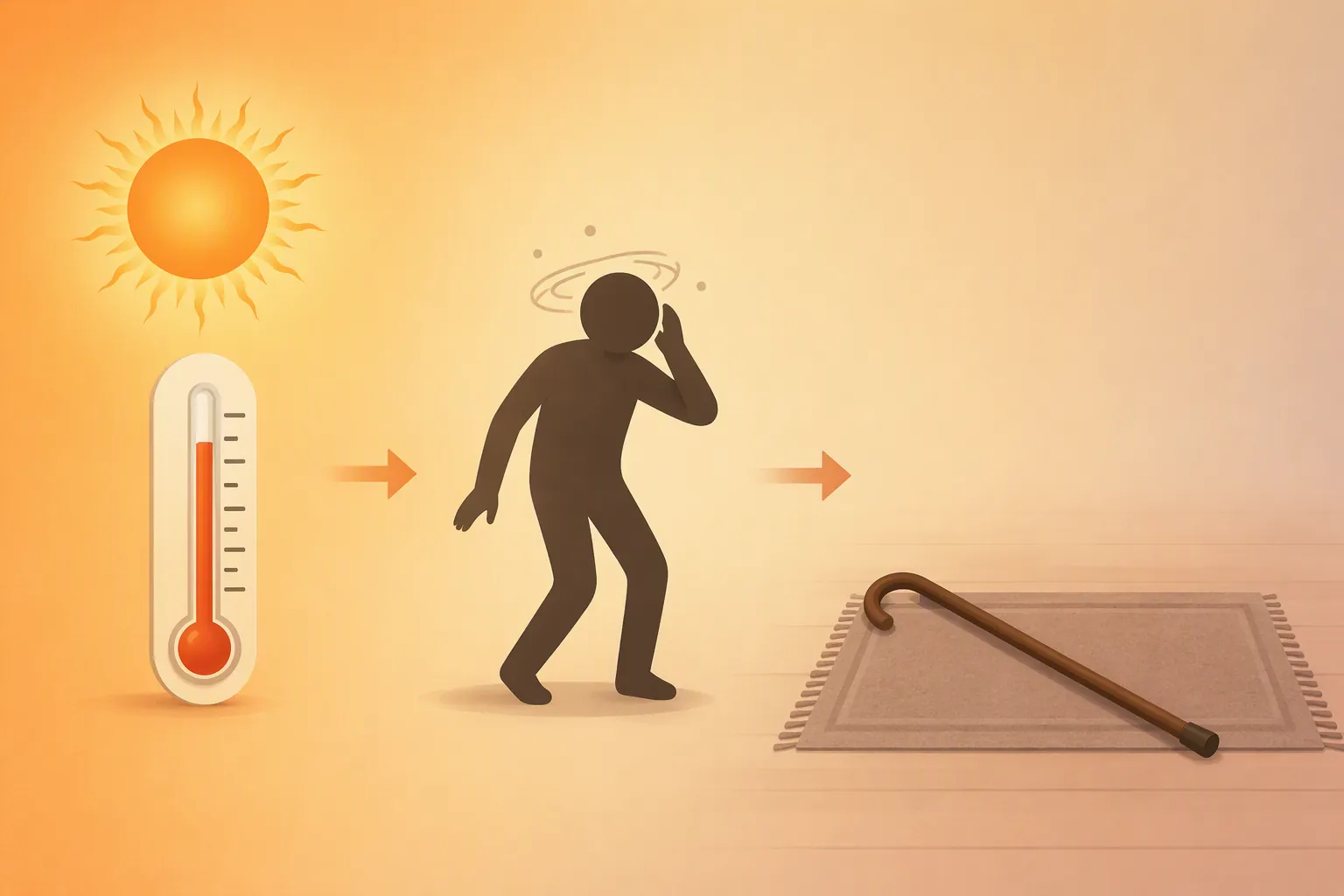
Home check-ins are for prevention and early correction. They are not a substitute for emergency care when heat illness looks severe. CDC/NIOSH describes heat stroke as the most serious heat-related illness and lists symptoms that can include confusion, altered mental status, slurred speech, loss of consciousness, seizures, and very high body temperature; it instructs calling 911 for suspected heat stroke.[1]
- Call 911 for suspected heat stroke, severe confusion, collapse, seizure, loss of consciousness, or a parent who cannot be awakened or cannot answer normally.
- Call 911 if fainting does not quickly resolve, if the parent falls and may be injured, or if they remain weak, confused, or unsafe to stand.
- Call 911 if the parent has dangerous symptoms plus a power outage, failed AC, no transportation to cooling, or dependence on medical equipment that may stop working.
- Call the prescribing clinician or pharmacist for medication questions, but do not delay emergency care when symptoms are severe.
The emergency plan also needs a communication plan. Make sure the parent can reach help if the cell phone is dead, the medical alert device is charging, or the landline setup has changed. If that part of the household is fragile, review emergency communication continuity for an older adult before the next high-heat day.
Keep the plan small enough to run
The workable version is not a thick binder. It is a one-page risk profile, a HeatRisk action rule, two daily check-ins, and a clear emergency threshold.
Before symptoms appear, know the parent’s heat-sensitive conditions, medications, AC access, cooling location, power-outage vulnerabilities, and fall hazards. When HeatRisk rises, escalate the plan instead of repeating the same advice louder. During hot weather, check at least twice daily and ask about fluids, cooling, dizziness, faintness, confusion, and safe walking. Never change medications abruptly without clinical advice. When heat illness looks severe — suspected heat stroke, severe confusion, collapse, dangerous fainting, or a fall with possible injury — call 911.
References
- Heat-related Illnesses, CDC NIOSH
- Heat and Medications – Guidance for Clinicians, CDC
- Heat and Older Adults Aged 65+, CDC
- Heat waves and annual death rates in older adults in the United States, Harvard T.H. Chan School of Public Health
- How to Use the HeatRisk Tool and Air Quality Index, CDC
Related reading
Noticed something outdated or inaccurate on this page? Flag a correction. We review every report against CDC, NIA, and AARP HomeFit guidance before updating a page.
Part of the Fall Prevention section.