
STEADI: intervene
Rehab-First Long COVID Treatment for Older Adults
Long COVID has no single cure, but older adults do have a concrete path grounded in evidence: coordinated physical, occupational, and pulmonary rehabilitation plus pacing. This guide gives adult-child caregivers the steps from the first doctor's visit through Medicare-covered therapy to a safe return to daily activity.
If your parent is months past COVID and still weaker, breathless, foggy, or suddenly unsteady, the useful question is not whether long COVID has a neat cure. It does not. The CDC says there is no approved laboratory test for long COVID and no single approved treatment for it; care is built as a personal medical management plan with a clinician.[1] That sounds unsatisfying until it becomes specific: document the symptoms, get the right exam, screen for post-exertional crashes, and ask for rehabilitation that protects walking, daily function, breathing, and home safety.
Older adults do not always present like the tidy symptom lists. In one JAGS cohort of 1,019 older COVID survivors with a mean age of 64.6, the most common persistent symptoms were fatigue, myalgia, and dyspnea.[2] That is enough to take the weakness seriously, especially when an older adult’s first obvious change may be less walking, trouble bathing, or a fall rather than a complaint that sounds like “long COVID.” RECOVER researchers have also warned clinicians to keep suspicion high when older adults show atypical features such as weakness or falls instead of classic fever or cough patterns.[3]

The first visit needs more than “she’s tired”
A tired older adult can be dismissed too quickly. A vague visit also wastes the caregiver’s one chance to get orders started. Before the appointment, write down what changed after COVID in functional terms: how far your parent can walk, whether they now need the arms of a chair to stand, how often they nap after basic tasks, whether showering triggers breathlessness, whether they stopped cooking, and whether symptoms flare the next day.
CDC clinical guidance supports exactly this kind of practical starting point: evaluation is based on history and physical exam, a symptom diary can help, care can begin by addressing the most burdensome symptom, ICD-10 code U09.9 can be used for post-COVID conditions where appropriate, and clinicians should screen for post-exertional malaise before exercise is prescribed.[4]
- Bring a short timeline: date of COVID infection if known, when the decline started, and whether function has improved, plateaued, or worsened.
- Name the top functional loss: “She cannot walk from the bedroom to the kitchen without sitting,” or “He stopped showering unless someone is in the house.”
- Ask the clinician to check for treatable contributors that can mimic or worsen long COVID symptoms, including medication side effects, anemia, heart or lung problems, dehydration, sleep disruption, depression, and deconditioning.
- Ask directly: “Should we use U09.9 for post-COVID condition in the chart, and can you order PT, OT, or pulmonary rehab based on the limitation you see today?”
- Ask before any exercise plan: “Do these symptoms suggest post-exertional malaise or post-exertional symptom worsening?”
This is the same kind of appointment self-advocacy that helps prevent falls in other chronic conditions: ask for the referral, the assistive-device check, the medication review, and the home-safety look before the next crisis. If you need a model for the provider-request part, see what to ask to prevent falls.
Why rehabilitation is the main treatment path to ask about
Rehabilitation is not a magic word. It only matters if it turns into measurable work: gait training, breathing work, sit-to-stand practice, energy conservation, safer showering, fewer risky transfers, and a plan for what to do when symptoms flare.
The strongest older-adult-specific reason to push for that plan is a 2024 systematic review and meta-analysis of 11 randomized controlled trials with 832 participants whose average age was 64.4 years. Compared with usual care, rehabilitation improved 6-minute walk distance by 15.77 meters and 30-second sit-to-stand performance by 4.11 stands. It also improved ADL independence and quality of life, while reducing fatigue, depression, and anxiety.[5]
That does not mean every parent will recover at the same speed, or that a clinic can promise a return to baseline. It does mean “wait and see” is not the only option. In that analysis, exercise training produced the largest gains in walking distance, fatigue, anxiety, and depression; respiratory rehabilitation produced the biggest gains in pulmonary function and quality of life.[5] The practical conclusion is simple enough to bring into an exam room: the rehab order should match the problem your parent is actually having.
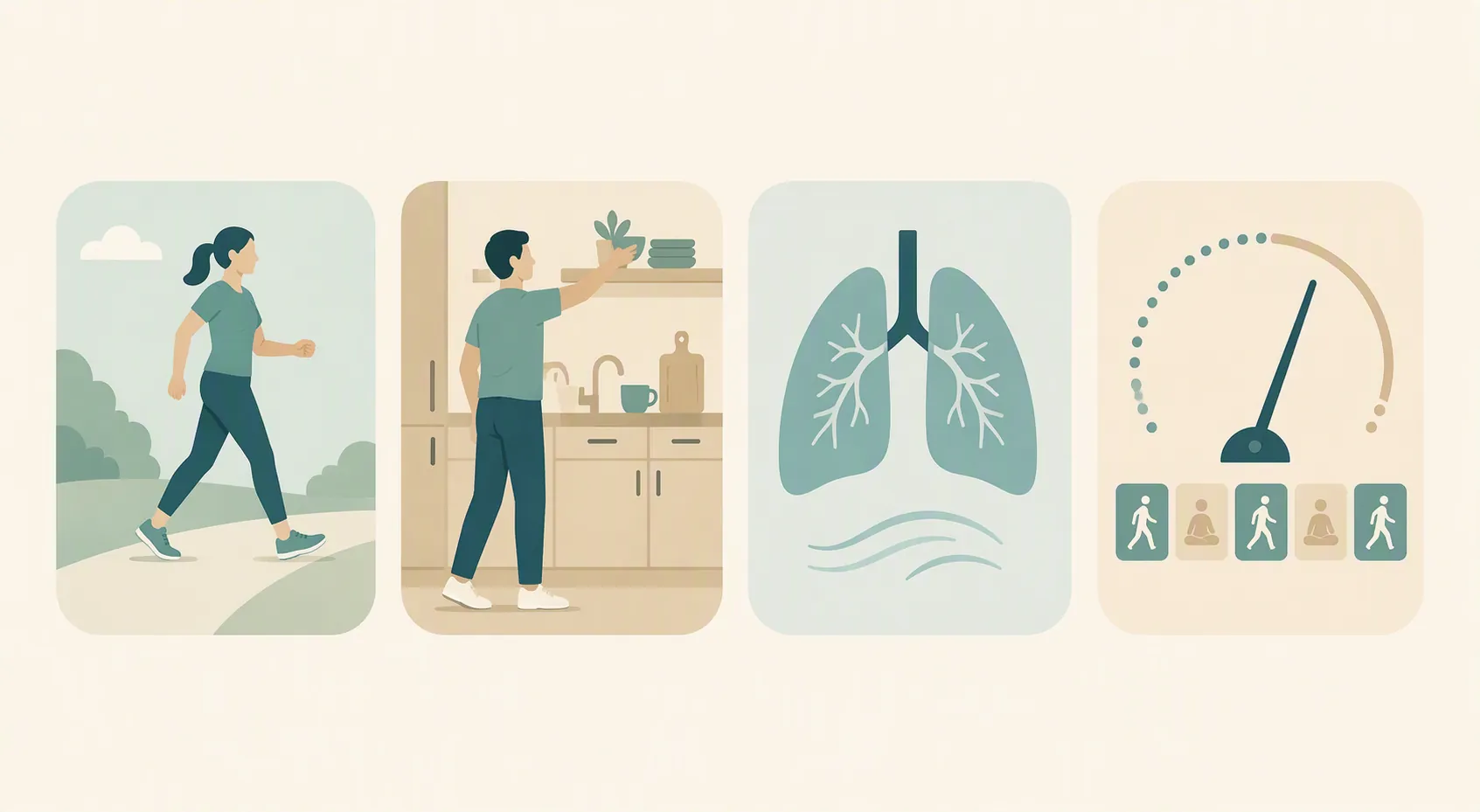
Match the therapy to the limitation
A decent long COVID treatment plan for an older adult is usually not one referral. It is a mix, and the mix should change depending on what is stealing independence first.
| Problem you see at home | Ask about | What the referral should accomplish |
|---|---|---|
| Slower walking, new imbalance, difficulty rising from a chair | Physical therapy | Assess gait, strength, endurance, transfers, fall risk, and assistive-device fit; set safe home exercises and walking boundaries. |
| Breathlessness with dressing, showering, stairs, or short walks | Pulmonary rehabilitation or respiratory-focused rehab | Assess breathing limitation, teach breathing strategies, and build monitored tolerance without ignoring symptom flares. |
| Trouble bathing, dressing, cooking, medication routines, or conserving enough energy for the day | Occupational therapy | Modify tasks, recommend equipment, simplify routines, and reduce fall risk during ADLs. |
| Crashes after errands, therapy, housework, or visitors | Pacing and energy conservation plan | Keep activity inside a tolerable range, plan rest before symptoms surge, and reduce activity during flares. |
| Falls, near-falls, furniture-walking, fear of the bathroom at night | Home-safety evaluation and assistive devices | Improve the bed-to-bathroom route, lighting, grab points, footwear, seating, and device use. |
WHO guidance for post-COVID condition includes energy conservation, pacing, flare-up response by reducing activity until the flare resolves, assistive devices, and home-environment modifications.[6] That is not decorative advice. For an older adult, it can be the difference between using the bathroom safely at 2 a.m. and falling while trying to prove they are “getting stronger.”
Physical therapy is for more than exercise sheets
Ask PT to test the things that matter at home: sit-to-stand ability, walking speed or distance, balance, stair tolerance, and whether the cane, walker, or rollator is actually the right height and type. A parent who grips the walls may not need encouragement; they may need a device, training, and a clearer rule for when to sit.
Occupational therapy protects ADLs
OT is where long COVID care becomes less abstract. The therapist can work on bathing, dressing, meal prep, laundry, medication routines, reach limits, shower seating, grab bars, and the order of tasks during the day. If your parent can walk across a clinic but cannot safely shower at home, the rehab plan is incomplete.
Pulmonary rehab belongs on the table when breathlessness is the limiter
If dyspnea is what shuts down walking, dressing, or stairs, ask whether pulmonary rehabilitation or respiratory-focused therapy fits. The Deng analysis found respiratory rehabilitation had the strongest effect on pulmonary function and quality of life among the rehab types studied.[5] The clinician still has to decide whether your parent qualifies and whether another lung or heart condition needs workup first.
The exercise warning that should come before the exercise order
Some long COVID patients worsen after exertion. Long COVID Physio describes post-exertional symptom exacerbation as a worsening of symptoms after physical, cognitive, emotional, or social activity, often delayed by 12 to 48 hours.[7] That delayed timing is what fools families. Monday’s “good walk” can become Wednesday’s bed day.

This is where rehab enthusiasm needs a brake. If your parent has post-exertional malaise, a simple graded-exercise push can backfire. CDC guidance says clinicians should screen for post-exertional malaise before beginning an exercise program.[4] The plan should then shift toward pacing, energy conservation, flare response, and safe daily function rather than automatically increasing steps or repetitions.
- Track delayed symptoms for at least a few days after activity, not just during the activity.
- Separate physical exertion from cognitive and social exertion. A long phone call, paperwork, or a crowded appointment can also drain the day.
- Use rest before the crash, not only after it.
- During a flare, reduce activity until symptoms settle instead of trying to “push through.” WHO guidance supports reducing activity until the flare resolves.[6]
- Ask the therapist to write clear stop rules: symptoms, heart-rate or breathlessness thresholds if appropriate, and what to do the next day.
A useful home boundary might sound plain: one shower with a shower chair counts as the main activity of the morning; grocery shopping and PT do not go on the same day; visitors leave before dinner if the next-day crash pattern is obvious. That is treatment when the goal is preserving function, not winning a step-count contest.
Medicare coverage: what to verify before therapy starts
For many older adults, the plan lives or dies on coverage and access. Medicare Part B covers medically necessary outpatient physical therapy. After the Part B deductible, the patient generally pays 20% of the Medicare-approved amount, and Medicare states there is no annual limit on medically necessary outpatient therapy services.[8] That “medically necessary” phrase is why the clinician’s documentation matters: the referral should connect therapy to walking, transfers, ADLs, breathlessness, falls, or another concrete limitation.
Pulmonary rehabilitation coverage is more diagnosis- and rule-specific. CMS has billing and coding guidance for pulmonary rehabilitation services, but the details should be re-verified on CMS.gov, with the ordering clinician and the rehab provider, before the first visit.[9] Do not assume that “long COVID” alone automatically opens every pulmonary rehab door; ask what diagnosis, test results, or documentation the program requires.
- Ask the clinic: “Are you billing this as outpatient PT, OT, pulmonary rehab, or another service?”
- Ask whether the therapist accepts Medicare assignment and what the expected coinsurance will be.
- Ask whether a Medicare Advantage plan requires prior authorization or use of an in-network provider.
- Ask the referring clinician to document the functional problem, not just the diagnosis label.
- If transportation is a barrier, ask about home health eligibility, outpatient clinics with caregiver training, or community-based supports.
For a broader look at arranging help at home, see home help for the elderly in 2026. If the recovery plan exposes a bigger home-access problem, such as stairs becoming unsafe, also check stair lift cost and funding options. Medicare therapy coverage and home-modification funding are not the same thing, and mixing them up leads to expensive surprises.
Home safety is part of the treatment plan
Long COVID rehab does not end when the session ends. The risky hours are often ordinary: the first trip to the bathroom, stepping over a tub wall, carrying laundry, standing too long at the stove, or walking to the mailbox because yesterday went well.
Walk the home with the therapist’s questions in mind. Is there a clear bed-to-bathroom route? Is the cane by the bed or across the room? Is there a night light? Can your parent sit to dress? Is the shower set up for a bad day, not just a good day? Does the walker fit through the bathroom door? The goal is not to make the house look medical. The goal is to remove the little ambushes that turn fatigue into a fall.
If there has already been a fall, do not treat it as just another symptom note. Use a time-based response like what to do after a fall, and consider whether a broader fall-prevention services roadmap is needed while recovery is still uncertain.
A script for the next appointment
Bring this in writing. Hand it over early, before the visit disappears into lab refills and blood pressure readings.
- “Since COVID, my parent’s biggest functional change is: ____.”
- “The symptom that limits daily life most is: fatigue, breathlessness, weakness, dizziness, pain, brain fog, sleep, mood, or something else.”
- “Here is the symptom diary, including what happens 12 to 48 hours after activity.”
- “Please evaluate for long COVID using history and exam, and check for other treatable causes of this decline.”
- “Should U09.9 be used in the chart for post-COVID condition?”
- “Before prescribing exercise, please screen for post-exertional malaise.”
- “Can you refer to PT for strength, balance, gait, transfers, and device fitting?”
- “Can you refer to OT for ADLs, energy conservation, bathroom safety, and home setup?”
- “If breathlessness is the main limiter, does pulmonary rehab fit, and what documentation does Medicare or the program require?”
- “What are the stop rules if symptoms flare after therapy or home activity?”
That is what long COVID treatment options for older adults look like when the plan is honest: no approved test, no single cure, no promise that your parent will bounce back on a schedule. But there is a defensible route—clinical evaluation, symptom prioritization, PEM screening, coordinated rehabilitation, Medicare-aware access, and home-safety changes aimed at keeping strength, mobility, and daily independence from slipping away.
Medical disclaimer: This article is for general education and is not medical advice, diagnosis, or treatment. Long COVID symptoms can overlap with urgent or treatable conditions. Contact a licensed clinician for individualized care, and seek urgent help for chest pain, severe shortness of breath, fainting, new confusion, stroke symptoms, or a serious fall.
Clinical reviewer: Dana Whitmore, RN, BSN, geriatric care reviewer.
References
- Long COVID Basics — CDC.
- Dias et al. JAGS 2025 cohort — Journal of the American Geriatrics Society, 2025.
- RECOVER Researchers Identify Gaps in Long COVID Research for Older Adults — RECOVER.
- Long COVID Clinical Guidance — CDC.
- Effects of rehabilitation interventions on patients with long COVID: a systematic review and meta-analysis — 2024.
- Post COVID-19 condition (long COVID) — World Health Organization.
- Post-exertional Symptom Exacerbation — Long COVID Physio.
- Physical therapy services — Medicare.gov.
- Article - Billing and Coding: Pulmonary Rehabilitation Services (A56152) — CMS.
Related reading
Noticed something outdated or inaccurate on this page? Flag a correction. We review every report against CDC, NIA, and AARP HomeFit guidance before updating a page.
Part of the Fall Prevention section.