
STEADI: Intervene
Which Post-Tornado Cleanup Tasks Are Safe for Older Adults?
After a tornado, the safest cleanup role for an older adult is usually directing and delegating, not lifting and hauling. This guide sorts post-storm tasks into do, delegate, and never-attempt categories, with the gear, pacing, and stop signals that make the safe tasks safer.
The first unsafe moment after a tornado often looks ordinary: an older homeowner reaches for gloves, says they will “just move a few things,” and steps toward wet boards, branches, nails, broken glass, and uneven ground before anyone has decided what work is actually safe. For many adults 65 and older, the safest post-tornado cleanup role is usually directing, documenting, sorting light items from a safe area, and pacing short tasks—not lifting, climbing, sawing, or entering unstable spaces.
That is not a judgment about independence. It is a judgment about the worksite. In the CDC’s review of the April 25–28, 2011 tornado outbreak in five southeastern states, 32.5% of the 338 fatalities were among people aged 65 and older, and 2 of the 20 indirect deaths were attributed to falls or injuries during cleanup. Those figures describe that specific outbreak, not a universal tornado rate, but they make the risk visible at exactly the point families tend to underestimate it: after the wind stops, when people start moving debris [1].
The fall risk is not starting from zero. CDC fall data show that about 1 in 4 people age 65 and older falls each year, falls are the leading cause of traumatic brain injury in older adults, and roughly 319,000 older adults are hospitalized for hip fractures annually [2]. Add wet drywall, poor lighting, fatigue, unstable footing, and rushed decisions, and cleanup becomes a task-assignment problem before it becomes a glove-and-boot problem.
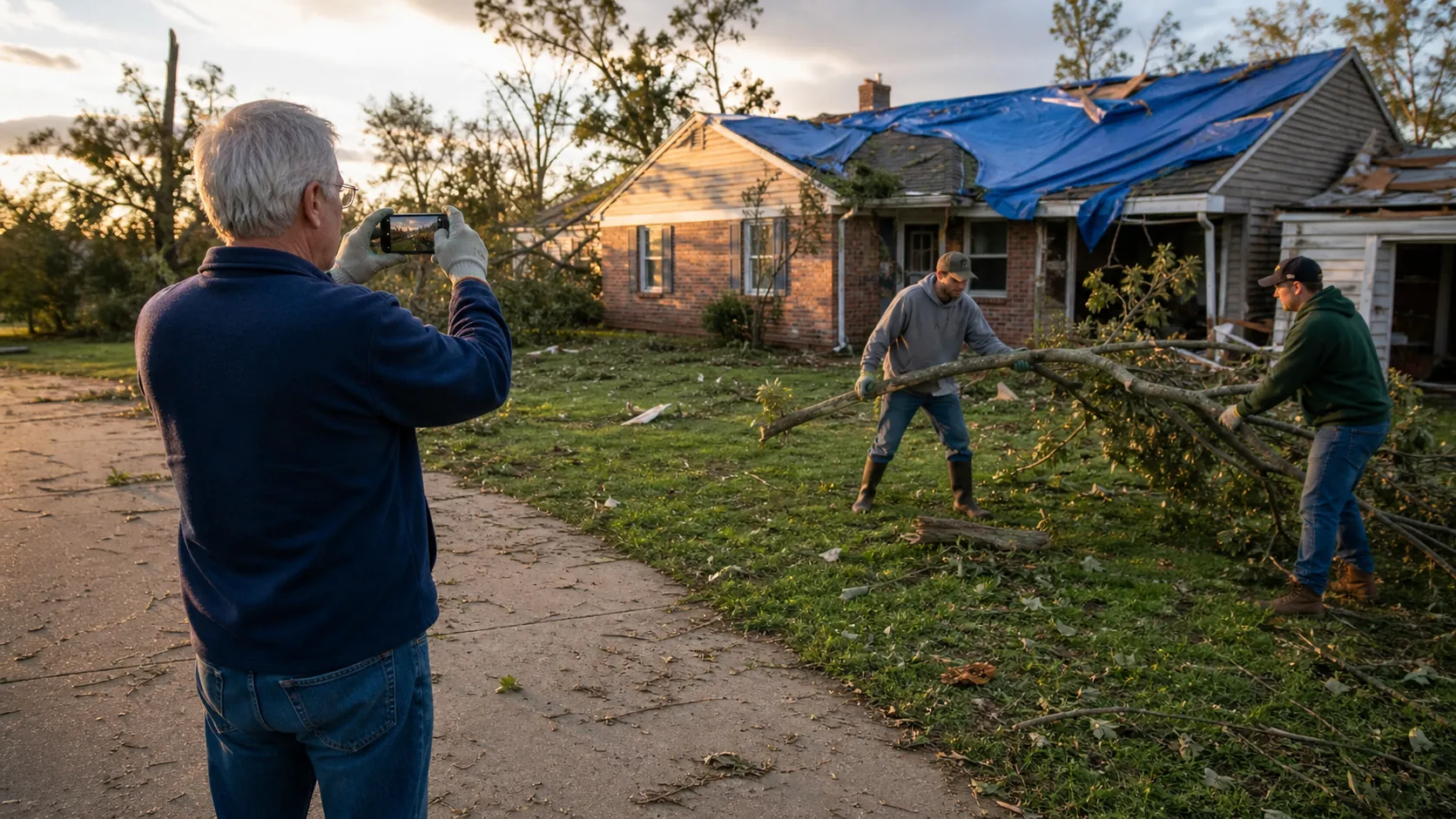
Start by deciding where no one goes yet
Before assigning jobs, stand in a safe place and gate the property. No one—older adult, adult child, neighbor, or volunteer—should enter an area that may be structurally unstable, smells of gas, has downed or damaged utility lines nearby, contains standing water with unknown hazards, has a damaged porch or stairs, or requires climbing over debris to get in. CDC tornado guidance warns people to be careful around damaged buildings and to leave immediately if they hear shifting or unusual noises that could mean the structure is about to fall [3].
This first gate matters because many cleanup injuries happen before the “real” work begins. OSHA lists tornado response hazards such as slips, trips, falls, sharp objects, electrical hazards, unstable structures, heat stress, and exhaustion [4]. NIOSH similarly highlights risks from debris, nails, glass, falls from heights, chainsaws, heavy lifting, heat, and fatigue during tornado cleanup [5]. If the entry path itself is unsafe, the task is not “take a quick look.” The task is to stay out and call the appropriate utility, emergency official, contractor, or disaster-response contact.
If power is out, the cleanup zone also overlaps with generator, carbon monoxide, lighting, refrigeration, and medication-storage decisions. Use a separate power-outage plan for those hazards; this site’s power-outage safety checklist for seniors is a better place to handle those details than the debris pile.
The cleanup assignment: do, supervise or delegate, never attempt
A useful post-tornado plan does not begin with “Can Mom help?” It begins with “Which job is this?” The same person who should not haul soaked carpet may be the best person to remember where the insurance papers are, identify family photos, direct volunteers away from fragile items, or keep a written log of calls and expenses.
| Cleanup task | Usually safest role for an older adult | Why the boundary matters |
|---|---|---|
| Photographing damage from the driveway, sidewalk, or another stable area | Do, if footing is dry, level, and clear | Documentation helps insurance and assistance claims without requiring entry into unstable spaces. |
| Making calls, keeping a damage log, listing medications or medical equipment affected by the storm | Do | This is high-value work that does not require climbing, lifting, or stepping through debris. |
| Sorting dry, lightweight papers, photos, clothing, or small keepsakes in a safe room, garage bay, porch area, or driveway table | Do, in short sessions | The task can be controlled if the work surface is stable and the older adult does not bend repeatedly into piles. |
| Pointing out what should be saved, discarded, photographed, or left for the adjuster | Do or supervise | The older adult keeps control over the home’s contents while others do the hazardous moving. |
| Moving branches, fence pieces, wet boxes, furniture, appliances, carpet, or soaked drywall | Supervise or delegate | Heavy and waterlogged items increase fall, strain, and crush risk; CDC cleanup guidance sets a 50-pound per-person lifting limit and recommends teams of at least two for heavy objects [6]. |
| Picking up glass, boards with nails, roofing fragments, twisted metal, or splintered lumber | Supervise or delegate | Sharp debris can cause puncture wounds and cuts; stepping backward or turning while carrying it also raises fall risk. |
| Entering a damaged garage, shed, attic, basement, or room with sagging ceiling, shifted walls, wet insulation, or blocked exits | Do not enter until cleared by someone qualified | Structural hazards and poor exits turn a minor stumble into a rescue problem. |
| Climbing ladders, roofs, damaged porches, stairs without railings, or piles of debris | Never attempt | Falls from heights are a named tornado-cleanup hazard, and the landing surface is often filled with nails, glass, or unstable debris [4][5]. |
| Using a chainsaw or cutting storm-damaged trees, limbs, or roof material | Never attempt unless the person is trained, properly equipped, and physically able—and for most older homeowners, delegate | Chainsaw injuries, unstable limbs, kickback, awkward footing, and fatigue make this a poor “quick job” after a storm [5]. |
| Working near downed lines, suspected gas leaks, floodwater, or sparking equipment | Never attempt | Leave the area and call emergency services, the utility, or local officials. |
| Continuing cleanup after dark, while dizzy, short of breath, confused, overheated, or in increasing pain | Stop | The safest task becomes unsafe when the body or the environment changes. |
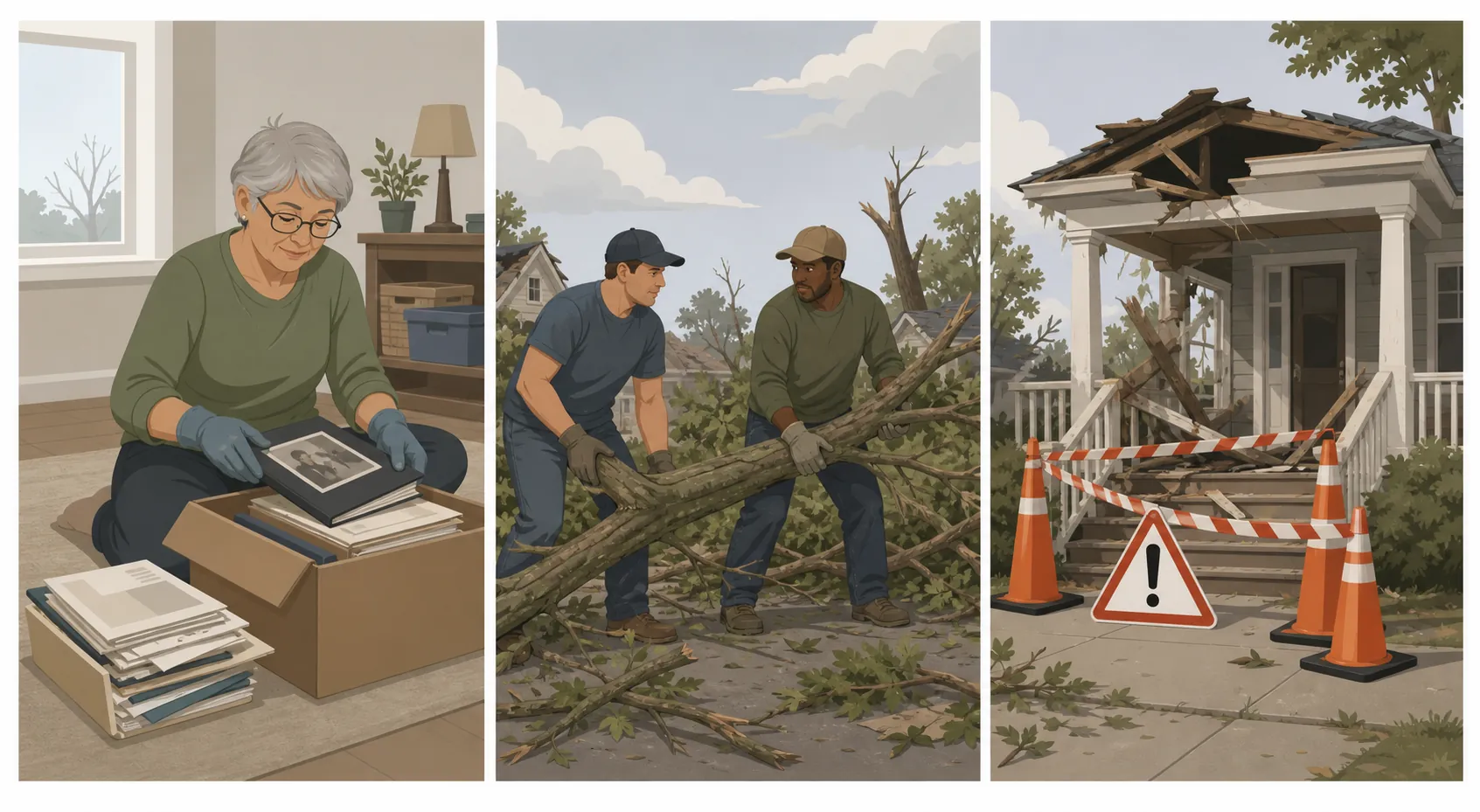
The “do” jobs should keep the older adult out of the debris path
The best safe tasks are useful, specific, and physically boring. Photograph the roof damage from the driveway. Sit at a dry table and sort mail, insurance folders, medication lists, and photo albums. Keep a notebook of who called, what was promised, and which rooms were photographed. Tell helpers which items are sentimental and which can go to the curb. These jobs protect control and dignity without putting the person on unstable ground.
If the older adult uses a cane, walker, or rollator, do not treat the mobility aid as a pass to cross wet grass, gravel, loose shingles, cords, or branches. Wheels can stop suddenly, tips can slide, and a person can fall while trying to pull the device free. For a broader balance discussion, see the guide to walker versus rollator safety for balance problems. After a tornado, the safer assumption is simple: mobility aids belong on clear, level, well-lit surfaces, not in debris fields.
Delegating is still a real job
Delegation often fails because families say “Don’t do anything,” which leaves the older adult standing there, angry and unassigned. A better instruction is concrete: “You take the photos from here. You decide what stays. We will move the heavy things.” That keeps decision-making with the homeowner and transfers the fall-and-strain risk to people better positioned to manage it.
For heavy objects, CDC cleanup guidance is blunt enough to be useful: do not lift objects over 50 pounds per person, use teams of at least two for heavy or bulky items, pace yourself, rest, and do not work alone [6]. That rule should apply to the younger helpers too. A large branch, soaked rug, wet box of books, or piece of furniture may not look like a medical event waiting to happen, but it can force twisting, backward steps, sudden grip changes, and hurried balance corrections.
The Red Cross tells families that children should not take part in disaster cleanup [7]. Older adults are not children, and age alone does not make someone helpless. The useful principle is narrower: not every person should do every post-disaster job. After a tornado, task assignment should match footing, strength, balance, vision, heat tolerance, medical conditions, and the consequences if something goes wrong.
Some tasks are not worth negotiating
Ladders, roofs, damaged porches, unstable stairs, and partially collapsed rooms should be outside the older adult’s assignment. They should usually be outside the family’s assignment as well until the area is evaluated. Falls from heights, unstable structures, electrical hazards, and sharp debris are not theoretical tornado-cleanup risks; they are named in federal recovery guidance [3][4][5].
Chainsaws deserve the same boundary. A fallen limb can be under tension, the ground may be slick, and the person cutting may have nowhere safe to step when the wood shifts. If no one present is trained, equipped, and steady enough to do the work safely, the task belongs to a professional tree crew or disaster-recovery team, not to the nearest person who owns a saw.
Make the safe jobs safer
Protective gear lowers risk; it does not upgrade a dangerous assignment into a safe one. CDC tornado guidance recommends sturdy shoes or boots, long pants, heavy work gloves, goggles or other eye protection, and an N95 mask when cleaning up after a tornado [3]. If those items are not available, the job should usually shrink—not proceed barefoot, in sandals, without eye protection, or with bare hands because everyone feels rushed.
- Set a work zone before work starts. One area is for safe sorting. One area is for debris staging. One area is off-limits. The older adult should not have to guess where it is safe to stand.
- Use short work periods. Ten to twenty minutes of sorting or photographing may be enough before sitting, drinking water, checking pain, and reassessing footing.
- Keep at least two adults on site when cleanup is happening. CDC guidance says not to work alone during cleanup [6]. For an older adult, that should include even “light” work if the area has debris, poor lighting, heat, or damaged walking surfaces.
- Keep hands free while walking. Carrying a box, broom, or trash bag can block vision and remove the ability to catch balance.
- Move the task to the person, not the person into the hazard. Bring papers, small keepsakes, and light items to a stable table instead of asking the older adult to step into a damaged room to sort them.
- Stop before daylight fades. A room or yard that was manageable at 4 p.m. can become a fall trap at dusk.
Heat and fatigue deserve more respect than they usually get on cleanup day. OSHA includes heat stress and exhaustion among tornado response hazards [4]. NIOSH also flags heat, dehydration, and overexertion in cleanup work [5]. Even when the older adult is doing only “safe” tasks, tired legs, sweat in the eyes, medication timing, missed meals, poor sleep, and emotional shock can change balance quickly.
If cleanup is happening in warm weather, treat heat as part of fall prevention. The point is not only avoiding heat illness; it is avoiding the shaky, lightheaded, distracted movement that leads to a step backward onto a nail or a trip over a branch. For related guidance, see how hot weather and sleep loss can raise senior fall risk.
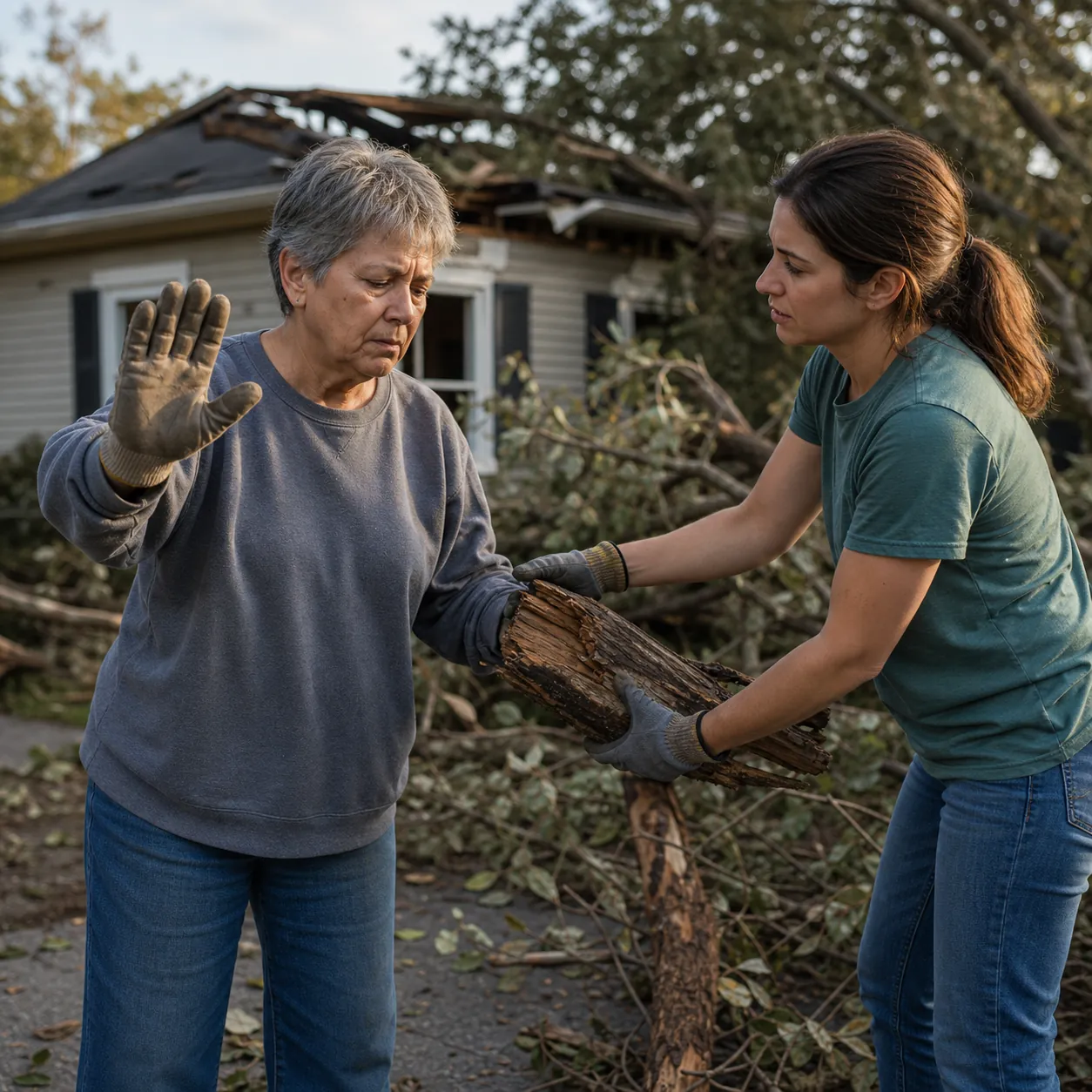
Stop signals: when cleanup ends for the moment
Families should agree on stop signals before the older adult starts helping. Once symptoms appear, people argue with themselves: one more box, one more photo, one more branch. The safer rule is that any stop signal ends the task first; decisions about restarting come later.
- Dizziness, faintness, new unsteadiness, or needing to grab furniture, a car, a wall, or another person for balance
- Chest discomfort, shortness of breath, unusual sweating, severe weakness, or a sense that something is wrong
- Confusion, poor judgment, repeating questions, or forgetting where hazards are
- Increasing back, hip, knee, shoulder, foot, or hand pain
- A cut, puncture wound, embedded splinter, animal bite, or wound contaminated with soil, rust, floodwater, or debris
- Footing that has changed: mud, loose boards, exposed nails, wet leaves, broken glass, cords, unstable stairs, or a blocked exit
- Loss of daylight, loss of working phone service, worsening weather, or the older adult being left alone
- Gas odor, sparking, shifting sounds, new cracks, sagging ceilings, or any sign the structure is changing
Chest discomfort, severe shortness of breath, fainting, stroke-like symptoms, major bleeding, a head injury, or inability to bear weight after a fall calls for emergency care, not a family debate. This guide is general safety information, not medical advice; when symptoms, wounds, medications, or chronic conditions are involved, contact a clinician, urgent care, or emergency services.
For wounds, ask a clinician whether tetanus protection is current. CDC clinical guidance says vaccination is recommended for dirty or major wounds if the person’s last tetanus vaccine was 5 or more years ago, and for clean and minor wounds if the last dose was 10 or more years ago [8]. A nail puncture from storm debris is not the place to guess from memory.
If a fall happens during cleanup, stop the whole work area until the person is assessed and the cause is corrected. The response path in what to do after an elderly parent falls or may have a fracture is more useful in that moment than continuing to clear the driveway.
Who to call instead of doing the dangerous job
The right delegate depends on the hazard. Downed or damaged utility lines belong to the utility or emergency officials. Gas odor belongs to emergency services or the gas company. Structural damage belongs to qualified inspectors, contractors, or local officials. Large trees and limbs belong to trained crews. Heavy debris may be handled by adult volunteers or cleanup teams if they have the right equipment and follow lifting limits.
Ready.gov advises people to follow local officials’ instructions after a tornado and stay clear of damaged buildings, downed power lines, and disaster areas unless authorities say it is safe [9]. The Red Cross older-adult preparedness guidance also emphasizes support networks and planning for help with transportation, communication, medical needs, and recovery tasks [10]. Those supports are not extras after a storm; they are what keep an older homeowner from becoming the default labor crew.
For longer recovery, older adults and caregivers may need help beyond the first day’s debris decisions. The National Council on Aging summarizes disaster-assistance programs that may help older adults after a disaster, including federal, state, local, nonprofit, and benefits-related resources [11]. Those programs do not replace immediate safety decisions at the doorway, but they can reduce the pressure to do unsafe work because “no one else is coming.”
Bring the home fall-prevention plan into the cleanup zone
Post-tornado cleanup is temporary, but the fall hazards are familiar: cluttered paths, poor lighting, loose surfaces, missing handholds, rushing to answer the door, carrying too much, and stepping where the eyes have not checked. The CDC STEADI-style home walk-through is useful here because it trains the family to look for trip paths before someone is already moving through them. Start with the CDC STEADI home fall-prevention checklist and then adapt the same habit to the driveway, porch, garage, and first safe room inside the house.
A room-by-room checklist can also help after the obvious debris is gone. Wet flooring, shifted rugs, cords, buckets, fans, temporary lighting, and moved furniture can create a second wave of falls during recovery. Use the room-by-room fall-prevention checklist before the older adult resumes normal walking routes through the home.
The safer cleanup plan is not “Dad does nothing.” It is: Dad documents from the driveway, chooses what matters, sorts light items at a stable table, rests before he is exhausted, and stops when symptoms or conditions change. The branches, ladders, wet carpet, broken glass, chainsaws, unstable rooms, and utility hazards have named delegates or professional help. After a tornado, safety is proven by choosing the right task, in the right place, for the right person, for the right amount of time.
References
- Tornado-Related Fatalities — Five States, Southeastern United States, April 25–28, 2011, CDC MMWR, July 20, 2012.
- Facts About Older Adult Falls, CDC.
- Stay Safe After a Tornado, CDC.
- Tornado Response and Recovery, OSHA.
- Tornado Cleanup and Response, NIOSH.
- Natural Disasters and Severe Weather: Safety, CDC.
- Tornado Safety, American Red Cross.
- Clinical Guidance for Wound Management to Prevent Tetanus, CDC.
- Tornadoes, Ready.gov.
- Older Adults Emergency Preparedness, American Red Cross.
- Disaster Assistance: 6 Helpful Programs for Older Adults, National Council on Aging.
Related reading
Noticed something outdated or inaccurate on this page? Flag a correction. We review every report against CDC, NIA, and AARP HomeFit guidance before updating a page.
Part of the Fall Prevention section.