
STEADI: intervene
What Seniors Should Do If Power Is Still Out After a Storm
When a power outage stretches past the first few hours, the rules change: food has a 4-hour refrigerator window, a full freezer lasts about 48 hours (24 when half full), and refrigerated medications may be compromised. The prioritized, source-backed checks for older adults and their caregivers run in a specific order — carbon monoxide and downed-line safety, food and water limits, medication status, and heat and cold warning signs — before deciding whether it's time to leave the home.
If the power is still out after the first few hours, stop treating “wait and see” like a neutral choice. The useful order is simple: check for carbon monoxide and downed wires first, then check food and water, then refrigerated medications, then indoor heat or cold, then decide whether the older adult can safely stay. The numbers matter: generators must stay outside and at least 20 feet from windows, doors, and vents; refrigerated food has about 4 hours if the door stayed closed; a full freezer has about 48 hours, or 24 hours if half full; and downed power lines call for at least 35 feet of distance and a 911 call.[1][2][3]
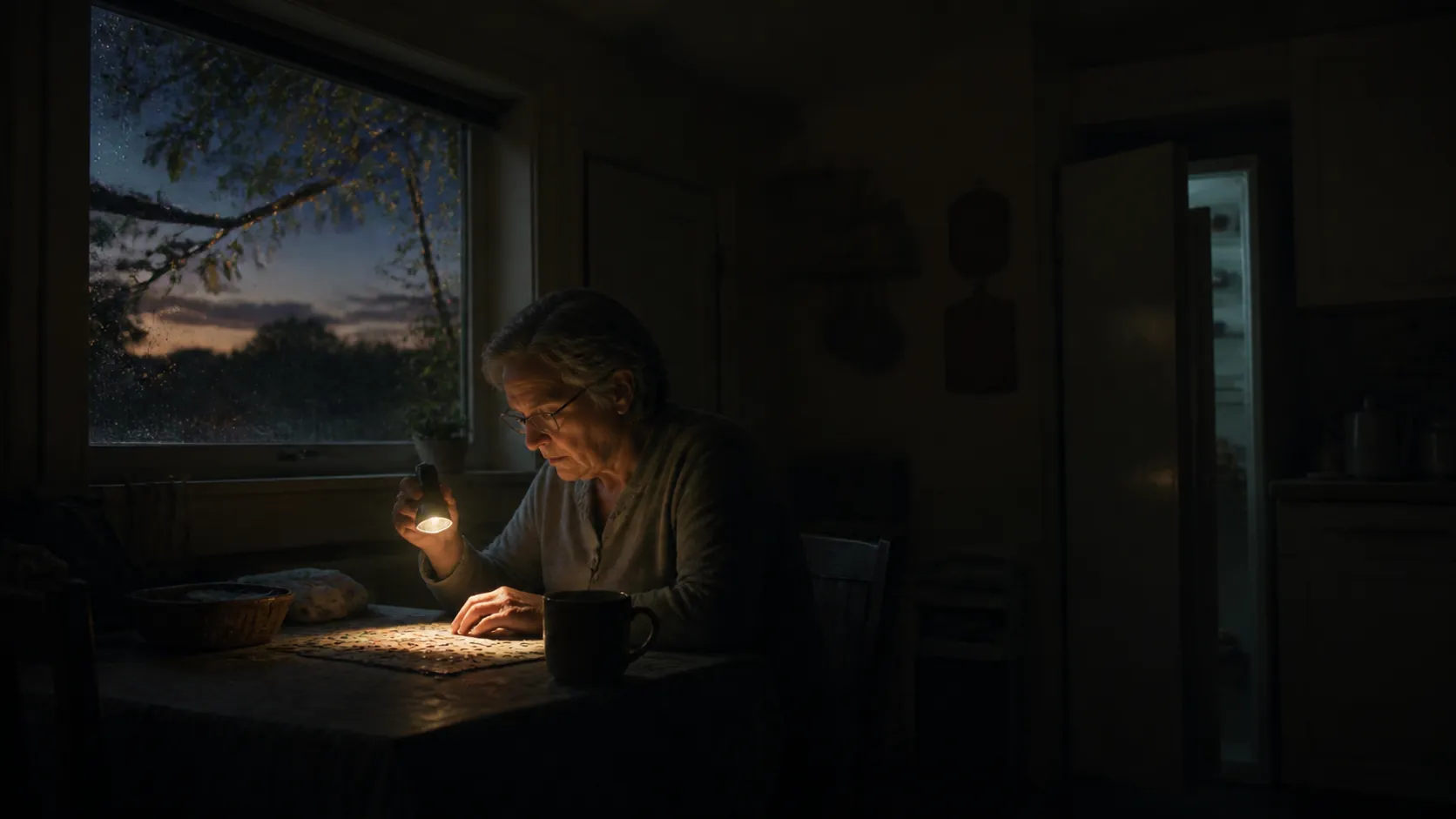
This is not a preparedness lecture. If the kit was incomplete, the phone is at 28%, and the refrigerator has already been closed for hours, you still have decisions to make. Use the table as the quick pass through the home, then slow down on the checks that apply.
| Do this now | What decides the next move |
|---|---|
| Check carbon monoxide risks and downed lines | Any generator, grill, camp stove, or gas oven used wrong is an immediate hazard. Any downed line means stay back and call 911. |
| Check refrigerator and freezer time | At about 4 hours without power, refrigerated perishables are no longer something to casually trust. Freezer timing depends on how full it is. |
| Check refrigerated medications | If power has been out for a day or more, medication storage may be compromised unless the label says otherwise. |
| Check the person, not just the thermostat | Heat, cold, confusion, weakness, dizziness, shivering, or a medical device losing power can turn the home into the wrong place to wait. |
| Decide whether to leave before the last backup fails | If the home is too hot, too cold, medically unsafe, or equipment batteries/oxygen are running low, move to a safer location. |
First sweep: carbon monoxide, generators, and downed lines
Carbon monoxide gets first place because it does not wait politely while everyone sorts the freezer. It is colorless and odorless, and it can come from the exact things people improvise with when the house is dark: generators, grills, camp stoves, and fuel-burning heaters used too close to living space.
A portable generator belongs outdoors, away from the house. Do not run it indoors, in a garage, in a basement, on a porch, or near an open door. CDC guidance says to keep generators more than 20 feet from windows, doors, and vents, and to point exhaust away from the home.[1]
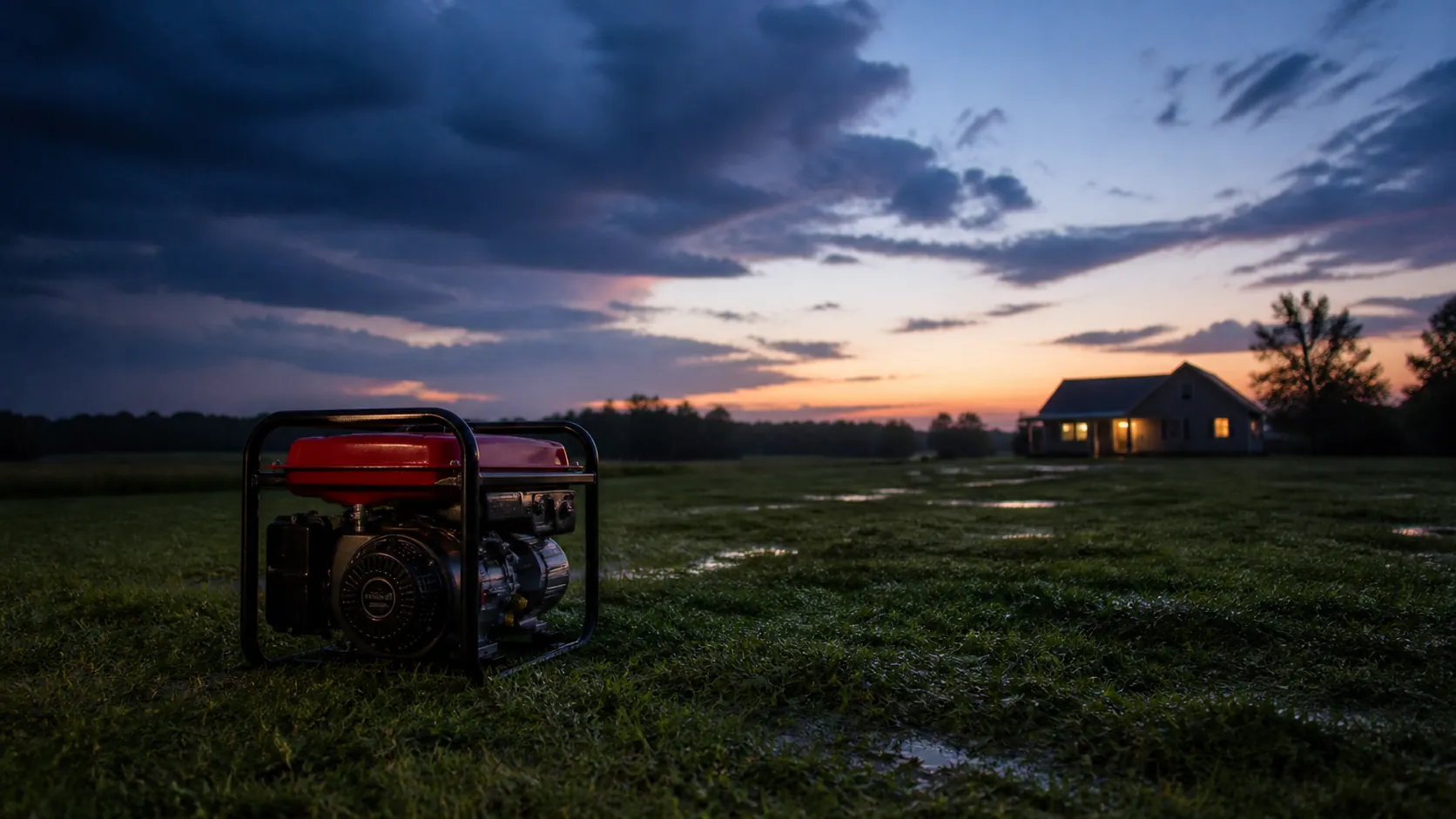
Do not use a gas range or oven to heat the home. The American Red Cross gives that warning plainly, and this is one of those instructions where there is no clever workaround.[3] If the home has a battery-backup carbon monoxide detector, make sure it is working. If it alarms, or if anyone has symptoms that could fit carbon monoxide exposure, get outside and call emergency services. Do not open a window and continue negotiating with the generator setup.
Downed lines are the other immediate stop sign. Stay at least 35 feet away from any fallen power line or anything touching it, and call 911.[3] Wet branches, fences, puddles, vehicles, and metal railings are not worth testing. If an older adult needs to leave the house and the route passes near a wire, that route is closed.
Falls still matter here, but they are not the first danger. Use flashlights, clear the walking path, and keep mobility devices out of cord paths. If darkness and layout are the immediate problem, the site’s four-zone guide for helping an elderly person during a power outage is the better companion piece. For this extended-outage check, do not let fall prevention distract from a generator that is too close to the house or a line in the yard.
Food: use the clock, not smell, taste, or optimism
Now check the refrigerator and freezer. The refrigerator door staying closed buys time, but not unlimited time. Ready.gov says food in a refrigerator is safe for about 4 hours during a power outage if the door stays closed. A full freezer holds temperature for about 48 hours; a half-full freezer, about 24 hours.[2] FoodSafety.gov gives the same refrigerator and freezer timing.[4]
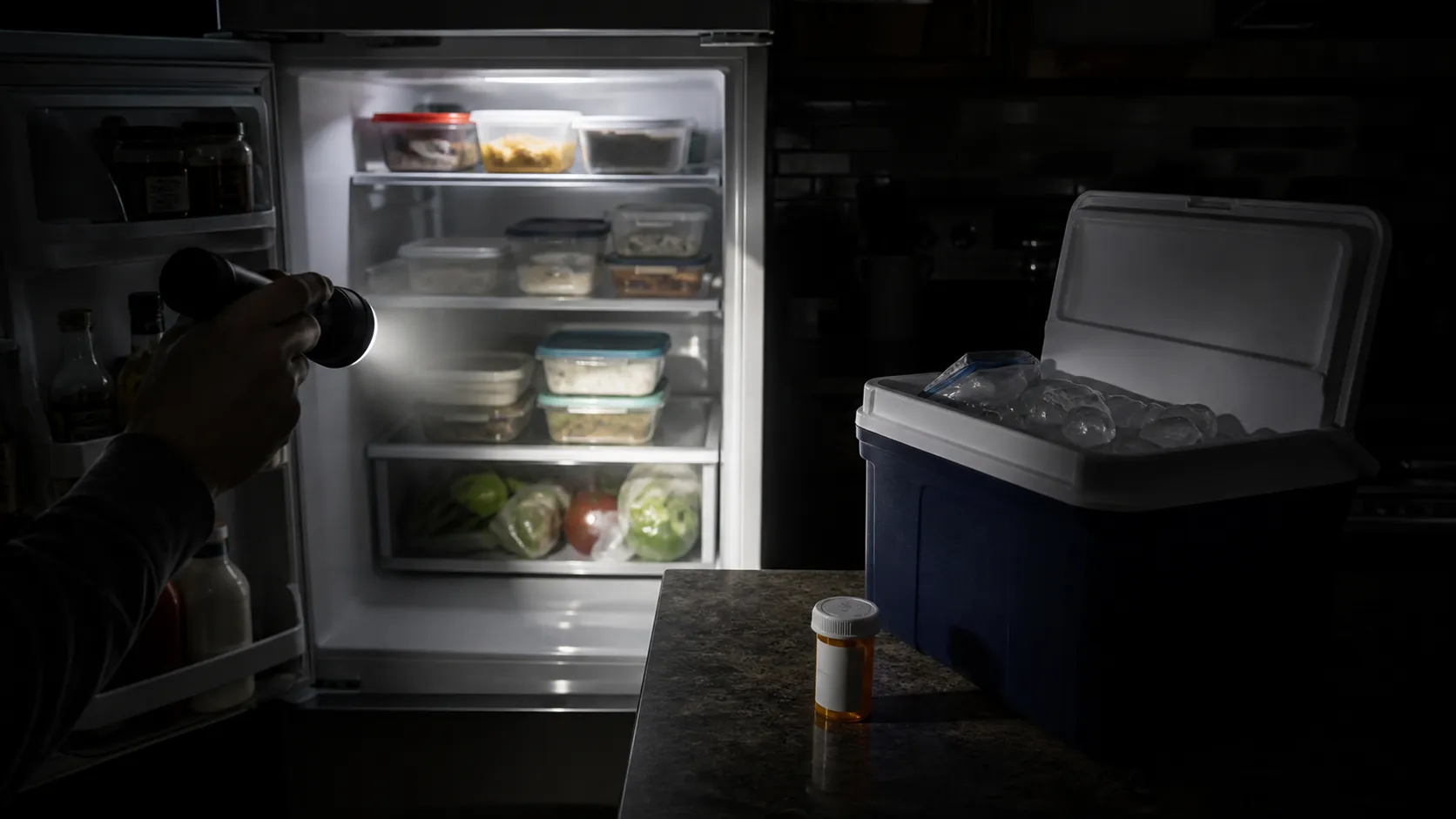
If the power has been out longer than 4 hours and the refrigerator stayed closed, do not keep opening it to “check.” Decide what needs to be moved to a cooler with ice and what is already past the line. Perishable food held at 40°F or above for 2 hours or more should be discarded.[1][4]
Do not taste food to decide whether it is safe. Ready.gov and FoodSafety.gov both say not to taste food after an outage to determine safety.[2][4] That includes the food someone “just bought,” the leftovers that smell fine, and the milk that would be annoying to throw away. A stomach illness after a storm is not a small inconvenience for an older adult who may already be overheated, dehydrated, or short on help.
A practical pass through the kitchen looks like this:
- Write down, as closely as possible, when the power went out.
- Keep refrigerator and freezer doors closed unless you are moving food once.
- Put a thermometer reading ahead of smell or appearance if you have one.
- Move only still-cold essentials to a cooler with ice; do not use a cooler as a way to rescue food that has already warmed too long.
- Throw out questionable perishables instead of asking an older adult to “try a little.”
Water advice depends on local conditions after the storm. If local officials have issued a boil-water notice, do not assume the tap is fine just because the water runs. If there is no safe water in the home and the older adult cannot get it without climbing stairs, walking through debris, or driving around outages, that belongs in the stay-or-go decision, not in the “we’ll manage” pile.
Refrigerated medications need their own check
Do not treat medications like another carton of food. Check the labels and separate anything that requires refrigeration. CDC guidance says that if power is out for a day or more, refrigerated medications should be thrown away unless the drug’s label says otherwise.[1]
Insulin deserves particular attention because many households keep it refrigerated. CDC advises using a cooler and ice packs to keep insulin cold during an outage, while also warning not to freeze it.[1] If the insulin has been out of its safe storage range, or the person is unsure, call the pharmacist, prescribing clinician, insurer nurse line, or local emergency medical resource. This article cannot tell you whether a specific medication is still safe for a specific person.
This is the point where a caregiver should stop saying, “We’ll wait a little longer,” without adding a sentence after it: “The insulin is in a cooler with ice,” or “The pharmacy said what to do,” or “We are leaving before the medication problem becomes urgent.” If none of those sentences is true, waiting is already using up the margin.
Powered medical equipment: leave before the last battery
Oxygen concentrators, powered beds, CPAP machines, nebulizers, stair lifts, communication devices, and refrigerated medical supplies change the outage math. A home can feel familiar and still be the wrong place if the equipment that makes it livable is running down.
The safer rule is to move before the backup is nearly gone. Banner Health’s guidance for people who rely on oxygen or medical equipment is to go to a backup location before batteries or oxygen are almost depleted.[7] That is the right instinct: a calm ride while there is still phone battery and daylight is better than a rushed move when the device is already failing.
If a local emergency registry, utility medical baseline program, or support network already exists, use it now rather than saving it for a worse moment. Ready.gov’s older-adult guidance emphasizes building a support network and planning for personal needs, including medical equipment and prescriptions.[8] If that planning was not done before this storm, the mid-outage version is blunt: call the person most likely to answer, say what equipment is in the home, how much battery or oxygen remains, and where the older adult can safely go.
Cords, extension leads, oxygen tubing, and battery packs also create fall hazards in the dark. For the mobility side of that problem, use the site’s guide to power outage fall risks every senior caregiver should know. In this moment, the bigger decision is whether those devices can keep running safely at all.
Heat and cold: the house may be the problem
After a storm, people often want to stay because the house is familiar, the pets are there, or they do not want to be a bother. Those are real pressures. They do not cool a hot room or warm a cold one.
For heat, fans are not a safety plan for older adults in dangerous conditions. CDC guidance for adults age 65 and older says that electric fans may provide comfort, but when temperatures are in the high 90s they will not prevent heat-related illness, and people should move to an air-conditioned place or cooling center.[5] If the power is out, the air conditioning is out too. A shaded room and a fan may feel like action, but they are not enough if the indoor temperature is climbing and the older adult is flushed, weak, dizzy, confused, nauseated, or unusually tired.
The Red Cross says to evacuate if the home is too hot or too cold.[3] That sounds broad because it has to cover many homes, bodies, and climates. For an older adult, use a lower tolerance for “too hot.” Medications, chronic illness, limited mobility, and dehydration can make heat harder to handle. If the person cannot get to a cooler place inside the home, cannot drink enough safe fluids, or cannot be checked regularly, staying becomes harder to justify.
Cold has its own hard line. CDC hypothermia guidance says a body temperature below 95°F is a medical emergency requiring immediate medical attention.[6] Do not wait for dramatic shivering; older adults may become confused, drowsy, or quiet. If the home is cold and the person is not staying warm with safe heat, dry clothing, and blankets, that is not a character test. It is a reason to leave or get emergency help.
Small electrical and lighting checks that still matter
Use flashlights instead of candles. Candles add fire risk to a house that may already have blocked exits, tired people, pets, oxygen equipment, or clutter from storm cleanup. Red Cross outage guidance recommends flashlights instead of candles.[3]
Unplug appliances and electronics to avoid damage from power surges when electricity returns, and leave one light switched on so it is obvious when power has been restored.[2] If someone uses a walker, cane, wheelchair, or bedside commode, do not create a maze of charging cords and extension cords around the route to the bathroom. The safest charger setup is not the one closest to the outlet; it is the one no one trips over at 2 a.m.
If you are thinking about what should have been moved, taped down, or lit before the storm, save that for later and use the site’s pre-outage fall-proofing guide after this outage is over. Right now, move the obstacles that are in the path, keep the light source with the person, and do not send an older adult outside to inspect damage.
The stay-or-go decision
By this point, the answer is usually no longer vague. The home is either safe enough to keep monitoring with limits, or one of the checks has already made the decision.
Leave the home, call 911, or get help moving the older adult if any of these are true:
- A generator, grill, camp stove, fuel-burning heater, or gas oven is being used in a way that could create carbon monoxide exposure.
- There is a downed power line near the home, driveway, sidewalk, or route out; do not pass it.
- The home is too hot or too cold for the older adult to stay safely.
- A powered medical device, oxygen supply, communication device, or essential medication storage plan is becoming unsafe.
- The refrigerator, medication, and temperature checks are all uncertain and no one can reliably recheck the person.
- The only available lighting, walking route, or bathroom route creates a serious fall risk that cannot be fixed quickly.
If staying is still reasonable, make it conditional. Write down the next check time. Keep refrigerator and freezer doors closed. Keep the phone charged from any safe available source. Recheck the room temperature and the person’s condition, not just the utility company’s outage map. If someone says they will come by, give them a job: bring ice, pick up prescriptions, charge a battery, move food to a cooler, or take the older adult to a cooler or warmer place.
Do not go back into a damaged area casually once the power returns or the storm debris is visible. Wet floors, loose railings, hidden branches, and shifted furniture create the next round of injuries. For that stage, use the site’s guide to post-storm home safety for seniors. For now, the immediate question is narrower: is this home still safe without power for this older adult, with these medications, this equipment, this temperature, and this amount of help?
This article is general safety information, not individualized medical advice. For medication, oxygen, powered medical equipment, symptoms of heat illness, hypothermia, carbon monoxide exposure, or any sudden change in alertness, breathing, chest pain, weakness, or confusion, contact emergency services or a qualified medical professional.
References
- What to Do to Protect Yourself During a Power Outage — CDC
- Power Outages — Ready.gov
- Power Outage Safety — American Red Cross
- Food Safety During Power Outage — FoodSafety.gov
- Heat and Older Adults (Aged 65+) — CDC
- Hypothermia — CDC
- How to Prepare for a Power Outage if You Rely on Oxygen or Medical Equipment — Banner Health
- Older Adults — Ready.gov
Related reading
Noticed something outdated or inaccurate on this page? Flag a correction. We review every report against CDC, NIA, and AARP HomeFit guidance before updating a page.
Part of the Fall Prevention section.