
STEADI: Intervene
Power Outage Checklist to Prevent Falls in Older Adults
A power outage turns everyday fall hazards — unlit paths, loose rugs, a walker left across the room — into acute injury risks for older adults. This checklist covers the lighting, path-clearing, and mobility-backup steps to set up before an outage, plus safer movement rules for the dark.
The power goes out, and the first dangerous moment may not be the refrigerator, the phone battery, or the weather report. It may be an older adult standing up to reach the bathroom in a house that suddenly has no edges. The hallway rug, the doorway threshold, the oxygen tubing, the walker parked across the room — all of it was manageable at 2 p.m. with the lights on. In the dark, it becomes the real emergency.
A power outage plan for an older adult should start there: can the person reach light, the bathroom, and their mobility aid without improvising? Food, water, heat, medication, charging, and evacuation plans still matter. But if a parent falls on the way to the toilet before anyone opens the emergency kit, the kit was not the first problem.
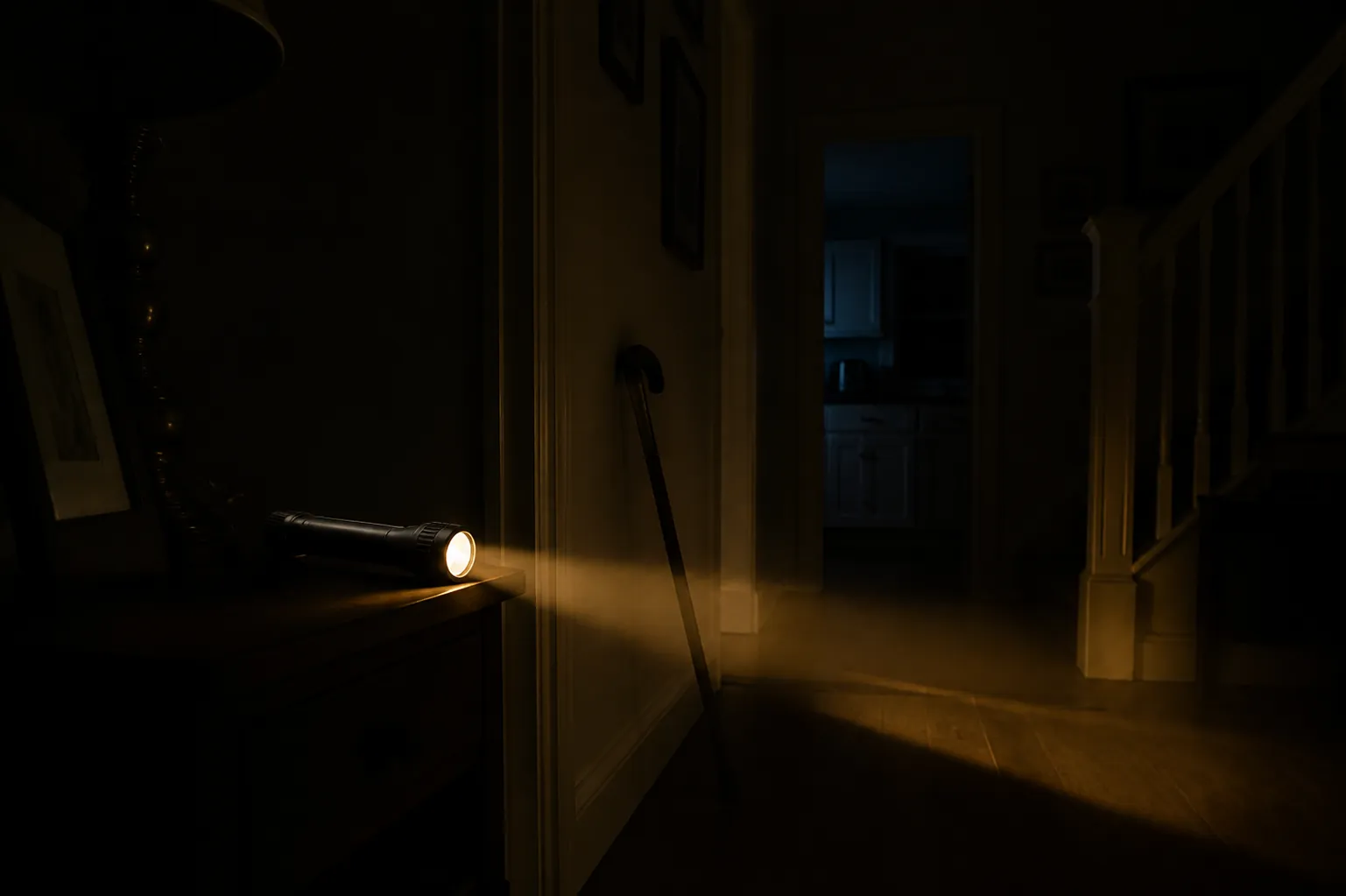
The baseline risk is already high before the storm or grid failure starts. The CDC reports that more than 1 in 4 adults age 65 and older falls each year, and about 3 million older adults are treated in emergency departments annually for fall injuries [1]. A 2020 narrative review of power outages and community health includes falls among documented outage-related health concerns, alongside carbon monoxide poisoning, fire, heat, and cold [2]. Ready.gov’s home fall-prevention guidance points directly at the household details that matter here: low lighting, night lights, clutter, cords, and clear walkways [3]. For outage lighting, Ready.gov and the CDC both steer people toward battery-powered flashlights or lanterns instead of candles because candles add fire risk [4][5].
So the plan below is deliberately narrow. It is not a full severe-weather kit, and it should sit beside one. For the broader food, water, medication, communication, and shelter planning, use the companion severe weather preparedness checklist for older adults. This article is about the dark walk through the house.
Before the outage: set up the house for the walk that will actually happen
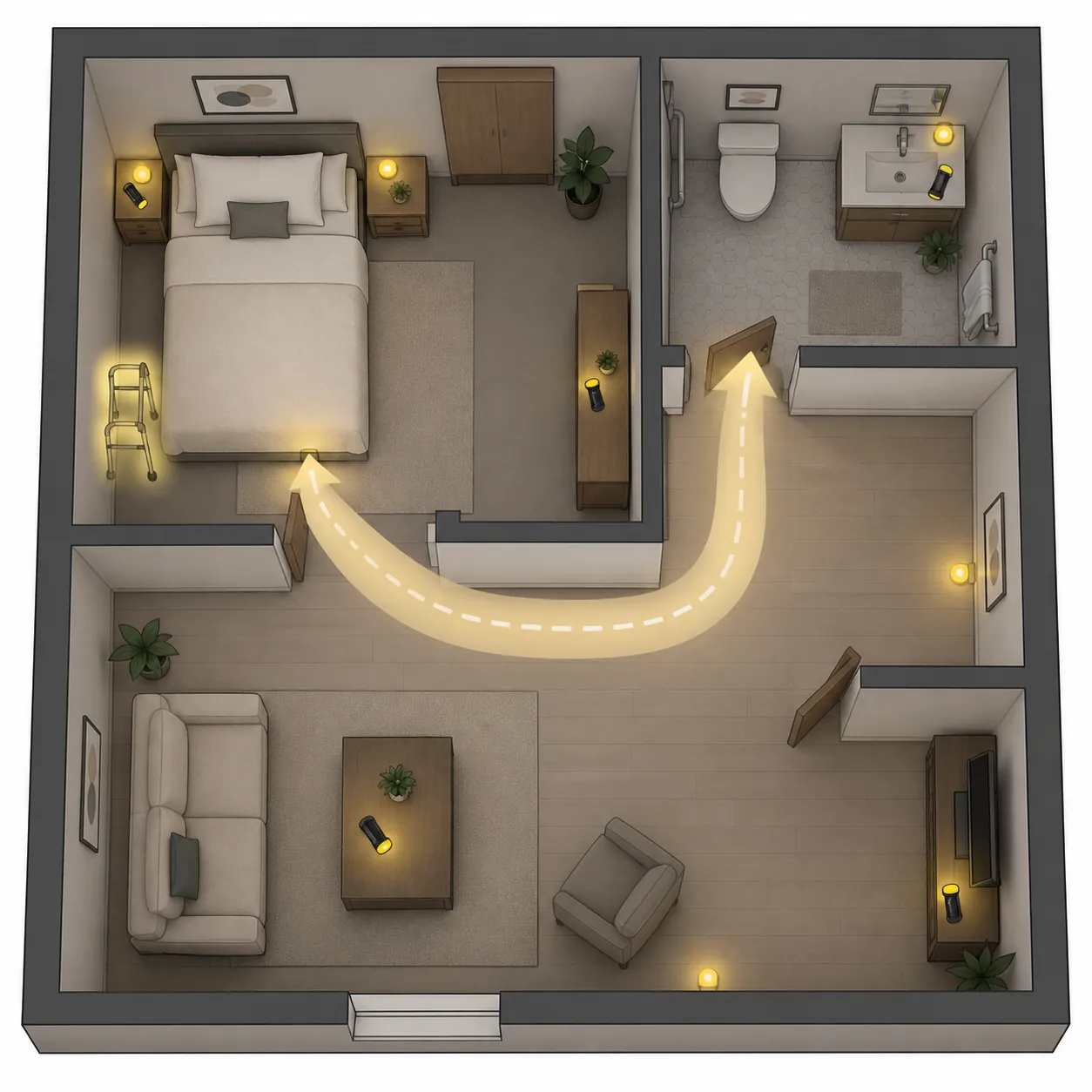
Do this in daylight. Walk from the bed to the bathroom, from the favorite chair to the kitchen, from the bathroom to the bedroom, and from the main sitting area to the exit. Do not look for “emergency supplies” first. Look for the places where someone would put a hand out, catch a toe, turn too sharply, or abandon a walker because the route is blocked.
| Area | Set up before the outage | Why it matters in the dark |
|---|---|---|
| Bedside | Put a working flashlight or battery lantern within arm’s reach. Keep the cane, walker, glasses, hearing aids, and sturdy footwear in the same reachable zone. | The first move should be reaching for light while seated, not standing and searching. |
| Bedroom-to-bathroom path | Clear clothing, cords, baskets, pet beds, throw rugs, and furniture corners from the route. Add night lights, battery night lights, or glow-in-the-dark switch markers where appropriate. | This is often the trip people make when sleepy, urgent, and least patient. |
| Bathroom doorway and floor | Remove loose mats or tape down edges that curl. Keep the doorway wide enough for the walker or cane actually used at night. | A narrow or cluttered bathroom entrance turns a familiar doorway into a pivot point. |
| Hallway and stairs | Place flashlights or lanterns at both ends of the hall and near stair access. Mark step edges if stairs may be used. | Low light makes depth and edges harder to judge, especially when someone is already moving cautiously. |
| Favorite chair and living room | Keep a flashlight beside the chair, not across the room. Clear cords from lamps, chargers, oxygen equipment, fans, and medical devices. | Many outages begin while someone is sitting, watching TV, reading, or using a device. |
| Kitchen | Put a lantern on an easy-to-reach counter. Clear the route to water, medication, and a phone charger or backup battery. | The kitchen becomes a supply area during an outage, so the path to it needs to stay open. |
| Entry and exit route | Keep shoes, keys, coat, mobility aid, flashlight, and go-bag accessible without crossing clutter. | If leaving becomes necessary, the exit should not be a new obstacle course. |
Ready.gov recommends improving low lighting with night lights and keeping walkways clear as part of home fall prevention [3]. A commercial outage-tracking site, PowerOutage.us, gives similar practical advice for seniors, including keeping flashlights in multiple rooms and recognizing that darkness can make familiar rooms harder to navigate; use that as corroboration, not as the main safety authority [6].
The bedside zone is the highest-value fix
If you only have fifteen minutes today, fix the bedside area. Put the flashlight where the older adult’s hand naturally lands. Test whether it can be turned on by touch, not by reading a tiny switch. If the person uses a walker, the walker belongs beside the bed, not folded in a corner because it looks neater. If they use a cane, it needs a stable resting place where it will not slide flat under the bed.
Add glasses and shoes to the same zone. Bare feet on a cold floor, slippers with weak backs, and searching for glasses in the dark all create unnecessary movement before the person is ready to walk. The goal is not to make the room look like a clinic. The goal is to remove the first blind reach.
The bathroom route needs a stricter standard than the rest of the house
The bathroom path should be boring. No decorative stool that has to be angled around. No laundry basket that “usually” stays out of the way. No rug that is safe only when someone can see its edge. If the older adult uses a walker, walk the route with the walker. A hallway that is technically open may still force the walker into a wall, a doorframe, or a rug corner.
Mark the path with light, not memory. Plug-in night lights are useful when power is on, but a power outage needs battery backup or glow-in-the-dark markers as well. Glow markers can help identify a switch plate, a bathroom doorway, or the edge of a doorframe. They are not a substitute for a flashlight or lantern; they are breadcrumbs.
Rugs, cords, and thresholds should be handled before anyone is tired
Loose rugs are not emergency supplies, but they may decide the emergency. Remove them from the bedroom-to-bathroom route or secure them so the edges cannot curl. Do the same with cords. Phone chargers, oxygen tubing, fan cords, power-strip cords, and extension cords are easier to excuse in daylight because everyone can step over them. That is not the test.
Thresholds deserve attention, too. A small lip between bedroom and hallway or hallway and bathroom can catch a slipper, walker foot, or tired toe. If it cannot be modified, mark it and make sure the person knows to slow down there during an outage.
Use battery-powered light, not candlelight
Candles feel simple until someone has to carry one, set it down near paper, lean over it, or navigate oxygen tubing. Ready.gov recommends flashlights for emergency lighting and warns that candles can cause fires [4]. The CDC also advises using battery-powered flashlights or lanterns rather than candles during a power outage [5].
- Put one flashlight or lantern within reach of the bed.
- Put one beside the favorite chair or sofa.
- Put one in or just outside the bathroom.
- Put one near the kitchen route.
- Put one by the exit used most often.
- Check batteries on a routine schedule, not during the storm.
Lanterns are often better than narrow-beam flashlights for rooms where the person needs both hands. A headlamp can help some older adults, but only if it is comfortable, easy to turn on, and already familiar. Do not introduce unfamiliar equipment at midnight and call it preparedness.
Printable fall-prevention checklist for an older adult’s power outage plan
This is the checklist to tape inside a cabinet, keep with the emergency plan, or review with a parent before storm season. It is intentionally focused on falls.
- Bedside flashlight or lantern works and can be reached while seated.
- Cane, walker, wheelchair, glasses, hearing aids, and sturdy footwear are kept beside the bed.
- Bedroom-to-bathroom path is clear enough for the actual mobility aid used at night.
- Loose rugs are removed or secured; curled rug edges are fixed.
- Cords, tubing, baskets, pet items, and small furniture are out of walking routes.
- Bathroom doorway, toilet approach, and sink route are open and not blocked by mats or storage.
- Battery night lights, lanterns, or glow markers identify the bathroom path and key switches.
- Flashlights or lanterns are placed in the bedroom, bathroom route, living area, kitchen, and exit area.
- Stair access is blocked off if stairs should not be used in the dark, or marked and lit if stairs are unavoidable.
- Phone, medical alert device, or communication method is reachable from the bed and favorite chair.
- The older adult has practiced the rule: sit first, find light, then stand.
- A neighbor, family member, or caregiver knows when to check in if the outage lasts.
During the outage: sit until light is located
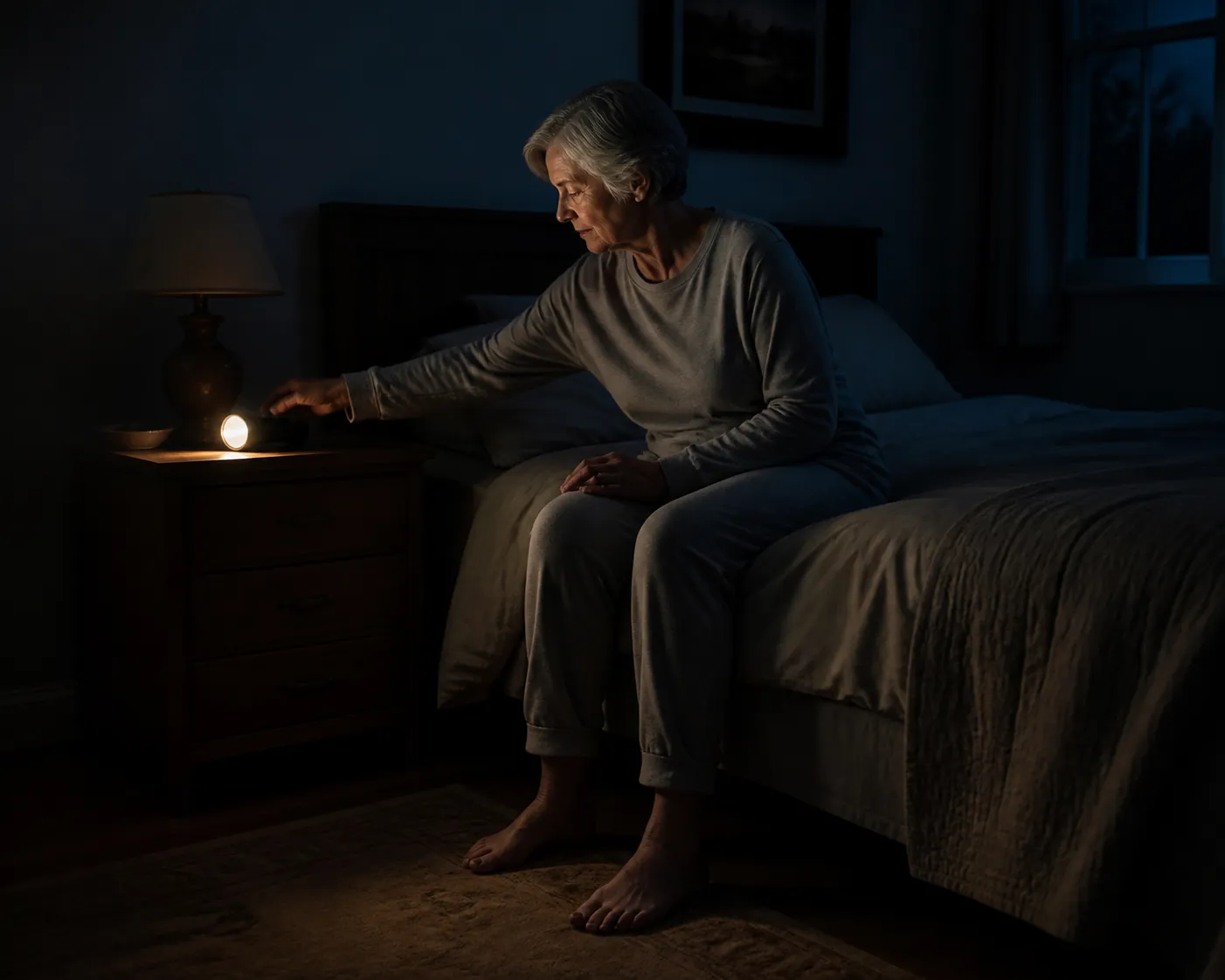
The most important rule during the outage is plain: do not stand up and start walking while looking for light. Sit still. Put both feet on the floor. Find the flashlight, lantern, phone light, or call button. Turn on the light. Then reach for the cane, walker, shoes, or glasses before standing.
That rule may feel fussy until the lights fail at the wrong moment. It prevents the first rushed step, which is often the step that catches the rug edge, cord, pet bowl, or doorway threshold. If the older adult has urgency, dizziness, neuropathy, low vision, or a history of falls, this rule is not optional house policy; it is the outage plan.
- Stay seated when the lights go out.
- Call out or phone for help if another person is home.
- Locate and turn on a flashlight or lantern before standing.
- Put on glasses and secure footwear.
- Reach for the cane, walker, or wheelchair before taking the first step.
- Move only on the pre-cleared path.
- If dizzy, weak, confused, overheated, chilled, or unable to see the path, sit back down and call for help.
Keep trips short and purposeful
A power outage is not the time to tidy, search cabinets, carry laundry, or check every window. If the older adult must move, the route should have a reason: bathroom, medication, water, phone, safer temperature, or exit. Carrying objects while using a cane or walker is especially risky. Put needed supplies at reachable stations before the outage so the person is not tempted to roam.
For someone who uses a wheelchair or has limited transfer strength, the plan needs an extra layer: transfer routes, backup lighting at transfer points, battery status for powered mobility equipment, and a way to call for help without moving across the room. Use a dedicated wheelchair safety checklist for seniors at home for the equipment-specific details.
Do not let the outage turn into a stair problem
If the home has stairs, decide in advance whether they are part of the outage route. “We’ll be careful” is not a plan. If the older adult can stay on one level during an outage, set up that level with light, water, phone access, medication, bathroom access, and a resting place. If stairs are unavoidable, place lighting at the top and bottom, mark the edges if needed, and keep both hands free.
The same thinking applies to shelter routes during severe weather. If the outage is tied to a tornado warning or a move to an interior shelter space, review the separate guide to fall-proofing an elderly parent’s tornado shelter route. A short route can still be dangerous if it is dark, rushed, and cluttered.
When the outage lasts: know when fall prevention becomes evacuation planning
Some outages stay short. Others become temperature, medical-device, elevator, oxygen, medication-storage, or communication problems. At that point, the fall-prevention plan has to connect to a larger decision: is the home still safe enough to stay in?
Summer outages deserve particular attention because heat can weaken, confuse, or rush an older adult before a fall. If heat is part of the scenario, pair this checklist with a heatwave safety checklist for seniors living alone and the guide on why seniors living alone cannot trust thirst in extreme heat. If local officials issue an evacuation order or the home is no longer safe, use the evacuation response plan for what seniors should do when an evacuation order is given.
The move from “stay home” to “leave” also has fall hazards: dark parking lots, wet steps, crowded shelters, unfamiliar bathrooms, and hurried packing. Keep the go-bag, shoes, flashlight, mobility aid, medications, and keys together so leaving does not begin with a frantic search.
After power returns: check the path before normal routines resume
When the lights come back, people relax and start cleaning up. That is another easy time to fall. Before the older adult resumes normal movement, walk the main routes again. Look for flashlights left on the floor, cords pulled across walkways, extension cords, moved furniture, wet entryways, spoiled food bags near the kitchen path, and rugs shifted during the outage.
- Return the cane, walker, wheelchair, glasses, shoes, and flashlight to their assigned places.
- Replace used batteries or recharge lanterns and backup power banks.
- Clear temporary cords and charging setups from walking paths.
- Check that bathroom mats, rugs, and thresholds are still secure.
- Ask what was hard to reach or confusing in the dark, then fix that spot while it is still fresh.
That last question is useful because the home will tell you what the checklist missed. Maybe the flashlight was on the wrong side of the bed. Maybe the walker did not fit through the bathroom turn. Maybe the phone was charged but not reachable. Adjust the setup now, not during the next outage.
The standard is simple
A good outage plan for an older adult is not proven by how many supplies are stacked in a closet. It is proven by the first dark trip through the home. If the older adult can sit, reach light, put on glasses and shoes, take the correct mobility aid, and get to the bathroom or phone on a clear path without guessing, the plan is doing the job this checklist is meant to solve.
References
- Facts About Falls | Older Adult Fall Prevention | CDC, CDC
- Power outages and community health: a narrative review, Current Environmental Health Reports, 2020
- Preventing Falls at Home, Ready.gov
- Power Outages, Ready.gov
- What to Do to Protect Yourself During a Power Outage, CDC
- Power Outage Preparedness for Seniors & Elderly, PowerOutage.us
Related reading
Noticed something outdated or inaccurate on this page? Flag a correction. We review every report against CDC, NIA, and AARP HomeFit guidance before updating a page.
Part of the Fall Prevention section.