
STEADI: Intervene
Protect Older Adults From Volcanic Ash Slip Hazards
Volcanic ash is a documented fall hazard, not just a breathing hazard — thin layers of wet or dry ash are very slippery, and the most serious injuries occur during cleanup. Caregivers and older adults get an ash-specific fall-safety plan for walkways, entryways, and indoor floors, with a clear rule for who should do the cleaning and which jobs are off-limits.
A dusted walkway is no longer an ordinary walkway
Protecting older adults from volcanic ash exposure is usually discussed as a breathing problem. For a home fall-prevention plan, that is only half the job. The other half is the front step, the ramp, the driveway, the entry rug, and the kitchen floor after someone has tracked gray grit inside.
The CDC lists “injuries from falls” and vehicle accidents related to “slippery, hazy conditions caused by ash” among health concerns after a volcanic eruption. IVHHN is even more direct about the home-safety problem: thin layers of wet or dry ash can be very slippery because they reduce traction. That matters for any household. It matters more when the person crossing the surface has slower reaction time, weaker leg strength, a walker, a cane, neuropathy, low vision, or a history of falls. [1][2]
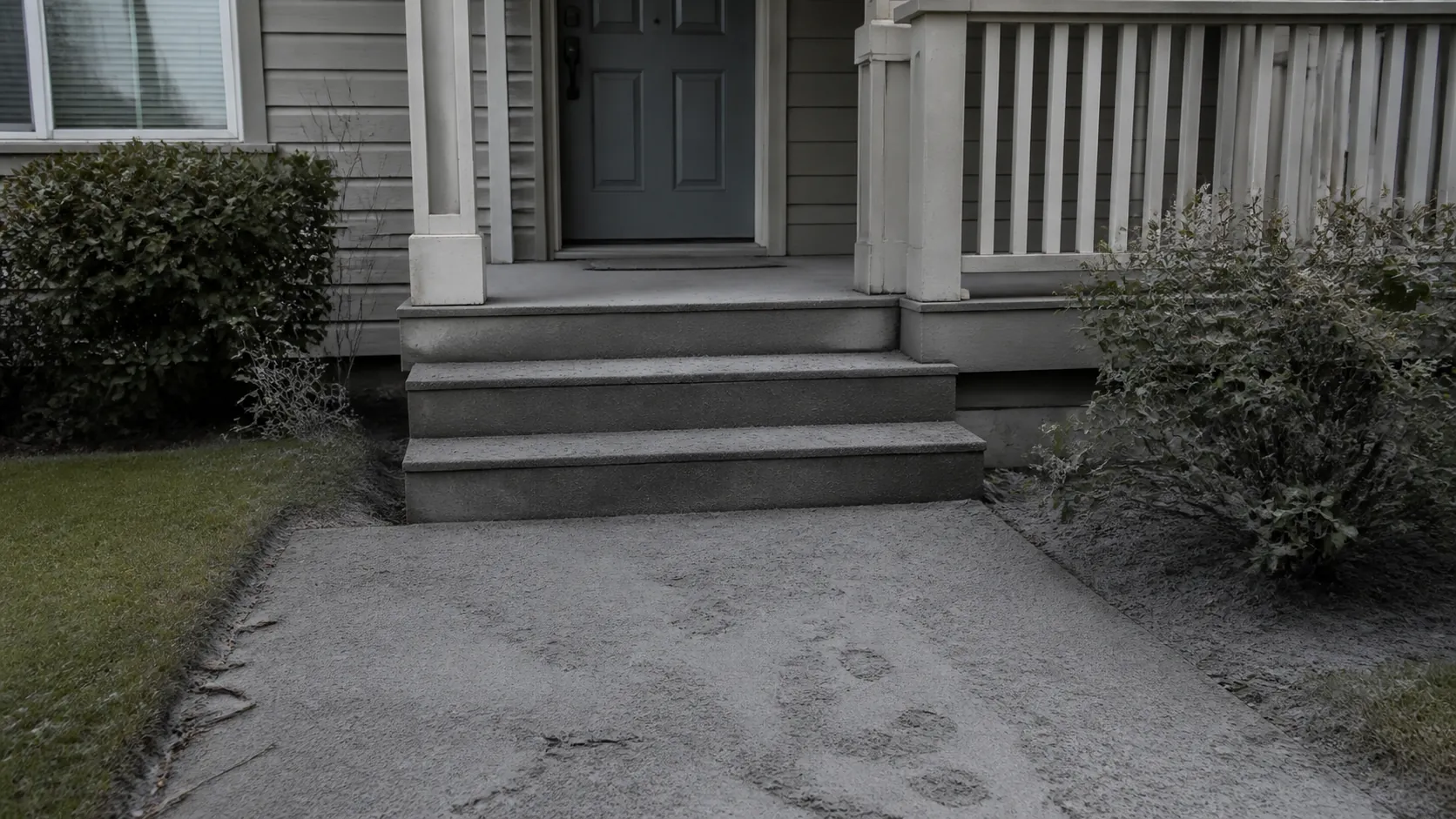
The mistake is treating ash like ordinary dirt. Dirt on a step is a nuisance. Ash on a step changes the surface. It can also make the air hazy enough that edges, cracks, and curb lines are harder to see. A walkway that looked safe yesterday may need to be treated like a wet leaf-covered path today: no casual trips to the mailbox, no “I’ll just sweep a little,” and no testing the surface with an older adult’s balance.
Start with the cleanup decision, not the broom
The first household rule should be decided before anyone opens the door: the older adult is not the cleanup crew. That can feel heavy-handed, especially when the person is capable, proud, and used to handling their own home. But ash cleanup is exactly the kind of task that quietly stacks risks: slippery footing, repetitive bending, reduced visibility, heavier-than-expected material, and fine particles stirred back into the air.
USGS warns that ash-covered surfaces are slippery and that many injuries and some fatalities have occurred during roof ash-clearing, from falls or roof collapse. USGS also describes cleanup as physically demanding and notes that ash may be heavier than people expect. That is enough to make cleanup a delegation problem, not a chore list for the older adult. [3][4]
The breathing issue supports the same decision. USGS explains that avoiding exertion matters because heavier breathing can draw particles deeper into the lungs. ANTHC notes that serious secondary health problems related to ash are rare but usually occur during cleanup, and that falls from ladders and roofs can be deadly. The American Lung Association advises sensitive populations, including older adults, to avoid cleanup duties if possible and notes that cleanup can re-disperse ash into the air. [5][6][7]

For families that have already made a post-storm cleanup plan, use the same chain of command and make it stricter. The ash-specific version of post-storm cleanup fall safety is simple: younger, steadier helpers clear the surfaces first; the older adult waits on a clean, dry, well-lit indoor path.
| Task | Fall-safe household rule |
|---|---|
| Clearing walkways, steps, ramps, porch landings, and the route to the car | Younger helper does it before the older adult uses the route. |
| Managing shoes, mats, bags, pet paws, and tracked-in grit at the door | Caregiver or younger helper controls one entry point and keeps ash from spreading. |
| Cleaning fine ash from indoor hard floors | Use damp methods; keep the older adult off the floor area until it is clean and dry. |
| Shoveling ash, climbing a ladder, clearing gutters, or working on the roof | Off-limits for the older adult. |
The three ash fall-zones around the home
Think of the home in three zones: outside walking surfaces, the entry point, and indoor floors. The goal is not to make the older adult “be careful” in all three places. The goal is to keep ash from becoming a walking surface in the first place.

Zone 1: outside walkways, steps, ramps, and driveways
Outside is where thin ash can be most deceptive. A light gray coating may look less threatening than snow or ice, but IVHHN’s warning covers thin layers, wet or dry. A caregiver should not wait for ash to look deep before taking it seriously. [2]
Clear the outside route the older adult actually uses: front door to mailbox if that trip is truly necessary, door to car, ramp to driveway, and any garage path. Steps and threshold lips deserve more attention than open flat pavement because a small traction loss at an edge can become a full fall before the person has time to correct.
- Block off unused doors so no one creates a second ashy path by accident.
- Clear the full width needed for a walker, cane, or caregiver-assisted walk, not just a narrow strip.
- Check porch steps, ramp transitions, curb cuts, garage thresholds, and the place where the person turns to lock the door.
- Do not ask the older adult to “test” whether the path is safe. A steadier helper checks it first.
Visibility belongs in the same decision. If ash is still hazy enough that contrast is poor, an older adult may not see the step edge, loose mat, garden hose, curb, or uneven slab. That is a go/no-go problem, not a pep talk. Caregivers who already use a weather-based outing rule can adapt the same thinking from bad-weather outdoor safety for seniors and neighborhood fall-safety checks: if the route cannot be seen clearly and walked with normal traction, the trip waits.
Zone 2: the entry point, where ash tries to become an indoor fall hazard
The entry point is where good housekeeping becomes fall prevention. Every extra doorway spreads the problem. Pick one controlled entrance and make that the only door used until the outside routes and indoor floors are clean.
At that door, shoes stop. Bags stop. Pet paws stop. A helper handles anything gritty before it crosses into the main walking path. The older adult should not have to balance on one foot at the threshold, twist to remove shoes, or step over a pile of cleanup supplies. Those little entryway gymnastics are how a prevention plan defeats itself.
- Keep a chair just inside the clean side of the doorway if shoes must be changed.
- Keep ash-covered footwear, outer layers, bags, and tools out of the older adult’s walking route.
- Do not let a temporary mat bunch, curl, or slide. A dirty but flat entry is safer than a “helpful” loose rug.
- Assign one person to watch the threshold during cleanup, especially if neighbors, relatives, or contractors are coming in and out.
This is also where the air-control plan can connect to the fall plan. If the household is using a cleaner indoor room during an ash or smoke event, keep that room away from the entry traffic whenever possible. For the sealing and filtration side of that setup, see CareWise Guide’s clean air room guide for seniors. Here, the fall-prevention point is narrower: do not let the cleanest indoor walking area become the place where shoes, tools, and gritty floor film collect.
Zone 3: indoor floors with fine ash tracked across them
Fine ash on a hard floor should not be treated like ordinary dust. It can create a slick film, especially where people turn, stop, or push off: beside the bed, in front of the toilet, at the kitchen sink, near the favorite chair, and along the route from the entry to the bathroom.
CDC guidance after a volcanic eruption supports damp-cleaning methods indoors: use damp cloths instead of dry sweeping, and do not use a standard vacuum because it can blow fine ash back into the air. That recommendation serves both sides of this problem. It reduces re-suspended particles, and it avoids turning a dusty fall hazard into an airborne one while someone is standing over it. [8]
- Keep the older adult off the floor section being cleaned until the surface is clean and dry.
- Prioritize bathroom paths, bedroom paths, kitchen work areas, and the route to the main chair before less-used rooms.
- Avoid dry sweeping that pushes ash into a wider film.
- Avoid standard vacuuming unless local guidance or equipment instructions specifically support it for ash; CDC warns that ordinary vacuuming can blow fine ash back into the air. [8]
The caregiver’s check is practical: can the older adult walk from the bed to the bathroom, from the chair to the kitchen, and from the entry to the main living area without crossing grit? If not, the indoor cleanup is not finished, even if the room looks mostly tidy.
Roof, ladder, and shoveling work is a hard no
This rule does not need softening: the older adult does not clear the roof, climb a ladder, clean gutters, shovel ash, or carry heavy ash loads. Not “only the porch roof.” Not “just one ladder step.” Not “while someone watches.”
IVHHN reports that, in several eruptions, people have died after falling from roofs while cleaning ash. USGS warns about injuries and fatalities during roof ash-clearing from falls or roof collapse. ANTHC also states plainly that falling from ladders and roofs can be deadly. [2][3][6]
A person can be strong for their age and still have too little reserve for this job. The hazard is not only muscle. It is balance while looking up or down, footing on a contaminated surface, fatigue, awkward tool handling, and the temptation to keep going because the job is “almost done.”
If an older adult insists on helping
Independence matters. So does not turning independence into a cleanup injury. If the older adult wants a role, give them one that does not put them on ash, on a ladder, or in a cloud of disturbed particles.
- They can sit in a clean indoor area and call relatives, neighbors, or local services for help.
- They can make a written list of medications, mobility aids, pet needs, and essential appointments so the caregiver can decide what trips truly matter.
- They can identify the normal walking routes in the home so helpers clear the right surfaces first.
- They can report symptoms or fatigue, but medical questions should go to a clinician or local public health guidance.
What they should not do is sweep the porch to “save someone a trip,” step outside to judge the driveway, or start wiping floors while other people are still tracking ash through the house. Those are not small contributions. They are exposure points.
The household rule for today
For an older adult’s home, the fall-safe ash plan is this: younger helpers clear ashy walking surfaces before the older adult uses them; the household uses one controlled entry point so ash stops at the door; indoor floors are cleaned with damp methods instead of dry sweeping or ordinary vacuuming; and the older adult does not shovel, climb, or clear the roof.
Educational note: This article is for general fall-prevention education and is not medical advice. Follow local emergency management and public health instructions during an ashfall event, and contact a qualified clinician for personal medical guidance.
Reviewed by: Marisol Vega, RN, BSN, CAPS — geriatric registered nurse and Certified Aging-in-Place Specialist.
References
- Volcanoes and Your Safety — Centers for Disease Control and Prevention
- Health impacts of volcanic ash — International Volcanic Health Hazard Network
- Volcanic Ash Impacts & Mitigation: Safety Considerations — U.S. Geological Survey
- Protecting Against Ash — U.S. Geological Survey
- Volcanic Ash Impacts & Mitigation: Health — U.S. Geological Survey
- Protect yourself and community against volcanic ash — Alaska Native Tribal Health Consortium
- Volcanic Eruptions — American Lung Association
- Safety Guidelines: After a Volcanic Eruption — Centers for Disease Control and Prevention
Related reading
Noticed something outdated or inaccurate on this page? Flag a correction. We review every report against CDC, NIA, and AARP HomeFit guidance before updating a page.
Part of the Fall Prevention section.