
STEADI: Intervene
How Much to Drink in Heat When Seniors Have Fluid Limits
Older adults on a doctor-ordered fluid limit can't safely follow the standard 'drink 2-4 glasses an hour' heat advice. This guide covers getting a heat-specific number from the prescriber, stretching the daily allowance, and knowing which warning signs mean call the doctor versus call 911.
Hot-weather advice often starts with a simple instruction: drink often, and do not wait until you feel thirsty. Then a caregiver opens the medication list or discharge papers and sees the opposite kind of instruction: daily fluid limit, water pill, heart failure plan, kidney disease plan. Both instructions may be trying to prevent harm. They just are not written for the same person.
The CDC names this conflict directly for older adults: people whose doctors limit how much fluid they drink, or who take “water pills,” should ask how much they should drink during hot weather. [1] That one sentence matters more than any universal hydration slogan.

A good example of the advice that causes confusion appears in New York State Office for the Aging extreme heat resources: older adults are told to drink “at least 2-4 glasses of water per hour” during extreme heat. [2] That may be useful general heat guidance for many people. It is not a number to apply literally to an older adult who has been prescribed a fixed daily fluid cap.
The question is therefore not, “How much should every senior drink in hot weather?” It is: “What heat-specific amount has this person’s prescriber approved, and how will the household follow it without guessing?”
Start with the number this person is actually allowed to use
For an older adult on a fluid limit, the safest heat plan begins before the hottest afternoon. Call the prescriber, cardiology office, nephrology office, dialysis team, primary care clinician, or home health nurse and ask for a heat-specific plan. If a heat wave has already started, make the call anyway. This is not a nuisance question; it is exactly the situation the CDC warns about. [1]
Do not ask only, “Should Mom drink more?” That invites a vague answer. Ask for the number and the counting rules.
| Ask the care team | What you need to write down |
|---|---|
| What is the total fluid allowance for a very hot day? | A daily amount, not just “drink more” or “be careful.” |
| Does the usual daily limit change during this heat wave? | Yes, no, or only under specific conditions. |
| What counts as fluid? | Water, coffee, tea, juice, ice, soup, gelatin, ice cream, or other fluid-containing foods if the team wants them counted. |
| Should any medication instructions change during extreme heat? | Only clinician-approved changes, especially for diuretics or blood pressure medicines. |
| What signs mean call the office the same day? | The person-specific triggers, plus who to call after hours. |
| What signs mean call 911? | Emergency symptoms that should not wait for a callback. |
For heart failure, published advice is not the same as a personal prescription. The British Heart Foundation explains that, under NICE-based guidance, some people with severe heart failure may be asked to restrict fluids to about 1.5 to 2 liters a day, or roughly 6 to 8 cups, and it specifically advises checking with the care team about fluid restriction in hot weather. [3] That range can help a caregiver understand why “2-4 glasses per hour” may be a mismatch, but it does not replace the number on this patient’s plan.
For kidney disease, the same caution applies in a different way. The National Kidney Foundation says fluid limits are mainly an issue for people in later-stage CKD, especially stage 4 to 5 or dialysis, and gives the rule of thumb that if urine is coming out, fluid can go in. [4] That is a kidney-disease principle, not permission for a caregiver to change a cardiology, nephrology, or dialysis order independently.
Spend the daily allowance deliberately
Once the care team gives a heat-day amount, the job at home becomes less abstract. The household is no longer debating whether generic heat advice or the old fluid cap “wins.” It is managing a fixed allowance.

A simple way to do that is to measure the day’s approved amount into a pitcher, marked bottle, or written tally. Every drink comes out of that allowance. If the clinician says certain foods count, those need to be counted too. The British Heart Foundation specifically includes fluid-containing foods such as soup, jelly (gelatin), and ice cream when describing fluid restriction management. [3]
The practical plan can be very plain:
- Write the approved heat-day amount where everyone can see it.
- Choose one measuring method: a marked pitcher, a measuring cup, pre-filled small cups, or a paper tally.
- Reserve some fluid for the hottest part of the day instead of finishing most of it in the morning.
- Use small sips spread through the day rather than large, anxious servings.
- Count fluid-containing foods if the care team includes them in the limit.
- Keep a little allowance available for taking pills safely, unless the care team gives different instructions.
This is where many families accidentally lose track. A cup of coffee, a bowl of soup, and a dessert that melts at room temperature may feel different from “drinking water,” but they may still matter under a fluid restriction. The point is not to make the day miserable. It is to prevent a quiet math error from becoming shortness of breath at night or dizziness in the bathroom.
Cooling the person and the room helps protect the fluid allowance. Shade, air conditioning, cool showers if safe, light clothing, and a cooler room reduce the pressure to solve heat exposure only by drinking. For broader household planning, use a full heat wave safety checklist for seniors and a red-alert plan before the day becomes a scramble.
What to watch after the plan starts
A heat-day fluid plan is not “set it and forget it.” Older adults can tip toward dehydration, fluid overload, medication side effects, heat illness, or falls. The observations at home do not diagnose the problem, but they tell the caregiver when the plan needs medical input.
Urine is a clue, not the whole answer
The American Red Cross includes urine color as one way to monitor hydration during extreme heat. [5] Darker urine, much less urine than usual, or a sudden change from the person’s normal pattern should get attention, especially if it comes with dizziness, weakness, confusion, or extreme thirst.
But urine checks have limits. Kidney disease, diuretics, urinary problems, and some medications can change what a caregiver sees. Use urine as one observation to report, not as a reason to override the fluid limit.
Daily weight catches changes a caregiver may not see yet
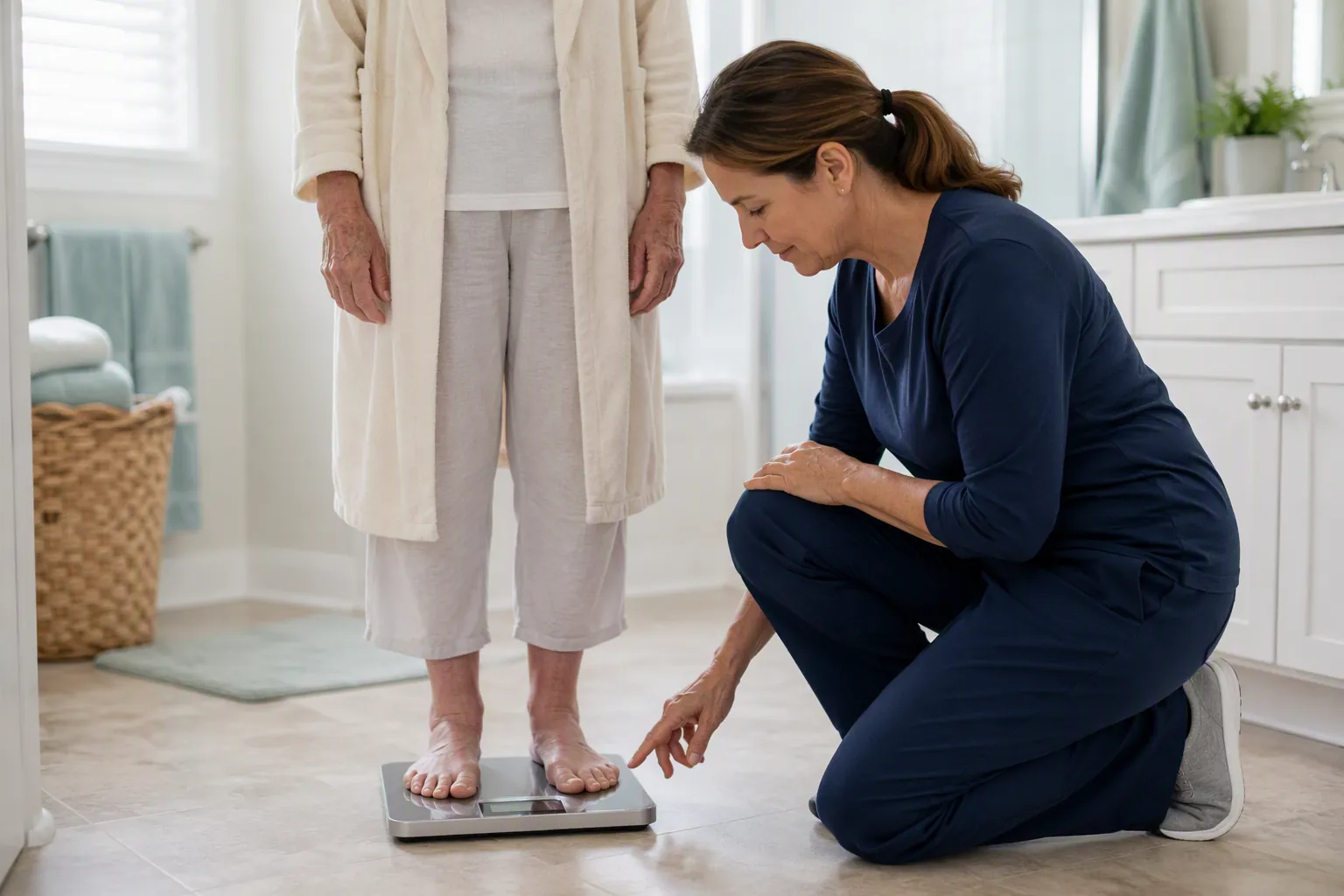
If the care plan already includes daily weights, keep doing them during hot weather. Use the same scale, about the same time of day, with similar clothing. Write the number down. A caregiver trying to remember yesterday’s weight while also managing heat, meals, pills, and worry is being asked to do too much.
For heart failure, the British Heart Foundation lists sudden weight gain, increased swelling, more breathlessness, extreme thirst, and dizziness as reasons to contact the care team when managing fluid restriction in hot weather. [3] Notice the pattern: the same day can hold signs of too little fluid and signs of too much fluid. That is why the response is a call, not a home experiment with the limit.
For people on hemodialysis, the National Kidney Foundation gives a more specific weight-gain boundary: between treatments, weight gain should generally be no more than about 2.2 pounds, or 1 kilogram. [4] Keep that in its lane. It is a dialysis-specific guidepost, not a universal trigger for every older adult with heart failure or every person taking a diuretic.
Call the doctor versus call 911
The hardest part of caregiving in a heat wave is not reading advice. It is deciding what to do at 7 p.m. when the office is closed, the parent says they are thirsty, their ankles look different, and the forecast still looks ugly tomorrow. A written threshold prevents the household from turning every symptom into a debate.
Call the doctor or care team promptly
Use the care team’s own instructions first. If they did not give symptom thresholds, ask for them. In general, the British Heart Foundation’s hot-weather fluid restriction advice points to the same kinds of changes a caregiver should not sit on: sudden weight gain, increased swelling, more breathlessness, extreme thirst, or dizziness. [3]
- Call if weight rises suddenly according to the person’s heart failure or kidney plan.
- Call if swelling in the feet, ankles, legs, hands, or abdomen increases.
- Call if breathlessness is worse than usual, especially if it changes how the person walks, sleeps, or talks.
- Call if thirst is extreme or hard to manage within the approved allowance.
- Call if dizziness, lightheadedness, or near-fainting appears, because heat can raise fall risk fast.
- Call if urine output or color changes sharply from the person’s normal pattern.
Dizziness and near-fainting deserve extra respect in an older adult. Heat, dehydration, blood pressure changes, and medications can combine into a fall before anyone has time to sort out the exact cause. For that broader chain, see how summer heat increases fall risk in older adults.
Call 911 for emergency heat illness signs
If heat stroke is suspected, do not wait for the doctor’s office to call back. Follow emergency guidance and call 911. The Red Cross also warns not to give fluids to someone who is not fully awake. [5] That rule matters in this article because panic often makes people reach for water first. If the person is not fully awake, drinking can be unsafe.
Use the site’s detailed guide to heat stroke in seniors and when to call 911 for the full emergency checklist. If there is confusion, loss of consciousness, severe weakness, collapse, or any other sign that feels like a heat emergency, the safer call is emergency care, not an at-home adjustment to the fluid limit.
What the newer heart-failure evidence does, and does not, change
Families may reasonably wonder whether strict fluid limits are always necessary. In 2025, the American College of Cardiology reported results from the FRESH-UP trial: among 504 stable heart-failure patients, restricting fluid intake to 1,500 mL per day did not show benefit compared with liberal fluid intake. [6]
That finding is important, but it is not a home instruction. It studied stable heart-failure patients, and it supports clinician-directed reconsideration of blanket restriction. It does not authorize a caregiver to drop an existing fluid cap during a heat wave, especially when the person’s actual diagnoses, kidney function, diuretic dose, swelling pattern, and recent hospital history are not captured by the headline.
If the result makes you question whether the current limit still fits, that is a good topic for the prescriber. It is not a reason to treat “drink 2-4 glasses an hour” as the new plan.
The heat plan that belongs on the refrigerator
For an older adult with a doctor-ordered fluid limit, a usable hot-weather plan has four parts. It has the prescriber-approved heat-day number. It has one counting method for drinks and fluid-containing foods. It has daily observations such as urine pattern and weight. And it has written call thresholds for the doctor and for 911.
The rest of heat safety still matters: cooling the home, reviewing heat-sensitive medicines, knowing the red-alert plan, and spotting heat illness before a fall. Use the broader red alert heat safety guide and heat stroke symptom guide for those decisions.
So do not follow the hourly “2-4 glasses” rule literally for someone on a prescribed fluid limit. Do not loosen the cap independently because it is hot. Get the heat-specific number, spend the allowance on purpose, check the scale and urine pattern, and use the agreed call thresholds when the day stops looking routine.
References
- Heat and Older Adults (Aged 65+), CDC.
- Extreme Heat Resources, New York State Office for the Aging.
- How do I manage fluid restriction in hot weather?, British Heart Foundation, updated Apr 2026.
- The Dos and Don'ts of Fluid Management for Kidney Disease, National Kidney Foundation.
- Extreme Heat Safety, American Red Cross.
- Limiting Fluid Intake May Not Be Needed for Some People With Heart Failure, American College of Cardiology, Mar 30 2025.
Related reading
Noticed something outdated or inaccurate on this page? Flag a correction. We review every report against CDC, NIA, and AARP HomeFit guidance before updating a page.
Part of the Fall Prevention section.