
STEADI: intervene
Seniors' Three-Stage Action Plan for Flash Flood Warnings
This guide translates the three National Weather Service alert levels—Flood Watch, Flood Warning, and Evacuation—into clear, senior-specific steps for older adults with mobility limitations, medication needs, or medical devices. Learn what to do at each stage to stay safe when flash flood warnings are issued.
If a Flood Watch appears on the phone, radio, or TV, that is not a quiet period for an older adult who needs extra time to move. It is the main preparation window. A Flash Flood Warning may come when water is already rising, roads are already closing, or the safest path through the house is already wet.
Flash floods can develop in less than six hours, and they can happen even where it is not raining if heavy rain falls upstream.[1] That timeline matters differently for someone who needs a walker, hearing aids, oxygen tubing, a charged phone, daily medications, or another person to drive.
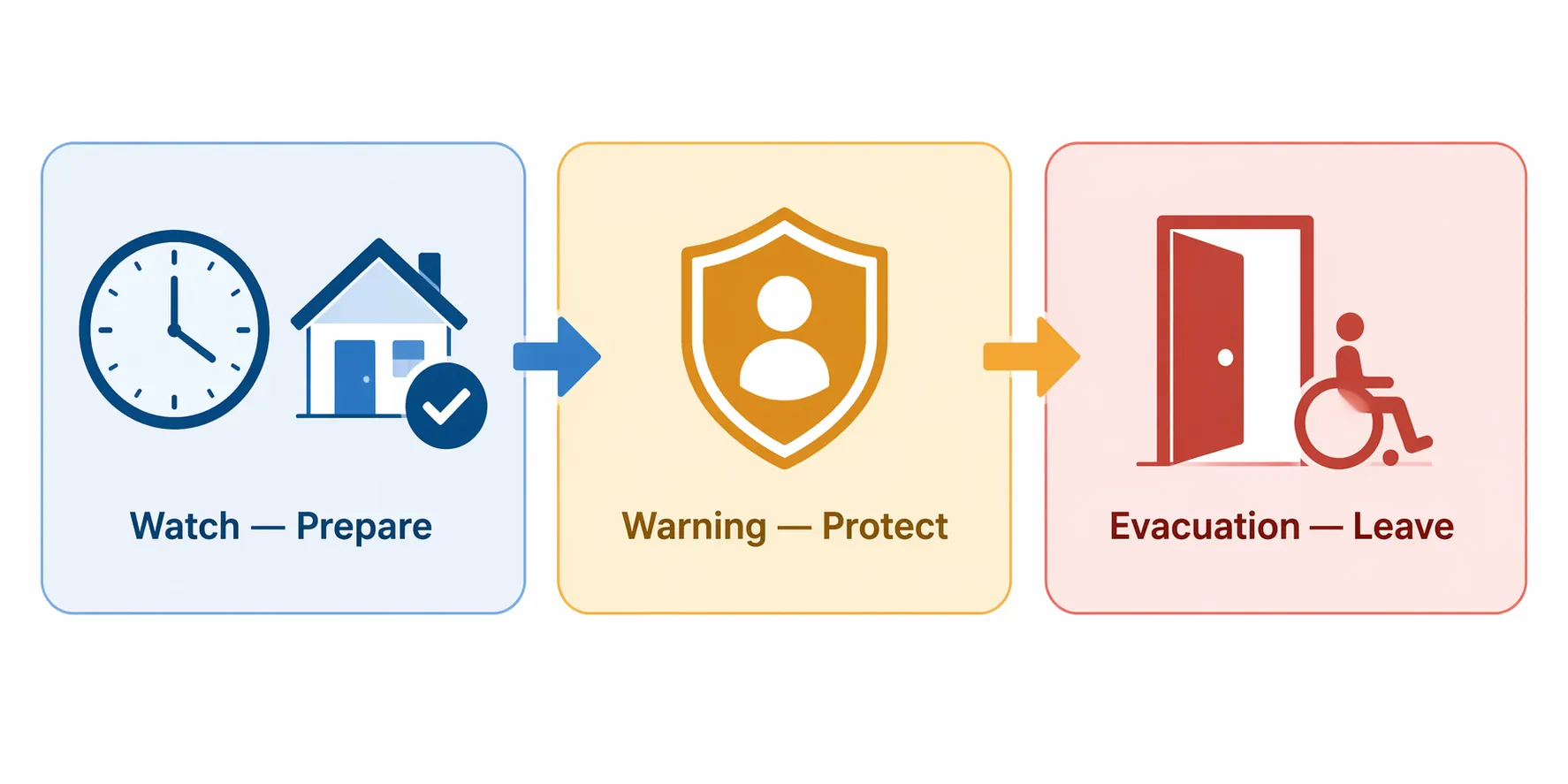
The three alert stages, translated for slower movement
The National Weather Service uses flood alerts to describe changing levels of danger. For seniors and caregivers, the practical meaning is less about the wording and more about what can still be done safely at that point.
| Alert stage | Plain meaning | Senior-specific action |
|---|---|---|
| Flood Watch | Flooding is possible. | Prepare now: gather essentials, activate help, charge devices, confirm transportation, and decide whether leaving early would be safer. |
| Flood Warning | Flooding is happening or expected soon. | Protect life: stop unnecessary movement, avoid floodwater, move to safer ground if you can do so without crossing water, and keep medications and devices within reach. |
| Evacuation order or instruction | Local officials are telling people to leave a dangerous area. | Leave using the plan already started during the Watch. Do not spend this stage searching the house for missing items. |
This is why emergency preparedness for seniors during a flash flood warning starts before the warning. More than 4,000 flash flood warnings are issued each year in the United States, so this is not exotic disaster planning; it is a recurring home-safety problem with very little margin for delay.[2]
At Flood Watch: prepare as if later movement will be harder
A Flood Watch is the stage for ordinary-looking tasks that become unsafe when rushed. Shoes are found. The walker is moved close to the chair. The pill organizer is put in the bag instead of left on the counter. The phone charger is unplugged before the lights flicker. The person who promised to drive is called while roads are still passable.
Older adults are not a small footnote in flood planning. After Hurricane Katrina, people age 75 and older accounted for 50% of deaths while making up 6% of the population in the affected area, according to AARP’s Disaster Resilience Tool Kit.[3] Flash flood planning should not wait until a frail person has to move quickly through water, darkness, noise, and confusion.
Start the support chain before anyone sounds urgent
The first call during a Watch should not be dramatic. It should be specific: “There is a Flood Watch. I am starting the plan. Can you confirm whether you can drive if we need to leave?”
- Call or text the primary helper, backup helper, and nearby neighbor.
- Confirm who has a key, who can drive, and who can physically help with stairs, ramps, oxygen equipment, or a wheelchair.
- If the older adult lives alone, set a check-in schedule rather than waiting for them to report trouble.
- If phone service is unreliable, agree on one short status phrase such as “I am upstairs,” “I am leaving,” or “I need a ride.”
Ready.gov advises older adults to build a support network that can help during emergencies, including people who know where supplies are kept and how to operate needed equipment.[4] That network is most useful when it is activated early enough to do more than worry from a distance.
Gather what must stay with the person, not what would be nice to save
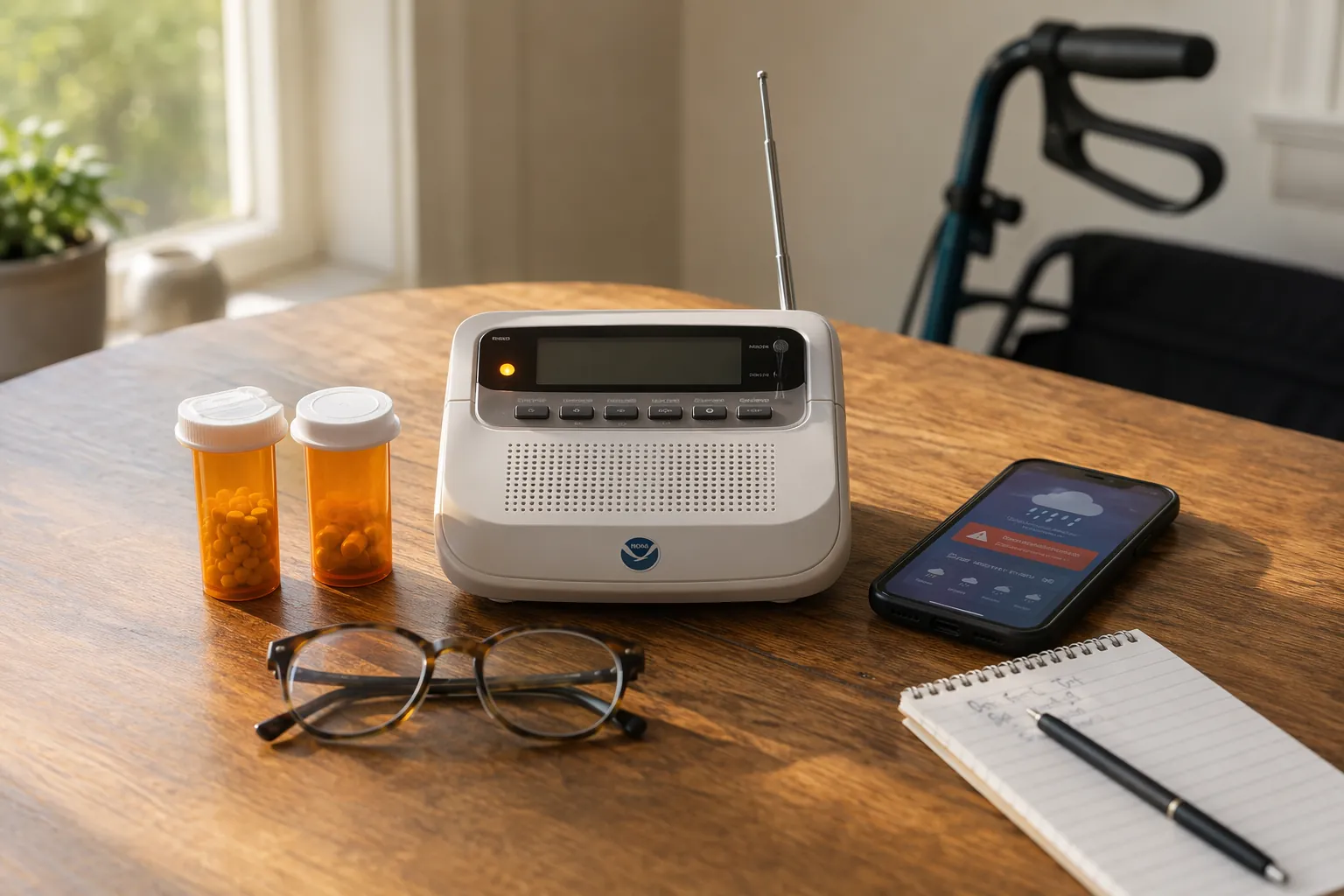
During a Watch, bring senior-specific essentials to one reachable place near the safest exit or the room where the person will wait. This is not the moment to pack the whole house. It is the moment to stop life-sustaining items from being scattered across the bedroom, bathroom, kitchen, and charging station.
- Daily medications, a current medication list, pharmacy information, and prescriber contact information.
- Glasses, hearing aids, hearing-aid batteries, dentures, cane, walker, rollator, wheelchair cushion, or transfer aids.
- Phone, charging cord, portable battery, medical-alert device, and written phone numbers in case the phone dies.
- ID, insurance cards, emergency contacts, house key, car key, and any access instructions a responder or helper may need.
- CPAP, oxygen supplies, nebulizer equipment, power-wheelchair charger, or other device parts that cannot be replaced quickly.
The American Red Cross recommends that older adults plan for both possibilities: staying home for at least two weeks or evacuating, and it advises keeping a 30-day supply of medications when possible.[5] Individual medication decisions belong with a doctor or pharmacist, especially for prescriptions that are controlled, refrigerated, complex, or difficult to refill.
For a fuller packing list, use a senior-specific go-bag guide such as this hurricane go-bag checklist for an elderly parent living alone. The flood-stage plan here is narrower: get the irreplaceable items into reach before the house becomes harder to move through.
Set up layered alerts, because “check your phone” is not enough
Phone alerts help, but they should not be the only warning system for an older adult. AARP reports that 15% of adults age 50 and older have no internet access.[3] Even for people who do use smartphones, a phone can be in another room, silenced, uncharged, or hard to hear over rain, fans, oxygen equipment, or a TV.
- Turn on Wireless Emergency Alerts on the phone.
- Use a NOAA Weather Radio with tone alert, especially for overnight warnings.
- Ask a caregiver, neighbor, or family member outside the storm area to monitor alerts.
- Keep one local TV, radio, or trusted weather source available without requiring the older adult to search multiple apps.
If alert setup has been postponed because it feels technical, do it during blue-sky weather and keep instructions printed near the radio or charging station. This emergency alerts guide for elderly people during severe storms can help build a four-layer alert system before the next Watch.
Move the person and the equipment before the floor becomes a hazard
A Watch is also the right time to reduce fall risk. Clear the route from the chair to the bathroom, bedroom, exit, and safest interior area. Move throw rugs, electrical cords, laundry baskets, pet bowls, and low stools. Put shoes on early if barefoot walking is common at home.
If the home has stairs, a basement, a sunken living room, or an exterior ramp that becomes slippery, decide now where the older adult will wait. California’s Department of Aging advises older adults to plan evacuation routes and consider mobility, disability, and access needs in advance.[6] In a flood, that advice becomes very concrete: the safest room may be the one that avoids stairs, keeps exits reachable, and allows a helper to bring equipment in one trip.
For more detail on moving through wet or dark spaces without falling, use this flash flood season fall-prevention guide for older adults. The key during the Watch is to do the trip once, slowly, with the mobility aid in hand.
Decide early whether leaving later will be unrealistic
Some households can wait safely for more information. Others cannot. If the older adult cannot transfer without help, cannot hear alerts reliably, uses powered medical equipment, lives below grade, depends on a single road out, or needs a wheelchair-accessible ride, the Watch may be the only calm time to leave.
This is not panic. It is sequencing. Leaving early is often less disruptive than trying to leave when the caregiver is shouting instructions over the phone, the walker is on the wrong side of the room, and the pill organizer is still beside the sink.
At Flood Warning: protect life and reduce movement
A Flood Warning means flooding is happening or expected soon.[1] At this stage, the plan changes. Stop packing nonessential items. Stop checking distant rooms. Stop trying to move furniture, sweep water, or save boxes from the garage. The work now is to keep the older adult out of water and away from avoidable walking.
Do not walk through floodwater
Six inches of moving water can knock a person down.[1] That threshold is dangerous for anyone, and it is especially dangerous for someone using a cane, walker, rollator, prosthesis, oxygen tubing, or balance support. The water does not have to look dramatic to create a fall that the person cannot recover from alone.
Floodwater can also hide holes, curbs, broken glass, displaced steps, electrical hazards, sewage, and chemicals. The CDC warns that floodwater may contain many hazards and that people should avoid contact with it when possible.[7] If water is already across the floor, driveway, sidewalk, or street, do not ask the older adult to “just step through it” unless emergency officials direct it as the safest available option.
Do not drive through flooded roads
A car is not a rescue plan once water is across the road. Twelve inches of moving water can sweep a vehicle away.[1] For an older adult, a stalled or floating car creates a second emergency: opening a door may be difficult, hearing instructions may be hard, and climbing out may be impossible without help.
If the planned driver has not arrived before flooding begins, call for guidance rather than trying to beat the water. Use local emergency instructions, not a familiar shortcut, to decide whether any route remains safe.
Move to higher or safer ground only if the route is still safe
If officials advise moving to higher ground and the path is dry and passable, move deliberately. Put shoes on. Use the mobility aid. Carry the medication bag, phone, charger, glasses, hearing aids, and essential device supplies. If a caregiver is on the phone, they should give one instruction at a time and wait for the older adult to finish it.
If higher ground means stairs, pause before starting. A person who can climb stairs on a normal day may not manage them safely while frightened, rushed, carrying a bag, or navigating a power outage. If the stair route is wet, dark, or blocked, call emergency services or local authorities for direction instead of improvising.
Preserve power and communication
During a Warning, batteries become part of the safety plan. Lower the phone brightness. Keep calls short. Send status texts when possible. Keep the portable battery with the person, not in the kitchen drawer. If power is out or flickering, avoid unnecessary trips to reset clocks, unplug appliances, or check rooms that do not affect immediate safety.
Powered medical devices need a separate plan because floods and outages often overlap. If the older adult uses oxygen, CPAP, a nebulizer, a hospital bed, a lift chair, or a power wheelchair, follow the backup plan already arranged with the device provider, utility, clinician, or emergency contact. For device-specific planning, see medical power outage preparedness and this power outage safety checklist for seniors.
Keep status messages short
A caregiver may want details; the older adult may need direction. In a Warning, use short exchanges:
- “Are you dry and inside?”
- “Do you have your medicine bag and phone charger?”
- “Is there water between you and the door?”
- “Stay where you are. I am calling for local instructions.”
A stationary monitoring spot can help: one chair, one table, one charger, one radio, one medication bag, one mobility aid. This guide to monitoring hurricane updates safely uses hurricane language, but the same idea works for flash flood alerts: reduce wandering while information changes.
At Evacuation: leave with the plan, not with a last-minute search
If local officials issue an evacuation order or tell the area to leave, obey the instruction. Ready.gov tells people to follow instructions from local officials during disasters, including evacuation guidance.[4] For an older adult, the safest evacuation is usually the one that begins before the route is crowded, wet, dark, or blocked.
Take the items gathered during the Watch: medications, medication list, glasses, hearing aids, mobility aid, phone, charger, ID, keys, emergency contacts, and essential medical-device supplies. Leave the rest unless officials, time, and safety clearly allow more.
- Use the pre-identified driver, paratransit option, neighbor, caregiver, or local emergency instruction.
- Do not send the older adult back for papers, keepsakes, laundry, pet items, or extra clothes if water or time pressure is increasing.
- Keep the mobility aid with the person, not packed in the trunk under other bags.
- Keep medications and medical-device supplies in the passenger area where they can be reached.
- Tell the support network where the older adult is going and who is transporting them.
If the older adult lives alone, a consolidated checklist can reduce phone confusion once the stage-based plan is understood. Use this flash flood safety checklist for seniors living alone to keep the same essentials in one place before the next alert.
What the adult child can do by phone
A phone call during a flood alert can either calm the process or scatter it. The caller should not ask broad questions such as “Are you ready?” or “Do you have everything?” Those questions make a slow-moving person mentally search the whole house.
| If the alert says | Say this first | Then check |
|---|---|---|
| Flood Watch | “Start the flood plan now. Put your medicine bag, phone charger, glasses, and walker by your chair.” | Transportation, backup contact, NOAA Weather Radio, medical-device battery, safest room or early departure. |
| Flood Warning | “Do not walk or drive through water. Stay where it is dry while we check official instructions.” | Water between person and exit, power status, phone battery, medications within reach, need for local help. |
| Evacuation | “Take the bag we already packed and leave with the planned driver now.” | Mobility aid, medications, phone, charger, ID, device supplies, destination, route from officials. |
The useful hierarchy is simple: Watch is for action, Warning is for protection, Evacuation is for leaving without improvising.
References
- Flood Safety, National Weather Service, https://www.weather.gov/safety/flood
- Severe Weather 101: Flood Basics, NOAA National Severe Storms Laboratory, https://www.nssl.noaa.gov/education/svrwx101/floods/
- Disaster Resilience Tool Kit, AARP, https://www.aarp.org/livable-communities/tool-kits-resources/info-2019/disaster-resilience-tool-kit.html
- Older Adults, Ready.gov, July 1, 2026, https://www.ready.gov/older-adults
- Older Adults Emergency Preparedness, American Red Cross, https://www.redcross.org/get-help/how-to-prepare-for-emergencies/inclusive-preparedness-resources/older-adults.html
- Disaster Preparedness Tip Sheets, California Department of Aging, https://aging.ca.gov/Programs_and_Services/Emergency_Preparedness/
- Floods, Centers for Disease Control and Prevention, https://www.cdc.gov/floods/
Related reading
Noticed something outdated or inaccurate on this page? Flag a correction. We review every report against CDC, NIA, and AARP HomeFit guidance before updating a page.
Part of the Fall Prevention section.