
STEADI: Intervene
Solar Eclipse Safety Tips for Seniors Start With Footing
The real Aug 12 eclipse danger for seniors is a fall, not eye damage. A seated, shaded, one-look-at-a-time plan keeps them steady and cool.
For an older adult watching the Aug. 12, 2026 solar eclipse in the United States, I would start the safety plan at the feet. The Sun still matters. Eye protection is nonnegotiable. But the outing itself quietly sets up the kind of ordinary accident families remember: a parent standing too long in August heat, wearing very dark eclipse viewers over prescription glasses, tipping their head back while people shift around them.
Two facts make the plan simpler for U.S. viewers. First, the path of totality for Aug. 12, 2026 runs through places such as Greenland, Iceland, and northern Spain; in the United States, the eclipse is partial, so there is no totality interval when it becomes safe to remove solar viewers and look directly at the Sun [1]. Second, the partial phases change slowly enough that a person does not need to stand and stare continuously; the American Astronomical Society says brief looks every few minutes are enough to follow the progress [2].
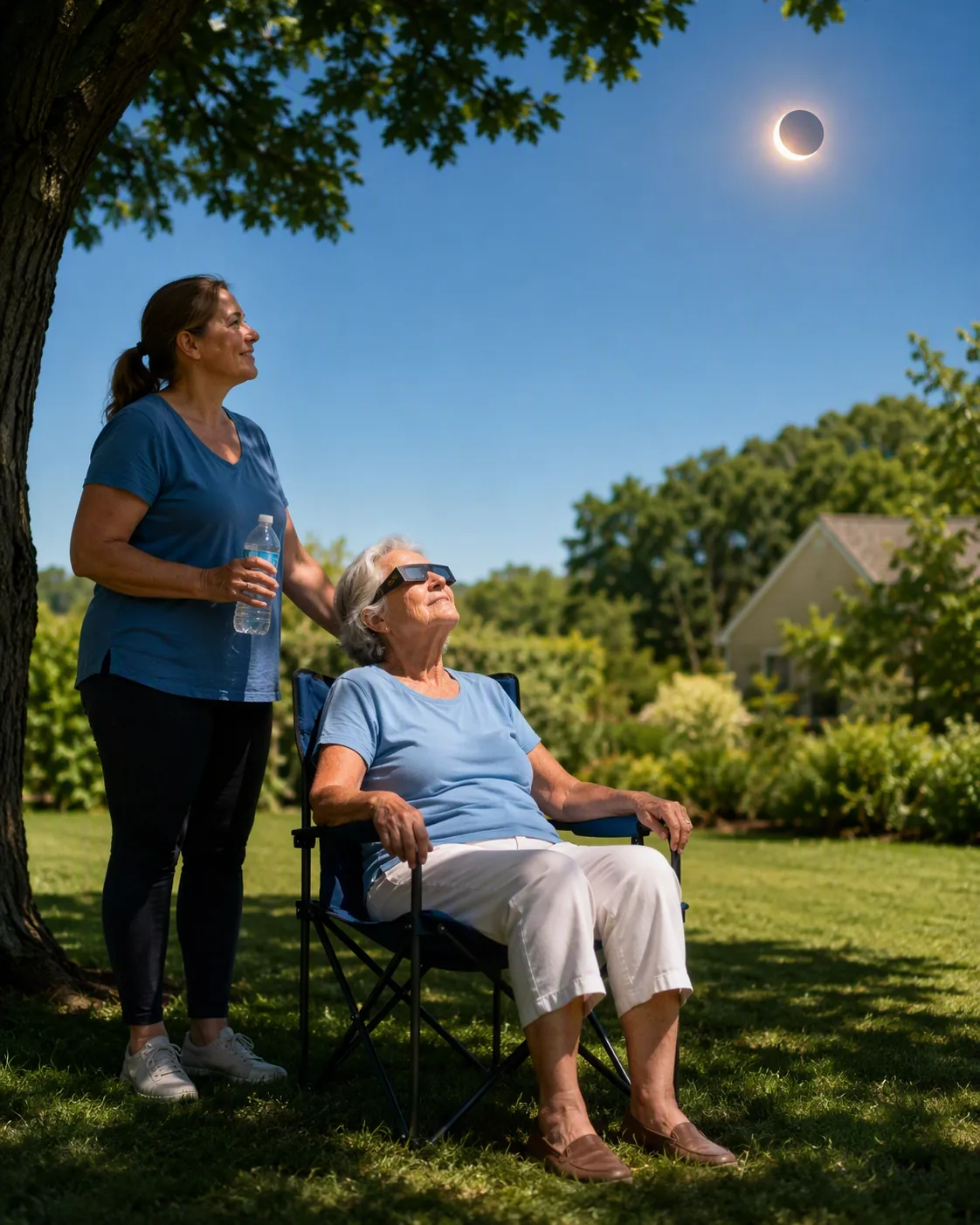
That is the whole shape of good eclipse safety for seniors: seated, shaded, one look at a time. The person should never have to walk, scan the ground through dark filters, balance with their neck tipped back, and look at the Sun all at once.
The no-glasses-off rule is easier in the U.S. this time
Some eclipse advice gets complicated because totality has a special exception: during the brief total phase of a total solar eclipse, viewers in the path of totality may look without solar glasses only while the Sun is completely covered. That exception does not help U.S. viewers on Aug. 12, 2026. From the United States, this is a partial eclipse only, so every direct look at the Sun requires proper solar viewing protection [1][3].
Use eclipse glasses or handheld solar viewers that comply with ISO 12312-2. NASA notes that it does not approve or endorse particular brands, so the standard and the condition of the viewer matter more than a logo claim [3]. If the older adult wears prescription glasses, the eclipse viewers go over those glasses. Taking off regular glasses to make the viewers fit may make the ground, curb, chair legs, and other people harder to judge.
The American Astronomical Society gives a useful viewing sequence: cover your eyes with the solar viewer before looking up at the bright Sun, and turn away from the Sun before removing the filter [2]. For a senior, that is not only eye-safety advice. It is also a fall-prevention rule. Stop first. Put the viewer in place. Look up briefly. Turn away. Then lower the viewer.
Do not use eclipse glasses or handheld viewers together with cameras, binoculars, or telescopes unless the optical equipment has the correct solar filter attached at the front end; concentrated sunlight can damage the filter and the eye [3]. Discard any viewer with torn, scratched, or punctured filters. The AAS also describes a practical safety check: indoors, you should not see ordinary household lighting through safe viewers; outdoors, only very bright reflections or the Sun should be visible; and the Sun should appear comfortably bright and sharply edged during a brief test glance [4]. Recently manufactured ISO 12312-2 viewers do not carry the old “3-minute” or “3-year” limits sometimes printed on older products [4].
Why eclipse viewing can turn into a fall-risk setup
There is no good evidence that eclipse-day falls among older adults have been counted as their own category. So the sensible claim is narrower: the eclipse outing combines several known fall-risk ingredients at the same time. Darkened vision. Neck-up posture. Prolonged standing. Outdoor surfaces. Heat. Crowds. A person who is usually steady in the kitchen can be much less steady on a sloped lawn or brick path while looking upward through nearly black filters.
Vision is not just about reading the event program or seeing the crescent Sun. Visual motion signals help people maintain balance while standing and walking. In a 2022 study of 251 elderly patients with visual impairment, researchers recorded 143 falls over 12 months, a 56.97% incidence in that study population; balance and gait disorders were associated with higher fall odds, and glaucoma was also identified as an independent fall-risk factor [5]. That study does not prove that eclipses cause falls. It does show why deliberately reducing usable vision during an outdoor event deserves more respect than a brochure usually gives it.
Balance is already a many-part system. The National Institute on Aging describes balance problems in older adults as connected to factors such as medications, inner ear problems, vision changes, blood pressure changes, and conditions affecting muscles, joints, or nerves [6]. An eclipse can tug on several of those systems at once. The head tilts back. The eyes are covered. Attention leaves the ground. The person may stand longer than planned because everyone else is standing.
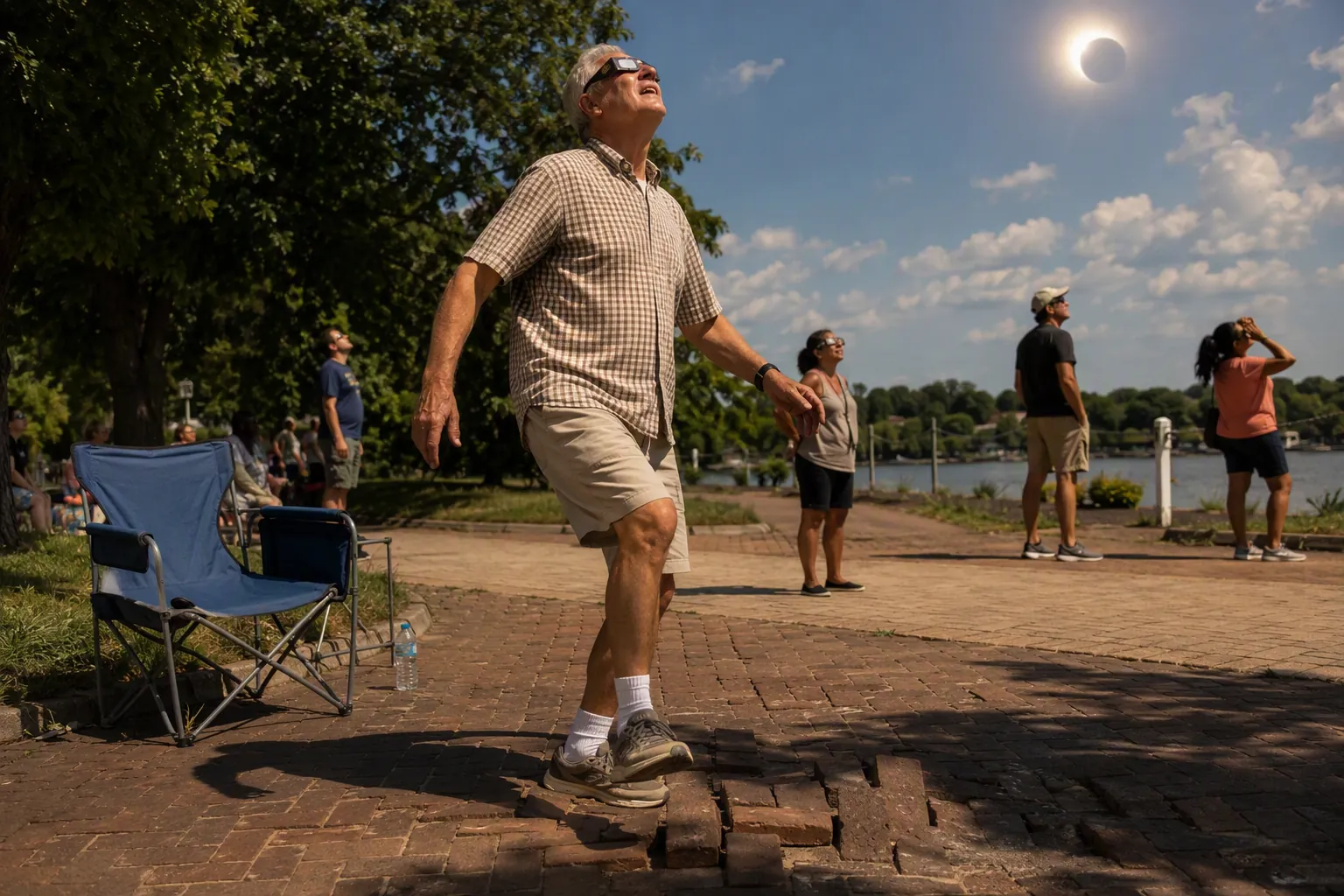
The ground also matters. The CDC’s STEADI home safety checklist is written for everyday fall prevention, but the same thinking applies outside: remove tripping hazards where possible, improve lighting, use handrails, and pay attention to places where footing changes [7]. On eclipse day, the outdoor version is a curb, a sprinkler rut, a folding-chair leg, a picnic blanket edge, a cracked sidewalk, or a crowd that starts moving just as the older adult is still wearing filters.
August heat adds another layer. Older adults may have more trouble adjusting to sudden temperature changes, and chronic conditions or some medicines can affect temperature regulation and sweating [8]. That does not mean every older person must stay indoors. It does mean a midday or midafternoon eclipse errand should be planned more like a heat-and-balance outing than like a quick step onto the porch.
The seated, shaded, one-look-at-a-time plan
The best viewing setup is almost boring. That is the point. A chair is placed before the eclipse becomes interesting. Water is within reach. The path in and out has already been checked. The older adult sits before putting on the viewer. No one asks them to “come over here and look” after the filters are on.
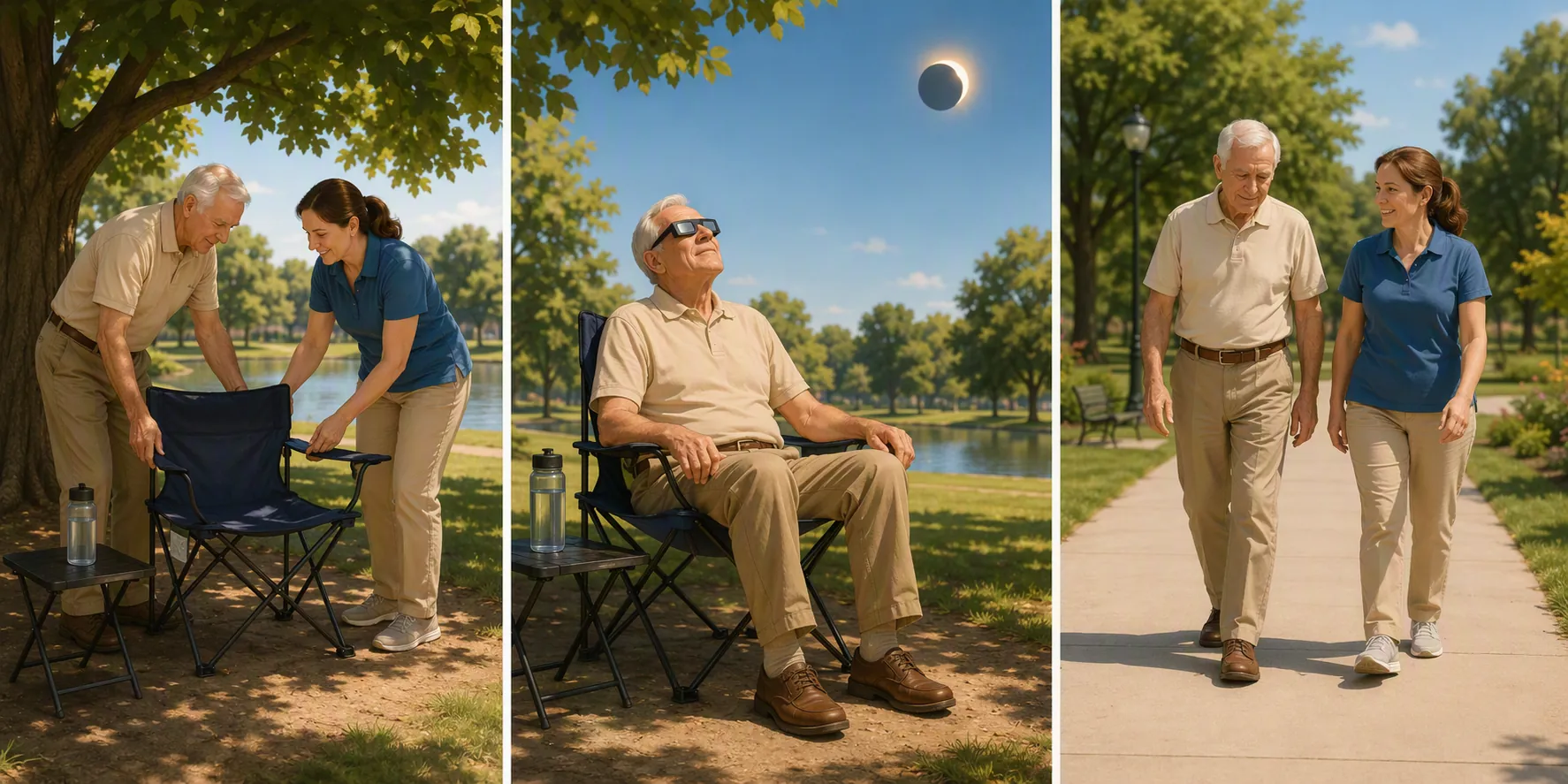
| Moment | What to do | What it prevents |
|---|---|---|
| Before viewing | Choose shade, set a stable chair, check the ground, and place water within reach. | Standing too long, tripping over uneven ground, overheating. |
| For each look | Sit or stand still first, put eclipse viewers over prescription glasses, look briefly, turn away, then remove the viewer. | Walking blind, losing balance with the head tipped back, removing filters while facing the Sun. |
| Between looks | Rest eyes, drink, cool down, and keep viewers off while moving. | Fatigue, heat stress, scanning the ground through dark filters. |
| Leaving | Leave before the crowd moves if stamina is fading or the heat is building. | Rushing, being jostled, making the hardest walk at the most tired moment. |
Set the viewing spot before the show starts
Pick a place where the older adult can sit with both feet flat and still have a clear view of the Sun when it is time for a brief look. Shade should cover the chair and waiting area, not just the caregiver. A canopy, porch, tree shade, or shaded park edge is better than asking someone to stand in open heat because the view is slightly better.
Check the surface before anyone is excited. Look for loose bricks, wet grass, irrigation holes, exposed roots, gravel, curled mats, and chair legs that stick into the walking path. If the viewing site is a park, school field, overlook, or neighborhood gathering, treat it like any unfamiliar outdoor surface. A caregiver who wants a broader outdoor-footing checklist can adapt the same habits used for travel and damaged walkways in this senior traveler fall-prevention checklist.
Use the shoes and mobility aids the person normally relies on. Eclipse day is not the day to leave the cane in the car because the walk looks short, or to wear loose sandals because everyone is “just going outside.” The risky part is often the first step after sitting, the curb at the parking lot, or the slow turn away from a crowd.
Make each look a single task
The viewing rhythm should be simple enough that nobody has to improvise:
- Sit down or stand still with feet planted.
- Put eclipse glasses or the handheld viewer in place over prescription glasses.
- Look up briefly.
- Turn the face away from the Sun.
- Remove the viewer.
- Move only after the viewer is off and regular vision is available again.
If several people are sharing one handheld viewer, pass it while everyone is seated or standing still. Do not make the older adult reach across a cooler, twist around a chair, or step toward someone while the filter is already over their eyes. The viewer is for looking, not for walking.
A caregiver can be useful without hovering. Keep the water bottle, hat, and phone off the ground. Announce when the next brief look is coming. Remind the group not to crowd the chair. If a grandchild drops a viewer or wants a turn, an adult with normal footing can retrieve it. The older person should not have to bend, reach, and look up in the same minute.
Plan the heat break as carefully as the viewing
Hydration is not a last-minute lecture after someone looks pale. Bring water, choose shade, and decide in advance where the cooler indoor or air-conditioned place is. For a longer outing, especially during a heat advisory, use a check-in plan like the one in this 72-hour heat dome fall prevention checklist for parents. Heat-related dizziness and weakness are fall risks before they become dramatic medical events.
This is general safety information, not medical advice. If an older adult has heart disease, kidney disease, diabetes, Parkinson’s disease, a history of fainting, or medications that affect blood pressure, alertness, urination, or sweating, ask their clinician what heat precautions apply. A short eclipse viewing from a shaded porch may be fine for one person and too much for another.
End the viewing early if there is dizziness, faintness, new confusion, unusual weakness, chest discomfort, trouble walking, nausea, or signs that the person is not cooling down. Families who do not already have a heat-illness threshold should review the warning-sign and emergency guidance in this heat wave power outage safety guide for seniors before eclipse day. The rule in the moment is plain: once steadiness or heat tolerance is in doubt, the eclipse is over for that person.
When staying home is the safer plan
Some older adults should skip the park or public event and watch from home with proper solar viewers, or use a reliable livestream instead. Reasons to simplify include recent falls, new dizziness, unstable blood pressure, recent medication changes, poor heat tolerance, severe vision loss, worsening gait, or anxiety in crowds.
There is also a planning question that belongs before any special outing: what is this person’s baseline fall risk? If the answer is unclear, the annual Medicare wellness visit can be a useful place to raise falls, balance, medications, vision, and home safety before a seasonal event exposes the weak spots. This guide on using the free Medicare visit for fall prevention explains how to make that conversation less vague.
For Aug. 12, the caregiver’s job is not to drain the wonder out of the eclipse. It is to remove the unnecessary tests: no walking with dark filters, no standing in full heat because the group forgot chairs, no rushing through a crowd after fatigue has already arrived. Let the older adult sit, cool down, look briefly with proper protection, and stop while the walk back is still easy.
The eclipse can still be enjoyed. Build the plan around steadiness first, shade second, and eye protection as a required but not sufficient safety step.
References
- Total Solar Eclipse on August 12, 2026, NASA
- How to View a Solar Eclipse Safely, American Astronomical Society
- Eclipse Viewing Safety, NASA
- How Can You Tell If Your Eclipse Glasses or Handheld Solar Viewers Are Safe?, American Astronomical Society
- Risk factors of falls in elderly patients with visual impairment, Frontiers in Public Health, 2022
- Older Adults and Balance Problems, National Institute on Aging
- Check for Safety: A Home Fall Prevention Checklist for Older Adults, CDC STEADI
- Heat and Crowds on Eclipse Day: Older Adults Safety, Helioclipse
Related reading
Noticed something outdated or inaccurate on this page? Flag a correction. We review every report against CDC, NIA, and AARP HomeFit guidance before updating a page.
Part of the Fall Prevention section.