
Room checklist
Bathroom Modifications for Aging in Place: Why 40% of Repeated Fallers Still Have None
Nearly 2 million older adults who have fallen multiple times still lack bathroom safety modifications. This guide explains why the gap persists and provides a phased approach to installing cost-effective fall prevention features before the next fall occurs.
After a second fall, the bathroom should stop looking ordinary. The slick floor is still there. The low toilet is still there. The towel bar may still be doing the work of a grab bar, even though it was never built to hold a person’s weight. Yet in a national study of Medicare beneficiaries, 40.2% of older adults who had fallen two or more times still reported no bathroom modifications. That represented about 1.9 million people in the 2016 data set the researchers analyzed.[1]
That is the hard part to sit with. The warning had already arrived. The family already knew falls were not theoretical. Still, the room most likely to require wet-footed turns, transfers, reaching, bending, and balance recovery had not changed.
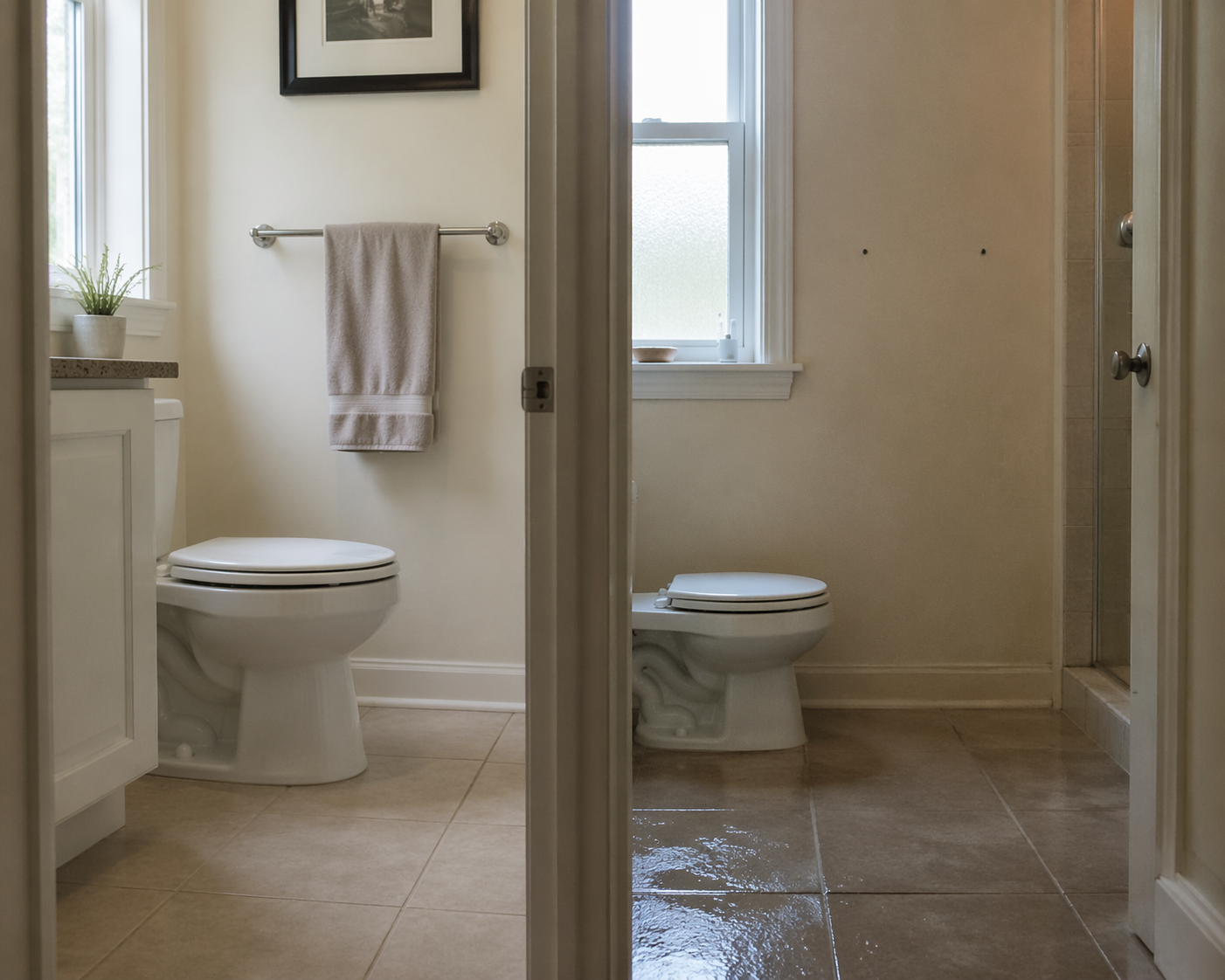
The same study found that only 55.5% of Medicare beneficiaries with one or more falls had any bathroom modifications at all.[1] The larger fall statistics explain why this matters: falls are the leading cause of injury death for adults 65 and older, and 43,020 older adults died from falls in 2024, according to CDC data updated in January 2026.[2] But the more useful question for a family standing in the hallway after discharge is narrower: what has to change before the next bath, the next midnight bathroom trip, or the next transfer from toilet to walker?
Why Families Stall After the Warning
A fall often gets treated as a medical event with a home address attached to it. The emergency room checks the injury. The discharge papers mention follow-up care. Family members start making calls about medication, blood pressure, dizziness, vision, or physical therapy. Those are legitimate concerns. They can also push the bathroom into the background, even when the fall happened there or the next one easily could.
There is also the renovation problem. Once someone says “aging in place bathroom design,” many families picture a full remodel: demolition, tile selection, contractor delays, a shower replacement, and a bill they are not ready to face. That mental leap is one reason nothing gets done. The choice is framed as either a major project or acceptance of the existing room.
Older parents may hear the same conversation differently. A grab bar can sound like a label. A raised toilet can feel like proof that the body has changed. Adult children sometimes soften the topic because they do not want to turn one frightening week into a fight about independence. The result can be a quiet compromise in which everyone agrees the bathroom is risky and no one changes it.
The Ng et al. estimate deserves one caveat: it comes from 2016 Medicare survey data and may not capture later remodeling behavior, including changes after the COVID-era home-improvement surge.[1] It is still a peer-reviewed national estimate, and it points to a pattern family caregivers will recognize. Risk becomes obvious before action becomes organized.
Start With the Room, Not the Catalog
Designing a bathroom for aging in place starts less glamorously than most remodel photos suggest. Before choosing finishes, walk the room in the order the older adult actually uses it: doorway, toilet, sink, shower or tub, towel storage, lighting, and the path back out. The goal is not to admire the bathroom. It is to notice where balance, reach, water, fatigue, and haste meet.
A practical pass through the room should ask: where does a hand go when standing up, stepping over a tub edge, turning to sit, or reaching for soap? If the answer is “the towel bar,” “the shower door,” “the sink edge,” or “nothing,” that is not a small design preference. It is a transfer problem.
For a hands-on walk-through, use a bathroom safety checklist for seniors rather than relying on memory while everyone is tired. The checklist format matters because families tend to notice the dramatic hazard and miss the daily one: a bath mat that slides, a shampoo bottle stored too low, a doorway too tight for a walker, or lighting that works at noon but not at 2 a.m.
| Bathroom zone | What to look for | First practical response |
|---|---|---|
| Toilet | Pushing up from the vanity, towel bar, tank, or walker | Add properly anchored grab bars and consider a comfort-height toilet |
| Shower or tub | Stepping over a tub wall, turning on wet tile, reaching for controls | Add grab bars, non-slip surfaces, and a handheld shower wand |
| Floor | Glossy tile, loose mats, water pooling, threshold changes | Use slip-resistant materials and remove unstable mats |
| Entry and circulation | Narrow approach, blocked walker path, awkward door swing | Clear the route now and assess whether layout changes are needed later |
| Storage and lighting | Bending, twisting, or reaching overhead for daily items | Move essentials into easy reach and improve night visibility |
The Minimum Viable Bathroom Safety Package
The first package does not have to be a dream bathroom. It has to reduce the most obvious fall mechanics: slipping, unsupported transfers, low seating strain, and unsafe reaching. The core set is simple: grab bars, non-slip flooring or surfaces, a comfort-height toilet, and a handheld shower wand.
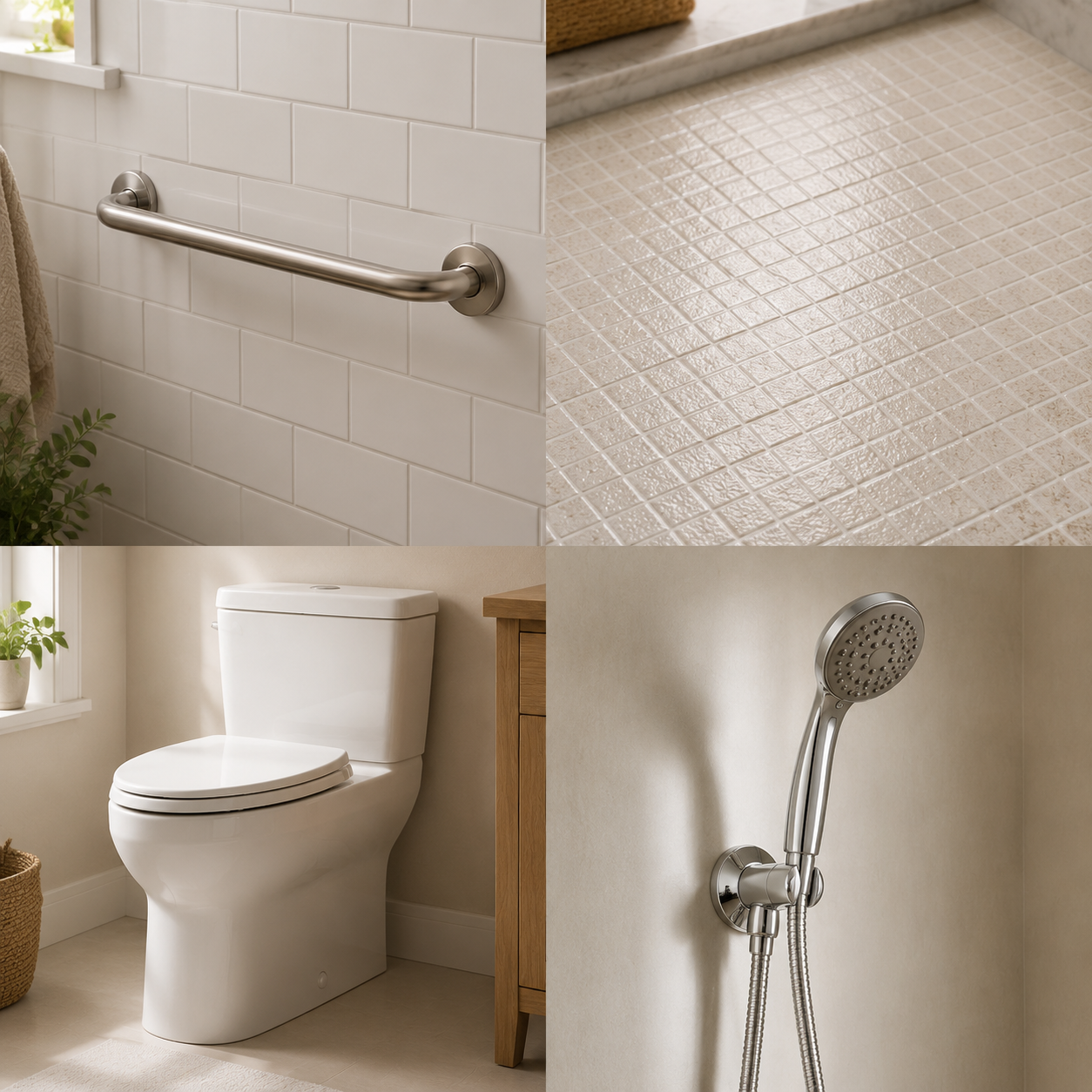
CDC fall-prevention guidance treats grab bars and non-slip surfaces as high-value environmental changes, with estimates placing fall-risk reduction at roughly 50% when these kinds of bathroom modifications are added.[2] That does not mean a grab bar prevents every fall. It means the bathroom no longer asks an older adult to recover balance using a towel rack, a wet wall, or a sliding mat.
Grab Bars Where Transfers Actually Happen
Grab bars should be installed at the toilet and inside the bathing area, not just wherever a wall happens to look empty. Universal design specifications commonly place bathroom grab bars 33 to 36 inches above the finished floor.[3] The exact placement still has to match the person’s height, reach, transfer direction, and wall structure.
This is not the place for suction-cup confidence. A properly mounted bar needs secure backing or appropriate anchoring. For installation details, use a dedicated grab bar installation guide and bring in a qualified installer when the wall construction is uncertain.
A Floor That Does Not Betray Wet Feet
A bathroom floor can look clean and still be a poor aging-in-place surface. AARP’s bathroom upgrade guidance points to slip-resistant flooring with a DCOF rating of 0.42 or higher, a standard that gives families a more concrete specification than “not too slippery.”[4] This matters in the shower, around the toilet, and at the sink, where small splashes become part of daily use.
Loose bath mats deserve special suspicion. Some families add them to solve slipperiness and accidentally create a tripping edge. If a mat is used, it should stay flat, resist movement, and not bunch under a cane, walker, or dragging foot.
A Toilet That Reduces the Work of Standing
A comfort-height toilet, typically 17 to 19 inches high, can reduce the strain of sitting and standing for many older adults.[4] It is not automatically right for every body; shorter users may feel less stable if their feet do not plant well. But after a fall or mobility decline, toilet transfer deserves direct attention because it happens repeatedly and often when the person is tired, hurried, or alone.
A Handheld Shower Wand for Control
A handheld shower wand sounds minor until someone has to turn, lean, and rinse while trying not to lose footing. It lets the person bring water to the body instead of moving the body around the water. Paired with a shower chair or bench when needed, it can reduce awkward reaching and make assisted bathing less physically demanding for both the older adult and the caregiver.
As a planning range, this minimum viable package often falls between $3,500 and $8,500 nationally, depending on labor, wall conditions, flooring choices, plumbing changes, and whether the family is replacing fixtures or adding targeted safety features. Treat that range as a starting budget conversation, not a quote. Regional labor markets and hidden bathroom conditions can move the number quickly.
This Week: Make the Bathroom Less Dangerous Before the Perfect Plan Exists
The first week after a fall is not the time to solve every aging-in-place decision. It is the time to stop pretending that the old bathroom is neutral. Remove loose rugs. Improve night lighting. Put soap, towels, toilet paper, and bathing supplies within easy reach. Stop using towel bars, shower doors, or sink edges as transfer supports. If bathing feels unsafe, pause solo bathing until support or equipment is in place.
If the fall has just happened and the family is still sorting out discharge instructions, use an after-a-fall senior health services guide alongside the bathroom assessment. Medical follow-up and environmental changes should move together. Waiting for one to finish before starting the other is how weeks pass.
- Clear the walking path from bed to bathroom, including cords, laundry, bins, and small rugs.
- Add bright, automatic night lighting on the route and inside the bathroom.
- Replace sliding mats with stable, low-profile, non-slip options.
- Schedule grab bar installation rather than substituting temporary handholds.
- Write down where the fall happened, what the person was doing, and what they reached for.
This Month: Bring in the Right Assessment
A family can spot obvious hazards. A good assessor can connect those hazards to the person’s actual movement. That distinction matters when the older adult uses a walker, has one-sided weakness, is recovering from surgery, has cognitive changes, gets dizzy, or needs help bathing.
An occupational therapist can observe transfers, bathing routines, reach, balance, fatigue, and caregiver assistance. The therapist’s recommendations may be modest: a different grab bar location, a shower chair, better sequencing for dressing, or a toilet change. They may also identify when the current layout is asking too much of the person. For families deciding whether to modify or remodel, an occupational therapist’s home modification assessment is often the most practical next step.
A Certified Aging-in-Place Specialist can help translate safety needs into building decisions, especially when several rooms are involved or when a bathroom project may affect doorways, flooring transitions, lighting, and circulation. A room-by-room CAPS fall-prevention assessment is useful when the family needs both safety judgment and remodeling vocabulary.
The National Council on Aging’s home modification resources also frame home changes as part of fall prevention, not as decoration or convenience.[5] That framing helps families make a cleaner decision: the first question is not whether the bathroom looks dated. It is whether the current room supports the body that is using it now.
This Year: Decide Whether Targeted Fixes Are Enough
Some bathrooms can be made substantially safer with targeted work. Others are fighting the person at every step: a narrow doorway, a tub that cannot be entered safely, a toilet wedged into a tight alcove, poor ventilation that keeps surfaces damp, or a layout that leaves no room for a caregiver to assist.
That is when the conversation moves from immediate modification to planned remodeling. A fuller bathroom remodel may include a curbless or low-threshold shower, better clearances, reinforced walls for current and future grab bars, improved lighting, slip-resistant flooring throughout, and storage that does not require bending or reaching overhead. Universal design bathroom guidance also addresses turning radius and clearance, which become more important when walkers, wheelchairs, or caregiver assistance enter the room.[3]
Use a phased bathroom remodel safety guide when the minimum package no longer matches the person’s mobility or the room’s constraints. If several parts of the house are competing for attention, a prioritization framework for aging-in-place home modifications can keep the bathroom from either absorbing the whole budget or being postponed behind less urgent projects.
Funding research belongs in this year-ahead track, unless money is the only thing preventing an urgent safety fix. Grants, benefits, loans, local programs, and family cost-sharing take time to investigate. A home modification funding navigator can help families look for support without turning funding research into another reason to leave the bathroom unchanged.
What Counts as Enough
Enough is not the same in every home. For one parent, it may be two well-placed grab bars, a safer floor surface, a comfort-height toilet, a handheld shower wand, and better lighting. For another, especially someone using a mobility aid or needing hands-on help, the same list may be only the first layer before a larger redesign.
The broader aging-in-place question is not whether an older adult can stay home in theory. It is whether the home is being asked to do work it was never designed to do. For families looking beyond the bathroom, the 2026 aging-in-place reality check can help place bathroom decisions inside the larger plan for mobility, caregiving, and household support.
After a repeat fall, doing nothing to the bathroom is no longer a neutral choice. Families do not have to remodel the whole house under panic, and they do not have to get every future decision right this week. They do need to make the room safer now, get qualified eyes on the harder problems next, and reserve the larger renovation decisions for a plan that fits the person, the layout, and the budget.
References
- Bathroom modifications among community-dwelling older adults who experience falls, PMC, 2021
- Facts About Falls, CDC, January 27, 2026
- Bathrooms, The UD Project
- Bathroom Upgrades That Will Help You Age in Place, AARP
- Home Modification Tools and Tips to Help Prevent Falls, NCOA
Related reading
Need a professional assessment?
Find a CAPS-credentialed professional or local aging services through our outbound resource list — we never name or rank individual contractors.
Find Local HelpNoticed something outdated or inaccurate on this page? Flag a correction. We review every report against CDC, NIA, and AARP HomeFit guidance before updating a page.