
STEADI: intervene
How to Prepare Seniors for the Aftermath of a Tropical Storm
County-level research shows a tropical storm's real danger to older adults begins after landfall: cardiovascular, respiratory, infectious, and injury death rates climb in the month that follows, and dementia-related excess deaths peak months later. The guide explains why senior preparedness must extend past the storm, with an aftermath plan covering a 30-day medication reserve, backup power for oxygen, CPAP, and insulin, heat safety during outages, and caregiver check-ins through the first months.
The dangerous part of a tropical storm is not always the part shown on radar. For older adults, the harder question is what happens after landfall: the refill that cannot be picked up, the oxygen concentrator that loses power, the bedroom that stays hot for a second night, the caregiver who assumes another relative already called.
That is why tropical storm emergency preparedness for older adults has to start with a longer timeline than most checklists use. Packed bags and evacuation routes matter, but they do not answer the question that shows up on day four or week three: can this person still take the right medications, run the equipment they depend on, stay cool enough, keep appointments, and be checked on when public attention has moved elsewhere?
The age pattern in major disasters is blunt. In a Preventing Chronic Disease article on vulnerable older adults, Aldrich and Benson noted that before Hurricanes Katrina and Rita, adults age 60 and older were about 15% of New Orleans’ population, while people age 65 and older accounted for 71% of hurricane deaths. The age cutoffs are not identical, which is exactly why the figure should be read carefully rather than casually repeated, but the imbalance is still hard to dismiss.[1]
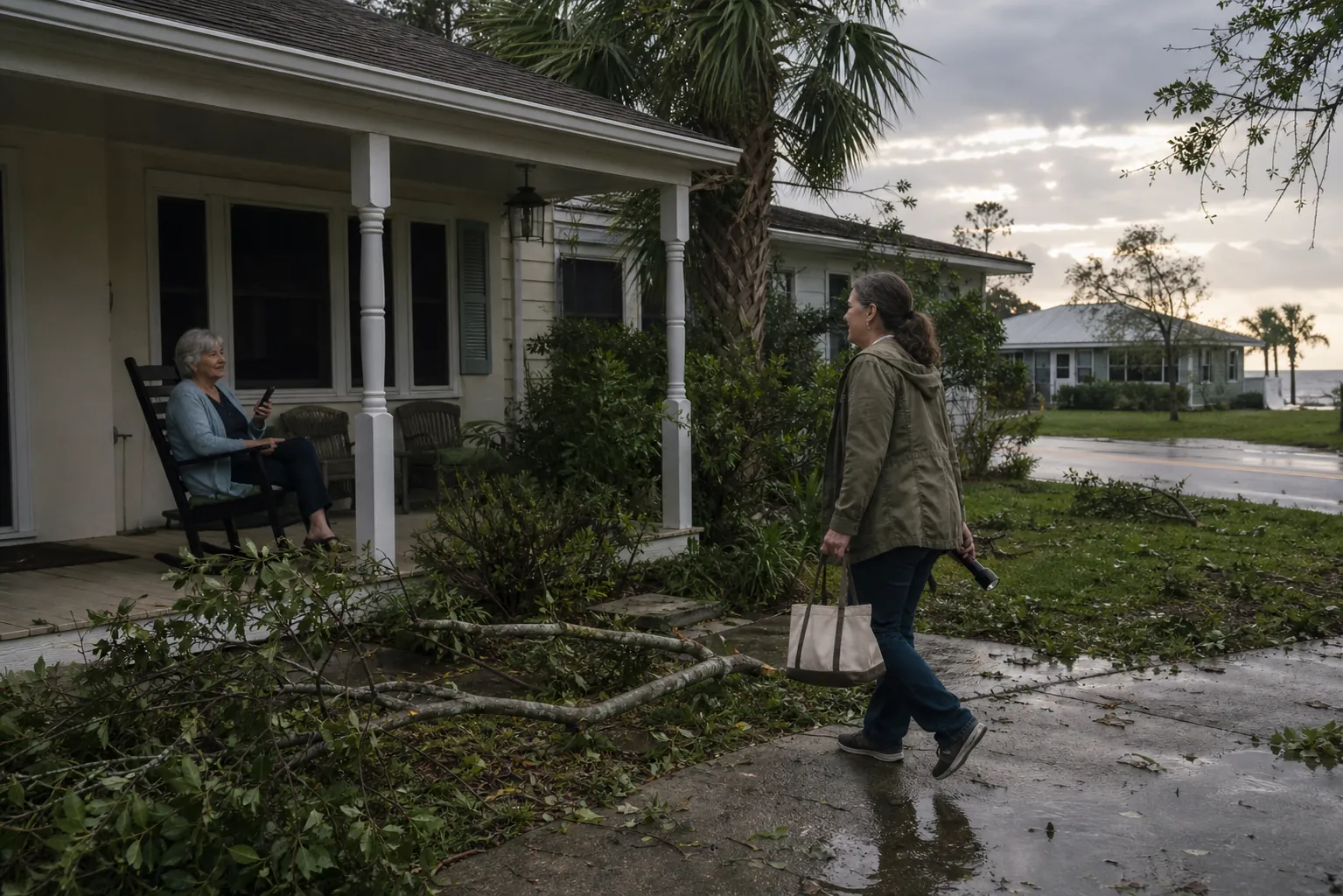
A larger county-level study gives a clearer view of the aftermath. In JAMA, researchers analyzed 33.6 million deaths across 1,206 U.S. counties and found that each additional tropical-cyclone day was associated with higher death rates in the following month: injury deaths rose 3.7%, infectious and parasitic disease deaths 1.8%, respiratory deaths 1.3%, cardiovascular deaths 1.2%, and neuropsychiatric deaths 1.2%.[2]
Those numbers do not prove that every death was caused by a single outage, fall, infection, or missed dose. They are county-level associations, not a record of what happened inside each home. But they do move the planning horizon. The month after exposure is not administrative cleanup time; it is part of the risk window.
For families caring for someone with dementia, the time window stretches further. A JAMA Network Open study of 346,171 Medicare beneficiaries with dementia in hurricane-declared counties after Hurricanes Irma and Harvey estimated 1.32 attributable deaths per 1,000 beneficiaries, with a relative risk of 1.08. Mortality peaked 3 to 6 months after the storms, and the excess was highest among beneficiaries age 85 and older and among those who were dual-eligible for Medicare and Medicaid.[3]
That delayed peak matters. A parent with dementia may appear to have “made it through” because the house is standing and the roads are open. But medication changes, dehydration, sleep disruption, infection, nutrition problems, loss of routine, caregiver turnover, and missed follow-up can accumulate quietly. The study does not isolate one mechanism, and families should not pretend it does. It does justify a plan that keeps checking after the emergency texts stop.
This is not only a Katrina story. AARP’s disaster resilience materials report that, among 87 people killed by Hurricane Ian in 2022 whose ages were known, 61 were age 60 or older; the same toolkit notes that 71 of 84 identified Camp Fire fatalities were age 60 or older.[4] Different disasters, different hazards, same planning lesson: age, disability, chronic illness, and dependence on services turn disruption into exposure.
The senior plan should protect the chain of care, not just the house
For an older adult living alone or semi-independently, “prepared” means more than having water and flashlights. It means the fragile chain around daily health still works when the pharmacy is closed, the elevator is out, the internet is down, the aide cannot get across a bridge, or a daughter is calling from several hours inland and cannot tell whether anyone has checked the refrigerator.
| What must still work | What to decide before the storm | Why it matters after landfall |
|---|---|---|
| Medications | How many days are on hand, where the list is kept, who can request refills | Pharmacies, deliveries, clinics, and transportation may be disrupted |
| Medical devices | How oxygen, CPAP, nebulizers, mobility devices, and chargers will run without household power | A short outage can become a treatment interruption if no backup is ready |
| Temperature safety | Where the person can cool down, how heat will be monitored, who decides when to leave | An intact house can still become unsafe when power and air conditioning fail |
| Essential care | How dialysis, oncology, wound care, home health, and specialist visits will be rescheduled or relocated | The appointment that disappears during cleanup may be the one that prevents a decline |
| Supervision | Who checks in on day 1, week 1, month 1, and later months | Older adults with dementia or limited mobility may not report problems accurately or early |
The usual household supplies still belong in the plan. CareWise Guide’s hurricane safety checklist for seniors covers the home-level preparation in more detail, and the stay-or-go hurricane plan for older parents is the better place for evacuation decisions. Here, the focus is narrower: what keeps a senior medically and physically safe after a modest storm becomes a prolonged interruption.
Medication continuity is the first aftermath problem to solve
A missed medication is not dramatic. It does not look like floodwater on television. It looks like a blood pressure pill that ran out on the same weekend the pharmacy lost power, or a caregiver discovering that the “extra bottle” in the cabinet expired two years ago.
The American Red Cross advises older adults to keep at least 30 days of medications and to plan either to remain at home for two weeks or to evacuate.[5] The National Council on Aging advises a two-week medication supply, a packed go-bag, and written stay-and-go plans.[6] For an older adult who takes multiple prescriptions, uses insulin, depends on mail-order delivery, or has limited transportation, the 30-day target is the safer planning standard when it is feasible.

The practical work is not simply buying a bigger pill organizer. Before storm season, families should confirm which prescriptions can be refilled early, which require prescriber approval, which are controlled substances with stricter rules, and which are filled by specialty or mail-order pharmacies. The person who will make calls during an outage needs the medication list, prescriber names, pharmacy numbers, insurance information, allergies, and permission procedures if the older adult cannot manage the call alone.
For insulin and other refrigerated medications, the plan has to include temperature, not just quantity. CDC guidance says insulin should be kept cool but never frozen. If insulin has been stored above 86°F, CDC advises monitoring blood sugar and contacting a doctor afterward.[7] That means the cooler, ice packs, thermometer, and destination for refrigeration are part of the medication plan, not accessories.
- Ask the pharmacy and prescriber before hurricane season how early refills work and what to do if a local pharmacy is closed.
- Keep a current medication list in paper form and in a phone photo; include doses, schedules, prescribers, pharmacy contacts, and allergies.
- Separate “daily-use” pills from the emergency reserve so the backup supply is not slowly consumed without anyone noticing.
- For refrigerated medicines, write down the cooling plan: cooler location, ice-pack rotation, thermometer location, and where the medication can be moved if power stays out.
- For dementia care, assign one person to verify actual pill-taking after the storm, not just to ask whether everything is fine.
Power planning is medical planning
A power outage is an inconvenience for one household and a medical event for another. Oxygen concentrators, CPAP machines, nebulizers, hospital beds, lift chairs, stair lifts, electric wheelchairs, refrigerated medications, phones, and internet-connected monitoring systems all assume electricity will be there.
The American Lung Association’s outage guidance is especially concrete for oxygen users: have extra batteries, a car charger, and a backup tank supply arranged with the oxygen supplier; do not reduce the oxygen flow setting without a health care provider’s approval; and run generators only outdoors.[8] Those are not small details. Reducing oxygen flow to “make the tank last” can create a different emergency, and running a generator in or near the home can expose people to carbon monoxide.
CPAP and BiPAP users need the same kind of pre-storm thinking, even when the equipment is not as visibly urgent as oxygen. The family should know whether the device has a compatible battery, how long that battery usually lasts under the prescribed settings, whether heated humidification can be safely turned off to conserve power, and how the device will be transported if the older adult leaves home. Those answers should come from the device manual, supplier, or clinician, not from improvising in a dark room.
For mobility equipment, charge everything before landfall: phone, hearing aids, backup power banks, electric wheelchair, scooter, lift device, and emergency alert pendant. If the older adult lives in a building with an elevator, the plan also needs a no-elevator version. That may mean leaving before conditions worsen, relocating to a lower floor, or arranging help through family, neighbors, building management, or county emergency management before the storm is close.
The oxygen and CPAP questions to answer before the forecast gets personal
- What device settings are prescribed, and where are they written down?
- How many hours of battery power are available under real use?
- Is there a car charger, and is the car fuel tank or EV battery kept ready before storm season?
- Has the supplier arranged backup oxygen tanks, if oxygen is prescribed?
- Who knows how to move the device, tubing, mask, distilled water if used, chargers, and written settings?
- If power is not restored by the first night, where will the older adult go?
If local authorities or the utility offer medical needs notifications or special-needs registry options, treat registration as one layer of the plan, not the plan itself. Procedures are local, capacity can be limited, and registration does not replace the family’s own transportation, medication, equipment, and check-in arrangements. Ready.gov’s older adult guidance frames emergency planning around assessing needs, making a plan, and building a support network; that framework is useful because it starts with dependence, not with supplies.[9]
Heat can turn an intact home unsafe
After a tropical storm, families often ask whether the house flooded, whether the roof leaked, and whether the car is drivable. They should also ask a less visible question: how hot is the bedroom at 9 p.m. when the air conditioning has been off all day?
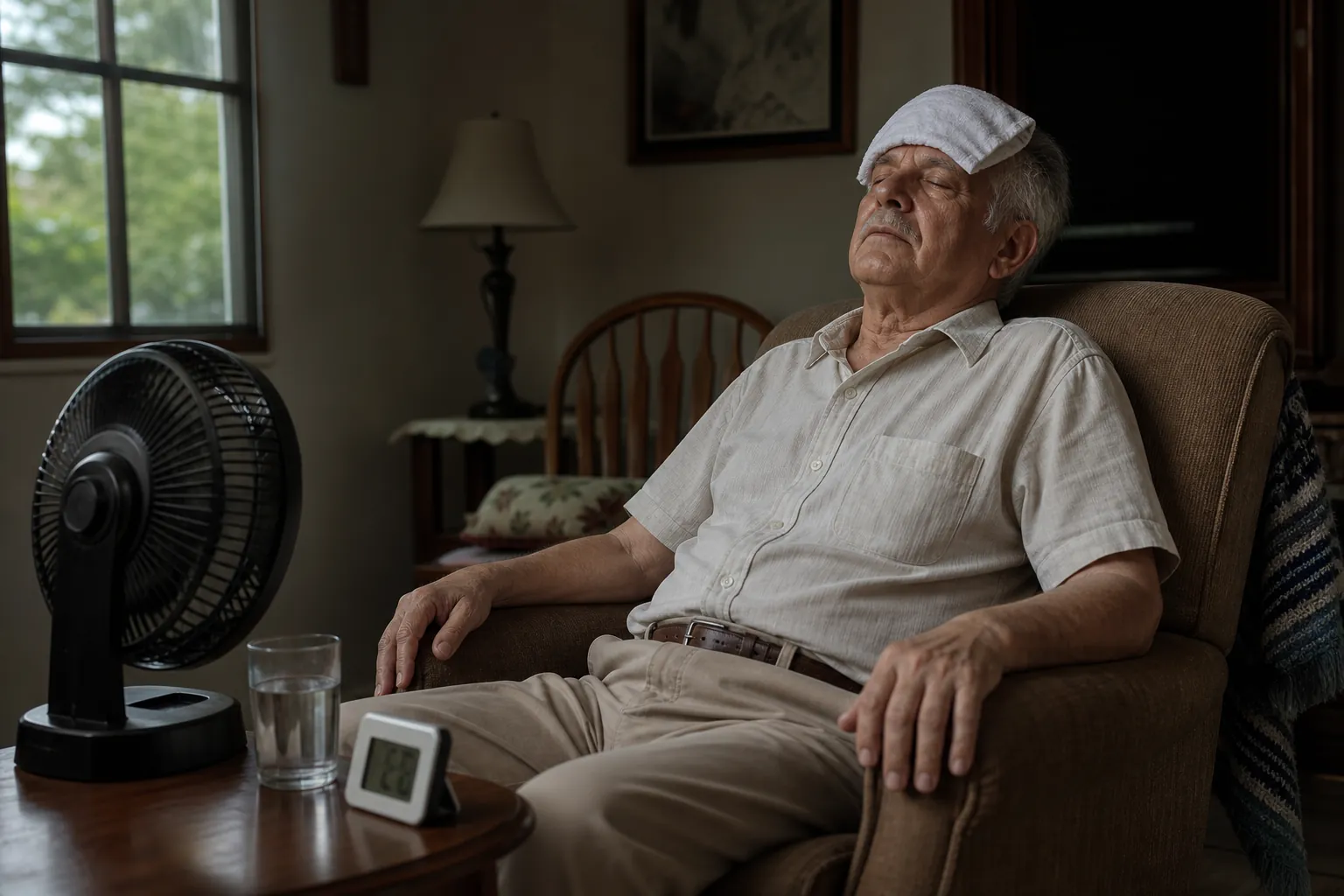
Heat planning should be specific enough that no one has to debate it while the older adult is already uncomfortable. Decide in advance who checks the indoor temperature, which room stays coolest, whether battery fans are available, where cooling centers or relatives with power are located, and what signs mean the person should leave the home rather than wait for restoration.
This is also where transportation planning becomes medical planning. An older adult who can tolerate a warm house for a few hours may not be safe there for multiple days, especially with cardiac, respiratory, kidney, diabetes, or cognitive problems. That does not mean every senior must evacuate for every tropical storm. It means the stay-at-home decision must include the length of the outage, the person’s health conditions, medication storage, hydration, mobility, and ability to communicate.
Generators deserve a hard boundary: if one is used, it belongs outdoors, away from living spaces, doors, windows, and vents. The same device meant to keep a refrigerator or oxygen equipment running can create a carbon monoxide hazard if it is brought into a garage, porch, hallway, or room because rain or theft feels like the more immediate problem.
Dark rooms, wet thresholds, and rushed cleanup create fall risks
The injury increase seen in the month after cyclone exposure is a population-level finding, not a household fall count.[2] Still, the home conditions after a storm are easy to picture: extension cords across walking paths, towels on wet floors, furniture moved away from windows, a flashlight in one hand and a cane in the other, porch steps slick with leaves, medications changed, sleep disrupted, and everyone hurrying.
For a senior fall-prevention plan, the first walkthrough after the storm should be boring and methodical. Check the route from bed to bathroom, bathroom to kitchen, chair to phone, and door to car. Move cords to walls, remove wet mats and loose towels, put battery lights at turns and thresholds, dry the entry, and make sure the older adult can reach a phone without crossing a dark room.
If the home needs cleanup, assign the senior a safe sitting area away from ladders, glass, fans, extension cords, buckets, and open doors. Independence should not mean stepping over debris to prove the house is manageable. For a broader home-preparation pass, use the room-by-room storm checklist before the season starts rather than discovering the tripping hazards by flashlight.
Do not let dialysis, oncology, wound care, or home health disappear into “reschedule later”
Some care cannot simply pause because the storm was downgraded. Dialysis, chemotherapy or radiation appointments, wound care, IV medications, anticoagulation monitoring, transplant follow-up, and home health visits may have narrow timing or safety requirements. The preparation task is to learn each provider’s disaster procedure before the season: alternate locations, after-hours numbers, what to do if roads close, and what symptoms require urgent care.
The most useful written plan is not a beautiful binder. It is a single page that can be read by a neighbor, adult child, aide, or shelter intake worker: diagnoses, medications, allergies, devices, baseline mobility, communication needs, emergency contacts, clinicians, pharmacies, preferred hospital, and the appointments that cannot be missed without medical advice.
If evacuation is likely, do not wait until watches are posted to decide how equipment, medication, and records will travel. CareWise Guide’s emergency evacuation plan checklist for elderly parents can carry that part of the work; the point here is that evacuation is only safe if the treatment chain goes with the person.
A check-in cadence for the long tail
No cited source turns the dementia mortality findings into a family check-in protocol. The cadence below is a practical response to the timing evidence, especially the month-after-cyclone mortality associations and the 3-to-6-month mortality peak among older adults with dementia.[2][3] It is meant to keep the household from declaring victory too early.
| When | What to verify | Who should be responsible |
|---|---|---|
| First 24 hours | Power status, indoor heat, injuries, water, phone charge, oxygen or CPAP function, medication access | The nearest reliable person, with one remote relative tracking by phone if possible |
| Days 2–7 | Actual medication taking, food intake, hydration, sleep, mobility, falls or near-falls, appointment cancellations, caregiver coverage | A named family member or caregiver, not “whoever gets through” |
| Weeks 2–4 | Refills, replacement supplies, device problems, new shortness of breath, infection concerns, mood changes, worsening confusion, missed specialist care | The person who can contact clinicians and pharmacies |
| Months 2–6 | Dementia routine, nutrition, weight change, caregiver strain, unresolved damage, delayed medical follow-up, new dependence with bathing, walking, meals, or money management | Family, primary care, dementia care team, home health, or community supports as appropriate |
The first call should not be a vague “Are you okay?” It should be concrete: Did you take the morning pills? Is the oxygen running at the prescribed setting? What does the thermometer say inside? What did you eat today? Can you get from the bed to the bathroom with the lights out? Has the dialysis center or oncology office called back? Is the aide coming tomorrow?
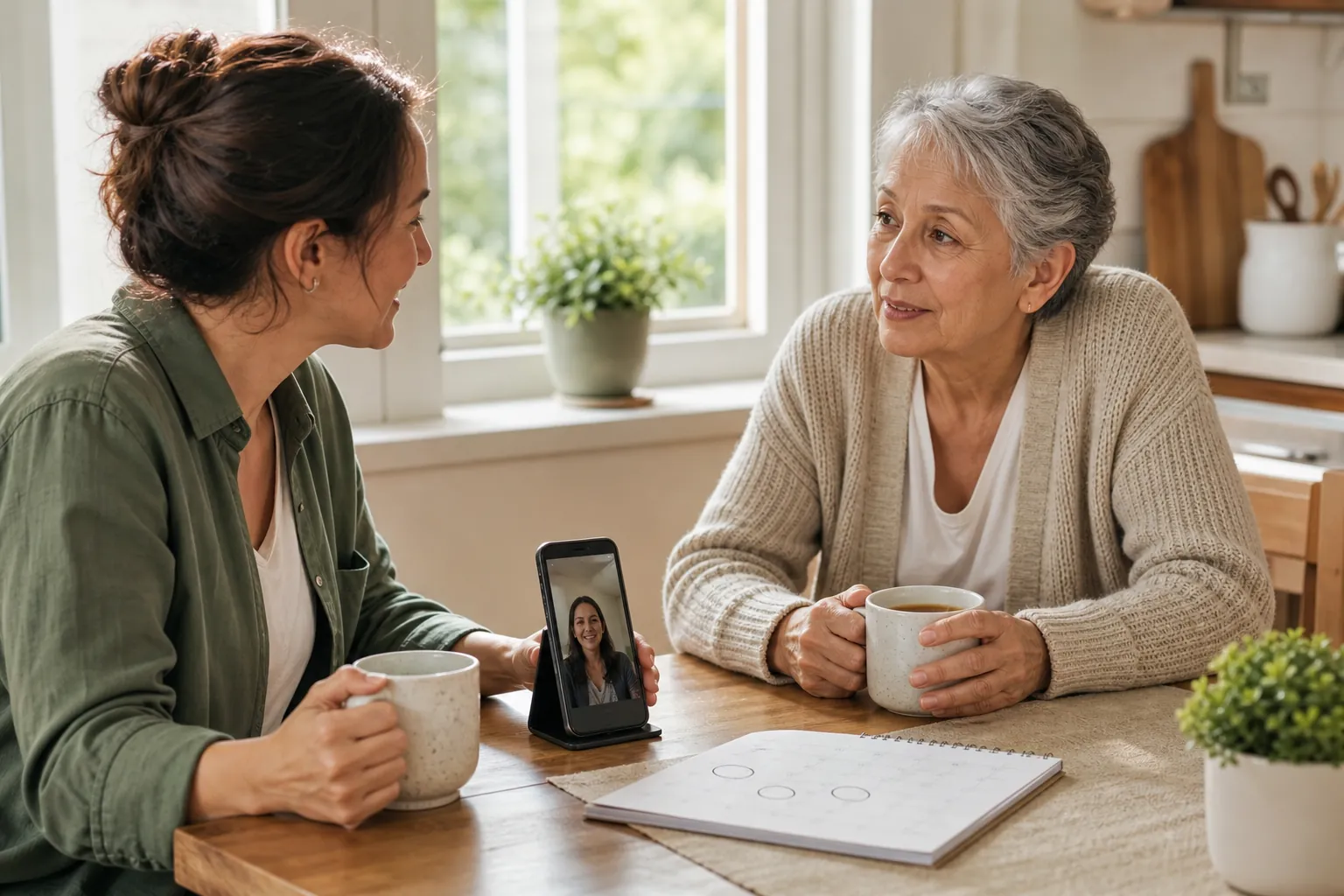
For an older adult with dementia, ask someone to observe when possible. A person may answer confidently while spoiled food sits in the refrigerator, pills remain in the organizer, or the air conditioner is still off. A video call can help, but it does not replace an in-person check when medication, heat, injury, or confusion is uncertain.
What to do before the next tropical storm is named
The work is easier before the forecast becomes personal. Choose one person to own each task: medication reserve, device power, cooling plan, transportation, clinician contacts, home walkthrough, and post-storm check-ins. Shared responsibility sounds kind until everyone assumes someone else handled the refill.
- Build toward a 30-day medication reserve when prescriptions, insurance rules, and clinicians allow; if not, know exactly what the limit is and who can authorize exceptions.
- Write down the cooling plan for insulin or other refrigerated medicines, including what to do if the home stays above safe storage conditions.
- Test batteries and chargers for oxygen, CPAP, phones, hearing aids, mobility devices, and emergency alert systems before storm season.
- Call oxygen, CPAP, dialysis, oncology, home health, and pharmacy providers before a storm to learn their outage and closure procedures.
- Decide what indoor temperature, outage duration, device failure, or caregiver gap will trigger relocation.
- Put check-in dates on a calendar that extends past the first month, especially for a parent with dementia, frailty, limited mobility, or little local support.
If the larger power system is under stress, the same logic applies. The CareWise Guide article on power grid emergency orders for older adults can help families think through outages that are not tied to one named storm.
Medical review and advice note
This CareWise Guide article is for education and emergency planning. It is not medical advice, a substitute for a clinician’s instructions, or a universal evacuation recommendation. Older adults who use oxygen, insulin, dialysis, oncology care, CPAP or BiPAP, implanted devices, or complex medication regimens should ask their own clinicians and suppliers for individualized storm and outage instructions before the season begins.
A senior tropical storm plan succeeds when the quiet systems still hold: medications remain available, treatment equipment can run, refrigerated drugs stay usable, the home does not become dangerously hot or dark, and someone keeps checking long after the storm has left the forecast.
References
- Disaster Preparedness and the Chronic Disease Needs of Vulnerable Older Adults, Preventing Chronic Disease
- Association of Tropical Cyclones With County-Level Mortality in the US, JAMA, 2022
- Hurricane Exposure and Mortality Among Older Adults Living With Dementia, JAMA Network Open, 2023
- Disaster Risks to Older Adults, AARP
- Older Adults, American Red Cross
- Emergency Preparedness 101: What to Do Before, During and After Disaster, National Council on Aging
- Managing Insulin in an Emergency, Centers for Disease Control and Prevention
- Power Outages, American Lung Association
- Older Adults, Ready.gov
Related reading
Noticed something outdated or inaccurate on this page? Flag a correction. We review every report against CDC, NIA, and AARP HomeFit guidance before updating a page.
Part of the Fall Prevention section.