
STEADI: Intervene
Wildfire Evacuation Plan for a Senior Who Can't Walk
The plan a caregiver needs when a senior can't walk safely or depends on oxygen, CPAP, or other powered medical equipment during a wildfire. It covers who lifts and drives, what equipment travels, backup power for medical devices, and how to recruit the fire department and neighbors before the fire starts.
If the senior can’t walk, the first question is not the go-bag
If an evacuation warning comes tonight and your parent, client, spouse, or neighbor cannot walk to the car, the wildfire evacuation plan checklist for seniors starts with one blunt line: who physically gets them through the door?
Recent California fires have made that question impossible to dodge. CalMatters reported in February 2025 that several Los Angeles fire victims were disabled and that most were over 70; the same reporting described an evacuee who was told by 911 that responders were stretched too thin to help, and a paramedic declined to give a ride.[1]
LA County Aging & Disabilities separately reported that the January wildfires took 31 lives and that 26 of those who died were age 65 or older or disabled.[2]
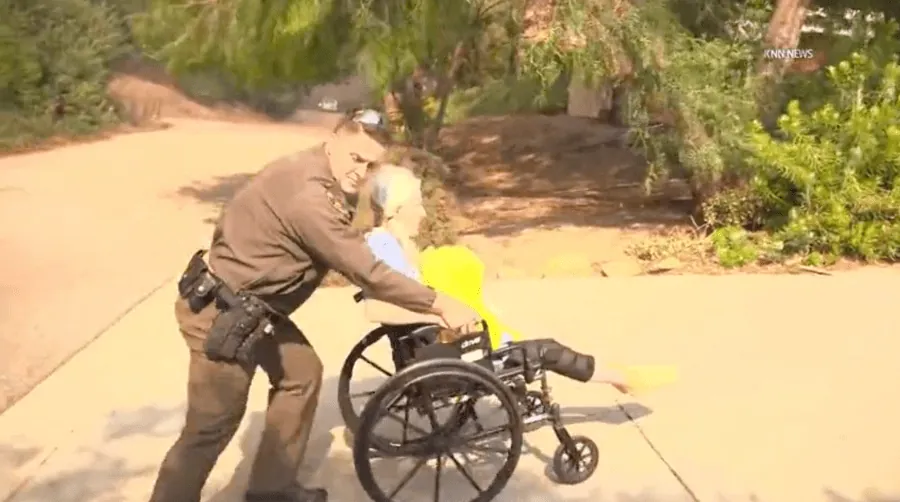
That does not mean responders do not care. It means a major wildfire can create more urgent needs than the system can physically answer at once. NIST’s Camp Fire evacuation case study documented 198 evacuation-assistance or rescue events, a useful reminder that “I’ll call for help” may turn into “many people are calling for help at the same time.”[3] In the 2018 Camp Fire, 80% of the 85 deaths were people 65 or older, and more than a dozen victims were physically or mentally impaired, according to reporting in Places Journal.[4]
So the plan cannot be a hopeful paragraph taped to the refrigerator. It has to name the lifter, the second lifter if one is needed, the driver, the backup driver, the vehicle, the keys, the destination, the equipment that goes, the power source, and the people outside the home who already know help may be needed.
Safety and legal note: this article is not medical, legal, or emergency-services advice. Before fire season, have the written plan reviewed by the senior’s clinician, respiratory therapist, mobility professional, attorney, or agency supervisor as appropriate for the senior’s medical devices, transfer needs, medications, advance directives, and paid-care rules. Write that reviewer’s name and review date on the plan.
Put names on the jobs before you buy one more emergency item
A medically fragile evacuation fails in the small spaces: bed to wheelchair, wheelchair to porch, porch to vehicle, vehicle to destination. The first version of the plan can be ugly and simple. It just has to force the blanks into the open.
| Plan line | What must be filled in |
|---|---|
| Transfer method | Can the senior stand-pivot, use a transfer board, use a Hoyer lift, be carried by two trained people, or require ambulance-level transport? |
| Primary transfer person | Name, phone number, and whether that person can transfer safely without injuring the senior or themselves. |
| Second transfer person | Name and phone number if the move requires two people. |
| Backup transfer help | Neighbor, relative, paid caregiver, building staff, or pre-identified responder contact if the primary person is unavailable. |
| Driver | Name of the person who drives, not just the person who lifts. |
| Backup driver | Name of the person who can drive if the first driver is at work, out of town, asleep, or also evacuating. |
| Vehicle | Which car or accessible van will be used, where it is parked, and whether the wheelchair, oxygen, walker, or lift equipment fits. |
| Keys and access | Who has house keys, vehicle keys, gate codes, garage access, medication lockbox access, and oxygen/equipment cabinet access. |
| Destination | Address, phone number, accessibility notes, power availability, pet policy if relevant, and who has confirmed the senior can arrive there. |
Start with the transfer, not the driveway
Write down the senior’s safest real transfer on an ordinary day. Not the transfer they could do three years ago. Not the transfer that works if they are calm, rested, and wearing the right shoes. The one that works when the caregiver is under pressure and the senior is frightened, short of breath, confused, weak, or half awake.
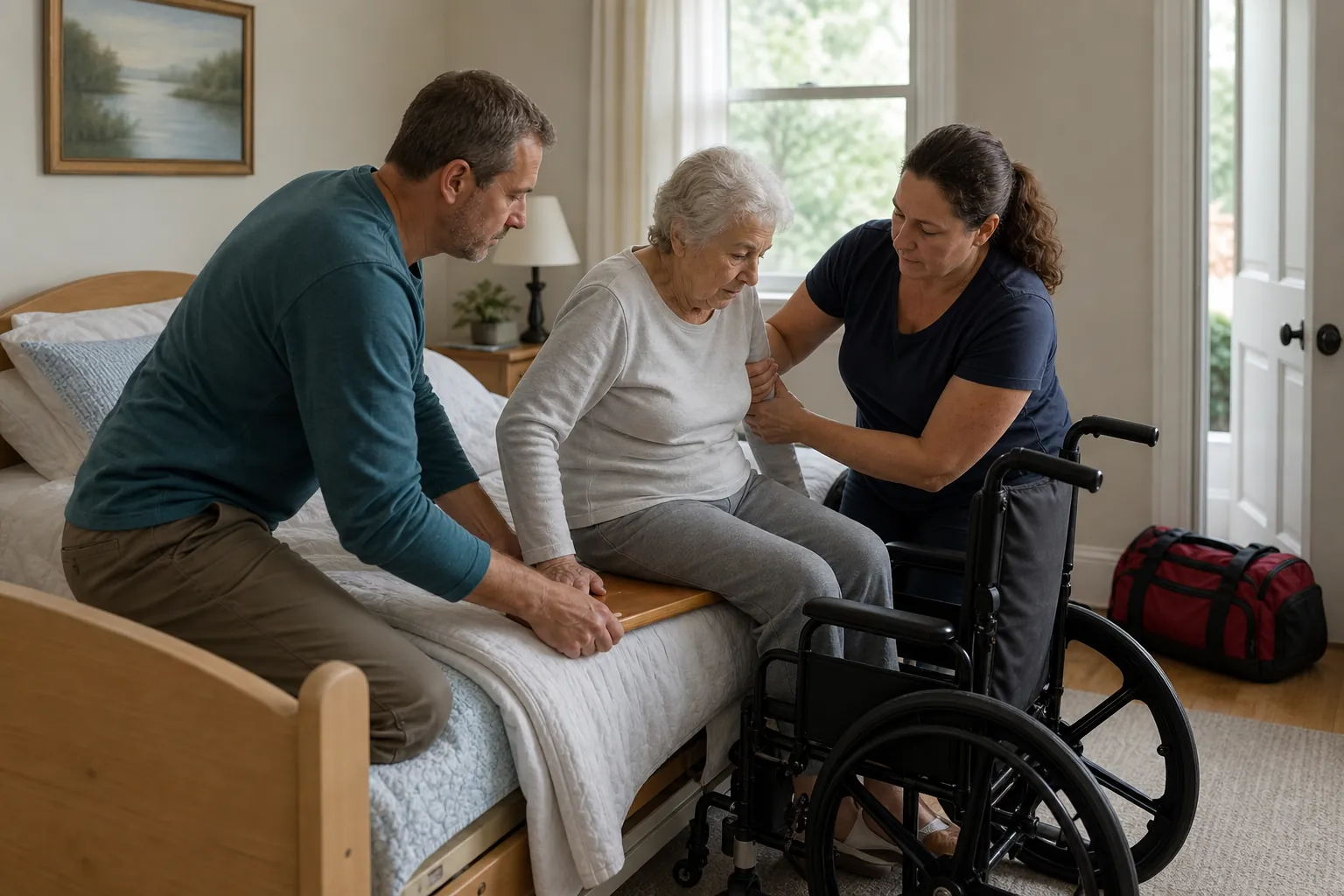
If one trained caregiver can do a stand-pivot transfer safely, the plan should say that. If the senior needs a slide board, gait belt, mechanical lift, or two-person assist, the plan should say that too. If the paid IHSS worker is the only person who can transfer the senior without harm, that is not a side note; it is the plan’s central weakness and the first backup that must be built.
CalMatters’ reporting included the story of an 80-year-old quadriplegic IHSS consumer, which is exactly the kind of case that exposes the gap between “evacuate when told” and “someone must perform a safe transfer.”[1] A family plan that depends on one worker, one adult child, or one neighbor is not finished until it answers what happens when that person cannot get there.
- Write the transfer type in plain language: “two-person bed-to-wheelchair transfer with transfer board,” “Hoyer lift to wheelchair,” “can stand-pivot only with gait belt,” or “cannot transfer without medical transport.”
- Practice the transfer with the actual evacuation chair, wheelchair, walker, shoes, oxygen tubing, and doorway route.
- Time the move from bed or recliner to vehicle. The exact time is less important than discovering the stuck points while the sky is clear.
- If the move is unsafe for one person, do not let pride write the plan. Name the second person and the backup second person.
The driver is a separate job
Caregivers often say, “I’ll take her.” That can hide three jobs inside one sentence: transferring the senior, loading the equipment, and driving through evacuation traffic. If the senior uses oxygen, has dementia, panics during transfers, or cannot sit safely without monitoring, one person may not be enough.
Name the driver even if the driver is the same person as the caregiver. Then name the backup driver. The backup has to know where the keys are, how to operate the accessible van ramp or seat controls, how to fold or load the wheelchair, and where the destination is. If the senior can only ride in one vehicle, the backup driver must be able to drive that vehicle.
- Keep a labeled spare key where the backup can legally and quickly access it.
- Back the vehicle into the driveway during high-risk fire weather if that makes departure safer and faster.
- Check whether the wheelchair, walker, oxygen tanks, CPAP, medication cooler, incontinence supplies, and go-bag all fit at the same time.
- If a power wheelchair cannot be loaded, identify the manual wheelchair that becomes the evacuation chair.
- If no household vehicle can handle the transfer or equipment, solve that before fire season through family, neighbors, paratransit, facility coordination, or the local fire department’s guidance.
Choose a destination that can handle the body in front of you
“We’ll go to my sister’s” is not a destination plan unless your sister’s home can actually receive the senior. Can the senior get through the entrance? Is there a place to sleep that does not require stairs? Is there an outlet near the sleeping area for CPAP or oxygen equipment? Can the bathroom be used with a walker or wheelchair? Is there space for a caregiver to perform transfers?
The destination does not have to be perfect. It has to be known. A hotel, relative’s home, assisted-living respite option, cooling center, or public shelter all require different equipment decisions. If the senior needs powered medical equipment, do not assume a shelter will have the right device waiting.
Medical equipment and power are part of the evacuation, not extras
Generic emergency-kit advice becomes dangerous when it quietly assumes the senior breathes, sleeps, transfers, toilets, and takes medication without equipment. AgingCare warns that shelters do not stock durable medical equipment such as therapeutic oxygen, CPAP machines, or blood-sugar monitors.[5] The American Red Cross advises older adults to keep at least 30 days of medications when possible and to make a backup plan for power to run medical devices or keep medicines cold.[6]
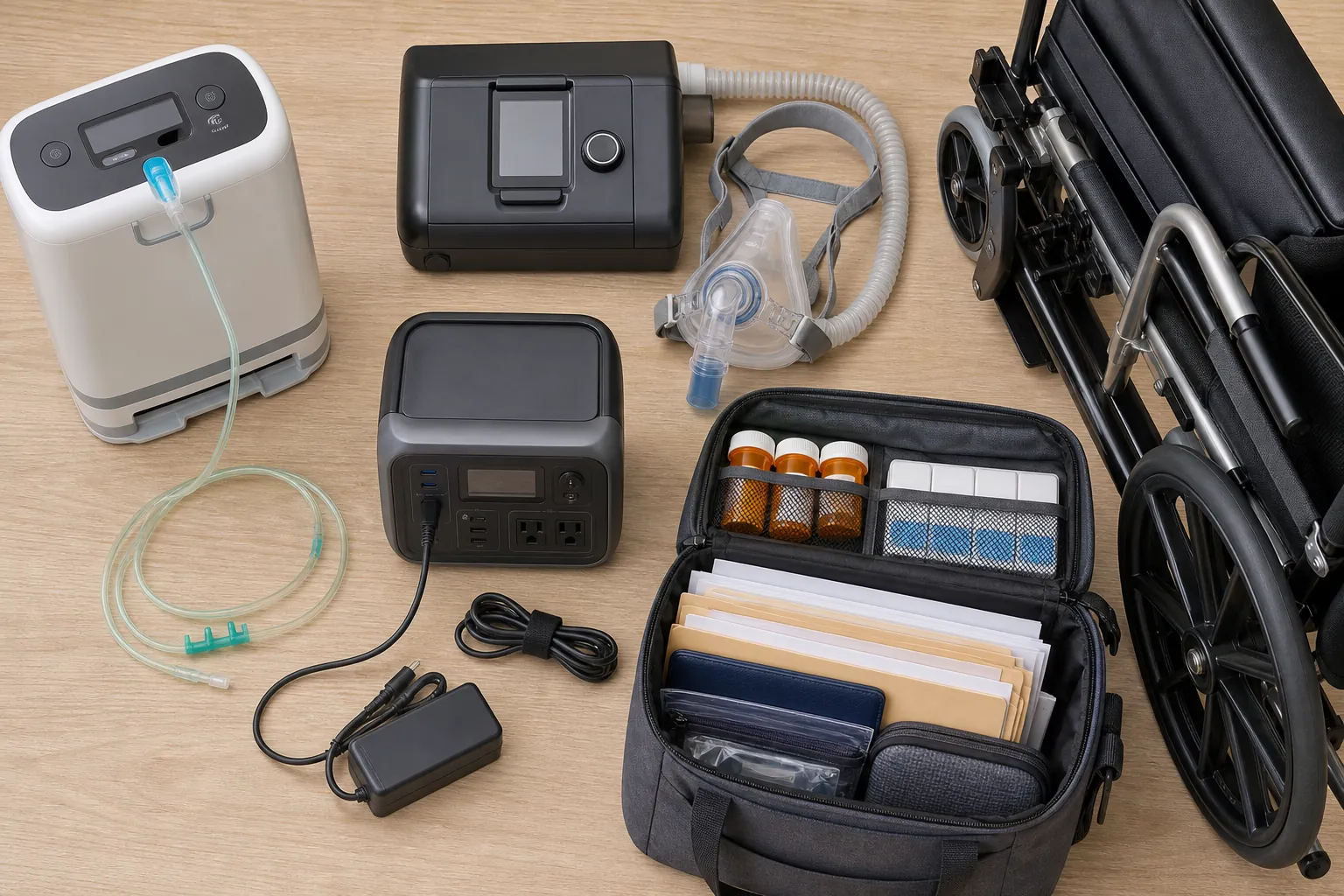
Make one equipment page for the senior. Keep it with the go-bag, send a copy to the backup caregiver, and put a photo of it on the caregiver’s phone. For item-by-item packing by cane, walker, wheelchair, power chair, or scooter, use the mobility-device evacuation checklist. This plan is the higher-level control sheet: what must leave, who loads it, and what happens if power fails.
| Need | What the caregiver must decide before fire season |
|---|---|
| Oxygen | Portable tanks or concentrator, tubing, cannulas, flow-rate instructions from the prescribing clinician or supplier, supplier phone number, and battery or vehicle-charging plan. |
| CPAP or BiPAP | Machine, mask, tubing, power cord, backup battery, and whether the senior can safely miss use during travel only if their clinician has addressed that. |
| Powered bed, lift, or recliner | Whether the senior can exit if power is out, whether a manual release exists, and what transfer method replaces the powered device. |
| Power wheelchair or scooter | Charger, key, manual freewheel instructions if applicable, and manual wheelchair fallback if the device cannot travel or charge. |
| Manual wheelchair | Footrests, cushion, seat belt if used, tire condition, and whether it fits through the evacuation route and into the vehicle. |
| Medication | Current medication list, enough medication to leave early, pharmacy and prescriber contacts, and refrigeration plan for medicines that must stay cold. |
| Diabetes or monitoring supplies | Meter or monitor supplies, batteries or charger, sharps container plan, snacks or glucose source if medically appropriate, and written instructions. |
| Incontinence and sanitation | Briefs, wipes, gloves, barrier cream, disposal bags, portable urinal or commode supplies if needed, and change of clothing. |
| Legal and medical documents | Copies of power of attorney, advance directive, insurance cards, medication list, device prescriptions, emergency contacts, and physician information. |
| Communication or dementia support | Simple ID card, preferred name, diagnosis notes, calming phrases, hearing aids and batteries, glasses, and a one-page explanation for helpers. |
Do not bury the power plan in a drawer. Public Safety Power Shutoffs and wildfire-related outages can interrupt concentrators, CPAP machines, powered beds, refrigeration, garage doors, phones, and chargers. CAL FIRE’s Ready for Wildfire guidance tells residents to be prepared to leave early and includes power-outage awareness; its emergency supply kit guidance also lists 1 gallon of water per person per day.[7][8] Alameda County’s older-adult preparedness guidance points residents toward PG&E programs and power-outage planning resources.[9]
- Label every charger and cord with the device name.
- Keep backup batteries charged on a schedule, not “when someone remembers.”
- Know which devices can run from a vehicle outlet and which cannot.
- Ask the oxygen or equipment supplier what battery duration, tank quantity, and travel setup are appropriate for the senior’s prescription and evacuation distance.
- If medication must stay cold, pack a cooler method and written temperature instructions from the pharmacy or clinician.
- If the garage door is electric, know the manual release and whether the caregiver can operate it.
For medication refrigeration and medical-device continuity during outages, the same habits used in winter storms and severe weather apply. Keep those details in the senior’s broader emergency file rather than rewriting them from scratch in every wildfire note.
Tell the fire department and neighbors before the fire starts
The worst time to introduce a medically fragile senior to the local fire department is when the road is already filling with smoke. CalMatters reported that disability and aging advocates advised families to “build the community around you” and to register with the local fire department; the same article described a 126-organization coalition, including AARP and Justice in Aging, that cited mobility limits, chronic conditions, and social isolation as disaster-preparedness concerns.[1]
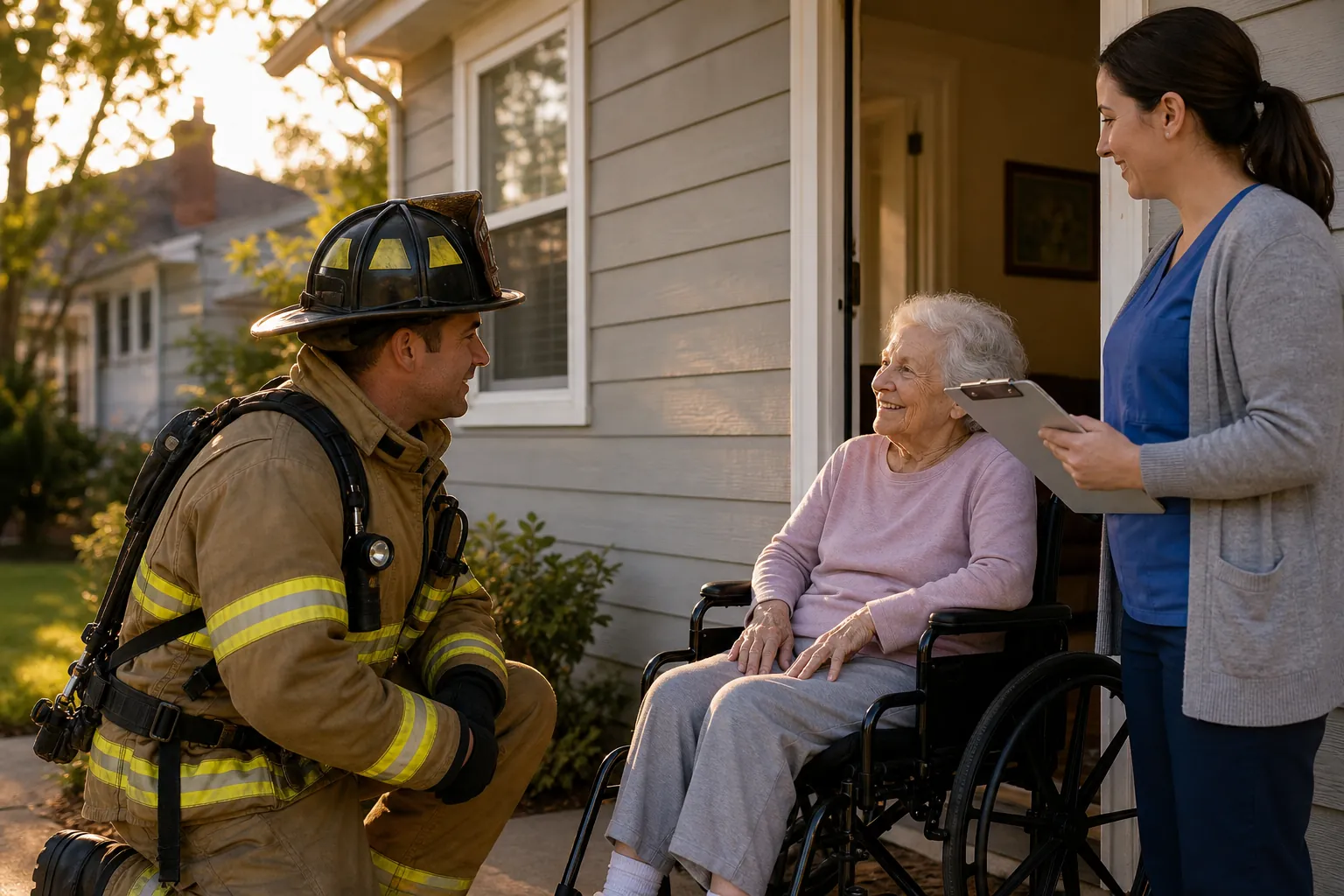
Call the local fire department or emergency-management office during a nonemergency period and ask what information they can accept. Some areas maintain voluntary registries or special-needs information; others may not. Either way, the call itself teaches you what the local system can and cannot promise.
- Give the senior’s address, apartment number, gate code, lockbox location if used, and best entrance.
- State the mobility issue plainly: “cannot walk,” “two-person transfer,” “wheelchair user,” “bedbound,” or “uses power wheelchair.”
- List power-dependent medical equipment: oxygen concentrator, CPAP/BiPAP, hospital bed, lift, refrigerated medication, or other devices.
- Name the primary caregiver, backup caregiver, and out-of-area contact.
- Ask whether responders recommend a visible window decal, lockbox, access note, or registry update schedule.
- Ask what the department wants families to do during an evacuation warning versus an evacuation order.
LA County’s emergency-planning framing is practical: know where you will go, how you will get there, how you will communicate, and what supplies you need.[2] For a senior who cannot walk, each of those questions needs a person’s name attached.
Neighbors need assignments, not vague goodwill
A neighbor may be the difference between evacuation and abandonment, but only if the neighbor knows the role before the emergency. Do not ask five neighbors to “check in sometime.” Ask one to knock if a warning is issued, another to call the caregiver, another to help carry the manual wheelchair to the car, and another to take the pet if the caregiver is occupied with oxygen or transfers.
- Give trusted neighbors the caregiver’s phone number and the backup caregiver’s phone number.
- Tell them whether the senior can open the door independently.
- Tell them where the wheelchair, walker, oxygen bag, or go-bag is kept if they are expected to retrieve it.
- Make clear whether they are being asked to lift. Most neighbors should not be improvising a dangerous transfer.
- Set a trigger: warning issued, power shutoff notice, visible smoke, caregiver unreachable, or local alert.
- Give them permission to call 911 if the caregiver cannot be reached and the senior cannot leave.
Leave early when mobility or medical power is fragile
A senior who needs a two-person transfer, oxygen, CPAP, a power chair, refrigerated medication, or a calm dementia routine should not be treated like a healthy adult who can wait for an evacuation order, grab a backpack, and drive away in ten minutes. Ready for Wildfire tells residents to be prepared to leave early.[7] For this household, early departure is not overreacting. It is time for the transfer, equipment, traffic, and mistakes.
Use a separate wildfire evacuation trigger guide to decide when your family leaves at the warning stage instead of waiting for the order. This article’s job is narrower: once the trigger is reached, who does the work?
If the senior lives alone, fold this plan into the larger aging-parent wildfire planning hub. If the likely problem is nighttime confusion, poor lighting, missing shoes, or a fall on the way to the door, use the night-evacuation fall checklist and borrow the same bedside staging habits used for earthquakes: glasses, shoes, flashlight, phone, and mobility aid in reachable places.
If officials tell the household not to evacuate yet and smoke is the immediate threat, switch to the wildfire smoke safety checklist for seniors. If the senior has already evacuated and the question is re-entry, cleanup, or unsafe utilities, use the wildfire recovery checklist instead of trying to make the evacuation page do every job.
The caregiver’s pre-season test
Run this once before the local high-risk season and again after any hospital stay, new diagnosis, new mobility device, new oxygen order, medication change, or caregiver schedule change. Do it on a normal afternoon. The point is not drama. The point is to find the missing person, missing charger, missing key, or impossible transfer while there is still time to fix it.
- Confirm the evacuation trigger: warning, order, power shutoff notice, visible smoke, caregiver availability, or a stricter family rule for early departure.
- Move the senior from their usual resting place to the evacuation chair or wheelchair using the written transfer method.
- Load the senior into the actual vehicle, or prove that the vehicle plan does not work and must be replaced.
- Load oxygen, CPAP/BiPAP, chargers, backup batteries, medication, documents, incontinence supplies, glasses, hearing aids, mobility aids, and the go-bag.
- Call or text the backup caregiver and backup driver as a drill. Make sure the numbers work and the people understand their jobs.
- Check that the destination still works: entrance, sleeping space, bathroom access, power, caregiver space, and permission to arrive.
- Open the document packet and confirm that medication lists, emergency contacts, power of attorney, advance directive, insurance cards, and device instructions are current.
- Update the vial-of-life or equivalent packet so responders can quickly see diagnoses, medications, allergies, emergency contacts, and decision-makers. LA County specifically highlights vial-of-life packets in its preparedness lessons.[2]
- Recharge every backup battery and label the next charging date.
- Send the revised plan to the primary caregiver, backup caregiver, driver, backup driver, out-of-area contact, and any neighbor who has an assigned role.
When the page is finished, it should not say “Dad will evacuate with help.” It should say who unlocks the door, who transfers Dad, who brings the oxygen, who drives, which car leaves, where it goes, who is called if the first person is gone, and who outside the household already knows Dad may not be able to leave without help.
References
- How can CA prepare disabled households for the next wildfire?, CalMatters, February 2025
- Lessons from the January Wildfires: Why Preparedness Matters, LA County Aging & Disabilities
- A Case Study of the Camp Fire – Notification, Evacuation, Traffic, and Temporary Refuge Areas (NETTRA), National Institute of Standards and Technology
- Lessons from Paradise on Fire, Places Journal
- 10 Things to Include in a Senior Emergency Kit, AgingCare
- Older Adults, American Red Cross
- Go! Evacuation Guide, Ready for Wildfire
- Emergency Supply Kit, Ready for Wildfire
- Older Adults, Alameda County
Related reading
Noticed something outdated or inaccurate on this page? Flag a correction. We review every report against CDC, NIA, and AARP HomeFit guidance before updating a page.
Part of the Fall Prevention section.