
STEADI: Intervene
How to Protect Older Parents from Poor Air Quality
Get an older parent's home air-quality ready before wildfire or high-pollution season. The checklist shows which low-cost, measurable upgrades cut exposure most — a MERV 13 filter where the system allows it, a HEPA air cleaner sized to the room, a stocked clean-air room, AQI alerts, and a 7–10 day medication supply.
The practical answer to how to protect an older parent from poor air quality starts before the first smoke advisory. Once the air is already bad, the choices become rushed: which room, which filter, whether the furnace fan should run, whether there are enough prescriptions, whether the purifier is the right size. The calmer work is to turn those choices into a few measurements and supplies that are already in place.
Older adults are not an afterthought in air-quality guidance. AirNow identifies older adults as a sensitive group and connects fine particle pollution, including PM2.5, with premature death, cardiac arrhythmias, heart attacks, asthma attacks, chronic bronchitis, and aggravation of heart disease, stroke, COPD, asthma, and diabetes.[1] That does not mean every smoky day becomes a medical emergency. It does mean the house deserves a plan that can be checked before anyone is coughing, wheezing, dizzy, or trying to interpret an alert in a panic.
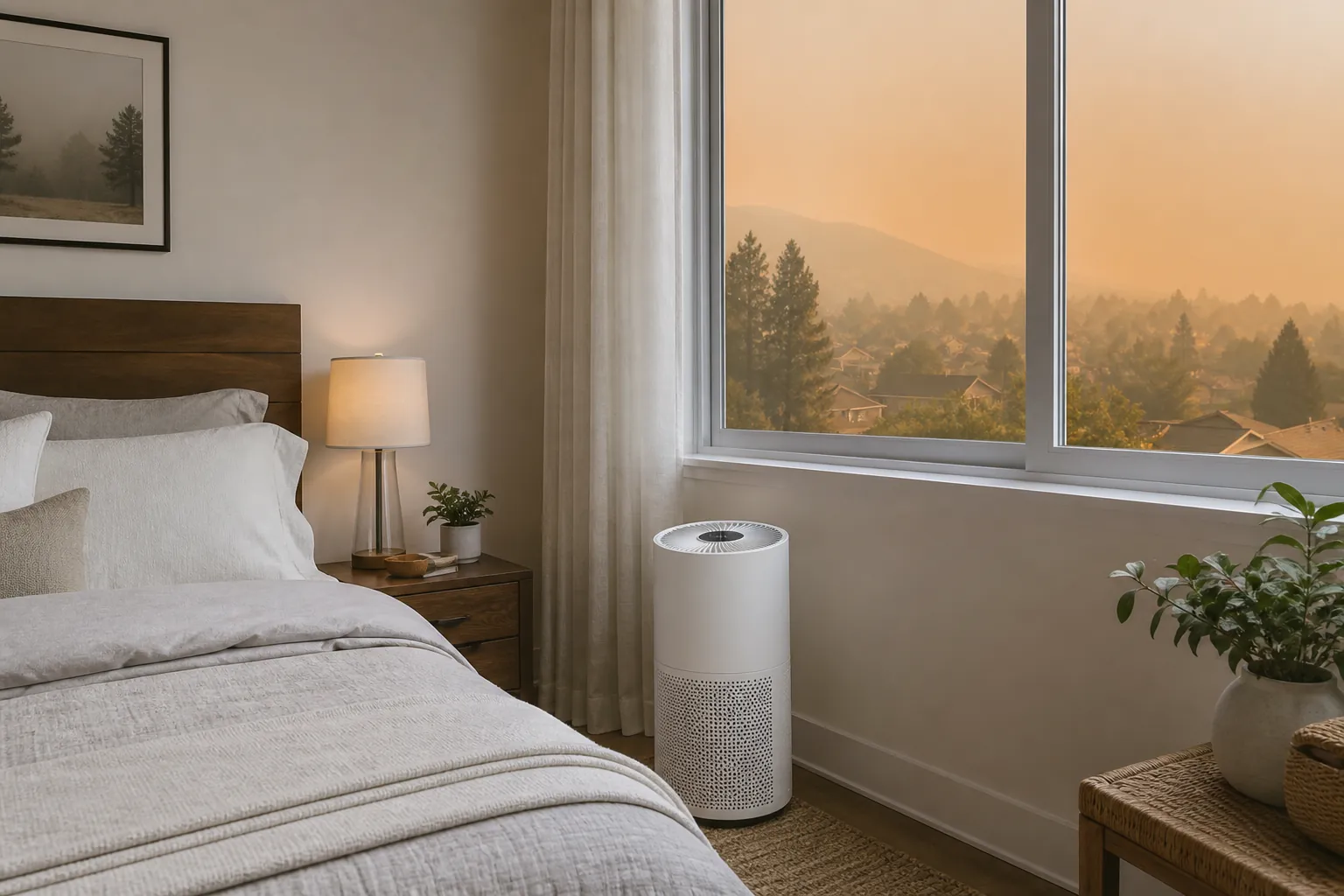
The pre-season preparation map
Before buying anything, write down where your parent actually spends the most time: bed, recliner, kitchen table, TV room, medication spot. The best equipment choice is usually the one that cleans the air where your parent will sit or sleep during a bad-air day, not the one with the most impressive label.
| Preparation task | What to check or measure | What “ready” looks like |
|---|---|---|
| HVAC filter | Confirm the system can safely handle a higher-efficiency filter before choosing MERV 13 or higher. | A compatible filter is installed, and spare replacements are stocked before smoke season.[2] |
| Portable air cleaner | Measure the room and choose a HEPA unit with a CADR at least two-thirds of the room’s area. | The cleaner is placed in the room where your parent spends the most time and can run during smoke events.[3] |
| Clean-air room | Pick a room that can be closed off, is comfortable for hours, and ideally has an attached bathroom. | The room has a non-ozone air cleaner, water, medications, phone charger, seating or bed, and a door-gap plan that does not block exit.[4] |
| AQI monitoring | Set alerts for your parent’s ZIP code and for your own phone if you live elsewhere. | Someone is assigned to check the AQI before outdoor errands, exercise, appointments, or window-opening decisions.[5] |
| Medication and supplies | Ask the parent’s healthcare provider or pharmacist how to maintain a short reserve safely. | A 7–10 day prescription supply is available when possible, along with spare filters and basic comfort supplies.[6] |
If you already keep a seasonal household list, this fits next to the same kind of preparation used in a winter-proofing walkthrough, severe weather checklist, or flood safety checklist. The difference is that smoke preparation is less about moving things upstairs or securing loose objects and more about deciding, in advance, which indoor air your parent will breathe most.
Start with the HVAC system, not the filter label
A MERV 13 filter can be a useful upgrade, but only if the heating and cooling system can handle it. AirNow’s smoke-readiness guidance says to use a MERV 13 or higher filter only if the system can safely use one, and to stock replacement filters before the season starts.[2] That compatibility check matters because a denser filter can increase resistance to airflow in some systems. If the system struggles, the upgrade can become a maintenance problem instead of a protection plan.
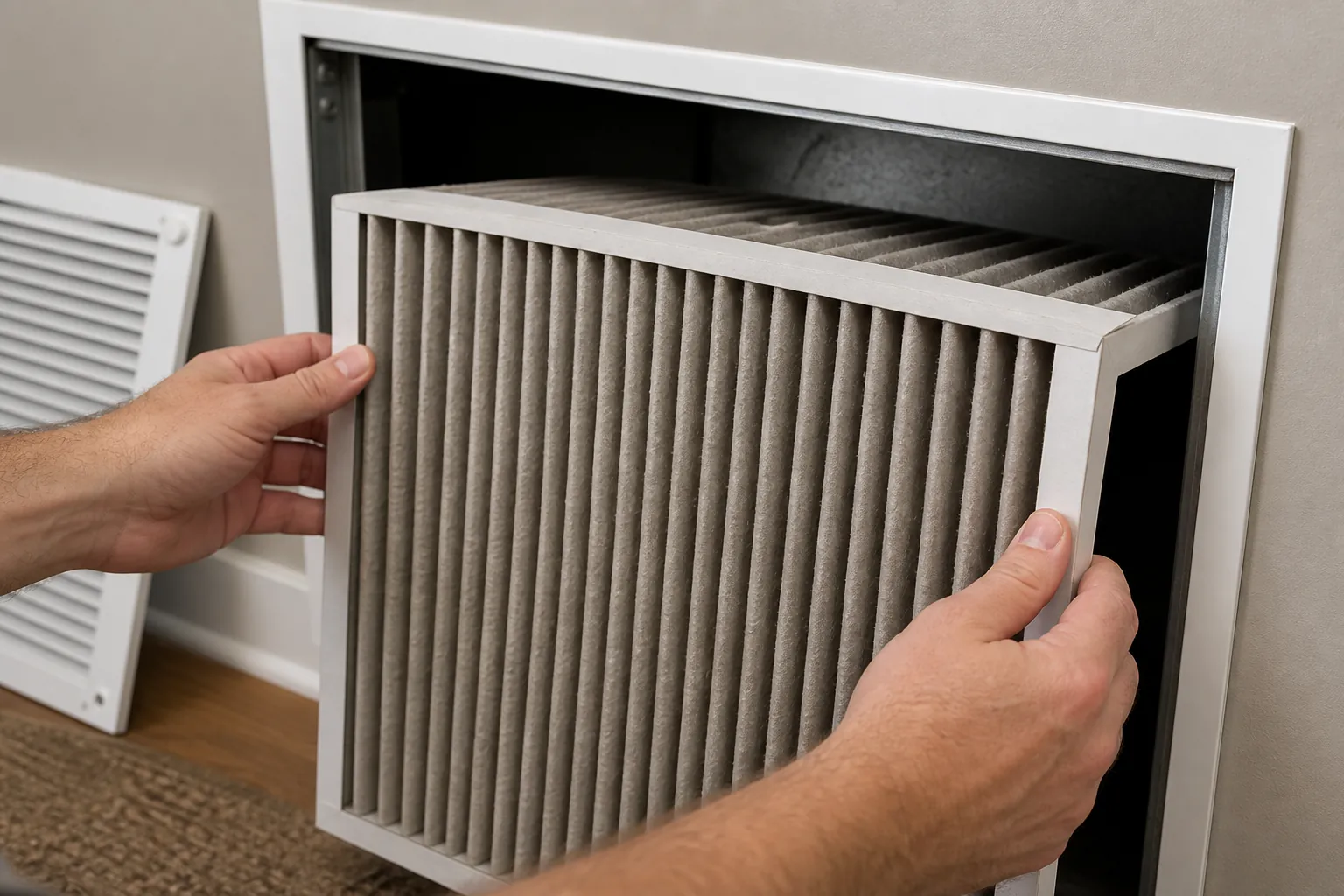
The right first call is often boring: ask an HVAC professional, landlord, building manager, or the system’s documentation what filter rating the equipment can support. If the answer is MERV 13, buy the exact size printed on the existing filter frame. If the answer is lower, do not improvise by forcing a thicker or more restrictive filter into the return.
Also check how the fan runs. The American Lung Association notes that HVAC systems filter air only when the fan is running.[3] In many homes, the system may cycle on and off according to temperature, not air quality. That means the HVAC filter can be part of the plan, but it should not be the only protection for a bedroom or sitting room during a smoke event.
For the pre-season checklist, the HVAC task is finished when four things are true:
- The filter size is written down or photographed.
- The highest safe filter rating for the system is confirmed.
- A compatible filter is installed before the season starts.
- At least one spare replacement is in the house, because filters may need to be changed more often during heavy smoke.[2]
This is also the place to acknowledge the less glamorous costs. Better filters cost money, and someone has to remember to change them. If that person is your parent, make the filter location and replacement schedule realistic. If it requires a ladder, a heavy grille, or kneeling in a tight hallway, assign the task to someone else before the alert season begins.
Choose the portable cleaner by room size and CADR
A portable air cleaner is usually the most practical way to improve the air in the room where an older parent will wait out a bad-air day. The American Lung Association says portable air cleaners with HEPA filters are the most effective for particle pollution, and recommends choosing a clean air delivery rate, or CADR, at least two-thirds of the room’s area.[3]
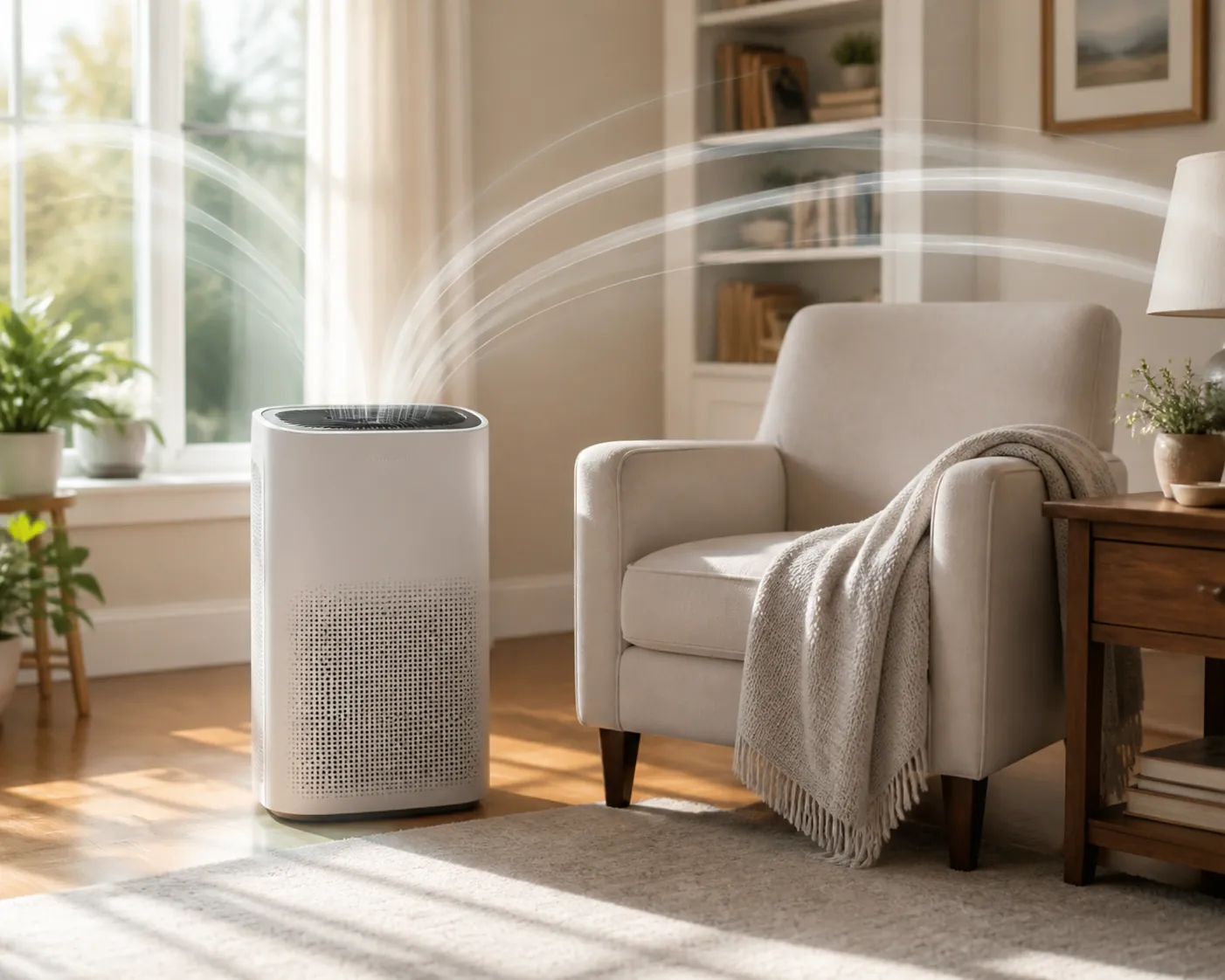
That turns shopping into arithmetic. Measure the room’s length and width, multiply them to get square feet, then look for a unit whose smoke CADR meets the two-thirds rule. For example, in a hypothetical 180-square-foot bedroom, two-thirds of the room area is 120, so the target would be a smoke CADR of at least 120. A larger room needs a higher CADR or a different plan, such as making the bedroom the clean-air room instead of trying to clean an open living area.
The label should also make clear what the machine does not do. For this use, avoid air cleaners that produce ozone or rely on ionizers or UV devices as the protection strategy. The American Lung Association cautions against ozone generators, ionizers, and UV air cleaners for indoor air cleaning.[3] A device that sounds more advanced is not automatically safer for a parent with asthma, COPD, heart disease, or other chronic conditions.
Placement matters almost as much as the purchase. Put the cleaner in the room where your parent will actually spend time, with space around the intake and outlet. Do not wedge it behind a chair, under a table, or against curtains. If the parent sleeps with the door closed, a bedroom unit may do more good than a stronger machine running across the house.
Run the unit long enough to learn its annoyances before smoke season. Some machines are too loud on the highest setting for sleep or phone calls. Some have bright lights. Some filters are expensive or hard to find. None of those limits make the device useless, but they should be known before your parent is expected to sit beside it for hours.
It is also important not to oversell what a purifier can do. Oregon State University Extension says high-efficiency portable air cleaners may reduce indoor particle concentrations by up to about 45%.[7] That is meaningful exposure reduction. It is not a guarantee that the room is fully safe, and it does not replace keeping smoke from entering the home in the first place.
Make one room usable, not just “clean”
The clean-air room is the room where your parent can stay when outdoor air is unhealthy and the rest of the house is harder to control. It should be small enough for the air cleaner to handle, comfortable enough to use, and practical enough that your parent will not keep leaving it for water, pills, a charger, or the bathroom.
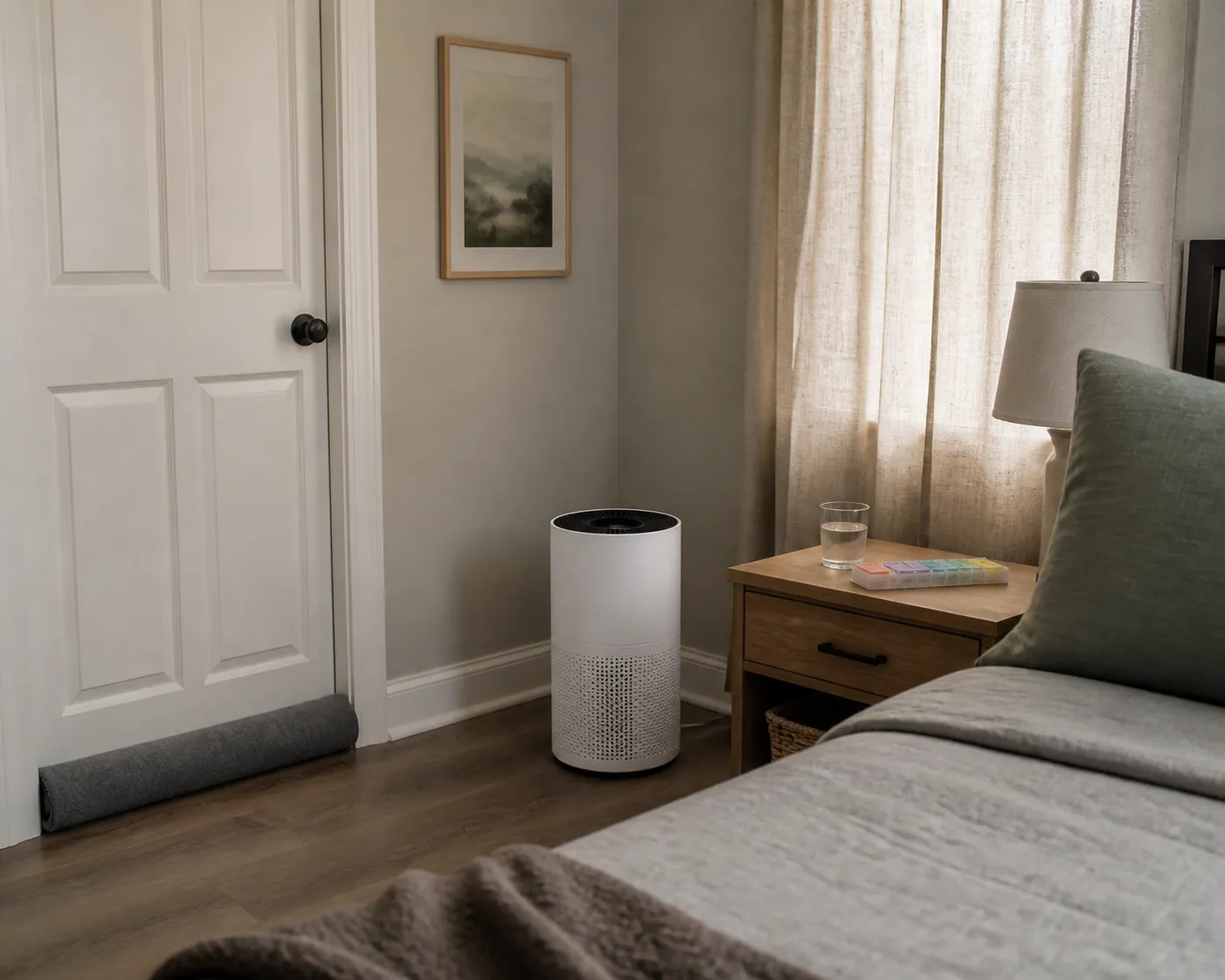
The American Lung Association’s clean-room guidance favors a room with an attached bathroom when possible, a non-ozone portable air cleaner, and sealing gaps such as the bottom of the door with a towel while keeping exits unobstructed.[4] That last condition is not a detail. A towel that blocks smoke at the door gap is useful; a towel, cord, or purifier placement that creates a tripping or exit problem is not.
Walk through the room as if your parent will spend half a day there. Can they sit without strain? Can they nap? Is the phone charger reachable without bending behind furniture? Is there a lamp? Is there a place for inhalers, oxygen equipment if prescribed, hearing aids, glasses, water, and a medication organizer? If the best air-cleaning room is also the least comfortable room, the plan may fail for a very ordinary reason: no one wants to stay there.
A good clean-air room also has a door policy. During smoke events, keep the door closed as much as possible. If people come in and out repeatedly, the room becomes a hallway with a purifier in it. If a pet will be in the room too, plan for that now rather than negotiating it when your parent is already stressed.
Stock it lightly, not like a bunker. A water bottle, shelf-stable snack, tissues, trash bag, medication list, phone charger, spare glasses if available, and the correct purifier filter are enough for many homes. If you already maintain a go-bag through a storm safety plan, do not duplicate everything. Put the air-quality-specific items where they will be used.
Set AQI alerts that trigger decisions
An alert is only useful if it changes what someone does. Set AQI notifications for your parent’s location, and if you live elsewhere, set the same alerts on your own phone. The point is not to watch numbers all day. The point is to know when to close windows, postpone an outdoor errand, start the air cleaner, or call and remind your parent to use the clean-air room.
AARP’s wildfire-smoke guidance notes that an AQI above 150 is unhealthy for everyone, while older adults and other sensitive groups should pay attention when the AQI reaches orange, or 101–150.[5] The same article quotes Stanford scientist Rob Jackson’s blunt rule: “Check the AQI before you do anything.”[5]
For a parent who values independence, this can be framed as a household routine rather than surveillance. The alert does not mean someone is in trouble. It means the day’s plan changes: walk indoors, keep windows closed, run the purifier, move the pill organizer and water into the clean-air room, or reschedule a nonurgent appointment.
Write down who responds to the alert. If your parent is comfortable with apps, they may check it themselves. If not, a caregiver, neighbor, building staff member, or nearby relative may be the person who checks and calls. The weak point in many plans is not information; it is the unassigned moment when everyone assumes someone else saw it.
Prescriptions, action plans, and chronic conditions
This article is home-preparation guidance, not medical advice. Medication changes, rescue inhaler instructions, oxygen instructions, and symptom thresholds belong with your parent’s healthcare provider. The caregiver’s job before smoke season is to make sure those instructions are written down, reachable, and paired with enough supplies to avoid a last-minute pharmacy trip during bad air.
CDC guidance for people with chronic conditions recommends having a 7–10 day supply of prescription medicines and following the healthcare provider’s advice for managing health conditions during wildfire smoke.[6] That is especially relevant for parents with heart disease, COPD, asthma, diabetes, or a history of stroke, because poor air quality can aggravate existing conditions rather than create a single obvious problem.
Put the medication list in two places: one in the clean-air room and one with the person most likely to call the doctor, pharmacy, or urgent care. Include medication names, doses, pharmacy phone number, prescriber name, allergies, and emergency contacts. If your parent uses inhalers, nebulizer equipment, oxygen, CPAP, or other respiratory or cardiac equipment, ask the provider what should change during smoke days and what symptoms should prompt medical care.
If the household also prepares for outages, hurricanes, or other emergencies, connect the plans. A hurricane-ready home modification plan may already cover backup power, refrigerated medications, and charging medical devices. Air-quality preparation should not create a second, conflicting system; it should add smoke-specific triggers and filtration supplies to the emergency routine you already trust.
Reduce indoor particle sources during bad-air days
Filtration works better when the home is not adding avoidable particles at the same time. CDC advises people with chronic conditions to avoid activities such as frying or grilling that worsen indoor air during wildfire smoke.[6] On smoke days, the simpler meal may be the safer meal: microwave, slow cooker, no-cook food, or something prepared earlier.
Also avoid burning candles, incense, or wood, and be careful with cleaning routines that stir up dust. If vacuuming is necessary, a vacuum with a HEPA filter is preferable to one that redistributes fine particles into the room. If your household already uses automated cleaning, this is the moment to check whether the device’s filtration and maintenance fit the air-quality plan rather than assuming clean floors mean cleaner air; the same issue comes up when comparing robot vacuums for aging in place.
Outdoor exposure deserves the same practical treatment. Johns Hopkins Medicine advises limiting outdoor time when air quality is poor and suggests showering after coming inside to remove particles from skin and hair.[8] For many families, that translates into moving the walk indoors, consolidating errands, asking someone else to take out trash, and keeping outdoor clothes out of the clean-air room.
The box-fan filter is a fallback, not the main plan
A DIY box-fan filter can look appealing because it is cheap and visible. Treat it as a constrained fallback, not the centerpiece of an older parent’s protection plan. AirNow warns that older box fans made before 2012 can be an electrical or fire hazard, and says any fan used for this purpose should be a 2012-or-newer model with a UL or ETL safety marking.[2]
That condition alone rules out the dusty fan pulled from a garage shelf unless its age and label are clear. A commercial HEPA portable cleaner sized to the room is easier to operate, easier to place safely, and less likely to become one more improvised device someone has to monitor.
Why this level of preparation is worth the trouble
The broad health evidence is serious, but it should not leave a caregiver frozen in statistics. An American Heart Association News report on a 2021 Circulation study described an analysis of more than 63 million Medicare records and found that even low levels of PM2.5, nitrogen dioxide, and ozone were associated with increased hospitalizations among adults 65 and older for heart attack, stroke, atrial fibrillation and flutter, and pneumonia.[9] That kind of evidence supports taking poor air quality seriously, especially for parents with chronic conditions.
None of that eliminates exposure. It does reduce the number of decisions that have to be made when visibility drops, the AQI alert sounds, or your parent says the air smells smoky. That is the value of the pre-season work: not a promise of safety, but a house that is already set up to respond.
Once smoke is already thick, the question changes to what to do during the event: when to stay inside, when to call a clinician, when to leave, and how to handle symptoms. That crisis guide is a separate path. The preparation work is what can be completed now, while there is still time to measure the room, buy the right filter, and make the clean-air room one your parent will actually use.
References
- Older Adults and Air Quality, AirNow.gov
- Be Smoke Ready, AirNow.gov
- Air Cleaning, American Lung Association
- How to Create a Clean Room, American Lung Association
- Wildfire Smoke Health Risks for Older Adults, AARP
- Wildfire Smoke and People with Chronic Conditions, CDC
- Protecting indoor air quality from wildfire smoke, Oregon State University Extension
- Air Quality and Health, Johns Hopkins Medicine
- Even low levels of air pollution can increase heart, lung risks in older adults, American Heart Association News, February 22, 2021
Related reading
Noticed something outdated or inaccurate on this page? Flag a correction. We review every report against CDC, NIA, and AARP HomeFit guidance before updating a page.
Part of the Fall Prevention section.