
The Hidden Costs of Aging in Place in 2026: Why Families Underestimate the True Price Tag
Last reviewed: — Review date is particularly important for Medicare coverage, device specifications, and clinical guidance, which change frequently.
Why "Aging in Place Is Cheaper" Is a Dangerous Oversimplification
The logic feels unassailable: staying in a paid-off home must cost less than paying $5,350 to $11,000 per month for assisted living. Over 90% of older adults prefer to remain at home, and their families often assume that preference aligns with the fiscally responsible choice. But that assumption skips a critical step — it compares the cost of a mortgage-free house against a facility's all-inclusive monthly fee without accounting for the expenses that appear only after a family commits to the aging-in-place path.
Those expenses do not arrive as a single bill. They accumulate in layers: a $200 grab bar installation this month, $4,000 in part-time home care next month, a $15,000 bathroom remodel the following year, and a steady erosion of a working adult child's income as caregiving hours eat into the workday. By the time families realize the full financial picture, they have already committed to a path that may be more expensive — and less financially predictable — than the facility they ruled out.
The goal of this guide is not to persuade you that assisted living is the better choice. It is to ensure that when you compare the two options, you are comparing the full cost of each — not the idealized version of aging in place that ignores the hidden layers.

The Hidden Cost Layers Families Miss
When families estimate the cost of aging in place, they typically think in terms of the mortgage (often paid off) and monthly utilities. What they miss are five major cost categories that emerge gradually as a senior's needs increase. Each one is manageable in isolation; together, they can rival or exceed the cost of assisted living.
1. Home Modifications: $10,000 to $100,000
Only 10% of U.S. homes are "aging ready," according to industry estimates, and only 18% of adults over 50 have made any modifications to their homes. The cost of bringing a typical home up to basic accessibility standards ranges from $10,000 to $100,000, depending on the scope of work. A single bathroom remodel with a walk-in shower, grab bars, and a raised toilet can run $15,000 to $25,000. A stair lift adds $3,000 to $10,000. Widening doorways for wheelchair access can cost $500 to $5,000 per doorway.
2. Part-Time vs. Full-Time Home Care: $4,000 to $6,478 per Month
Many families assume they can manage with a few hours of help per week. But the national median cost of full-time home care — defined as 44 hours per week — is $6,478 per month, according to A Place for Mom's 2026 cost data. Even part-time care at 20 hours per week typically runs $4,000 to $5,000 per month. These costs escalate quickly if the senior needs 60 or more hours of care per week, at which point home care can cost significantly more than a nursing home.
The critical variable is the number of care hours needed. A senior who requires 10 hours of weekly assistance may spend $2,000 per month on home care. A senior who needs 50 hours may spend $7,000 or more. Most families do not know where their parent will fall on this spectrum until they have already committed to the home care route.
3. Monitoring Technology and Safety Systems: $30 to $60 per Month
Personal emergency response systems (PERS), medical alert devices with fall detection, and passive home monitoring sensors typically charge a startup fee plus $30 to $60 per month in service fees. The National Institute on Aging notes that Medicare does not pay for these systems, though Medicaid and some private or long-term care insurance policies may cover them. Over five years, that is $1,800 to $3,600 in cumulative costs — a small line item, but one that rarely appears in initial budgets.
4. Transportation: $200 to $600 per Month
When a senior can no longer drive, the family must cover transportation to medical appointments, grocery stores, pharmacies, and social engagements. Rideshare services, volunteer driver programs, and specialized senior transportation services add $200 to $600 per month depending on frequency and distance. This cost is often absorbed by family caregivers in the form of time and fuel, but it is a real expense that should appear in any honest budget.
5. Increased Home Maintenance and Utility Costs
As a senior ages at home, the house itself requires more upkeep. Yard work, snow removal, gutter cleaning, HVAC maintenance, and minor repairs become harder to manage independently. Families often pay for these services out of pocket — or take them on themselves. Utility costs may also rise as the senior spends more time at home and requires additional heating, cooling, and lighting for safety.
| Cost Category | Typical Monthly Range | Typical One-Time Cost |
|---|---|---|
| Home modifications | N/A | $10,000 – $100,000 |
| Part-time home care (20 hrs/wk) | $4,000 – $5,000 | N/A |
| Full-time home care (44 hrs/wk) | $6,478 (national median) | N/A |
| Monitoring technology | $30 – $60 | $50 – $200 startup |
| Transportation | $200 – $600 | N/A |
| Home maintenance & utilities | $200 – $500 | Varies |
The $873 Billion Blind Spot: What Family Caregiver Labor Actually Costs
The largest hidden cost of aging in place is not a line item on any invoice. It is the economic value of the care that family members provide without pay. Nationally, family caregivers provide an estimated $873 billion worth of unpaid care each year, according to industry analyses. This figure represents real economic sacrifice: lost wages, reduced retirement savings, missed promotions, and career setbacks for adult children who reduce their work hours or leave the workforce entirely.
Consider a concrete example: an adult child earning $75,000 per year who reduces her work schedule from 40 to 30 hours per week to provide 10 hours of care. She loses roughly $18,750 in annual income, plus the compounding effect of reduced retirement contributions. Over five years, that is nearly $94,000 in lost wages — not including the value of the care itself. That cost is invisible in most budget comparisons, but it is a real financial burden borne by the family.
When families compare aging in place to assisted living, they should include the opportunity cost of the primary family caregiver's time. If that caregiver would otherwise be employed, the lost income is a real cost of the aging-in-place decision. For long-distance caregivers, the costs also include travel expenses, lodging, and additional time off work for visits and emergencies.

2026 Cost Benchmarks: Aging in Place vs. Assisted Living vs. Nursing Home
To make an informed comparison, families need current national benchmarks. The table below presents 2026 national median costs for the four most common care arrangements. Remember that these are national medians; actual costs in your area may be 20% to 40% higher or lower depending on your state and the level of care required.
| Care Arrangement | Monthly Cost (National Median) | Annual Cost (National Median) |
|---|---|---|
| Home health aide (full-time, 44 hrs/wk) | $6,478 | $77,736 |
| Homemaker services (full-time, 44 hrs/wk) | $6,478 | $77,736 |
| Assisted living | $5,350 – $11,000 | $64,200 – $132,000 |
| Nursing home (semi-private room) | $9,581 | $114,972 |
| Nursing home (private room) | $11,294 | $135,528 |
The key insight from this comparison is that full-time home care at 44 hours per week costs roughly the same as assisted living at the national median — and in many states, it costs more. When you add the hidden cost layers (home modifications, transportation, monitoring technology, and foregone caregiver income), the total cost of aging in place can exceed the cost of assisted living even before factoring in the value of the family caregiver's time.
However, home care becomes less expensive than a nursing home when the senior needs fewer than 40 to 50 hours of care per week. If the senior needs 60 or more hours of care per week, home care can cost significantly more than a nursing home. The tipping point depends on the specific care hours needed and the local cost of home care services.
The Funding Landscape: What Families Don't Know About Paying for Aging in Place
Most families assume that Medicare or their parent's health insurance will cover a significant portion of aging-in-place costs. The reality is far more limited. Understanding what each funding source actually covers — and what it does not — is essential to building a realistic budget.
Medicare: Short-Term, Skilled Only
Medicare covers home health services only when they are short-term, skilled, and ordered by a physician. This includes skilled nursing care, physical therapy, occupational therapy, and speech-language pathology services from a Medicare-certified home health agency. It does not cover long-term personal care (bathing, dressing, toileting), homemaker services, meal delivery, or 24-hour supervision. Most families discover this only after they have already started care.
Medicaid HCBS Waivers: State-Dependent and Income-Limited
Medicaid Home and Community-Based Services (HCBS) waivers can cover personal care, homemaker services, home modifications, and adult day care for individuals who qualify financially and medically. However, coverage varies dramatically by state. Some states have generous HCBS programs with long waiting lists; others have limited programs with strict eligibility criteria. The National Institute on Aging notes that Medicaid home health coverage varies by state and that most private insurance does not cover home health costs.
VA Benefits: Up to $126,526 for Eligible Veterans
For veterans with service-connected disabilities, the VA's Specially Adapted Housing (SAH) grant provides up to $126,526 in fiscal year 2026 for home modifications or new construction. The HISA (Home Improvements and Structural Alterations) grant covers medically necessary modifications for veterans with qualifying conditions. These grants can significantly reduce the home modification cost burden for eligible families.
Other Federal Programs: USDA Section 504 and HUD Grants
The USDA Section 504 Home Repair Program provides grants and loans to very-low-income homeowners for home repairs and modifications. HUD's Older Adult Home Modification Program allocated $30 million in grants for 2026 to support home modifications for low-income seniors. These programs are geographically limited and have specific eligibility criteria, but they can be a critical funding source for families who qualify.
Long-Term Care Insurance: Coverage Varies Widely
Long-term care insurance policies vary significantly in what they cover. Some policies cover home care, adult day care, assisted living, and nursing home care. Others cover only facility-based care. Most policies have a waiting period (typically 30 to 90 days) before benefits begin. Families should review their parent's policy carefully to understand what is and is not covered.
The critical takeaway is that most aging-in-place costs are out-of-pocket or require Medicaid eligibility. Medicare covers very little. Private insurance covers even less. Families who assume that "insurance will cover it" are often in for an expensive surprise.
When Aging in Place Makes Financial Sense — and When It Doesn't
The decision between aging in place and moving to a facility is not purely financial. It involves health status, family availability, home suitability, and personal preference. But a clear-eyed financial analysis can help families avoid the trap of assuming that staying home is always the cheaper option.
The table below summarizes the key factors that determine whether aging in place or assisted living is the more financially sound choice for a given situation.
| Factor | Aging in Place Likely Cheaper When... | Assisted Living Likely Cheaper When... |
|---|---|---|
| Care hours needed per week | Fewer than 20 hours per week | More than 40 hours per week |
| Home modification needs | Minimal or no modifications needed (home already accessible) | Major modifications needed ($50,000+) |
| Family caregiver availability | A family caregiver lives nearby and can provide significant care without reducing work hours | No family caregiver available, or caregiver would need to leave workforce |
| State-specific costs | Home care costs are below the national median in your state | Assisted living costs are below the national median in your state |
| Health trajectory | Stable, predictable health needs with slow decline | Rapidly declining health or complex medical needs requiring 24/7 supervision |
| Funding sources available | VA benefits, Medicaid HCBS waiver, or long-term care insurance covers home care | No external funding available for home care; facility costs are more predictable |
If you are making this decision after a fall or hospitalization, see our crisis-mode guide: Aging in Place vs. Assisted Living After a Fall: A Decision Guide for Adult Children.
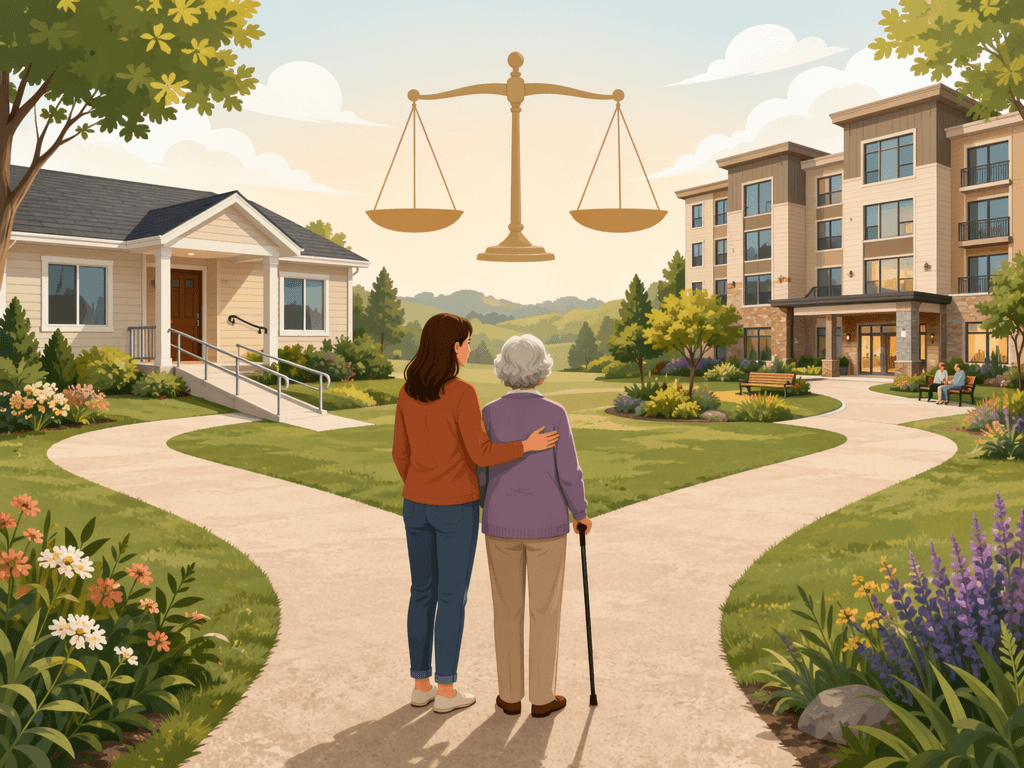
Financial Planning Checklist for Families Considering Aging in Place
Before committing to the aging-in-place path, use this checklist to build a realistic budget that includes all the hidden cost layers. Each step will help you avoid the financial surprises that catch most families off guard.
- Conduct a home safety audit. Identify all modifications needed for safe mobility and daily living. Get quotes from at least two CAPS-certified contractors. Use our Home Fall Prevention Checklist for Older Adults as a starting point.
- Calculate weekly care hours needed. Be honest about the level of assistance required for bathing, dressing, toileting, eating, mobility, medication management, and transportation. Use the ADL and IADL framework to assess functional needs. Multiply by 4.3 to get monthly hours.
- Research state-specific costs. Look up the median cost of home care, assisted living, and nursing home care in your state. National medians are a starting point, but local costs can be 20% to 40% higher or lower.
- Explore all funding sources. Check VA benefits for veterans, Medicaid HCBS waivers for income-eligible seniors, USDA Section 504 for very-low-income homeowners, HUD's Older Adult Home Modification Program, and any long-term care insurance policies. See our guide: How to Pay for In-Home Care in 2026: 7 Funding Sources Families Need to Know.
- Factor in family caregiver opportunity costs. Estimate the lost income, reduced retirement contributions, and career impact for the primary family caregiver. Include this as a real cost in your budget comparison.
- Add ongoing monthly costs. Include monitoring technology ($30–$60/month), transportation ($200–$600/month), increased home maintenance ($200–$500/month), and any other recurring expenses.
- Compare total monthly costs. Add up all monthly costs (home care + technology + transportation + maintenance + amortized modification costs) and compare to the monthly cost of assisted living in your area. Include the family caregiver opportunity cost as a separate line item.
- Build a 3-year and 5-year projection. Aging in place costs tend to increase over time as care needs escalate. Build a multi-year projection to see how costs evolve. Assisted living costs also increase, but they are more predictable.
The goal of this checklist is not to steer you away from aging in place. For many families, with the right planning and funding, it is both the preferred and the financially sound choice. But that conclusion should emerge from a complete cost analysis — not from the assumption that staying home is always cheaper. Use this framework to build a realistic budget, explore all funding options, and make a decision that your family can sustain financially and emotionally over the long term.
Read the Full Guide
FAQs provide a concise answer. For comprehensive coverage, see these related guides.
- Live-In Companion for Elderly: A Complete Decision-Making Guide for Family Caregivers
This guide helps adult children evaluate whether a live-in companion is the right solution for an aging parent who wants to stay home safely. It covers costs, legal requirements, fall-prevention integration, and how to find and hire the right person.
- When a Fall Signals It’s Time: A Decision Guide for Long-Term Care After an Older Adult Falls
A fall is often the sentinel event that forces a long-term care decision. This guide helps adult children navigate the post-fall pathway — from emergency care and Medicare’s 100-day SNF window to home modifications, home care, assisted living, and skilled nursing — so families can make informed, non-crisis choices.
- Nighttime Fall Prevention: How to Make the Bed-to-Bathroom Route Safe for Older Adults
The most dangerous moment for an older adult is the nighttime trip from bed to bathroom — when grogginess, poor lighting, and urgency collide. This guide provides a focused strategy for family caregivers to reduce fall risk along that critical path.
Comments
Join the discussion with an anonymous comment.