
How to Choose Between Elderly Care Options: Matching Care Level to Need
Last reviewed: — Review date is particularly important for Medicare coverage, device specifications, and clinical guidance, which change frequently.
Your mother wants to stay in her own house. She is not unusual — 60% of older adults living at home say they would prefer to have a caregiver come to them rather than move, according to Pew. But only 37% of those who want home care believe it is highly likely to happen. That gap between preference and confidence is exactly where you are sitting right now.
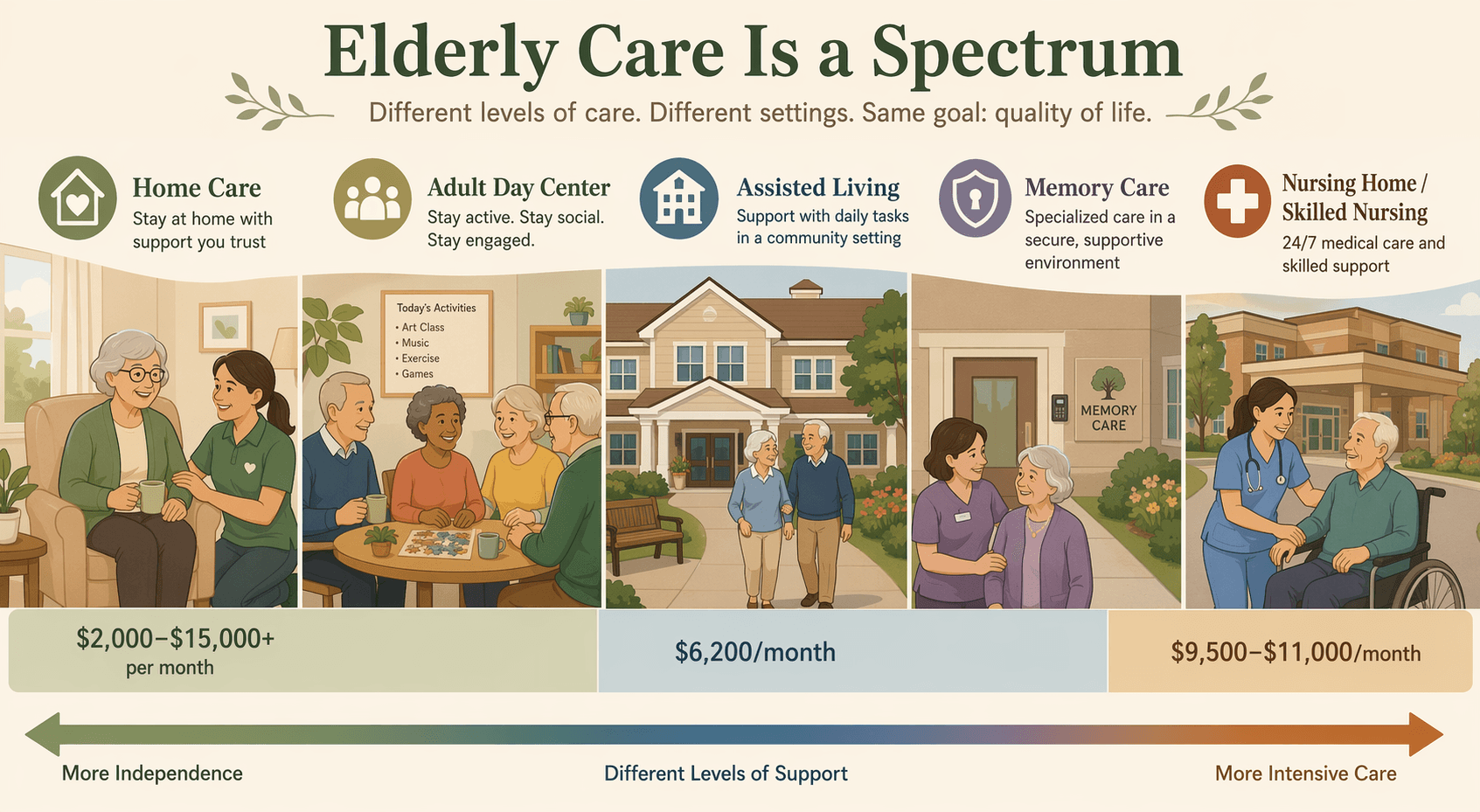
You need a decision framework, not a feelings check. The popular advice treats care options as a menu — home care, assisted living, nursing home — and asks you to pick one based on vague level of need. That does not work because the choice is not between types; it is a trade-off between money, time, and your parent's actual daily life. Here is a framework that uses three hard variables — ADL deficits, weekly support hours, and budget — anchored on a single number that will shift how you think about the whole decision.
Start with ADLs and IADLs: the hour counter you cannot skip
Before you look at a single cost number, you need to know how many hours of help your parent actually needs each week. Vague impressions like she needs some help are useless here. The standard geriatric assessment distinguishes between Activities of Daily Living (bathing, dressing, eating, transferring, toileting, continence) and Instrumental Activities of Daily Living (cooking, cleaning, managing money, shopping, using the phone, taking medication).
Each deficit adds a predictable chunk of weekly support. Bathing assistance typically runs about an hour per day. Meal preparation adds roughly half an hour per meal. Medication management can eat up another 30 minutes daily. Add them up and you get a working estimate of paid care hours per week. If you need a refresher on what counts as an ADL or IADL, the glossary entry breaks each one down with examples. If you are still unsure whether now is the right time to start, this practical assessment guide can help you make that call.
The number you get from this exercise — call it 25 hours, or 45 hours, or 60 hours — is the single most important input for the cost comparison that follows. Most families skip this step and end up comparing monthly rates without knowing which side of the breakeven they are on.
The 40-hour rule: when assisted living gets cheaper
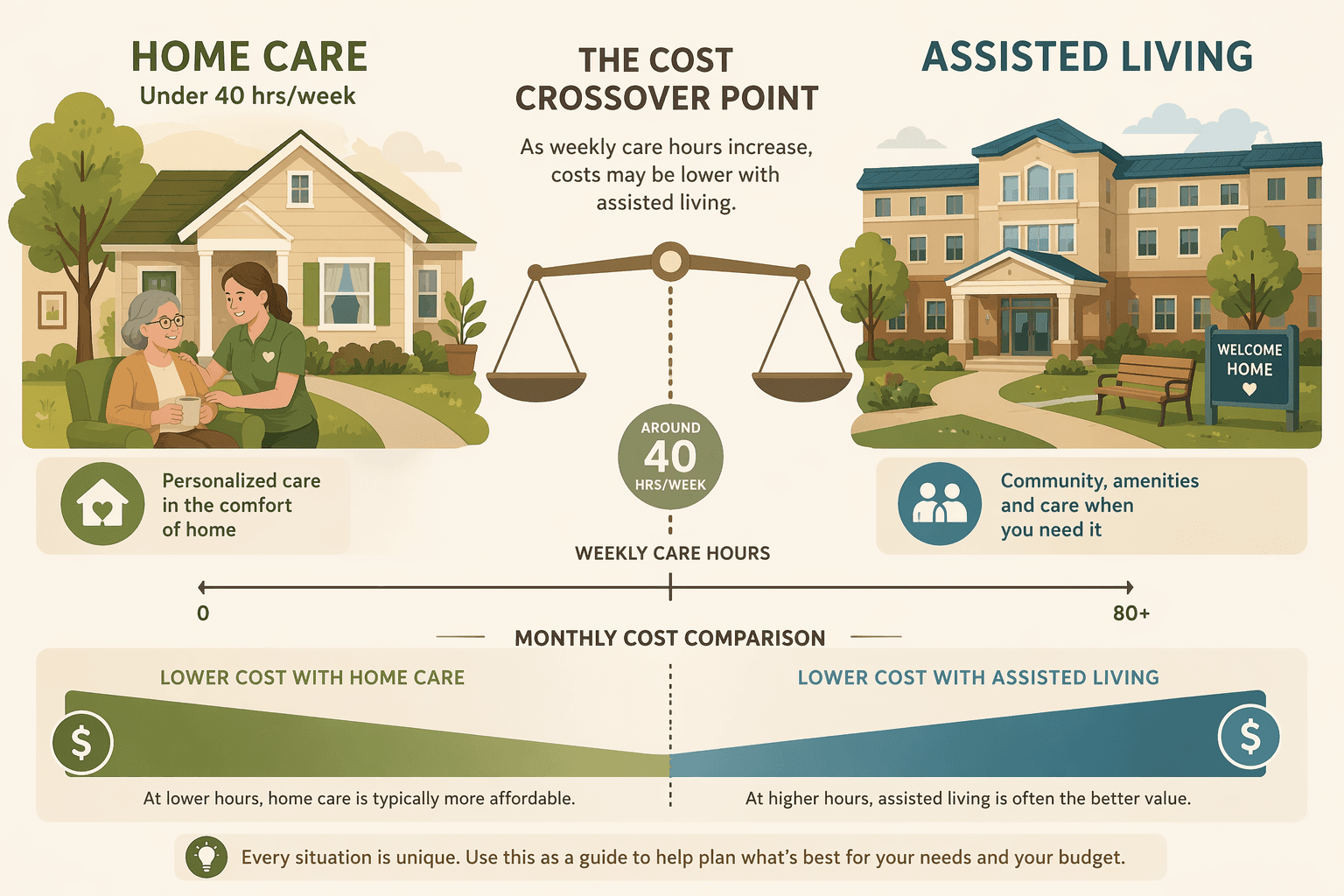
This is the number that flips most people's assumption. Home care averages $35 per hour, according to CareScout's 2025 data. Forty hours a week at that rate comes to $1,400 per week, or about $6,062 per month. The median monthly cost of assisted living is $6,200. They are nearly identical. Above 40 hours per week, home care becomes the more expensive option. Below 40, home care wins.
| Weekly home care hours | Home care monthly cost ($35/hr) | Assisted living monthly cost | Winner |
|---|---|---|---|
| 20 hrs | $3,031 | $6,200 | Home care |
| 30 hrs | $4,547 | $6,200 | Home care |
| 40 hrs | $6,062 | $6,200 | Toss-up |
| 50 hrs | $7,578 | $6,200 | Assisted living |
| 60 hrs | $9,094 | $6,200 | Assisted living |
I do not mean this as a precise formula — it is a first-pass filter. The 40-hour rule comes from U.S. News and it works because it reveals a structural relationship: hourly care scales linearly, while assisted living is a fixed monthly fee. If your parent needs 50 hours of help per week — say, someone who cannot be left alone for more than a few hours due to dementia or mobility issues — you are looking at $7,500 a month for home care before you even count the overnight backup. That same month in assisted living runs $6,200, and it includes meals, activities, and some level of supervision.
There is a deeper cost analysis on the 40-hour threshold that goes into the math with local examples. But for now, the key takeaway is: home care is not automatically cheaper. It depends entirely on how many hours of paid help you need to schedule each week.
What the breakeven does not count
I would not treat the 40-hour rule as a cliff. Three real-world factors can shift the conclusion.
- Your unpaid hours. Most families provide 10 to 20 hours of care per week without counting it. If you value your time at even $15 an hour, home care's true cost climbs. More importantly, if you burn out and need to replace your hours with paid care, the hours jump and the breakeven flips. That is the scenario this framework tries to prevent.
- Local prices. National medians are $35/hr for home care and $6,200/month for assisted living. In San Francisco, home care might run $40/hr and assisted living $5,000/month — the breakeven shifts to about 31 hours. In rural Alabama, the opposite happens. Get local quotes from at least two agencies and two facilities before you decide.
- Tiered pricing. Most assisted living communities do not include all care in the base rate. Medication management, incontinence care, and assistance with transfers often add $500–$1,500 per month. Read the contract carefully and ask what the rate covers at each level of care.
Financing reality: Medicare will not pay for most of this
Here is the short version: Medicare does not cover custodial care or assisted living room and board. It covers only short-term skilled nursing after a qualifying hospital stay — up to 100 days with a copay after day 20. Medicaid covers nursing home care and, in some states, home and community-based services, but only if you meet strict income and asset limits. About 21% of adults 65 and older have long-term care insurance. That means most families are paying out of pocket for the bulk of long-term care.
VA Aid & Attendance can help veterans and surviving spouses: up to $2,424 per month for a single veteran, $2,874 for a married veteran, and $1,558 for a surviving spouse (source: American Council on Aging via U.S. News). These amounts change, and eligibility rules are intricate — verify current rates at va.gov. For a deeper look at funding sources, see this guide to hidden money for family caregivers, which covers Medicare, life insurance, VA benefits, and grants you may be leaving on the table.
If your budget is tight, adult day care is a legitimate bridge option. At roughly $95 per eight-hour day (CareScout 2025), it works well for families who need 15–25 hours of supervised care per week but can handle evenings and mornings themselves.
The question most guides skip
Most decision guides start with what type of care does your parent need? That is backwards. Start with this question:
If the answer is no, because you work full time, your other parent is elderly, or there is no local care agency with enough staff, then assisted living is the practical default even if the ADL count is moderate. The can you actually schedule those hours? gate filters out situations where home care is theoretically cheaper but practically impossible.
If the answer is yes, then compare cost using local numbers. Below 40 hours, home care likely wins. Above 40, assisted living likely wins. If your parent needs 24/7 skilled nursing care — wound care, IV medications, tube feeding — a nursing home is the appropriate setting regardless of the cost comparison. See the 10 signs your parent needs 24/7 care guide for more on when that becomes necessary.
If you are touring assisted living facilities, the National Institute on Aging recommends visiting at different times without calling ahead, asking about staff-to-resident ratios, turnover rates, and what activities are actually offered. Get everything in writing, especially the tiered pricing schedule. Only 1% of older adults currently live in assisted living, but it is the most common destination for those who leave home — do not dismiss it based on the low national percentage.
A more detailed funding guide for home care covers payment strategies if you decide to keep your parent at home. The choice is hard, but it becomes manageable when you have three numbers — ADL hours, weekly support hours, and budget — instead of a menu of care types. Start with the hours. The rest follows.
Read the Full Guide
FAQs provide a concise answer. For comprehensive coverage, see these related guides.
- How to Pay for Elderly Home Care: Medicare, Medicaid, VA Benefits, and Out-of-Pocket Options Explained
A comprehensive decision flowchart for adult children and long-distance caregivers navigating the fractured payment landscape for in-home senior care. Covers Medicare limits, Medicaid HCBS waivers, VA benefits, long-term care insurance, private-pay strategies, community programs, and tax deductions — all in one place.
- Home Modification Costs for Aging in Place: What Families Need to Know
This article provides a clear, data-driven cost comparison between one-time home modifications and recurring assisted living expenses, helping adult children make informed decisions after a parent's fall or hospitalization.
- Residential Care Homes: The ‘Hidden’ Senior Housing Option Explained
Most families default to large assisted living communities because they are heavily advertised. This guide uncovers residential care homes (board and care homes) — small, home-like facilities in residential neighborhoods that often offer comparable personal care at a lower cost with better staff-to-resident ratios. Learn what they are, how they differ from assisted living, who they serve best, and how to find one.
Comments
Join the discussion with an anonymous comment.