
Glossary entry
Senior Residential Homes FAQ: Types, Costs, and How to Choose in 2026
What Are Senior Residential Homes?
"Senior residential homes" is an umbrella term used inconsistently across the senior care industry. In broad terms, it refers to any residential setting that provides housing, meals, and personal care for older adults who can no longer live safely or comfortably on their own. This category sits between aging in place at home (where a person receives care in their own residence) and a hospital or skilled nursing unit (which provides acute or rehabilitative medical care).
The confusion arises because the term can mean different things depending on who is using it. A real estate agent might use it to describe an independent living retirement community. A state licensing agency might use it to refer to a small board-and-care home. A family caregiver searching online might encounter the phrase applied to everything from a 6-bedroom converted house to a 200-unit campus with a dining hall and therapy gym.
What Types of Senior Residential Homes Exist?
While dozens of marketing names exist, the senior living landscape breaks down into four main facility types. Each serves a different level of need, has a different cost structure, and offers a different living environment.
- Residential care homes (also called board-and-care homes or group homes): Small, private facilities typically housing 4 to 10 residents in a converted single-family home. They provide personal care (bathing, dressing, medication reminders) and meals with 24-hour staff, but generally do not offer on-site nursing or medical care. According to the CDC, there were 32,200 residential care communities in the U.S. in 2022, with 1,313,600 licensed beds and 988,800 residents.
- Assisted living facilities: Larger communities where residents live in their own apartments or rooms and receive help with activities of daily living (ADLs) such as bathing, dressing, and medication management. The National Institute on Aging notes that assisted living is for people who need help with daily care but not as much as a nursing home provides. There are approximately 30,600 assisted living facilities in the U.S. with 1.2 million licensed beds.
- Nursing homes (skilled nursing facilities): Provide a wide range of health and personal care services, including 24-hour nursing care, rehabilitation therapy, and supervision for individuals with complex medical needs. There are more than 15,300 nursing homes in the U.S. with 1.6 million licensed beds.
- Continuing care retirement communities (CCRCs): Large campuses that offer independent housing, assisted living, and skilled nursing all on one site. Residents typically move in while still independent and transition to higher levels of care as their needs change. CCRCs usually require an entrance fee plus monthly fees. There are more than 1,900 CCRCs nationwide.
For a more detailed side-by-side comparison of all nine care types — including memory care, adult day care, and home care — see our full guide: Senior Care Options: A Complete Comparison of 9 Types of Care for Older Adults.
How Do Residential Care Homes Differ from Assisted Living and Nursing Homes?
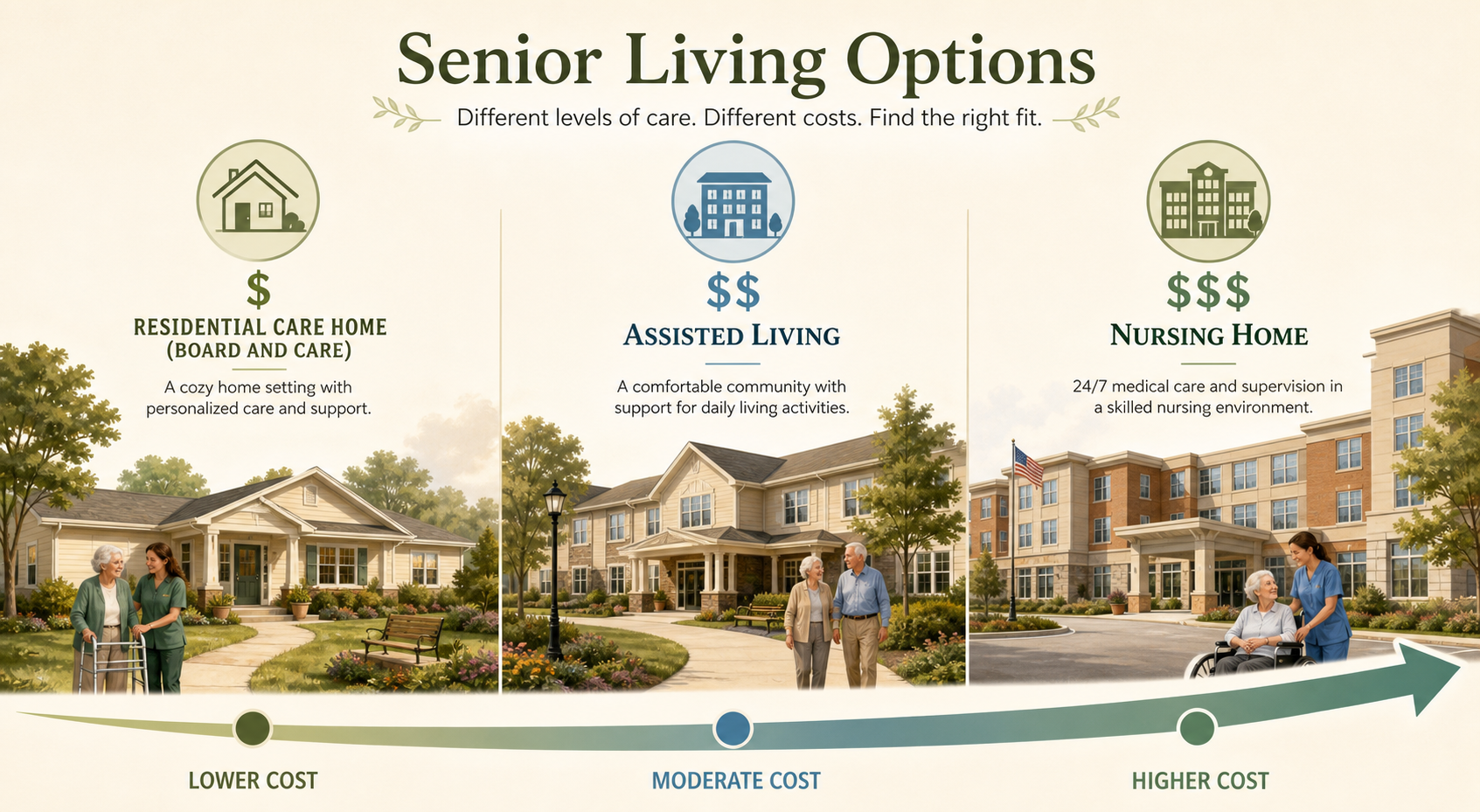
This is the most common point of confusion for families. The three options differ significantly in size, staffing, medical capability, and cost. The table below summarizes the key differences.
| Feature | Residential Care Home | Assisted Living | Nursing Home |
|---|---|---|---|
| Typical size | 4–10 residents | 25–200+ residents | 50–200+ residents |
| Living space | Private or shared bedroom in a converted house | Private apartment or room | Private or semiprivate room |
| Staffing | 24-hour non-medical staff; no on-site nurse required | 24-hour staff with some nursing on-site | 24-hour licensed nursing care |
| Medical care | Personal care only (bathing, dressing, meals) | Personal care + medication management | Full skilled nursing, rehabilitation, wound care |
| Typical resident | Needs help with daily tasks but not complex medical care | Needs moderate assistance with ADLs | Has significant medical needs or requires 24/7 supervision |
| Monthly cost (2025–2026) | ~$4,300 | $5,419 (national median) | $10,965 (private room) |
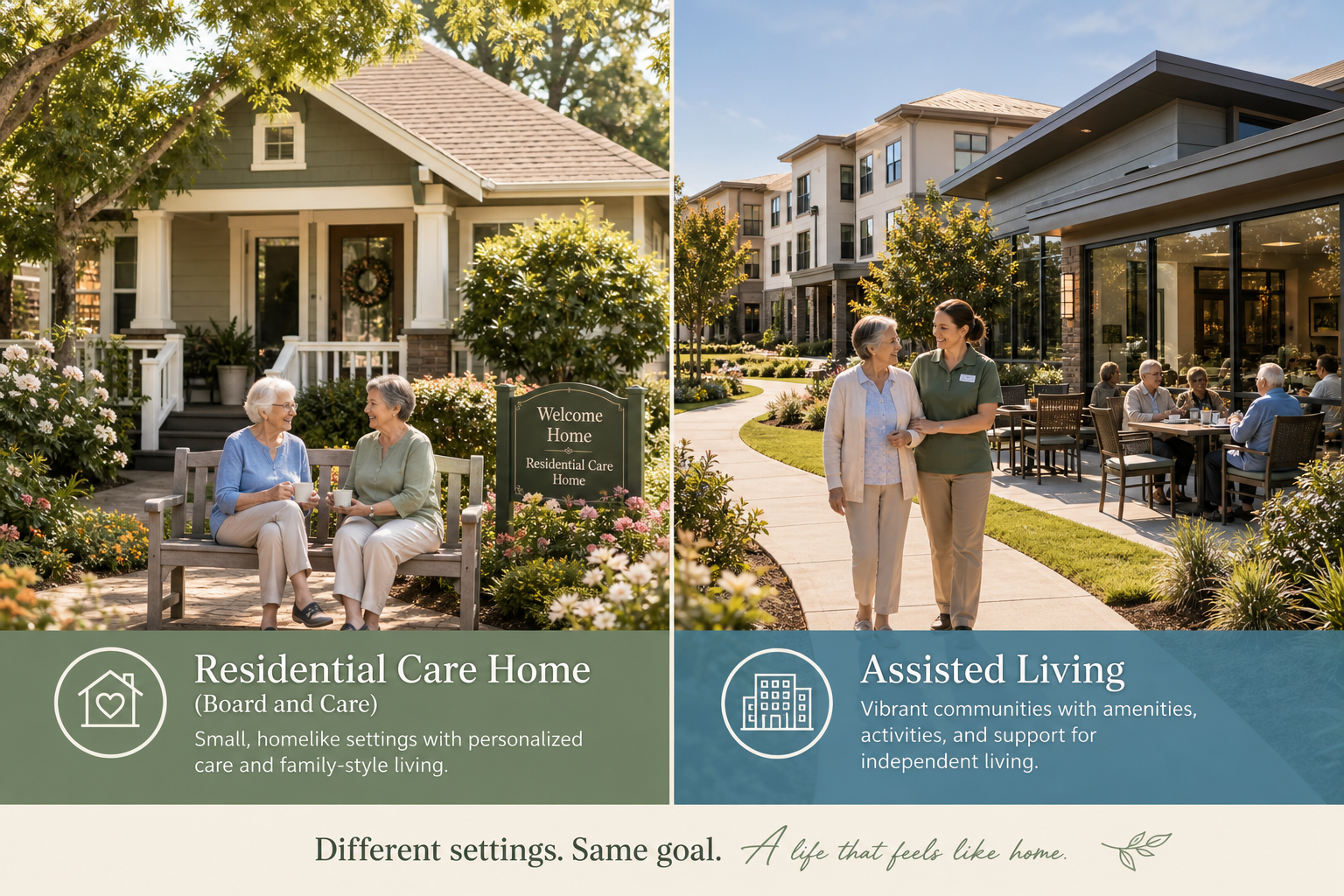
Residential care homes offer a more intimate, home-like setting with fewer amenities than larger assisted living communities but often at a lower cost. They are state-licensed and may be owned by an individual or a small company. For a deeper look at this option, read our dedicated guide: Residential Care Homes: The Overlooked Senior Living Option Families Need to Know About in 2026.
How Much Do Senior Residential Homes Cost in 2026?
Cost is often the first question families ask — and the answer varies dramatically by facility type, geographic location, apartment size, and the level of care required. Below are the most recent national figures available.
| Facility Type | Monthly Cost (National Median) | Annual Cost | Data Source & Year |
|---|---|---|---|
| Residential care home (board-and-care) | ~$4,300 | ~$51,600 | Genworth (2025) |
| Assisted living | $5,419 | $65,028 | A Place for Mom (2026) |
| Nursing home (semiprivate room) | $9,555 | $114,665 | Genworth (2025) |
| Nursing home (private room) | $10,965 | $131,583 | Genworth (2025) |
The 2026 assisted living figure of $5,419 per month comes from A Place for Mom's analysis of actual costs paid by more than 24,000 residents who moved into assisted living communities within their network in 2025. State-level medians range from $3,983 in Louisiana to $8,960 in the District of Columbia. Costs also depend on the pricing model — some facilities are all-inclusive, while others use a tiered or a la carte structure where additional services cost extra.
For a quick-reference table covering all care types and their costs, see our Senior Care Options: A Complete Glossary of Care Types, 2026 Costs, and Who Each Is For.
Does Medicare or Medicaid Cover Senior Residential Homes?
This is one of the most critical — and most misunderstood — questions families ask. The short answer is that Medicare does not cover long-term residential care, and Medicaid coverage depends on your state.
Medicare (federal health insurance for people 65+) generally does not pay for assisted living, residential care homes, or long-term nursing home stays. Medicare Part A may cover a short-term stay in a skilled nursing facility — up to 100 days — but only under specific conditions: the resident must have had a prior 3-day hospital stay and must enter the nursing home within 30 days of discharge. This coverage is for rehabilitation, not for ongoing custodial care.
Medicaid (joint federal-state program for low-income individuals) may cover assisted living or residential care home costs, but only through Home and Community-Based Services (HCBS) waivers, and coverage varies significantly by state. Some states offer generous HCBS waiver programs that pay for personal care services in assisted living or board-and-care settings; others have limited or no coverage.
Other potential funding sources include:
- VA Aid and Attendance benefit: A monthly pension supplement for qualifying veterans and their surviving spouses who need help with daily activities.
- Long-term care insurance: Private policies that may cover assisted living, residential care homes, or nursing home care, depending on the policy terms.
- Out-of-pocket payments: The most common payment method for assisted living and residential care homes.
If cost is a primary concern, our article on affordable alternatives when assisted living is too expensive explores lower-cost options including adult day care, shared housing, and Medicaid-funded programs.
How Do I Choose the Right Type of Senior Residential Home?
Choosing between a residential care home, assisted living, and a nursing home comes down to matching the facility's capabilities to your loved one's specific needs. The most important factor is the level of medical care required, followed by social preferences and budget.
Use this simple framework to narrow down the options:
- If your loved one needs help with daily tasks (bathing, dressing, meals) but is medically stable and does not require 24-hour nursing care, a residential care home or assisted living is appropriate. Choose a residential care home for a smaller, more intimate setting; choose assisted living for more amenities, activities, and social opportunities.
- If your loved one has complex medical needs — such as wound care, IV medications, feeding tubes, or requires 24-hour licensed nursing supervision — a nursing home (skilled nursing facility) is the appropriate setting.
- If your loved one has a dementia diagnosis, look for facilities with dedicated memory care units or staff trained in dementia care. Many assisted living facilities and some residential care homes offer memory care, but not all do.
- If your loved one is still relatively independent but wants to plan for future needs, a continuing care retirement community (CCRC) allows them to move through levels of care on one campus without relocating.
For a step-by-step decision framework based on hours of care needed per day, see our guide: Senior Care Options by Hours of Need: A Decision Framework for Family Caregivers.
Browse more in the Glossary.