
Room checklist
Habitat for Humanity Aging in Place vs. Government Home Repair Programs: Which Option Fits Your Senior Parent’s Situation?
A side-by-side comparison of Habitat for Humanity’s Aging in Place program, USDA Section 504, Area Agencies on Aging, and other funding sources for low-income older adults needing home modifications — with strategic guidance on eligibility, costs, and application order.
Why Most Older Adults Need Financial Help for Home Modifications
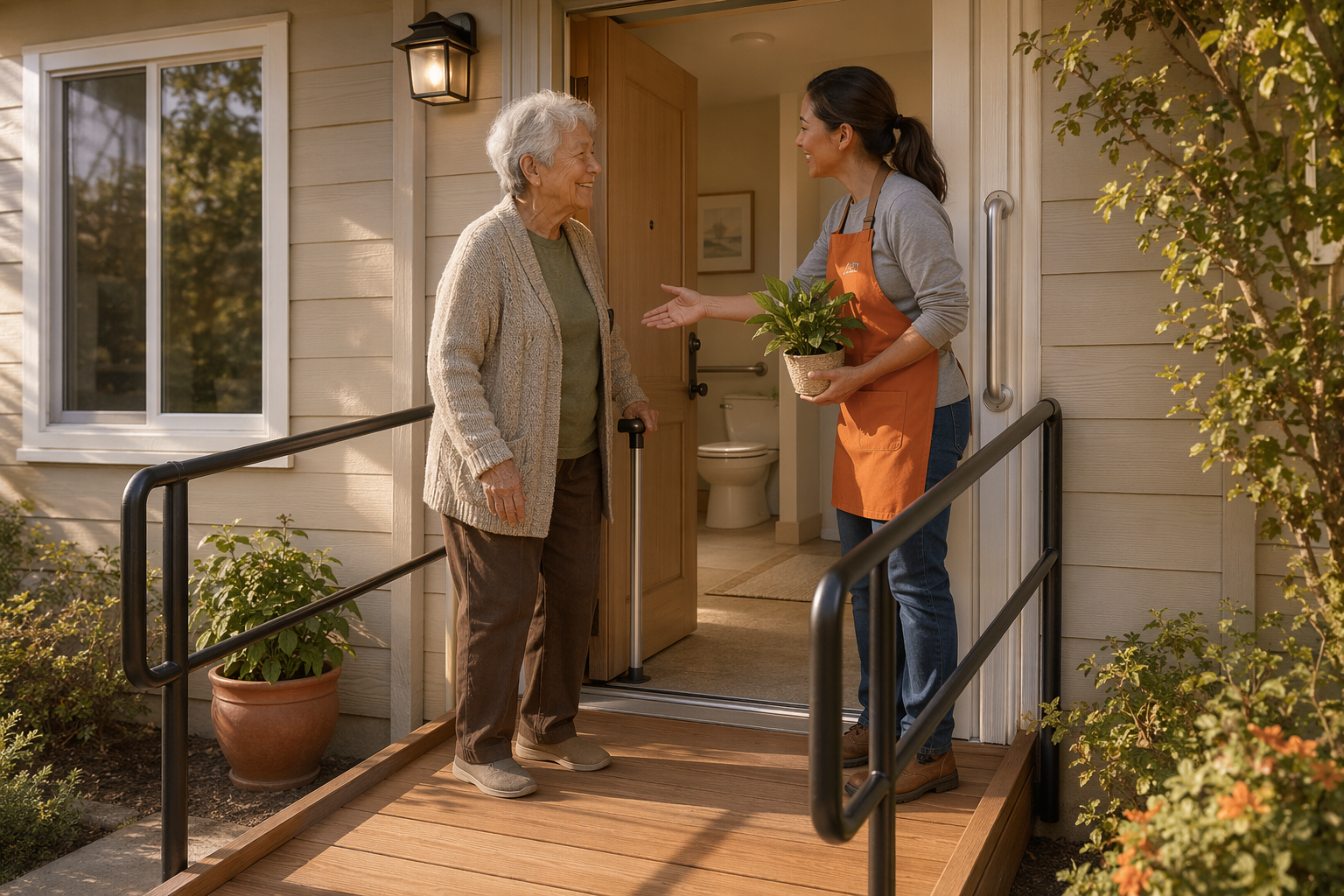
The desire to age in place is nearly universal. According to AARP, 77% of adults over 50 want to remain in their own homes as they grow older. Yet the physical reality of most American homes makes that wish difficult to fulfill. Only about 40% of homes have the most basic aging-ready features — a step-free entryway and a bedroom and full bathroom on the first floor. For the more than 19 million older adults living in homes that are in disrepair or ill-equipped to safely meet their needs, the gap between desire and reality is measured in missing grab bars, narrow doorways, and unsafe stairs.
The cost of closing that gap varies dramatically. A single grab bar might run $25 to $50 installed. A walk-in shower or a wheelchair ramp can cost $3,000 to $10,000. A full bathroom remodel for accessibility often lands between $15,000 and $25,000. For a family already managing the financial strain of caregiving, those numbers can feel insurmountable — and that is precisely why understanding the landscape of subsidized home repair programs matters.
Habitat for Humanity's Aging in Place Program: What It Covers and Who Qualifies
Habitat for Humanity is best known for building new homes, but a growing number of its local affiliates also run an Aging in Place (AIP) program that provides critical home repairs and modifications at no cost to qualifying homeowners. The program is built around a Housing Plus model, which pairs a construction specialist's home repair assessment with a functional assessment by a health or human services professional. This dual-evaluation approach ensures that modifications address both the physical condition of the home and the specific daily-living challenges of the resident.
Typical Modifications Covered
Habitat AIP programs typically cover a wide range of interior and exterior modifications. The exact scope depends on the local affiliate's budget and the homeowner's assessment results, but common projects include:
- Interior: Safety bars, improved lighting, floor repairs, ADA-compliant toilets and sinks, walk-in shower stalls, and energy efficiency upgrades.
- Exterior: Wheelchair ramps, new roofs, new siding and paint, and porch repairs.
- Social services: Help with grocery shopping, prepared meals, transportation for doctor visits, and errands — coordinated through the health assessment partner.
Eligibility and Income Limits
Age eligibility is typically early- to mid-60s and older. Income qualifications are determined locally, but affiliates generally seek low-income partners. For example, the Habitat for Humanity of Greater Memphis AIP program requires applicants to be age 62 or older, own and live in the home full time, and have a gross household income at or below 80% of the area median income. As of April 2025, the income limits for Shelby County, Tennessee were:
| Household Size | Maximum Gross Annual Income |
|---|---|
| 1 person | $31,900 |
| 2 persons | $36,450 |
| 3 persons | $41,000 |
| 4 persons | $45,550 |
The CAPABLE Model: Evidence Behind the Program
Habitat has incorporated the evidence-based CAPABLE model (Community Aging in Place, Advancing Better Living for Elders), developed by the Johns Hopkins School of Nursing, into its AIP approach. Data from a five-affiliate pilot showed meaningful outcomes: participants' confidence in not falling increased by 15%, depressive symptoms were reduced by 30%, and the average savings per participant was $22,120 when followed up 24 months later. These results underscore that safe and accessible housing is a key social determinant of health — not just a comfort issue.
Key Limitation: Not Every Affiliate Offers AIP
Habitat's AIP program is not available at every local affiliate. Some Habitats focus exclusively on new home construction and do not offer home repair or AIP programs. National availability is not centrally tracked, so the first step is always to contact your local affiliate directly and ask whether they run an Aging in Place program. If they do not, the other programs in this guide become even more important.
USDA Section 504 Home Repair: The Rural Option with Loans and Grants
For families living in rural areas, the USDA Section 504 Home Repair program is arguably the most powerful federal funding source for home modifications outside of veteran-specific benefits. It is the only federal grant program for non-veteran older adults that can fund major structural repairs, and it offers a combination of grants and low-interest loans.
Program Details
- Grants: Up to $10,000 (or up to $15,000 in presidentially declared disaster areas) for homeowners age 62 or older. Grants must be used to remove health and safety hazards. There is a lifetime limit of $10,000, and the grant must be repaid if the property is sold within three years.
- Loans: Up to $40,000 for homeowners of any age. The loan carries a fixed 1% interest rate and a 20-year term. Loans can be used to repair, improve, or modernize the home.
- Eligibility: Applicants must be the homeowner and occupy the house, be unable to obtain affordable credit elsewhere, and have a household income that does not exceed the very-low-income limit for their county (typically around 50% of the area median income).
- Geographic restriction: The home must be located in a rural area as defined by USDA. You can check eligibility on the USDA property eligibility website.
Applications are accepted year-round through local Rural Development offices. This is a significant advantage over programs with limited application windows, like some Habitat AIP programs.
Area Agencies on Aging and Local CDBG Programs: Smaller Grants, Faster Access
When a major renovation is not needed but a few targeted safety upgrades are, local programs can be the fastest path to funding. Area Agencies on Aging (AAAs) and Community Development Block Grant (CDBG) programs administered by counties and cities often provide smaller grants — typically $500 to $5,000 — that can cover safety assessments, grab bar installation, non-slip flooring, and other minor modifications.
These programs vary enormously by location. Some counties have robust home modification programs with dedicated case managers; others may only offer a one-time safety assessment and a list of referrals. The key advantage is speed: because the funding is local and the application process is often simpler, a family might receive assistance in weeks rather than months. The trade-off is that these programs rarely fund major structural work like roof replacements or full bathroom remodels.
To find your local AAA, call the Eldercare Locator at 1-800-677-1116 or visit the Eldercare Locator website. For CDBG programs, contact your county's community development or housing department.
Other Options: Medicaid Waivers, VA Grants, and Nonprofit Programs
Beyond the three primary pathways above, several other programs can fill specific gaps:
- Medicaid Home and Community-Based Services (HCBS) Waivers: For older adults already enrolled in Medicaid, HCBS waivers may cover home modifications that are deemed medically necessary to prevent institutionalization. Coverage varies by state, but common modifications include ramps, grab bars, and bathroom safety equipment.
- VA Specially Adapted Housing (SAH) Grants: Qualifying veterans can receive up to $117,014 for home modifications. The VA Special Home Adaptation (SHA) grant provides up to $23,444, and the Temporary Residence Adaptation (TRA) grant ranges from $8,415 to $47,130. These are among the most generous funding sources available but are limited to veterans with specific service-connected disabilities.
- Rebuilding Together: This national nonprofit provides free home repairs for low-income older adults and people with disabilities. Like Habitat AIP, availability depends on local affiliate capacity.
For a deeper dive into these programs, see our complete guide to funding sources for home modifications, which covers VA grants, Medicaid waivers, and other options in detail.
Side-by-Side Comparison: Eligibility, Funding, and Coverage at a Glance
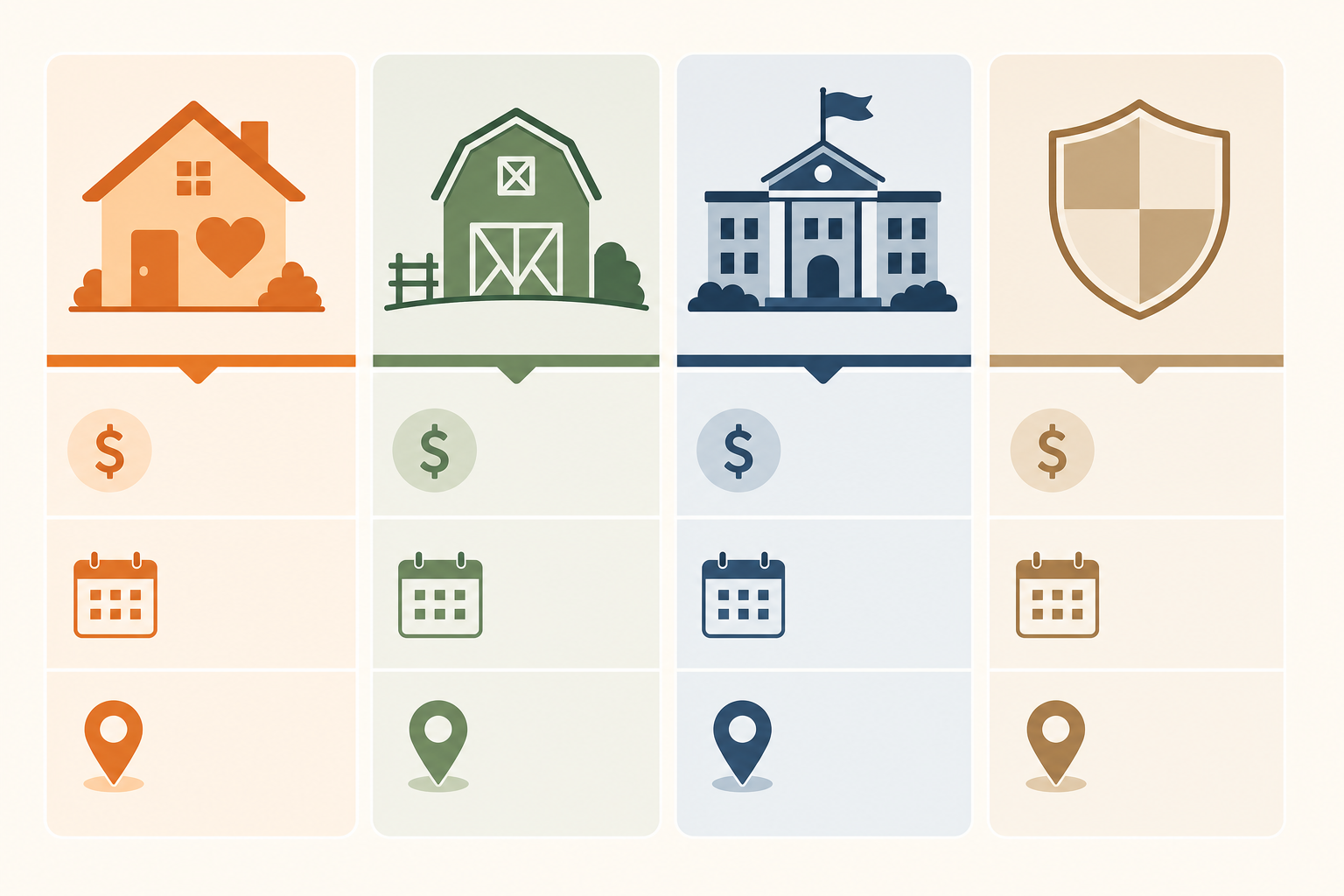
The table below summarizes the key differences across the four primary programs. Use it as a quick reference to identify which options are worth pursuing for your parent's situation.
| Program | Age Requirement | Income Limit | Grant vs. Loan | Max Funding | Typical Modifications | Geographic Restriction | Typical Wait Time |
|---|---|---|---|---|---|---|---|
| Habitat AIP | 62+ (typical) | ≤80% AMI (local) | Grant only (no cost) | Varies by affiliate | Grab bars, walk-in showers, ramps, roof, siding | Local affiliate availability | Months to 1+ year |
| USDA Section 504 | 62+ (grant); any age (loan) | Very-low-income (~50% AMI) | Grant + loan | $10K grant / $40K loan | Health/safety hazards, structural repairs | Rural areas only | Weeks to months |
| AAA / CDBG | 60+ (typical) | Varies by locality | Grant only | $500–$5,000 | Safety assessments, grab bars, minor repairs | Local county/city | Weeks |
| VA SAH Grant | Any age (veteran) | Service-connected disability | Grant only | $117,014 | Wheelchair ramps, bathroom mods, door widening | None | Months |
Strategic Guidance: Apply to Multiple Programs — Order Matters
One of the most common mistakes families make is assuming they can only apply to one program at a time. In reality, you can apply to Habitat AIP and USDA Section 504 simultaneously because they draw from different funding streams. The same is true for AAA/CDBG grants and VA benefits. Applying to multiple programs in parallel can dramatically reduce the total time to get modifications completed.
However, the order in which you apply matters. Here is a recommended sequence:
- Start with Habitat AIP (if available locally). It covers comprehensive modifications at no cost and includes the health assessment that may unlock additional community services. The application process can be lengthy, so starting early is critical.
- Apply to USDA Section 504 for structural repairs not covered by Habitat. If your parent lives in a rural area and needs a new roof, foundation work, or other major structural repairs that Habitat may not cover, the USDA grant (age 62+) or loan (any age) is the best option.
- Use AAA/CDBG for quick, minor fixes. While waiting for Habitat or USDA funding, local programs can address urgent safety issues like loose grab bars, poor lighting, or trip hazards.
- Check VA benefits for veterans. If your parent is a veteran, the VA SAH grant is the most generous option and should be pursued alongside other programs.
Documentation Checklist
Most programs require similar documentation. Having these ready before you apply will speed up the process:
- Proof of homeownership (deed or property tax statement)
- Proof of income (Social Security statement, pension letters, tax returns)
- Proof of age (driver's license, birth certificate, Medicare card)
- Proof of paid property taxes and homeowners insurance
- A list of needed modifications (photos help)
Real-World Scenarios: Which Program Fits Which Situation
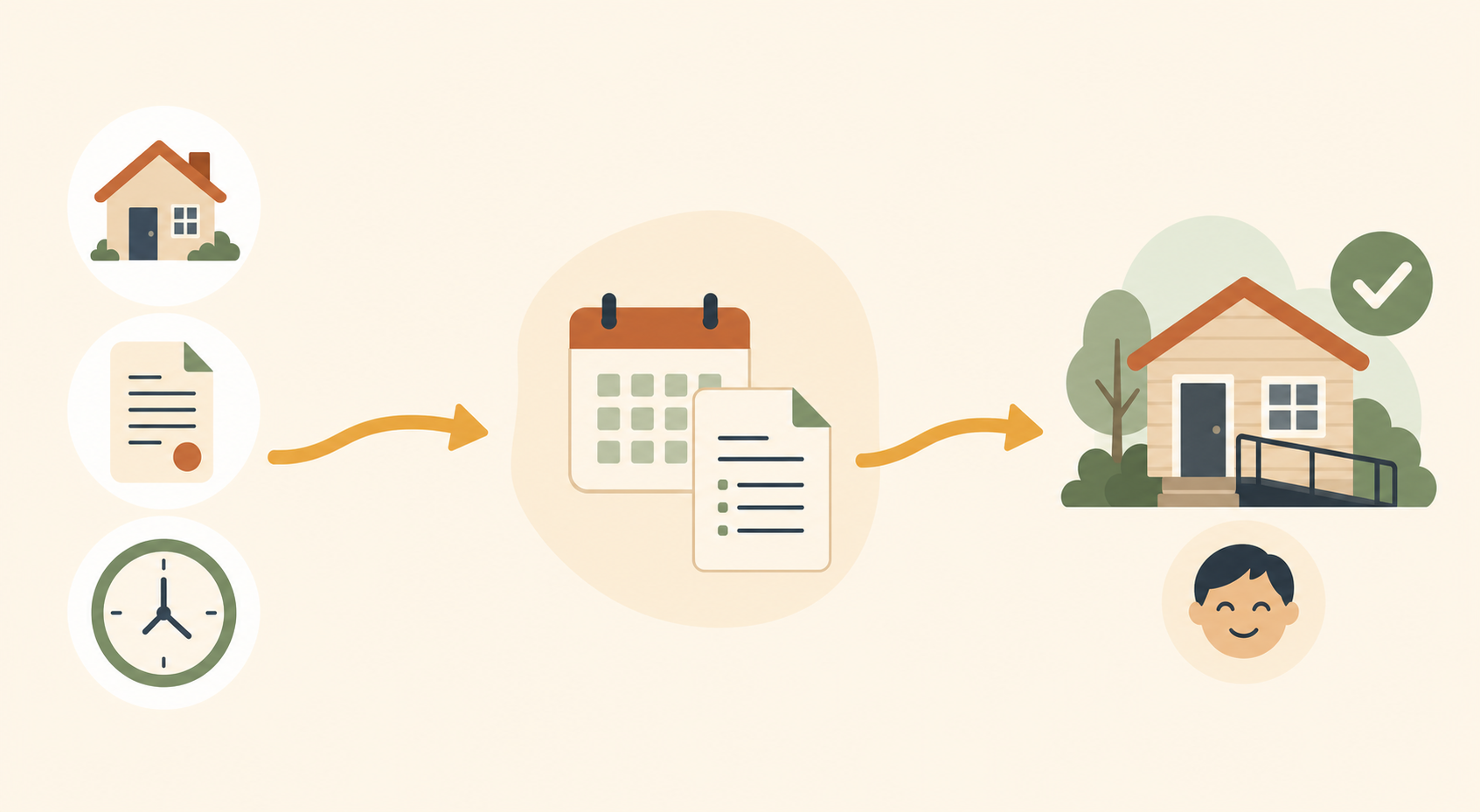
The decision framework above becomes clearer when applied to specific family situations. Here are three common scenarios:
Scenario 1: Urban Low-Income Senior Needing Bathroom Safety Upgrades
Your mother, 74, lives in a city apartment she owns. Her income is $28,000 per year. She needs a walk-in shower, grab bars, and a raised toilet. She does not qualify for USDA (urban location) and is not a veteran.
Best path: Contact the local Habitat for Humanity affiliate first. If they offer AIP, her income likely qualifies. If not, call the local Area Agency on Aging to ask about CDBG-funded home modification programs. For a comprehensive guide to bathroom safety upgrades and their costs, see our bathroom remodel for elderly safety guide.
Scenario 2: Rural Senior Needing Roof Repair and a Ramp
Your father, 78, lives on a farm in a rural county. His roof is leaking and he needs a wheelchair ramp. His income is $22,000 per year.
Best path: Apply to USDA Section 504 for the roof repair (grant for age 62+ covers health/safety hazards) and simultaneously apply to Habitat AIP for the ramp. If Habitat AIP is not available locally, the USDA loan (1% interest, 20-year term) can cover the ramp as well. For detailed ramp installation information, see our home ramp installation guide.
Scenario 3: Veteran Needing Wheelchair Ramp and Bathroom Modifications
Your uncle, 70, is a veteran with a service-connected mobility disability. He owns his home in a suburban area and has an income of $35,000 per year.
Best path: Apply for the VA Specially Adapted Housing (SAH) grant first — it offers up to $117,014 and can cover both the ramp and a full bathroom remodel. If the VA grant does not cover everything, apply to Habitat AIP for any remaining modifications. For a broader overview of government programs, see our complete guide to government help for elderly and disabled adults.
No single program will fit every family's situation. The key is to understand the landscape, gather your documentation, and apply to multiple programs in the right order. For a comprehensive overview of all funding sources, including those not covered here, read our guide to paying for aging-in-place remodeling.
If you are still weighing whether to modify your parent's home or move them to an assisted living facility, our aging in place remodel cost vs. assisted living decision guide can help you make that call with confidence.
Related reading
Need a professional assessment?
Find a CAPS-credentialed professional or local aging services through our outbound resource list — we never name or rank individual contractors.
Find Local HelpNoticed something outdated or inaccurate on this page? Flag a correction. We review every report against CDC, NIA, and AARP HomeFit guidance before updating a page.