
Room checklist
What Happens During a CAPS Home Assessment: A Step-by-Step Walkthrough from Scheduling to Final Report
If you've scheduled a Certified Aging-in-Place Specialist (CAPS) home assessment for your parent, this guide walks you through every stage — from the initial phone call and what to prepare, to the room-by-room inspection, the final report, and how to use the recommendations to create a safer home.
You've recognized the signs, had the conversations, and scheduled a Certified Aging-in-Place Specialist (CAPS) to come to your parent's home. Now the anxiety shifts from "should we do this?" to "what exactly is going to happen?" That uncertainty is normal — you're inviting a professional to walk through a private home, scrutinize every room, and deliver a list of things that need to change. Knowing the process in advance turns that anxiety into preparation.
A CAPS home assessment is a structured, methodical process that typically takes 1.5 to 3 hours from start to finish. It follows a predictable sequence: a pre-visit consultation, a sit-down family interview, a room-by-room walkthrough, an immediate debrief, and a formal written report delivered days later. Each stage has a purpose, and families who understand the flow walk away with far more useful recommendations.
This guide walks through every stage of that process — from the first phone call to the moment you hold the final report in your hands — so you know exactly what to expect, how to prepare, and how to get the most out of the investment.
Before the Visit: Scheduling, the Phone Consult, and How to Prepare
The assessment process begins long before the CAPS arrives at the front door. Most specialists start with a brief phone consultation — typically 15 to 20 minutes — to understand the situation at a high level before scheduling the in-person visit.
During that call, the CAPS will ask about the basics: your parent's age, current health conditions, mobility level, any recent hospitalizations or falls, and the primary concerns that prompted the call. This is also the time to discuss logistics — the home's layout (single-story vs. multi-story), which rooms are used most, and whether your parent uses any mobility aids like a walker or wheelchair.
What to Gather Before the Visit
Families who prepare thoroughly get more tailored recommendations. Here is what to have ready before the CAPS arrives:
- A current list of medications — especially those that can cause dizziness or light-headedness, which the Putnam Council on Aging identifies as a key fall risk factor the CAPS needs to know about.
- Medical records or discharge summaries from any recent hospitalizations, surgeries, or rehabilitation stays.
- A written list of daily challenges — what activities has your parent stopped doing, what has become difficult, what tasks now require assistance.
- Insurance information and any doctor recommendations for home modifications, especially if a physician has already suggested grab bars, a stair lift, or bathroom modifications.
- A list of questions you want to ask — the questions to ask before hiring a CAPS specialist guide is a good starting point for what to cover during the visit.
The Arrival and Sit-Down Interview (30–45 Minutes)
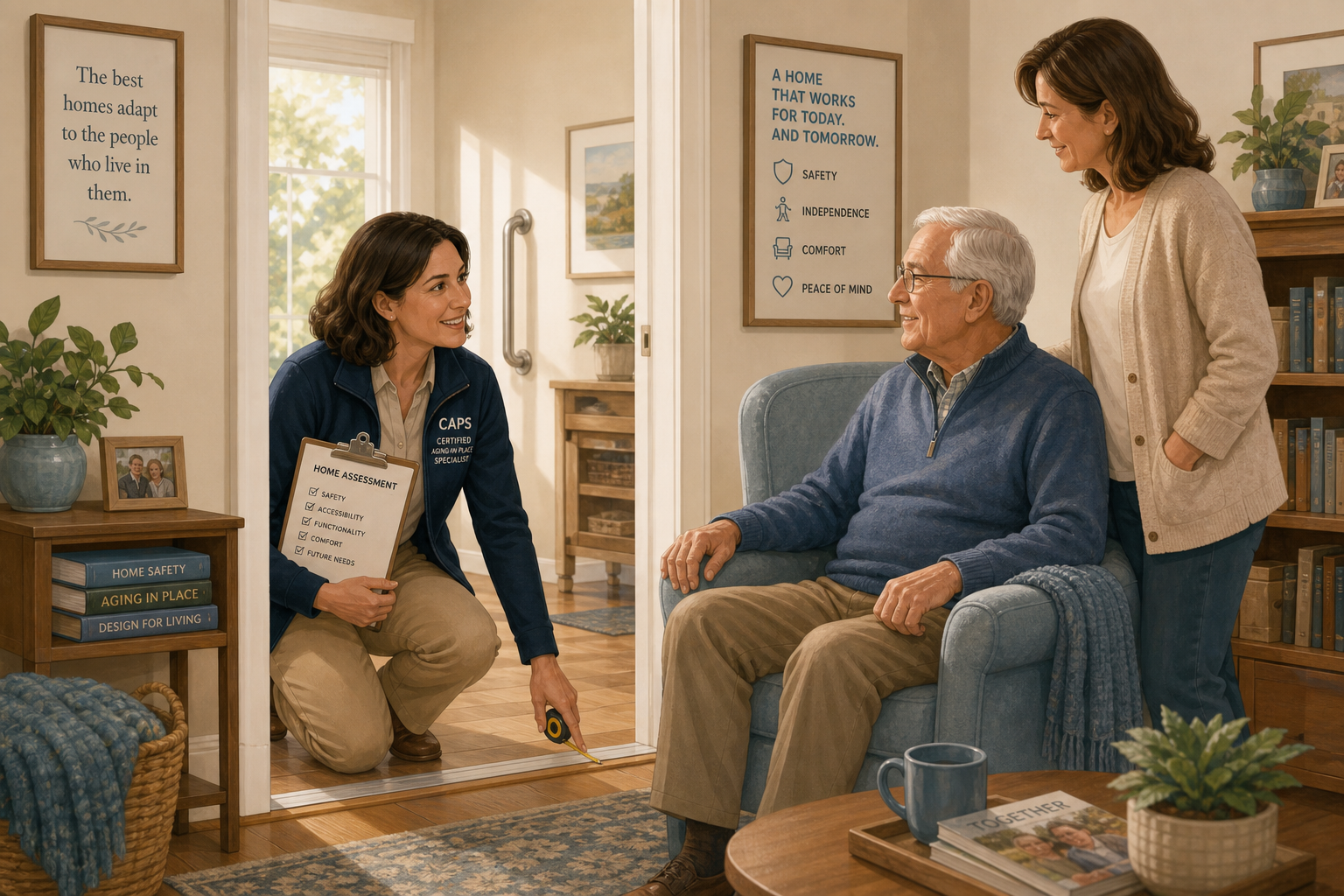
When the CAPS arrives, the first thing that happens is not a walkthrough — it is a conversation. The specialist will sit down with you, your parent, and any other family members involved in care decisions. This interview typically lasts 30 to 45 minutes and sets the foundation for everything that follows.
According to HomeCare Magazine, the CAPS begins by discussing which rooms are used most frequently and what the daily routine looks like. The goal is to understand the person's lifestyle, not just their medical condition. The specialist wants to know: What does a typical day look like? Where does your parent spend the most time? What activities have become difficult or impossible? What does your parent still do independently and want to keep doing?
This is also when the CAPS will ask about the family's budget and timeline. Are you looking for a few quick fixes under $500, or are you planning a major renovation over the next year? Being honest about budget constraints helps the specialist prioritize recommendations that fit your financial reality rather than producing an aspirational wish list you cannot act on.
The Room-by-Room Walkthrough (1–2 Hours)
After the interview, the CAPS begins the physical walkthrough. For a multi-story home, this can take up to two hours, according to LiveHomeSafely and Changing Places. The specialist moves through every room your parent uses — entryway, bathroom, bedroom, kitchen, living room, stairs, and storage areas — inspecting each one with a systematic eye.
The CAPS toolkit, as described by HomeCare Magazine, typically includes a measuring tape, blue painter's tape (for marking potential grab bar locations or outlining turning radii on the floor), a camera for documenting observations, and a notepad. This is not a casual walkthrough — the specialist is actively measuring, testing, and photographing.
Entryway and Exterior
The assessment starts at the front door. The CAPS checks doorway width, threshold height (thresholds are a significant tripping hazard), lighting at the entrance, and the stability of any existing handrails. The Putnam Council on Aging notes that entrance lighting and handrail condition are primary assessment points because the entryway is where falls often begin — especially when carrying groceries or navigating steps in poor light.
Bathroom
The bathroom receives the most detailed inspection because it is the highest-risk room in the home. The NYT Wirecutter reports that nearly 28% of bathroom injuries for people aged 65 and older are toilet-related. The CAPS will:
- Measure the doorway width to determine if a walker or wheelchair can enter.
- Physically shake towel bars to test whether they are loose — many people use towel bars as standing aids, but they are not designed to bear weight and frequently cause falls, according to HomeCare Magazine.
- Inspect the shower or tub type. Fiberglass showers and tubs are a particular concern because they can float away from the wall, making grab bar installation structurally unsound.
- Check toilet height and the space around the toilet for grab bar placement.
- Assess flooring material — is it slip-resistant or dangerously slick when wet?
Bedroom
In the bedroom, the CAPS evaluates whether the room can accommodate a hospital bed if that becomes necessary, according to HomeCare Magazine. The specialist checks bed height (getting in and out of a bed that is too low or too high is a common fall risk), clear pathways to the bathroom, night lighting or motion-sensor lighting options, and the arrangement of furniture to ensure unobstructed movement.
Kitchen
The kitchen assessment focuses on counter height, cabinet reach, appliance accessibility, and fire safety. The CAPS checks whether frequently used items are stored within easy reach, whether the stove has automatic shut-off features or is a fire risk, and whether the layout allows someone using a walker or wheelchair to navigate safely. The Putnam Council on Aging specifically notes that counter height and faucet type (lever-style handles are easier to use than twist knobs) are key evaluation points.
Living Room and Common Areas
In the living room, the CAPS looks for tripping hazards — throw rugs, electrical cords across pathways, cluttered walking routes — and evaluates seating. Chair height is critical: chairs that are too low make standing up difficult and increase fall risk. The specialist may discuss lift chairs as an option and will measure pathways to ensure they are wide enough for a walker or wheelchair.
Stairs and Hallways
For multi-story homes, the CAPS inspects every staircase the older adult uses. The specialist measures step rise and depth, checks handrail stability on both sides, evaluates lighting at the top and bottom of the stairs, and assesses whether a stair lift could be installed. The condition of stair treads and any loose carpeting is noted.
Specific Measurements and Observations the CAPS Makes
Throughout the walkthrough, the CAPS is taking concrete measurements and performing physical tests. These are not abstract observations — they are the data points that will determine every recommendation in the final report.
| Measurement or Test | Target or Standard | Why It Matters |
|---|---|---|
| Doorway clearance | 32 inches or wider | Accommodates wheelchairs and walkers; less than 4% of U.S. homes meet this standard, per CAPS Amy Roberts (Care.com) |
| Turning radius | Minimum 5 feet by 5 feet | Required for wheelchair maneuverability in every room, according to CAPS Valerie Jurik-Henry (Right at Home) |
| Towel bar shake test | Must not move when pulled | Towel bars are frequently used as standing aids but are not load-bearing — loose bars are a fall hazard (HomeCare Magazine) |
| Threshold height | Less than 0.5 inches preferred | High thresholds are a primary tripping hazard, especially for people with reduced foot clearance |
| Step rise and depth | Consistent rise (7 inches max), depth 11 inches minimum | Inconsistent step dimensions increase fall risk; standard measurements determine stair lift feasibility |
| Toilet height | 17–19 inches (comfort height) | Standard toilets (14–15 inches) require deeper knee and hip flexion, making standing difficult |
| Grab bar wall assessment | Must anchor into studs or reinforced blocking | Fiberglass shower walls and thin tile cannot support grab bars without structural reinforcement |
| Lighting levels | Adequate at all entry points, stair landings, and bathroom pathways | Poor lighting is one of the most common and cheapest fall risks to fix |
Questions the CAPS Will Ask You and Your Parent
The CAPS is not just inspecting the house — they are also gathering information from you and your parent throughout the visit. Knowing the questions in advance helps you provide thoughtful answers rather than scrambling to recall details on the spot.
- What activities have become more difficult in the past six months? (Bathing, cooking, climbing stairs, getting out of bed, using the toilet)
- Has there been any fall or near-fall in the past year? If so, where and under what circumstances?
- What can your parent still do independently, and what do they need help with?
- Have there been any recent changes in health, mobility, vision, or cognition?
- Has a doctor or physical therapist recommended any specific modifications?
- What is your budget range, and what is your timeline — are you looking for immediate fixes or planning a phased approach over months or years?
- What worries you most about your parent living in this home?
The last question is often the most revealing. It shifts the conversation from technical measurements to the emotional reality of caregiving — and it helps the CAPS understand what matters most to the family, not just what the building code requires.
The Post-Assessment Debrief: Urgent Items First
Before the CAPS leaves, you will get an immediate verbal debrief. According to LiveHomeSafely, urgent safety items are discussed right away — not buried in a report that arrives days later. If the specialist found a loose grab bar, a high threshold that is an imminent tripping hazard, or a towel bar that came off the wall when tested, you will know about it before the front door closes.
This debrief serves two purposes. First, it addresses safety issues that cannot wait — the CAPS may recommend immediate fixes you can do yourself, like removing throw rugs, adding night lights, or rearranging furniture to clear pathways. Second, it sets expectations for the formal report. The specialist will explain which recommendations are quick fixes, which are functional enhancements, and which are major structural projects that require contractor bids and permits.
The Final Report: What You Receive and How to Read It
Within a few days of the assessment, you will receive a formal written report. This is the primary deliverable — the document that transforms the specialist's observations into an actionable home modification plan. According to Care.com, a comprehensive report includes photographs, measurements, and prioritized recommendations.
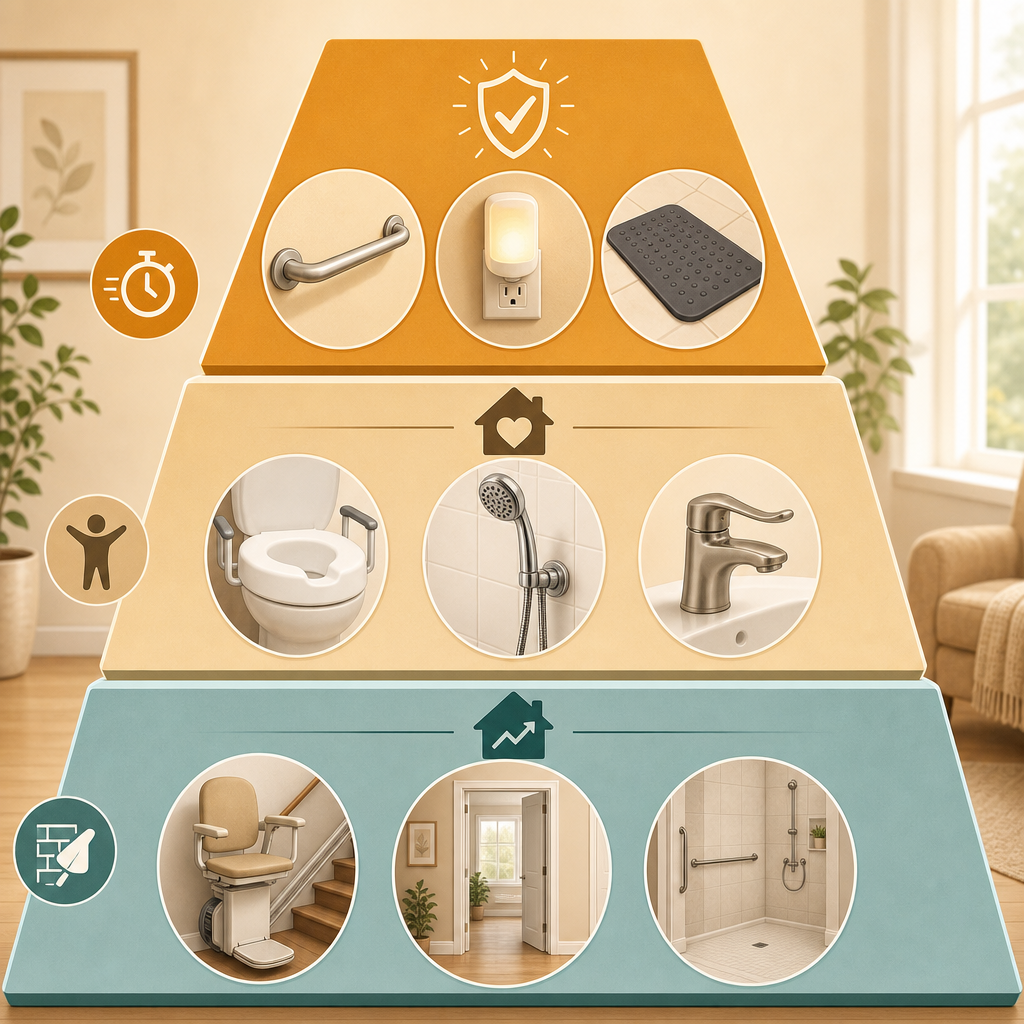
Many CAPS professionals organize recommendations into a three-tier framework, which Changing Places describes as:
- Quick Wins: Immediate, low-cost fixes that can be done in days — removing tripping hazards, installing lever-style door handles, adding motion-sensor night lights, organizing cabinets so frequently used items are within easy reach, and replacing standard light switches with illuminated or rocker-style switches.
- Smart Living: Functional enhancements that improve daily safety and comfort — grab bars in the shower and near the toilet, comfort-height toilets, handheld shower heads, non-slip flooring, smart thermostats, and stair chairs or ramps.
- Future Ready: Structural modifications that require planning, permits, and significant investment — walk-in showers with no-threshold entry, master bathroom relocation to the main floor, lift-access kitchen cabinetry, widened doorways, and stair lifts.
Next Steps: Using the Report to Phase Work and Move Forward
The report is not the end of the process — it is the beginning of the execution phase. Here is how to use it effectively:
- Start with Quick Wins. These are the items you can act on immediately — removing throw rugs, installing night lights, rearranging furniture. Doing these first builds momentum and demonstrates progress to your parent.
- Get contractor estimates for Smart Living and Future Ready items. The CAPS report should include enough detail (measurements, product specifications, installation requirements) for contractors to provide accurate bids. Some CAPS professionals offer project management services and can coordinate with contractors directly.
- Explore funding options. Major modifications can be expensive — stair lifts typically range from $3,000 to $5,000, and walk-in tubs from $5,000 to $15,000, according to the Aging in Place Directory. The guide to grants, loans, and assistance programs covers Medicaid waivers, VA grants, USDA Rural Development programs, and nonprofit options that can offset these costs.
- Phase work by priority and budget. Use the report's tiered structure to plan a multi-phase approach — address urgent safety items this month, functional enhancements this year, and structural renovations when budget allows. The room-by-room safety checklist and priority guide can help you track what has been completed and what remains.
- Schedule a follow-up visit. After modifications are installed, many CAPS professionals offer a follow-up assessment to verify that everything was installed correctly and meets the older adult's needs. This is especially important for grab bars, ramps, and stair lifts where improper installation can create new safety hazards.
A CAPS home assessment is an investment of time, money, and emotional energy. But families who go into the process knowing what to expect — who prepare the right documents, ask the right questions, and understand how to use the final report — consistently report that the assessment gave them clarity and confidence they did not have before. The walkthrough transforms a vague worry about "is this house safe?" into a concrete, prioritized plan that respects both the budget and the person who calls that house home.
For families who are still in the earlier stages of this journey — deciding whether a CAPS is the right professional to call — the red-flag signs that indicate a CAPS is needed guide can help you make that decision. And for those who have already received their report and are wondering about overall modification costs, the CAPS cost guide for home modifications provides a detailed budget breakdown.
Related reading
Need a professional assessment?
Find a CAPS-credentialed professional or local aging services through our outbound resource list — we never name or rank individual contractors.
Find Local HelpNoticed something outdated or inaccurate on this page? Flag a correction. We review every report against CDC, NIA, and AARP HomeFit guidance before updating a page.