
Room checklist
Aging in Place Home Modifications Cost Guide: Room-by-Room Budget Tiers for Families
A practical, evidence-based guide for adult children helping aging parents plan home modifications. Learn how to budget across three cost tiers — from under $50 to over $50,000 — with room-by-room price ranges, a prioritization framework, and financial assistance options.
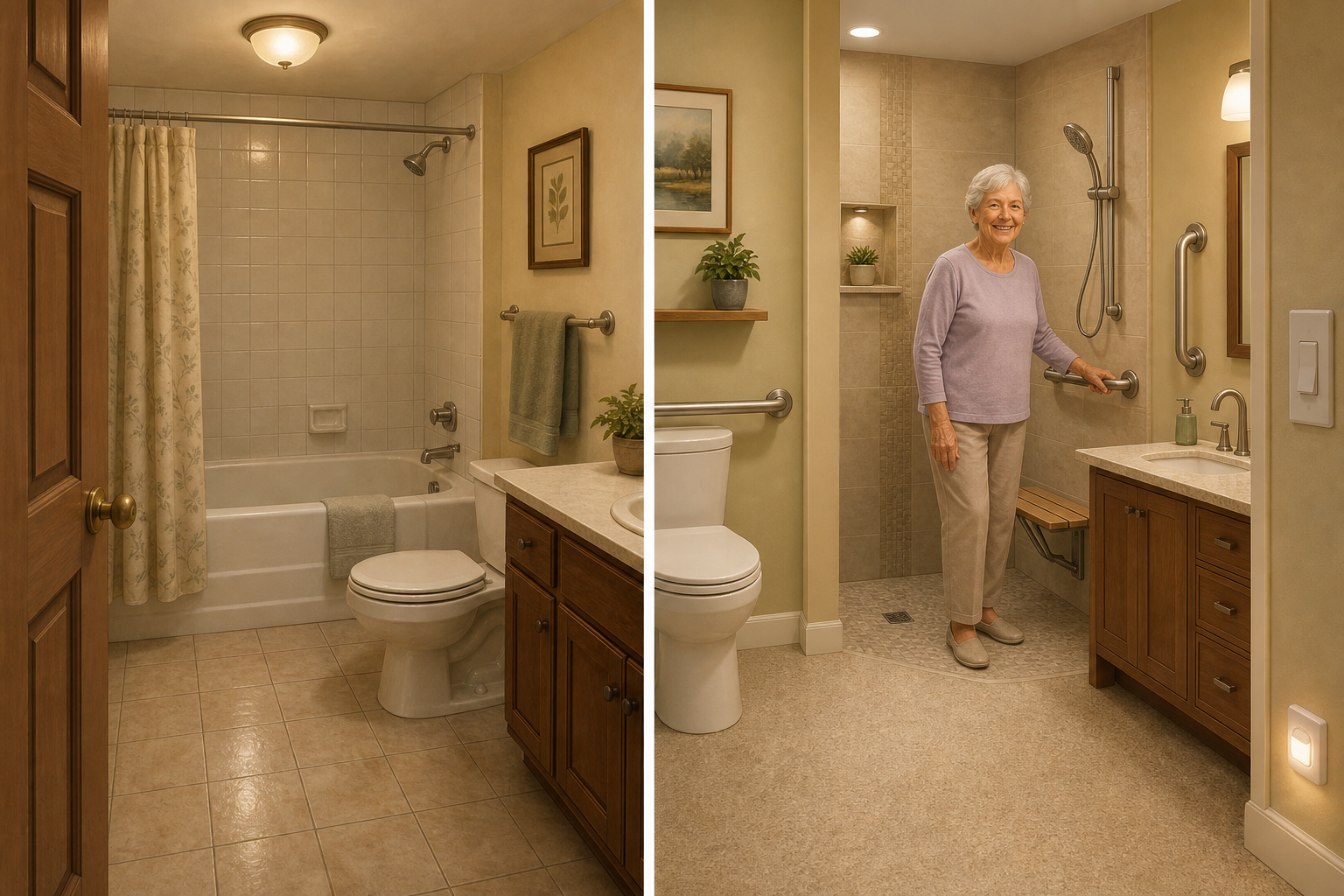
Why a Few Hundred Dollars Now Can Prevent a $50,000 Hospital Bill
When families first look into aging-in-place modifications, the price tags can feel overwhelming. A stair lift runs $2,500 to $18,000. A full bathroom renovation for wheelchair access can exceed $15,000. It is easy to look at those numbers and conclude that staying at home is simply too expensive.
But that conclusion misses a critical point: the most dangerous modifications are the ones you do not make. A single fall requiring hospitalization can cost tens of thousands of dollars in emergency care, surgery, and rehabilitation. The average annual cost of assisted living now exceeds $60,000. Against those numbers, a $300 grab bar or a $1,500 ramp looks less like an expense and more like an investment.
The research backs this up. A 2017 randomized controlled trial by Stark et al. found that home modifications reduced falls by 39% in the intervention group compared to the control group. A 2024 study by Hawkins et al. reported that 79% of participants had no falls at all after modifications were installed, and the average number of falls per year dropped from 2.53 to 1.5. A modeling study by Wilson et al. (2017) found that home modifications were cost-effective at NZD $5,480 per quality-adjusted life year gained — well below most willingness-to-pay thresholds.
The takeaway is not that every family needs to spend $50,000. It is that the cost spectrum is wide — from under $50 to over $50,000 — and understanding where your family falls on that spectrum is the first step toward making smart, sequenced decisions.
The Three Cost Tiers of Home Modifications: An Overview
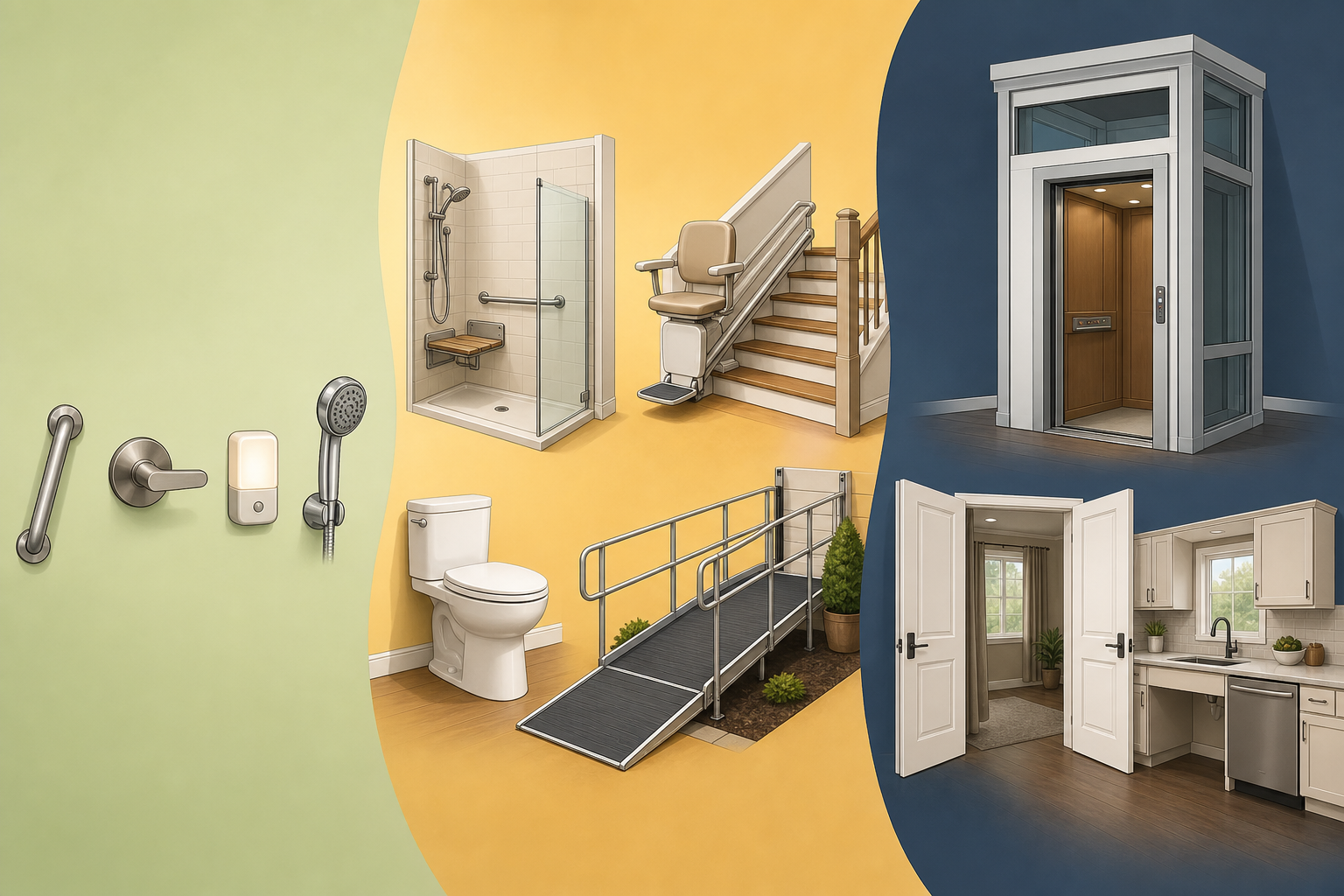
Rather than treating home modifications as a single, monolithic expense, it is more useful to think of them in three distinct cost tiers. Each tier corresponds to a different level of complexity, professional involvement, and impact on daily safety and independence.
| Cost Tier | Typical Range | Example Modifications | Professional Installation? |
|---|---|---|---|
| Low-Cost | $25 – $500 | Grab bars, lever handles, handheld showerheads, nonslip mats, toilet seat risers, motion-sensor night lights | Usually DIY |
| Mid-Range | $1,000 – $10,000 | Walk-in shower conversion, modular wheelchair ramp, stair lift, comfort-height toilet, nonslip flooring installation | Recommended |
| High-Cost | $10,000 – $50,000+ | Full bathroom renovation for wheelchair access, doorway widening, home elevator, main-floor bedroom/bathroom addition, full home remodel | Required |
This framework helps families avoid two common mistakes: dismissing low-cost upgrades as unimportant, and feeling paralyzed by the cost of high-end renovations. The reality is that the low-cost tier contains some of the most impactful safety interventions, and the high-cost tier can often be deferred or phased.
Low-Cost Upgrades ($25–$500): High-Impact Safety for Every Room
The low-cost tier is where families get the most safety improvement per dollar spent. These are typically simple, non-structural changes that can be completed in an afternoon with basic tools. Despite their low cost, they address the most common fall hazards.
Bathroom
The bathroom is the most dangerous room in the house for older adults. Almost 28% of bathroom injuries among adults 65 and older are toilet-related, according to CDC data. The single most effective low-cost intervention is installing grab bars. A study cited by the NIH found that grab bars in bathrooms increase the likelihood of recovering balance by 76%. Expect to pay $150 to $400 per grab bar, including installation.
- Grab bars: $150–$400 each. Install near the toilet and inside the shower or tub. Must be anchored into wall studs or blocking — suction-cup bars are not safe.
- Handheld showerhead: $30–$80. Allows bathing from a seated position, reducing the need to stand on a wet surface.
- Toilet seat riser: $30–$60. Raises seat height by 2–4 inches, making sitting and standing significantly easier.
- Nonslip bath mat or adhesive treads: $15–$40. Placed inside the shower or tub and on the bathroom floor outside the shower.
- Shower chair or bench: $40–$150. Allows seated bathing, which dramatically reduces fall risk.
Entryways and Doors
- Lever-style door handles: $15–$40 each. Replace round knobs that require gripping and twisting. Lever handles can be operated with an elbow or forearm.
- Motion-sensor night lights: $10–$25 each. Place along the path from bedroom to bathroom. Inadequate lighting is a primary contributor to nighttime falls.
Kitchen
- Lever-style faucet: $50–$150. Easier to operate than twist knobs, especially for individuals with arthritis or reduced hand strength.
- Pull-out cabinet shelves: $20–$60 per shelf. Eliminates the need to reach into deep cabinets, reducing bending and stretching.
- Under-cabinet task lighting: $20–$50. Improves visibility on countertops, reducing the risk of cuts or burns.
Mid-Range Projects ($1,000–$10,000): The Sweet Spot for Safety and Independence
Mid-range projects require professional installation and typically involve structural changes or specialized equipment. These are the modifications that make the most significant difference in daily function — the difference between needing help with bathing and being able to shower independently, or between being confined to one floor and having full access to the home.
The impact of these investments is well documented. A 2019 study by Carnemolla et al. found that after home modifications, weekly care hours decreased by 42%, informal care decreased by 46%, and formal care decreased by 16%. These are not just safety improvements — they are independence improvements that reduce the burden on family caregivers.
| Modification | Typical Cost Range | What It Does | Professional Needed? |
|---|---|---|---|
| Walk-in shower conversion | $6,000 – $12,000 | Replaces a tub with a low-threshold or curbless shower, often with a built-in seat and handheld showerhead | Yes — plumber and contractor |
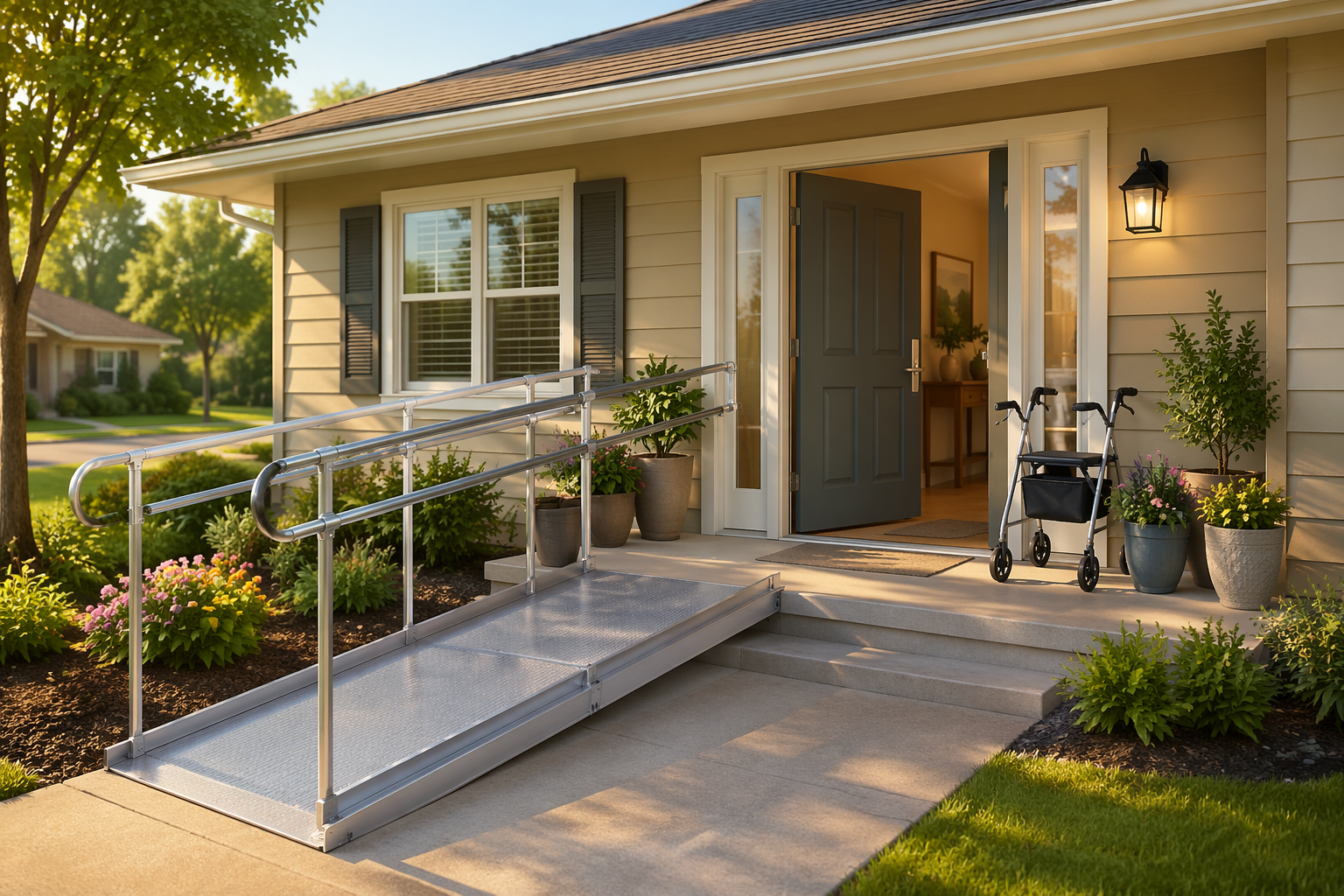
| Modular wheelchair ramp | $1,500 – $12,000 | Provides a gradual slope for wheelchair or walker access to the home. Cost depends on length and materials (aluminum, wood, concrete) | Yes — contractor or specialized ramp installer |
| Straight stair lift | $2,500 – $8,000 | Transports a person up and down a straight staircase while seated. Curved staircases cost significantly more | Yes — stair lift company |
| Comfort-height toilet | $200 – $600 | Sits 17–19 inches high (vs. standard 14–15 inches), making sitting and standing easier. Also called an ADA-height toilet | Minimal — can be DIY for a confident homeowner |
| Nonslip flooring installation | $3 – $8 per square foot | Replaces slippery tile, polished wood, or linoleum with textured vinyl, rubber, or cork flooring that provides traction | Yes — flooring contractor |
Before investing in mid-range projects, schedule an assessment with an occupational therapist. An OT can identify the specific modifications that will have the greatest impact for your parent's particular mobility limitations and home layout. This prevents spending money on modifications that do not actually address the underlying needs.
High-Cost Structural Changes ($10,000–$50,000+): Planning for the Long Term
High-cost modifications are major renovations that fundamentally change the layout or accessibility of a home. These are not decisions to make in a crisis — they require planning, permits, and significant financial commitment. But for families who plan to stay in the home for a decade or more, they can be far more cost-effective than the ongoing expense of assisted living.
| Modification | Typical Cost Range | When to Consider | Notes |
|---|---|---|---|
| Full wheelchair-accessible bathroom renovation | $15,000 – $30,000+ | When a walker or wheelchair is used regularly and the current bathroom is too narrow or has a step-in tub | Includes widened doorways, roll-in shower, grab bars, and accessible sink and toilet |
| Curbless (barrier-free) shower | $8,000 – $18,000+ | As a standalone project when the rest of the bathroom is functional but the shower is a fall hazard | One-time cost vs. $60,000+/year for assisted living |
| Doorway widening | $700 – $2,000 per doorway | When a wheelchair or walker cannot fit through standard 30-inch doors | Minimum 32-inch width recommended; 36-inch preferred for wheelchair users |
| Home elevator or vertical platform lift | $2,500 – $12,800 (elevator); $9,000 – $20,000+ (platform lift) | When the bedroom, bathroom, and kitchen are not all on one level and a stair lift is not feasible | Requires significant structural work and permits |
| Main-floor bedroom and bathroom addition | $30,000 – $60,000+ | When the home has no bedroom or full bathroom on the main level and moving is not an option | Most expensive option; consider moving to a ranch-style home as an alternative |
| Full home accessibility remodel | $15,000 – $60,000+ | When multiple rooms need significant changes and the family is committed to staying in the home long-term | Often phased over several years |
The most important thing to understand about high-cost modifications is that they are almost always cheaper than the alternative. A curbless shower conversion costs $8,000 to $18,000 as a one-time expense. Assisted living costs $60,000 or more per year. Even a $50,000 full bathroom renovation pays for itself in less than a year if it allows someone to remain at home rather than moving to a facility.
Smart Home Technology: A Growing Category ($200–$2,500+)
Smart home technology is an increasingly important category in aging-in-place planning. According to survey data, 49% of older adults already own at least one smart home device, with voice-controlled assistants (18%), smart thermostats (18%), and doorbell cameras (16%) being the most popular categories.
These devices are not structural modifications, but they can significantly improve safety, convenience, and peace of mind — both for the older adult and for family caregivers.
- Voice-controlled assistants (e.g., smart speakers): $30–$200. Can control lights, thermostats, and locks by voice, eliminating the need to reach for switches or get up to adjust the temperature.
- Smart doorbell cameras: $100–$300. Allow the resident to see and speak to visitors without opening the door, reducing the risk of falls on the front steps.
- Motion-sensor lighting systems: $50–$200 per room. Lights turn on automatically when someone enters the room, eliminating the need to find a switch in the dark.
- Smart thermostats: $100–$250. Can be controlled remotely by family caregivers to ensure the home is at a safe temperature.
- Medical alert systems (PERS): $20–$50/month or $200–$500 upfront. Provide a wearable button that connects to a monitoring center in case of a fall or emergency.
How to Get Accurate Estimates for Your Home
The cost ranges in this guide are based on national averages and published data from accessibility vendors. Your actual costs will depend on your home's construction, your region's labor rates, and the specific modifications needed. Here is a step-by-step process for getting reliable estimates.
- Schedule an occupational therapist assessment. An OT will evaluate your parent's mobility, strength, balance, and daily routines, then recommend specific modifications. This prevents you from spending money on changes that do not address the actual needs.
- Get multiple quotes from CAPS-certified contractors. Ask for at least three itemized estimates for any project over $1,000. CAPS-certified professionals have specific training in aging-in-place design and accessibility standards.
- Ask for itemized estimates, not lump sums. A detailed breakdown of materials, labor, permits, and disposal fees allows you to compare quotes accurately and identify where costs could be reduced.
- Check for regional cost variations. Labor rates vary significantly by region. The cost ranges from 3 Birds Accessibility (Pittsburgh area) may be higher or lower than what you will find in your area. Ask local contractors for region-specific pricing.
- Plan for contingencies. Add 10–20% to any estimate for unexpected issues that arise during construction, especially in older homes where walls may contain outdated wiring, plumbing, or structural problems.
Financial Assistance: Grants, Loans, and Programs That Can Help
Most families pay for home modifications out of pocket. Data from the 2006 Health and Retirement Study — the most recent large-scale national survey on this topic — found that only 6% of those who added home modifications reported any coverage from insurance or government programs. Among those who paid out of pocket, 40% spent less than $100 and 75% spent less than $500.
That said, several programs can help offset costs for eligible families.
| Program | Maximum Benefit (FY2026) | Eligibility | What It Covers |
|---|---|---|---|
| VA Specially Adapted Housing (SAH) Grant | $126,526 | Veterans with qualifying service-connected disabilities | Construction or modification of an accessible home |
| VA Special Housing Adaptation (SHA) Grant | $25,350 | Veterans with qualifying service-connected disabilities | Adaptations to the veteran's residence |
| VA Home Improvements and Structural Alterations (HISA) Grant | $6,800 (service-connected); $2,000 (non-service-connected) | Veterans with medical need for home modifications | Medically necessary home modifications |
| USDA Section 504 Home Repair Grant | $10,000 | Rural homeowners age 62+ with very low income | Removal of health and safety hazards |
| USDA Section 504 Home Repair Loan | $40,000 at 1% interest | Rural homeowners with very low income | Home repairs and improvements |
| FHA 203(k) Rehabilitation Mortgage | Up to $35,000 added to mortgage | Homeowners purchasing or refinancing | Finances home improvements as part of a mortgage |
| Medicaid Home and Community-Based Services (HCBS) Waivers | Varies by state | Individuals who qualify for Medicaid and meet functional need criteria | Home modifications as part of a broader care plan |
Nonprofit organizations like Rebuilding Together provide free home modifications for low-income homeowners, and the NCOA BenefitsCheckUp tool can help identify additional programs based on location and circumstances.
Your Prioritization Framework: What to Do First, Second, and Later
Faced with a long list of possible modifications, many families do nothing at all — overwhelmed by the scope and cost. The key is to sequence the work in three phases, starting with the highest-impact safety interventions and phasing in larger investments over time.
| Priority Level | What to Do | Cost Tier | Estimated Timeline | Why This Order |
|---|---|---|---|---|
| First Priority: Immediate Fall Hazards | Install grab bars in bathroom, add nonslip mats, improve lighting (night lights, brighter bulbs), secure loose rugs, install lever handles on doors | Low-cost ($25–$500) | 1–2 weeks | These are the most common and most dangerous fall triggers. Addressing them first reduces the immediate risk of a catastrophic injury. |
| Second Priority: Daily Function Improvements | Walk-in shower conversion, stair lift, modular ramp, comfort-height toilet, nonslip flooring, smart home devices | Mid-range ($1,000–$10,000) | 1–3 months | These modifications make daily activities — bathing, moving between floors, entering the home — safer and more independent. |
| Third Priority: Future-Proofing | Doorway widening, main-floor bedroom/bathroom addition, home elevator, full bathroom renovation for wheelchair access | High-cost ($10,000–$50,000+) | 3–12 months | These are major investments that anticipate future mobility decline. They can often be deferred until they are actually needed. |
This phased approach has two advantages. First, it spreads costs over time, making the total investment more manageable. Second, it allows families to see the impact of low-cost changes before committing to expensive renovations. Many families find that after completing the first phase, the urgency of the third phase diminishes significantly.
A gerontologist quoted by AARP recommends taking incremental steps — focus on lighting one year, grab bars the next. This approach is not only easier on the budget; it also gives the older adult time to adjust to each change before the next one arrives.
The evidence is clear: home modifications work. A 2025 systematic review of 20 studies published in PMC found that 65% confirmed the effectiveness of home modifications in fall prevention, functional independence, and cost savings. The review identified bathroom modifications, grab bars, and stair railings as the most impactful interventions. A separate analysis by Hollinghurst et al. (2022) of 657,536 older adults found that home adaptations reduced fall-related emergency admissions by 3% per quarter.
The question is not whether modifications are worth the cost. It is which modifications to do first, and how to sequence them in a way that fits your family's budget and timeline. Start with the low-cost tier. Address the immediate fall hazards. Then build from there.
Related reading
Need a professional assessment?
Find a CAPS-credentialed professional or local aging services through our outbound resource list — we never name or rank individual contractors.
Find Local HelpNoticed something outdated or inaccurate on this page? Flag a correction. We review every report against CDC, NIA, and AARP HomeFit guidance before updating a page.