
Room checklist
CAPS Specialist vs. Occupational Therapist: Who to Call First After a Fall?
After a parent's fall or hospital discharge, families often don't know whether to hire a CAPS-certified contractor or an occupational therapist. This guide explains the distinct roles of each professional, why the best outcomes come from using both together, and how to coordinate their work for a safer home.
The Confusion After a Fall: Two Professionals, One Goal
Your mother has just been discharged from the hospital after a fall. The discharge planner hands you a list of recommendations: install grab bars, improve lighting, remove throw rugs. You nod, but the moment you get home, a question hits you: who actually does this work? A contractor? A therapist? Someone with a certification you have never heard of?
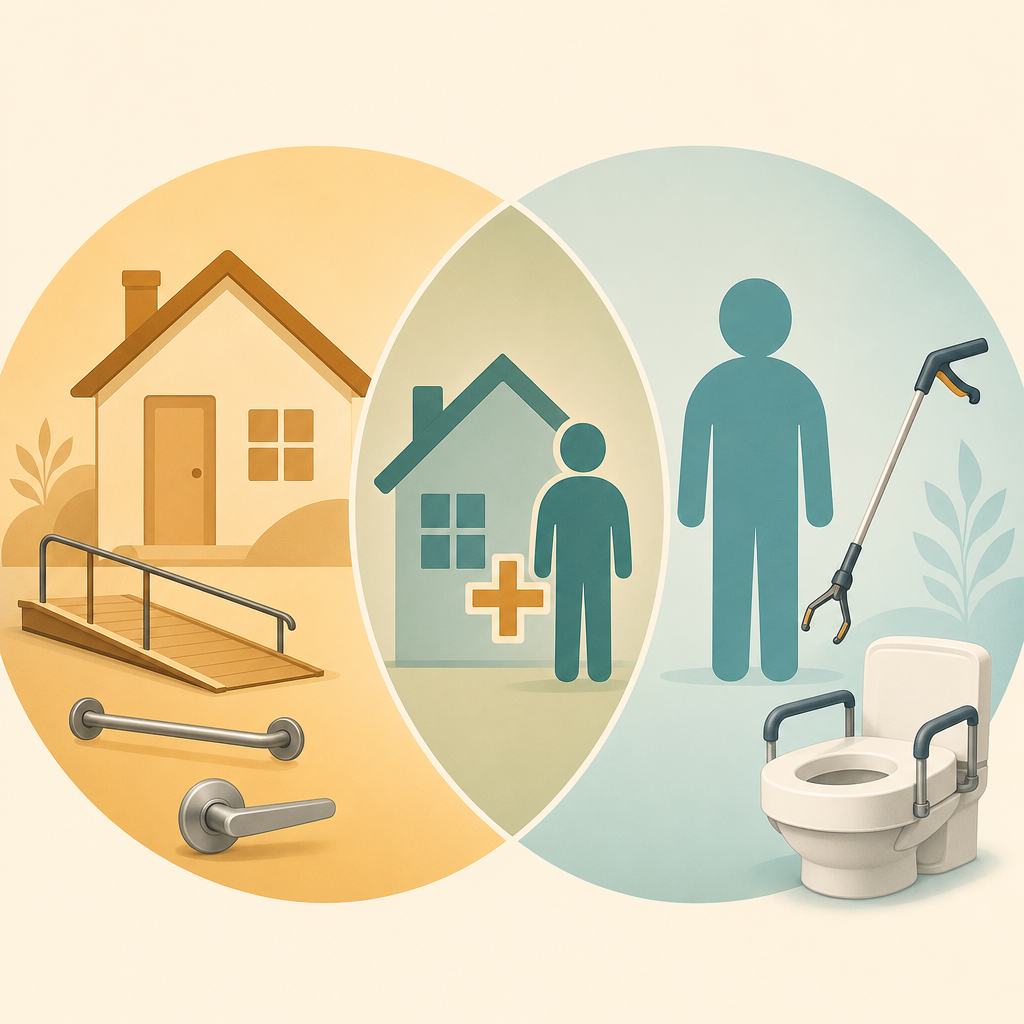
This confusion is normal. Two distinct professionals — a Certified Aging-in-Place Specialist (CAPS) and an occupational therapist (OT) — both focus on home safety, but they approach it from completely different angles. One modifies the house. The other modifies how a person interacts with the house. Most families do not know the difference, and that lack of clarity can delay critical safety improvements or lead to modifications that do not actually solve the underlying problem.
The core thesis of this guide is simple: a CAPS specialist focuses on the home structure, while an OT focuses on the person's ability to function within that structure. The best outcomes come from using both together, yet most families call one without knowing the other exists. Here is what each professional does, where they overlap, and — most importantly — who to call first.

What a CAPS Specialist Does: Home-Focused Modifications
A Certified Aging-in-Place Specialist is a professional designation offered jointly by the National Association of Home Builders (NAHB) and AARP since 2002. The credential is earned by completing three courses — CAPS I (Marketing & Communicating), CAPS II (Design Concepts and Methods), and CAPS III (Details and Solutions) — which together cost approximately $880 to $900 for NAHB members. After passing the courses, candidates apply for the credential and must complete 4 hours of continuing education each year to maintain it.
A critical point for families to understand: there are no prerequisites to enroll in the CAPS program. According to the NAHB and CAPS educator Steve Hoffacker, anyone with the desire to help people age in place can take the courses. This means CAPS professionals come from a wide range of backgrounds, including:
- Construction and remodeling
- Healthcare (occupational therapists, physical therapists, nurses, social workers)
- Design and real estate (interior designers, architects, real estate agents)
- Public service and related fields
What unites them is a shared focus on the home environment itself. A CAPS specialist assesses the physical structure of a home — door widths, threshold heights, bathroom layout, stair configuration, lighting placement — and recommends or implements modifications that make the space safer and more accessible. Their work is structural and design-oriented: installing grab bars, building ramps, widening doorways, lowering countertops, replacing faucets with lever handles, and ensuring a minimum 5-foot by 5-foot turning radius for wheelchair access.
When you hire a CAPS specialist, you are hiring someone who understands building codes, contractor coordination, and the practical realities of renovation. They can provide cost estimates, manage subcontractors, and ensure the finished work meets accessibility standards. Their expertise is the house.
What an Occupational Therapist Does: Person-Focused Solutions
An occupational therapist is a licensed healthcare professional with a fundamentally different training path. OTs must earn a master's degree, complete supervised clinical fieldwork, and pass the national certification exam administered by the National Board for Certification in Occupational Therapy (NBCOT). Their clinical training focuses on human anatomy, kinesiology, neurology, and the science of how people perform daily activities — what the profession calls "occupations."
When an OT conducts a home safety evaluation, they are not primarily looking at the house. They are looking at the person. They assess:
- How the individual moves through each room — balance, gait, strength, endurance
- Which specific daily activities have become difficult or dangerous — bathing, toileting, cooking, getting in and out of bed
- What adaptive equipment or behavioral strategies could restore independence — a shower chair, a reacher, a raised toilet seat, a different way of transferring
- The cognitive and sensory factors that affect safety — vision changes, memory issues, reduced sensation in the feet
The OT's goal is to identify the gap between what the person can do and what the environment demands, then close that gap through a combination of adaptive techniques, equipment, and — when necessary — environmental modifications. As the American Journal of Occupational Therapy has documented, occupational-therapy-based home modifications — such as shower seats, grab bars, improved lighting, and stair railings — have been shown to improve functional independence and reduce fall risk.
When you call an OT, you are hiring someone who understands the person. Their expertise is the body, the brain, and the daily routines that make a home livable.
Where Their Roles Overlap (and Why That Is a Good Thing)
The line between CAPS and OT is not always sharp, and that overlap is actually a strength. Many occupational therapists also hold the CAPS credential, creating a natural bridge between clinical assessment and structural design. A dual-credentialed professional can identify that a person cannot safely transfer onto the toilet (OT assessment) and then design and oversee the installation of the grab bar configuration that solves the problem (CAPS implementation).
But even when two separate professionals are involved, their work is deeply complementary. Consider a common scenario:
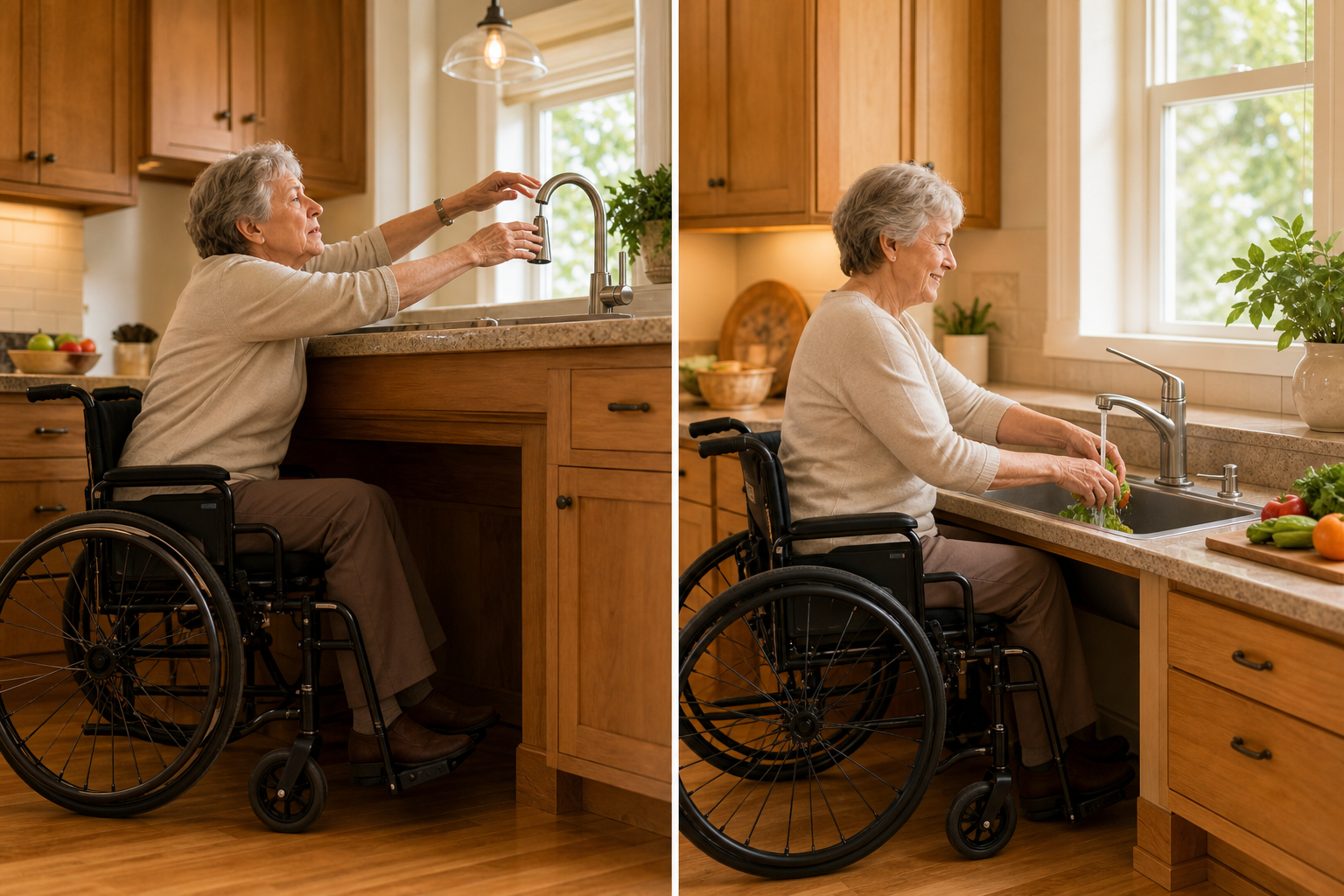
An OT evaluates a woman recovering from hip replacement surgery and observes that she cannot safely reach the kitchen sink from her wheelchair — the counter is too high, and there is no knee space underneath. The OT recommends a lowered counter section with knee clearance and a lever-style faucet. But the OT does not design the cabinetry, obtain permits, or coordinate with a countertop fabricator. That is where the CAPS specialist steps in: they take the OT's functional recommendation, design a modification that meets building codes, source materials, and manage the installation.
This combined approach is supported by evidence. A 2025 systematic review of 20 studies published in the journal Healthcare found that 13 studies (65%) confirmed home modifications were effective for fall prevention, functional independence, and cost savings. Notably, a U.S. randomized controlled trial by Stark et al. (2017) found that occupational-therapy-led home modifications reduced falls by 39%. The modifications themselves — grab bars, ramps, stairlifts — were the structural component, but the OT's clinical assessment was what ensured they were placed and configured correctly for the individual.
Cost Comparison: CAPS Assessment vs. OT Evaluation vs. Modifications
Cost is often the deciding factor for families, and the financial picture for CAPS versus OT is quite different — largely because of insurance coverage. The table below summarizes typical costs for each service and common modifications.
| Service or Modification | Typical Cost Range | Insurance Coverage |
|---|---|---|
| CAPS home safety assessment | $300 – $1,000 | Not covered by Medicare; private pay |
| OT home evaluation | $150 – $500 (or copay) | Often covered by Medicare Part B with a physician referral |
| Hourly CAPS consultation | $75 – $200 per hour | Private pay |
| Grab bars (installed) | $100 – $300 | Not covered by Medicare; some Medicaid waivers may apply |
| Wheelchair ramp | $1,500 – $5,000 | VA grants may cover; some Medicaid waivers |
| Stairlift | $3,000 – $5,000 | Not covered by Medicare; VA and some state programs may assist |
| Walk-in tub | $5,000 – $15,000 | Rarely covered; some VA benefits |
| Major bathroom or kitchen remodel | $10,000 – $50,000+ | VA SAH grant; Medicaid waivers in some states |
The key financial insight: an OT evaluation is often covered by insurance, making it the lower-cost first step. The CAPS assessment and the modifications themselves are typically private-pay, but the OT's clinical documentation can strengthen the case for funding through Medicaid waivers, VA grants, or other assistance programs.
How to Find Both Professionals and Coordinate Their Work
Knowing that you need both an OT and a CAPS is one thing. Actually finding and coordinating them is another. Here is a practical sequence that works for most families after a fall or hospital discharge.
Step 1: Start with the OT — and the hospital discharge planner
Before the patient leaves the hospital or rehabilitation facility, ask the discharge planner for a referral to an occupational therapist who performs home evaluations. Medicare Part B covers OT home health services when ordered by a physician, and many private insurers follow similar guidelines. The OT will visit the home, assess the person's functional abilities, and produce a written report with specific recommendations — this document becomes the blueprint for the CAPS specialist.
Step 2: Find a CAPS specialist using the NAHB directory
The NAHB maintains a national directory of CAPS-certified professionals. You can search by location and verify that the specialist's credential is current. When interviewing candidates, ask whether they have experience working with OT recommendations and whether they are comfortable collaborating with a clinical professional. A CAPS who understands the value of OT input will produce better results than one who works from a standard checklist.
Step 3: Share the OT report with the CAPS
Once you have the OT's written recommendations, share them with the CAPS specialist before any design or quoting begins. The OT report should specify: which activities are difficult (e.g., "cannot safely transfer from toilet to wheelchair"), what environmental barriers exist (e.g., "toilet is 14 inches high with no grab bar on the transfer side"), and what functional outcome is needed (e.g., "need a 17- to 19-inch raised toilet with a grab bar at 33 inches on the right side"). The CAPS then translates these functional requirements into a structural plan.
Step 4: Plan modifications in phases
CAPS professionals often recommend a phased approach — what can be done now, in six months, and in the next year. Bathroom and kitchen modifications are typically the highest priority because these rooms present the greatest safety risks and the most frequent daily challenges. A phased plan allows families to spread costs over time while addressing the most urgent hazards first.
The Evidence: Why Using Both Together Works
The argument for combining OT assessment with CAPS implementation is not just theoretical — it is backed by a growing body of research that spans clinical trials, population-level studies, and systematic reviews.
- A 2025 systematic review of 20 studies (Cha, Healthcare journal) found that 65% of studies confirmed home modifications were effective for fall prevention, functional independence, and cost savings. The review drew on data from the U.S., UK, Australia, and other countries, making it one of the most comprehensive analyses to date.
- A U.S. randomized controlled trial (Stark et al., 2017) found that occupational-therapy-led home modifications reduced falls by 39% compared to a control group that received only standard education about fall prevention.
- An Australian study of 157 older adults (Carnemolla & Bridge, 2019) found that weekly care hours dropped 42% after home modifications were completed — a finding with significant implications for both family caregiver burden and long-term care costs.
- A population-level study in Wales (Hollinghurst et al., 2022) tracking 657,536 people found that home modifications reduced fall-related emergency admissions by 3% per quarter — a small but statistically significant effect at scale.
These studies share a common thread: the modifications themselves are only as effective as the assessment that drives them. An OT identifies the specific functional deficit. A CAPS implements the structural fix. Together, they close the gap between what a person can do and what their home demands.
For families facing the immediate aftermath of a fall, the path forward can feel overwhelming. But the decision does not have to be complicated. Start with an occupational therapist — the cost is often covered by insurance, and their assessment will tell you exactly what needs to change. Then bring in a CAPS specialist to make those changes real. The house and the person are two halves of the same safety equation. Both need attention.
For a complete room-by-room guide to identifying hazards before you call either professional, see our Home Fall Prevention Checklist for Older Adults. And for detailed guidance on one of the most common and cost-effective modifications, read our Grab Bars for Bathroom Safety: A Complete Installation Guide.
Related reading
Need a professional assessment?
Find a CAPS-credentialed professional or local aging services through our outbound resource list — we never name or rank individual contractors.
Find Local HelpNoticed something outdated or inaccurate on this page? Flag a correction. We review every report against CDC, NIA, and AARP HomeFit guidance before updating a page.