
Room checklist
The Complete Bathroom Safety Upgrade: What Every Aging-in-Place Renovation Must Include
A room-by-room guide for adult children planning a bathroom safety renovation after a parent's fall. Covers the five essential modifications ranked by impact, with specific technical standards (DCOF ratings, grab bar placement, ANSI references), cost ranges, and a phased approach from under $500 to full renovation.
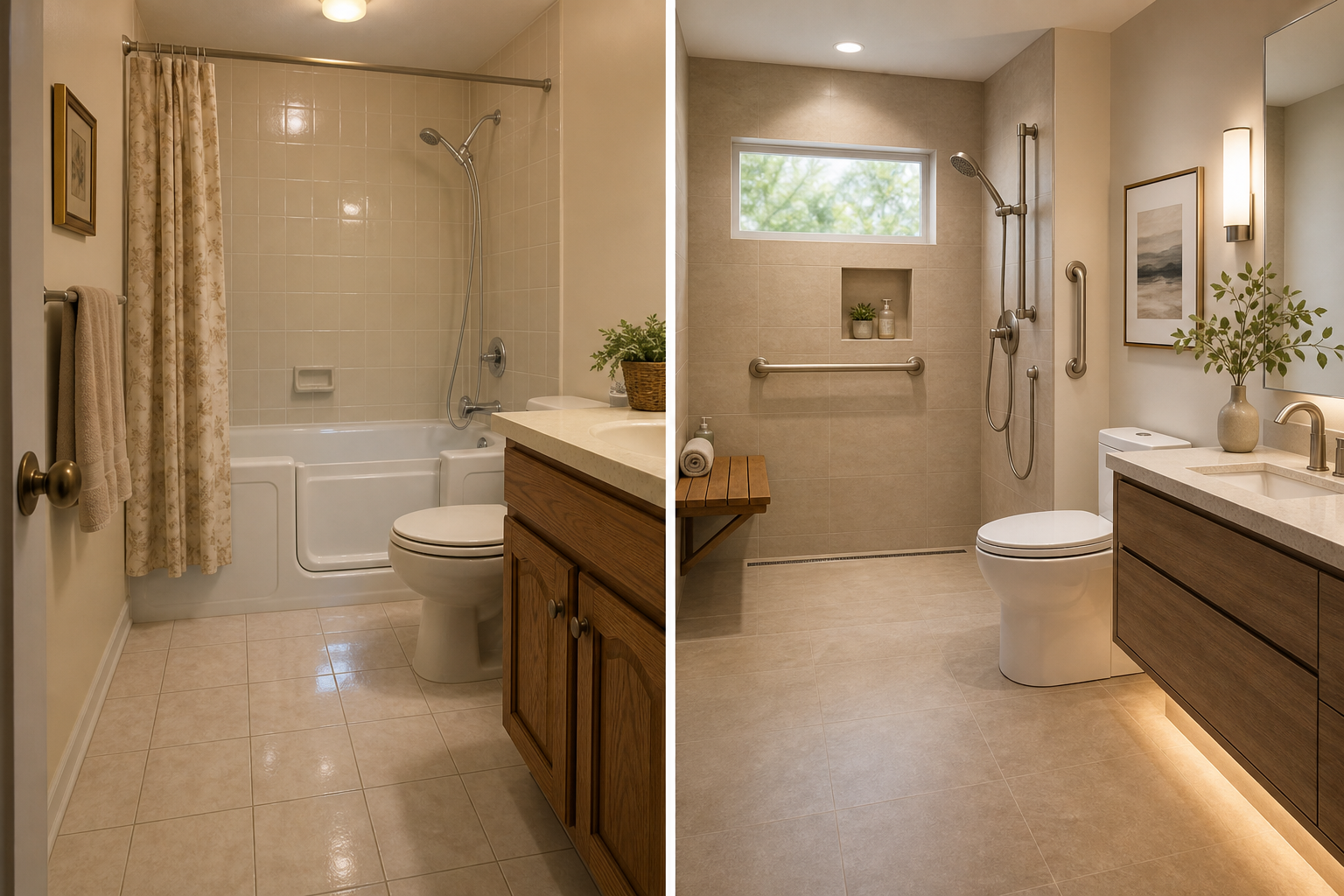
Why the Bathroom Is the Highest-Risk Room in the Home
The numbers are stark. According to a 2008 CDC study published in the Morbidity and Mortality Weekly Report, an estimated 234,094 nonfatal bathroom injuries among people aged 15 and older were treated in U.S. emergency departments in a single year — a rate of 96.4 per 100,000. Falls caused 81.1% of those injuries. For adults aged 85 and older, the injury rate skyrocketed to 515.3 per 100,000, nearly nine times the rate for those aged 15 to 24.
The bathroom concentrates risk because it combines multiple hazards: wet, slippery surfaces; hard, unforgiving fixtures; the need to balance while transferring in and out of a tub or onto a toilet; and often poor lighting. The CDC data shows that 68.3% of bathroom injuries occurred in or near the tub or shower, and 23.4% occurred on or near the toilet. For the 85-plus group, the toilet area alone accounted for 51.7% of injuries, at a rate of 266.6 per 100,000.
Despite this well-documented risk, the vast majority of homes remain unprepared. A 2004 Home Safety Council report cited in the same CDC study found that only 19% of U.S. homes had grab bars installed. More recent research confirms the gap persists: a 2023 study in BMC Geriatrics analyzing 2016 Medicare Current Beneficiary Survey data found that only 55.5% of older adults who had experienced a fall had bathroom modifications such as grab bars or a shower seat. Among those with repeated falls — roughly half of all fallers — 40.2% had no modifications at all, representing an estimated 1.9 million Medicare beneficiaries.
The consequences of inaction are severe. Falls are the leading cause of fatal and nonfatal injuries among older adults, and the total healthcare cost of non-fatal falls reached $80 billion per year as of 2020, according to the National Council on Aging. Medicare covers 67% of those costs. The average cost per fall-related inpatient visit is $18,658; per ED visit, $1,112. These are costs that a well-planned bathroom renovation — often a fraction of a single hospitalization — can meaningfully reduce.
The evidence for intervention is strong. Research cited by Amedisys indicates that home safety measures can reduce fall risk by as much as 40%. A study in the Journal of the American Geriatrics Society found that home modifications reduced falls by 26% and fall-related injuries by 33%. And the same grab bar that costs $50 to $150 to install can increase the chance of regaining lost balance by 75.8%, according to research cited by Amedisys. For a deeper look at the research supporting these claims, see our evidence review on aging-in-place modifications.
The Five Essential Modifications Ranked by Impact
Not all bathroom upgrades are created equal. When planning a safety renovation, the order of investment matters. The five modifications below are ranked by their combined impact on fall prevention, cost-effectiveness, and the number of daily activities they make safer. Every bathroom should include all five, but if budget is tight, start at the top of this list.
| Rank | Modification | Primary Purpose | Estimated Cost Range | Impact Level |
|---|---|---|---|---|
| 1 | Grab bars with proper wall blocking | Provide stable support during transfers and balance recovery | $150–$600 (3–4 bars installed) | Highest — supports every bathroom activity |
| 2 | Non-slip flooring (DCOF ≥0.42) | Eliminate slip hazard on wet surfaces | $6,400–$11,000 (professional install) | High — addresses the primary fall mechanism |
| 3 | Curbless / zero-threshold shower | Remove step-over hazard; enable wheelchair or walker access | $3,000–$15,000 | High — eliminates the highest-risk transfer |
| 4 | Comfort-height toilet (17–19 inches) | Reduce squatting depth and standing effort | $300–$1,200 | Moderate to high — reduces toilet-area falls |
| 5 | Layered lighting with motion activation | Improve visibility during nighttime and low-light use | $100–$800 | Moderate — enables safe navigation in all conditions |
This ranking reflects both the frequency of use and the severity of injury prevented. Grab bars earn the top spot because they support every bathroom activity — entering the shower, using the toilet, stepping out of the tub — and because research shows they dramatically improve the odds of recovering from a loss of balance. Non-slip flooring follows because the slip itself is the initiating event in the vast majority of bathroom falls. The curbless shower and comfort-height toilet target the two highest-risk locations identified in the CDC data: the tub/shower area (68.3% of injuries) and the toilet area (23.4% of injuries). Lighting rounds out the list because even the best modifications are ineffective if the user cannot see clearly.
Grab Bar Placement and Installation Standards
Grab bars are the single most impactful modification you can make, but only if they are installed correctly. A grab bar that pulls out of the wall under load is worse than no grab bar at all — it creates a false sense of security and can cause a fall when it fails. The standards below are based on current best practices from occupational therapy guidelines and accessible design specifications.
The Three Essential Locations
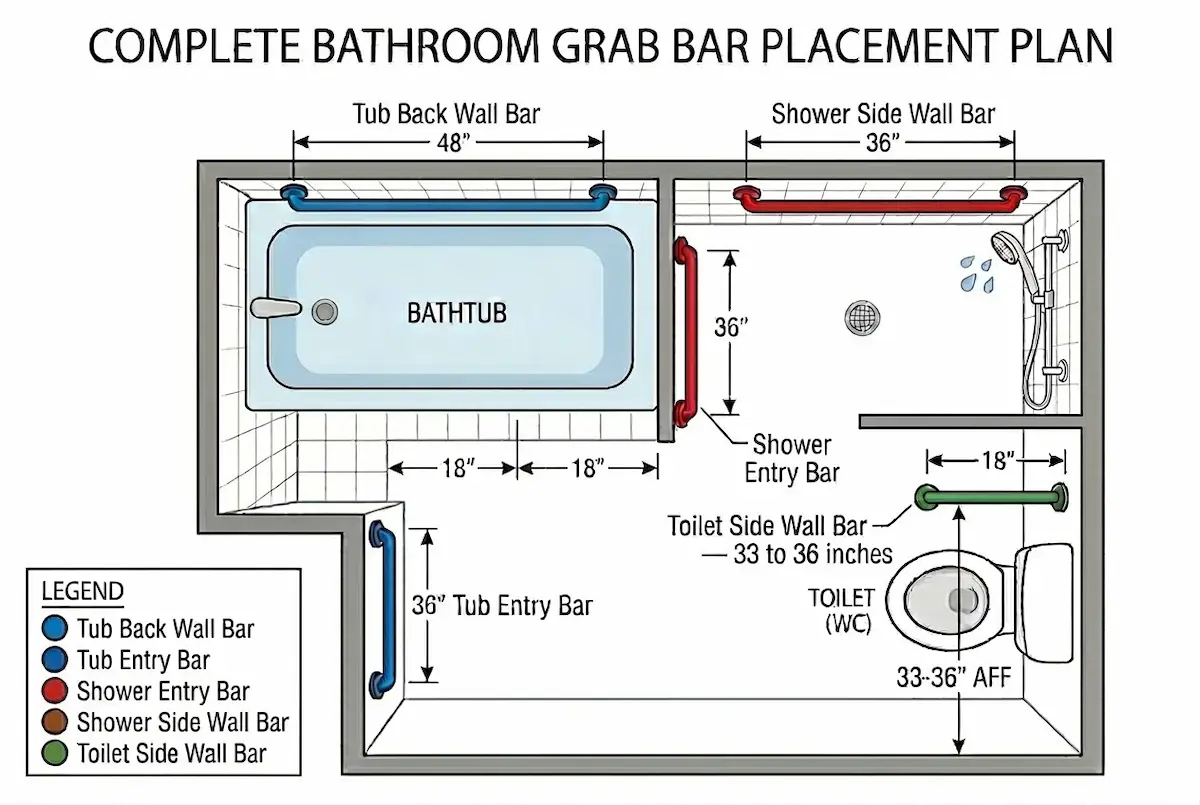
Every bathroom safety renovation should include grab bars in at least three locations, regardless of the user's current mobility level. Falls happen without warning, and bars installed after a decline are bars that arrive too late.
- Toilet side wall: A horizontal bar 33–36 inches above the finished floor, mounted on the wall beside the toilet. This supports both sitting down and standing up. If space allows, a second vertical bar at the front edge of the toilet provides additional leverage.
- Shower entry wall: A vertical or L-shaped bar mounted at the entry point of the shower or tub. This provides a stable handhold during the highest-risk transfer — stepping over a tub wall or into a shower pan.
- Shower wall near bench: A horizontal bar mounted on the wall adjacent to the shower bench or seat, at 33–36 inches AFF. This supports safe transfer from sitting to standing within the shower.
Technical Specifications
The following specifications are critical for safety and code compliance. These are not optional upgrades — they are the minimum standard for a grab bar that will perform in an emergency.
| Specification | Requirement | Why It Matters |
|---|---|---|
| Mounting height | 33–36 inches above finished floor | Matches the natural reach and leverage zone for most adults; too low or too high reduces usable force |
| Load rating | 250 lbs minimum (vertical and horizontal) | Must support the full weight of a person pulling or leaning; lower-rated bars can fail under sudden load |
| Wall blocking | 2x10 lumber blocking between studs | Provides solid anchoring; drywall anchors alone cannot support emergency loads; required by most building codes |
| Bar diameter | 1.25–1.5 inches | Fits the average adult grip; smaller diameters reduce grip strength; larger diameters are hard to grasp |
| Flange clearance | 1.5 inches from wall surface | Allows the hand to wrap fully around the bar without knuckles scraping the wall |
For a complete walkthrough of the decision process behind a bathroom remodel — including how to choose a contractor and sequence the work — see our phased decision framework for bathroom remodels.
Non-Slip Flooring: What the DCOF Rating Means for Safety
Flooring is the surface on which every bathroom fall begins. The wrong tile — glossy porcelain, polished marble, or any surface with a high-gloss finish — becomes dangerously slippery when wet. The right tile provides traction that can prevent a slip from ever starting.
The industry standard for wet-area slip resistance is the Dynamic Coefficient of Friction (DCOF) test, defined by the ANSI A326.3 standard. This test measures the friction between a tile surface and a sensor under wet conditions. The higher the number, the more slip-resistant the surface.
| DCOF Value | ANSI Classification | Suitability for Senior Bathrooms |
|---|---|---|
| < 0.42 | Not recommended for wet areas | Unsafe for bathroom use; high slip risk when wet |
| 0.42 – 0.59 | Minimum acceptable for commercial wet areas | Adequate for general bathroom use; meets basic safety standards |
| ≥ 0.60 | Recommended for high-safety environments | Preferred for senior bathrooms; provides meaningful traction even with soap and water present |
When selecting tile, look for the manufacturer's DCOF rating printed on the product specification sheet. If the rating is not listed, ask for it — many tiles sold as "bathroom floor tile" do not meet the ≥0.42 minimum. Porcelain tile with a textured or matte finish typically performs better than ceramic or polished stone. Textured vinyl sheet flooring is another strong option, offering good slip resistance at a lower cost and with a softer landing surface.
Professional installation of non-slip flooring typically costs $6,400 to $11,000 nationally, according to Inspiration Homes. This includes removal of existing flooring, subfloor preparation, and installation of the new tile or vinyl. While this is one of the more expensive items on the list, it is also one of the most permanent — properly installed non-slip flooring will perform for decades.
Shower Conversion Options: Curbless, Walk-In Tub, or Tub-to-Shower
The tub or shower area is the site of more than two-thirds of bathroom injuries. Eliminating the step-over hazard — the act of lifting one leg over a 12- to 20-inch tub wall — is one of the most effective interventions available. Three primary options exist, each with different trade-offs in cost, accessibility, and usability.
| Option | How It Works | Cost Range | Key Trade-Off |
|---|---|---|---|
| Curbless (zero-threshold) shower | Shower floor is flush with the bathroom floor; water drains via linear drain or sloped pan | $3,000–$15,000 (tub-to-shower conversion); $6,000–$10,000 (new curbless per AARP) | Best accessibility; requires subfloor modification; may need structural review |
| Walk-in tub | Door opens on the side; user enters before filling; seat is built in | $2,000–$20,000+ (standard to luxury per AARP) | No step-over, but user must wait for tub to drain before exiting; longer exposure to wet conditions |
| Tub-to-shower conversion (curbed) | Remove existing tub; install low-profile shower pan with 2–4 inch curb | $3,000–$8,000 (per Porchlight at Home) | Lower cost than true curbless; small step-over remains; may not accommodate wheelchair |
For most families, a curbless shower with a linear drain offers the best balance of safety, usability, and long-term value. It eliminates the step-over entirely, accommodates a walker or wheelchair, and can be designed to look like a natural part of the bathroom rather than a medical modification. The higher upfront cost — typically $6,000 to $10,000 for a new curbless installation, per AARP — is offset by the fact that it serves the user through multiple stages of mobility decline.
Walk-in tubs are a viable alternative for users who prefer soaking baths, but they come with a significant safety caveat: the user must sit in the tub while it fills and drains, which can take 10 to 20 minutes. During that time, the water cools, and the user may become chilled or impatient. More critically, if the user needs to exit quickly — due to a medical event or discomfort — they cannot open the door until the water has drained. For a full comparison of these two options, see our detailed walk-in shower vs. walk-in tub guide.
Toilet Height and Access: Comfort-Height vs. Raised Seat vs. Safety Frame
The toilet area accounts for nearly a quarter of all bathroom injuries, and for adults 85 and older, it is the single most dangerous location in the bathroom — 51.7% of injuries in this age group occur on or near the toilet. The problem is mechanical: a standard toilet seat is 14 to 15 inches high, which requires the user to squat deeply to sit and exert significant leg and core strength to stand. For someone with arthritis, reduced muscle strength, or balance issues, this movement is a fall risk every time.
Three solutions exist, each suited to different mobility levels and budgets.
| Solution | Height Added | Cost Range | Best For |
|---|---|---|---|
| Comfort-height toilet | 17–19 inches (permanent replacement) | $300–$1,200 | Long-term solution; users with moderate to significant mobility needs; best value over time |
| Raised toilet seat | Adds 2–5 inches to existing toilet | $30–$100 | Temporary or budget-conscious solution; easy to install; may feel less stable than a full toilet |
| Toilet safety frame | Freestanding frame with grab bars; fits around existing toilet | $80–$200 | Users who need grab bar support at the toilet but cannot install wall-mounted bars; portable |
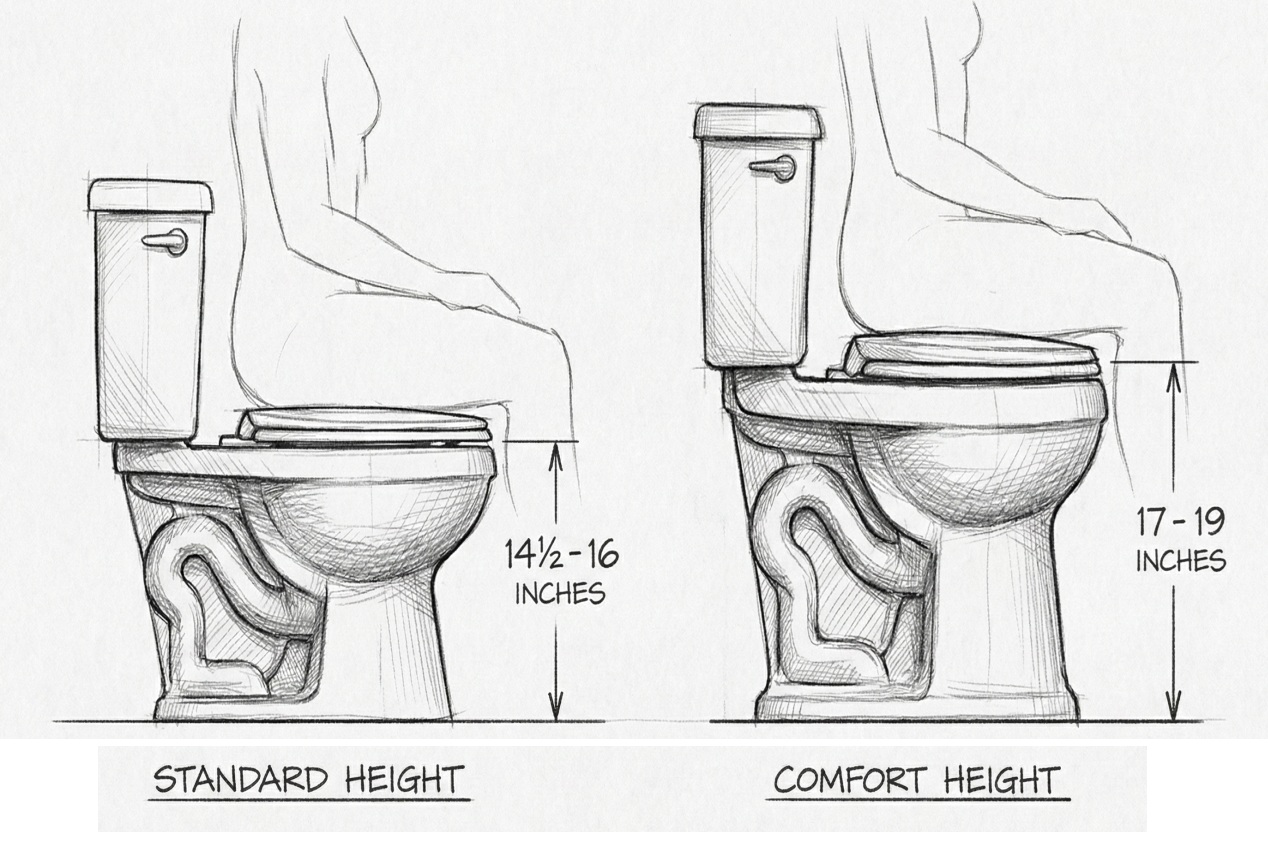
For most families, a comfort-height toilet is the right long-term investment. It replaces the existing toilet entirely, so there is no add-on device to clean around or adjust. The 17- to 19-inch seat height matches the standard chair height, making the sit-to-stand transition feel natural. Installation is straightforward for a plumber and typically costs $150 to $400 in labor on top of the toilet cost.
Raised toilet seats are a practical short-term solution, especially if the user is recovering from surgery or a fall and the bathroom is not yet renovated. They clamp onto the existing bowl and add height without requiring a plumber. The trade-off is stability: some users report that the seat shifts slightly during use, which can be unsettling. A toilet safety frame solves both the height and the stability problem by providing a freestanding grab bar structure around the toilet, but it takes up more floor space and may not fit in a small bathroom.
Lighting and Fixture Upgrades That Prevent Falls
Poor visibility is a contributing factor in many bathroom falls, particularly during nighttime use. An older adult who gets up to use the bathroom at 2 a.m. — often with reduced night vision and groggy from sleep — faces a hazardous navigation challenge if the path is dark. Lighting upgrades are among the most cost-effective modifications you can make.
Layered Lighting Strategy
A single overhead light fixture is not sufficient for bathroom safety. The goal is layered lighting that provides appropriate illumination for different activities and times of day.
- Ambient lighting: Even, glare-free overhead illumination that lights the entire room. LED fixtures with a color temperature of 3000K–4000K provide clear visibility without harsh shadows.
- Task lighting: Focused light at the vanity mirror for grooming tasks. Sconces mounted at eye level on either side of the mirror provide better illumination than an overhead light alone.
- Night lighting: Motion-activated night lights placed along the path from the bed to the bathroom, at the bathroom entry, and near the toilet. These should provide enough light to navigate safely without being bright enough to fully wake the user or disrupt sleep patterns.
- Emergency lighting: A battery-powered light that activates during a power outage. Falls can happen in the dark if a storm or grid failure occurs at night.
AARP also recommends circadian lighting systems that adjust color temperature throughout the day — warmer in the evening to support natural sleep cycles, cooler in the morning to promote alertness. While not essential for fall prevention, this can improve sleep quality, which in turn reduces fall risk.
Fixture Upgrades That Reduce Reaching and Balancing
Beyond lighting, several fixture upgrades reduce the need for awkward reaching, twisting, or balancing — movements that often precede a fall.
- Lever-handle faucets: Replace round or cross-shaped knob handles with lever handles that can be operated with a closed fist or the side of the hand. This is essential for users with arthritis or reduced hand strength.
- Anti-scald valves: Install pressure-balancing or thermostatic mixing valves that prevent sudden temperature spikes if water is used elsewhere in the house. A sudden burst of hot water can cause a flinch reaction that leads to a fall.
- Handheld showerhead with slide bar: A handheld showerhead on an adjustable slide bar allows the user to shower while seated, reducing the need to stand for the duration of the shower. It also makes it easier for a caregiver to assist with bathing.
- Touch or motion-activated faucets: These eliminate the need to grip and turn a handle, which is particularly helpful for users with limited hand mobility. AARP recommends them as a high-usability upgrade.
The Phased Approach: From Under $500 to Full Renovation
A complete bathroom safety renovation can cost anywhere from a few hundred dollars to $25,000 or more, depending on the scope. The good news is that you do not have to do everything at once. A phased approach allows you to address the highest-risk issues immediately while planning for larger structural changes over time.
| Phase | Cost Range | What It Includes | Risk Reduction |
|---|---|---|---|
| Phase 1: Immediate Safety | Under $500 | Grab bars (2–3 bars, DIY or handyman install), raised toilet seat, lever handle faucet, motion-activated night lights, non-slip bath mat | Addresses the highest-risk transfer points immediately; reduces fall risk by an estimated 26–40% when combined with behavioral changes |
| Phase 2: Functional Upgrades | $1,000–$3,000 | Comfort-height toilet, handheld showerhead with slide bar, shower bench or transfer bench, anti-scald valves, non-slip flooring in high-traffic zones | Improves daily safety and comfort; reduces reaching and balancing demands during routine use |
| Phase 3: Full Structural Renovation | $5,000–$25,000+ | Curbless shower with linear drain, wider doorway (36 inches minimum), full non-slip flooring throughout, built-in shower seat, 60-inch turning radius for wheelchair access | Provides full accessibility for walker or wheelchair users; supports aging in place through advanced mobility decline |
The financial case for investing in these modifications is compelling. The national average cost of a full bathroom renovation is approximately $16,500, according to 2026 data from USA Cabinet Store, with mid-range remodels delivering a 65–80% return on investment. But the real return is not measured in home value — it is measured in avoided healthcare costs and extended independence.
For families concerned about the upfront cost, several financial assistance programs can help. The VA Special Adaptive Housing (SAH) grant offers up to approximately $126,526 for eligible veterans (FY2026). The VA Home Improvement and Structural Alterations (HISA) grant provides up to $6,800 for service-connected veterans. The USDA Section 504 program offers up to $10,000 in grants and $40,000 in loans for low-income rural homeowners. For a comprehensive overview of all available funding sources, see our guide to paying for a senior bathroom remodel.
Start with Phase 1 this week. Install grab bars at the toilet and shower. Add a raised toilet seat and night lights. These changes cost less than a single trip to the emergency room, and they will begin reducing fall risk immediately. Then use the coming months to plan Phase 2 and Phase 3 — consulting with a CAPS-certified contractor, exploring funding options, and making decisions that will keep your parent safe and independent for years to come.
Related reading
Need a professional assessment?
Find a CAPS-credentialed professional or local aging services through our outbound resource list — we never name or rank individual contractors.
Find Local HelpNoticed something outdated or inaccurate on this page? Flag a correction. We review every report against CDC, NIA, and AARP HomeFit guidance before updating a page.