
Room checklist
Aging-in-Place Specialist vs. General Contractor vs. Occupational Therapist: Who Should You Hire for Home Modifications?
Family caregivers are often confused by the range of professionals offering home safety services. This article provides a clear decision framework comparing CAPS-certified aging-in-place specialists, occupational therapists, and general contractors — explaining who does what, when to call each, and how the collaborative OT→CAPS→contractor model works to prevent costly mistakes.
Why Most Families Call the Wrong Professional First
A parent falls in the bathroom. A doctor recommends making the home safer. A family member notices the stairs are becoming difficult. In each of these moments, the instinct is the same: call a contractor. Get a quote. Fix the problem.
That instinct is understandable, but it often leads to expensive mistakes. A general contractor knows how to build to code, but they may not know how to assess your parent’s specific functional limitations or design a home that adapts as those needs change. The result is a bathroom remodel that looks beautiful but lacks the right grab-bar placement, or a ramp that meets building codes but creates a new tripping hazard at the threshold.
The aging-in-place ecosystem involves three distinct professionals, each with a different role: the occupational therapist (OT), the Certified Aging-in-Place Specialist (CAPS), and the general contractor. Understanding who does what — and when to call each one — can save thousands of dollars and, more importantly, prevent the kind of unsafe modification that leads to another fall.
This article provides a clear decision framework. We’ll define each role, compare costs, walk through real-world scenarios, and explain how the collaborative OT→CAPS→contractor model works — and when it doesn’t apply. If you’ve already read our related article on calling the wrong professional first, this guide expands that argument into a full three-way comparison.
The Three Roles Defined: CAPS, OT, and General Contractor
Before deciding who to call, it helps to understand what each professional actually does. The table below summarizes the core responsibilities, training, and typical use cases for each role.
| Professional | Core Focus | Training & Credentials | What They Do | Best For |
|---|---|---|---|---|
| Occupational Therapist (OT) | Person’s functional abilities | Master’s or doctoral degree; state license; Medicare-certified provider | Assesses mobility, strength, balance, and daily living tasks; recommends specific modifications and adaptive strategies | After a fall, new diagnosis, or noticeable functional decline |
| CAPS-Certified Specialist | Home accessibility design & project coordination | NAHB 3-course certification (CAPS I, II, III); annual CE; $299–$399 national fee | Evaluates home layout, designs modification plans, coordinates with contractors, manages phased projects | Major renovations (bathroom, kitchen, stairlift) or multi-room accessibility planning |
| General Contractor | Construction execution & building codes | State license; liability & workers’ comp insurance; no universal design requirement | Installs modifications, manages subcontractors, obtains permits, ensures code compliance | Simple installations (grab bars, faucet replacement) or executing a CAPS-designed plan |
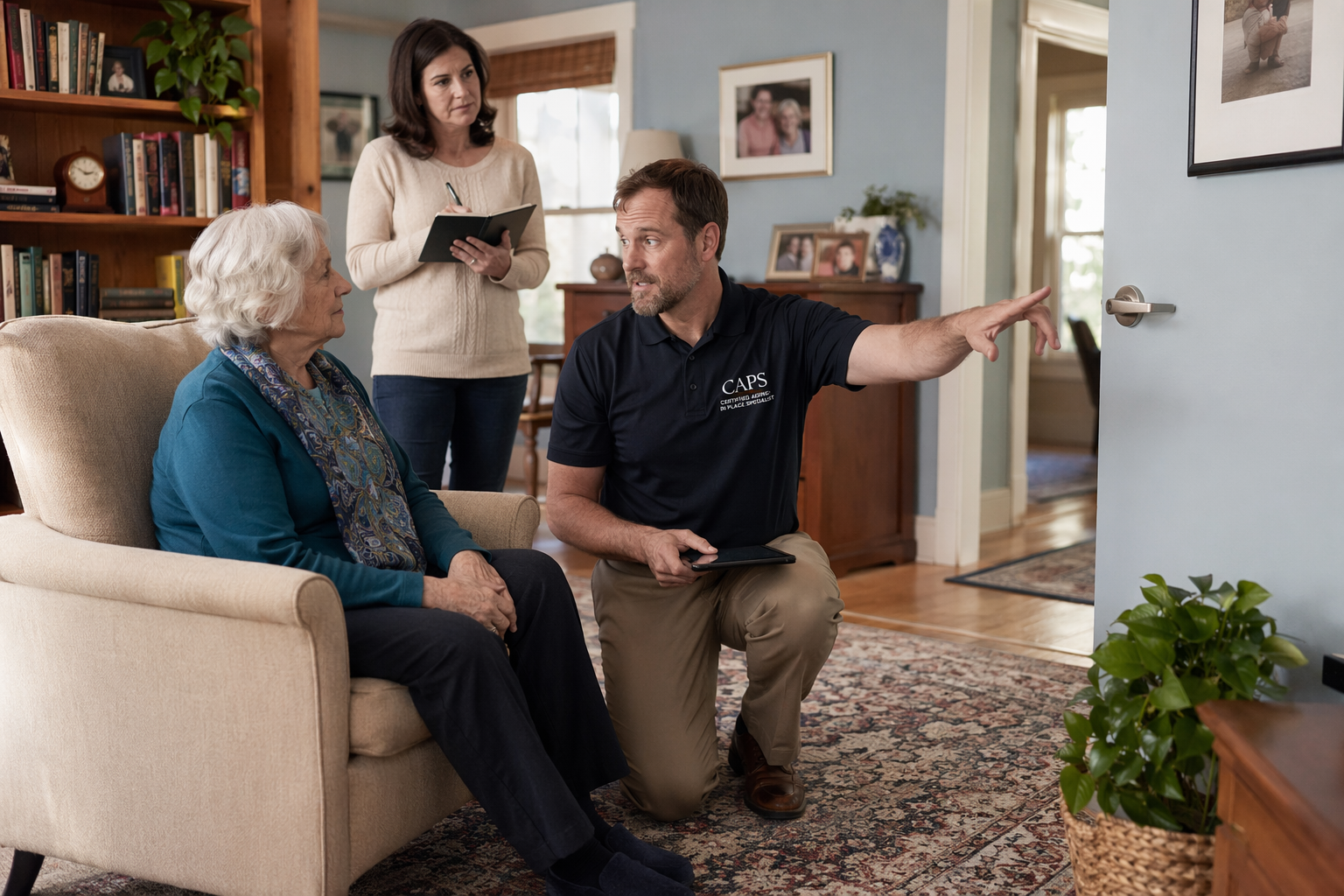
The CAPS credential, offered jointly by the National Association of Home Builders (NAHB) and AARP since 2002, requires completing three courses: CAPS I (Marketing & Communicating Aging in Place), CAPS II (Design Concepts and Methods for Livable Homes), and CAPS III (Details and Solutions for Livable Homes and Aging in Place). The program covers universal design principles, budget planning, phased construction, and collaboration with allied professionals like OTs and physical therapists.
It’s important to note that these roles are not mutually exclusive. Some OTs hold CAPS certification. Some contractors have earned CAPS credentials. But the scope of practice differs: an OT’s primary training is in human function and rehabilitation, while a CAPS professional’s training is in home design and construction coordination. A general contractor’s expertise is in building, not in assessing how a person’s changing abilities interact with their environment.
When Each Professional Is the Right First Call
The most common mistake families make is treating every home safety project as a construction problem. It’s not. The right first call depends entirely on the situation.
Scenario 1: After a fall or functional decline — Call an OT first
If your parent has recently fallen, been diagnosed with a condition affecting mobility (arthritis, Parkinson’s, post-stroke), or is showing signs of difficulty with daily tasks like bathing or climbing stairs, an occupational therapist should be your first call. An OT will conduct a functional assessment — observing how your parent moves through their home, identifying specific barriers, and recommending modifications tailored to their current abilities and likely progression.
OT assessments are often covered by Medicare Part B when ordered by a physician, making them the most affordable entry point for many families. The OT’s recommendations then serve as a prescription that a CAPS specialist or contractor can follow.
Scenario 2: Major renovation or multi-room project — Call a CAPS specialist (with or without an OT)
For significant structural work — a full bathroom remodel, stairlift installation, kitchen reconfiguration, or creating a first-floor living suite — a CAPS-certified professional is the right starting point. CAPS training covers universal design principles, budget planning, and phased construction, which means they can design a plan that works now and adapts as needs change.
Ideally, the CAPS specialist works from an OT’s functional assessment. But even without one, a CAPS professional can identify the most common safety issues and design solutions that meet current accessibility standards. They also coordinate with contractors, which reduces the risk of miscommunication during installation.
Scenario 3: Simple, single-item installation — A contractor alone may suffice
If the project is straightforward — installing a single grab bar, replacing a faucet with a lever-handle model, adding a non-slip mat — a qualified general contractor or handyperson can handle it. The risk is low, and the cost of an OT or CAPS assessment may not be justified.
However, even simple installations require attention to detail. A grab bar that isn’t anchored into a stud or secured with appropriate toggle anchors can fail under load. If you’re unsure about the specifics, a CAPS specialist can provide a quick consultation or review the contractor’s plan.
Cost Comparison: What Each Professional Charges
Cost is a major factor in deciding who to call. The table below provides national average ranges. Keep in mind that prices vary significantly by geography — the Census Bureau reports that New England has the lowest share of aging-ready homes (19.6%), which may correlate with higher local costs for assessments and modifications.
| Service | Typical Cost Range | Insurance / Funding |
|---|---|---|
| OT home assessment | $150 – $500 | Often covered by Medicare Part B with physician referral |
| CAPS home assessment | $300 – $1,000 | Rarely covered by insurance; may qualify for VA or Medicaid waivers |
| CAPS hourly consultation | $75 – $200 per hour | Out-of-pocket; some nonprofits offer sliding-scale fees |
| General contractor bid | Often free or included in quote | Out-of-pocket; included in project cost |
| Grab bar installation (single) | $100 – $300 | Out-of-pocket; may qualify for VA grant |
| Wheelchair ramp | $1,500 – $5,000 | VA grants, Medicaid waivers, some nonprofit programs |
| Walk-in tub | $5,000 – $15,000 | Rarely covered; some VA benefits apply |
| Stairlift | $3,000 – $5,000 | VA grants, some Medicaid waivers |
| Full bathroom or kitchen remodel | $10,000 – $50,000+ | VA SAH grant, USDA Rural Development, some Medicaid waivers |
For a more detailed breakdown of CAPS-specific costs and budget planning, see our full guide: 10-Year Aging in Place Remodel Roadmap: What to Do Now vs. Later.
The Collaborative Model: OT → CAPS → Contractor
For complex cases — a parent with progressive Parkinson’s who needs a full first-floor living suite, or a family planning a bathroom remodel after a hip fracture — the ideal workflow involves all three professionals in sequence.
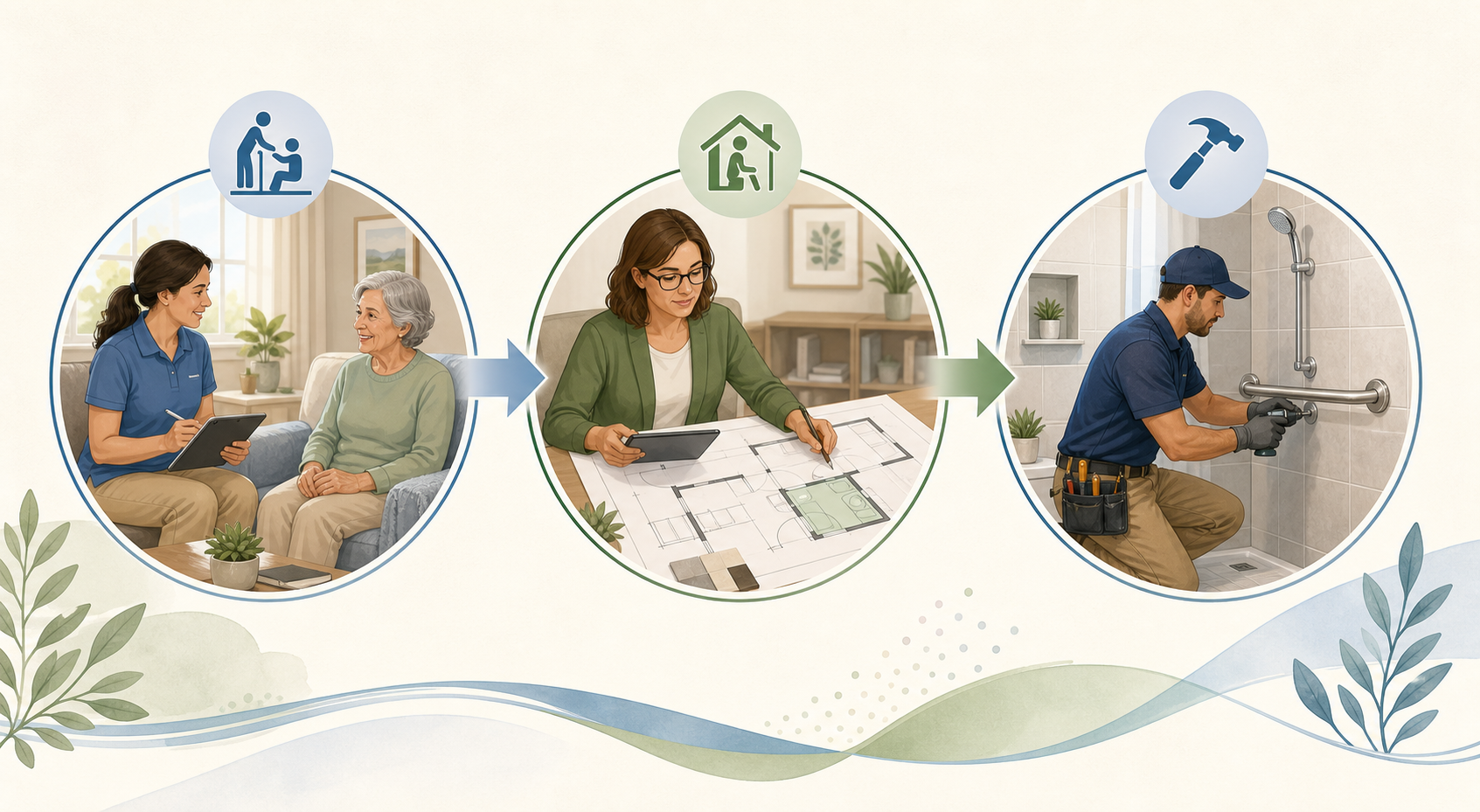
Here’s how the model works in practice:
- Step 1: OT assesses the person. The occupational therapist visits the home, observes the older adult performing daily tasks (bathing, cooking, navigating stairs), and identifies specific functional limitations. The OT produces a written report with recommendations — for example, “install a curbless shower with a fold-down seat at 18 inches height, add a grab bar at the toilet at a 45-degree angle on the right side.”
- Step 2: CAPS designs the plan. The CAPS specialist takes the OT’s recommendations and translates them into a construction-ready plan. They evaluate the home’s structural constraints (joist spacing for grab-bar anchors, doorway width for wheelchair access, electrical capacity for a stairlift), create a phased budget, and identify the right contractor for the job.
- Step 3: Contractor executes the build. The general contractor or CAPS-credentialed contractor installs the modifications according to the plan. The CAPS specialist typically oversees the project to ensure the design intent is preserved during construction.
This model is recommended by both the American Occupational Therapy Association (AOTA) and NAHB for comprehensive home modification projects. It reduces the risk of costly rework — like installing a grab bar in the wrong location or building a ramp that doesn’t accommodate the user’s wheelchair turning radius.
How to Find Each Professional
Once you know which professional you need, the next step is finding a qualified one. Here are the primary directories and resources for each role:
- CAPS specialists: Search the NAHB’s official CAPS directory at nahb.org. You can filter by location and verify current certification status. NAHB also provides a list of CAPS professionals who have completed continuing education in the past year.
- Occupational therapists: Use the American Occupational Therapy Association’s AOTA ProFind tool. Filter by “home modification” or “aging in place” specialty. Ask whether the OT has experience with home assessments — not all OTs offer this service.
- General contractors: Check your state’s licensing board for verified contractors with liability and workers’ compensation insurance. Ask specifically about experience with aging-in-place or accessibility projects. A contractor who has worked with a CAPS specialist before is a strong indicator of quality.
For a detailed hiring guide with specific vetting questions, see our article: How to Find and Vet a CAPS-Certified Contractor: 10 Questions to Ask Before Hiring.
Real-World Scenarios: Which Professional to Call
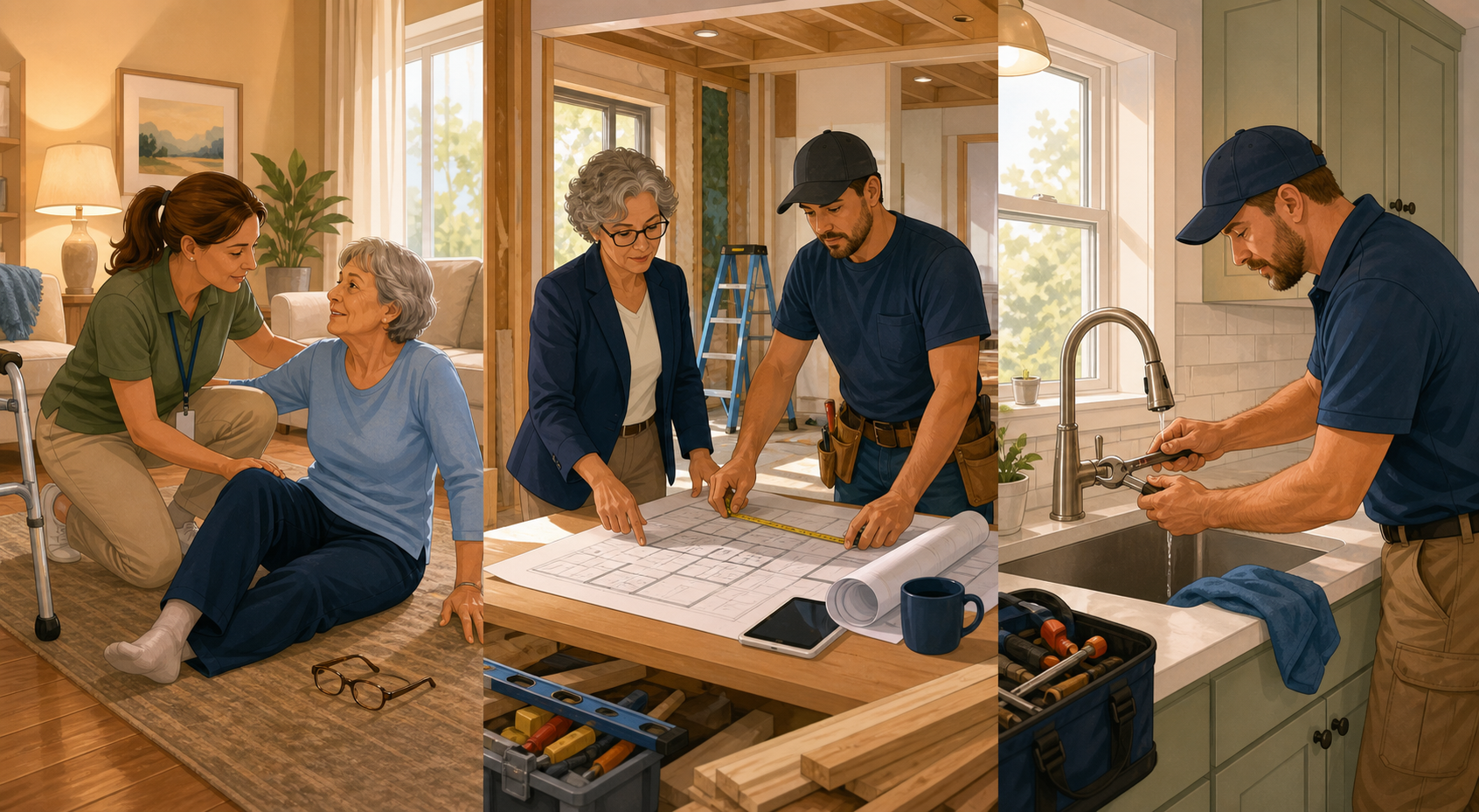
The decision framework becomes clearer when applied to concrete situations. Below are three common scenarios and the recommended first call for each.
Scenario A: A parent has fallen in the bathroom and is now afraid to shower alone
First call: Occupational therapist. The fall may be a symptom of broader balance or strength issues that an OT can assess. The OT will evaluate the bathroom layout, recommend specific modifications (grab bar placement, shower chair height, non-slip flooring), and provide a written plan. A CAPS specialist or contractor can then implement those recommendations. For a detailed phased guide to bathroom modifications, see Bathroom Remodel for Elderly Safety: A Phased Fall-Prevention Guide from $200 Fixes to Full Renovation.
Scenario B: A couple in their 70s is planning a full first-floor remodel to avoid stairs
First call: CAPS specialist. This is a major structural project involving layout changes, potential load-bearing wall modifications, and coordination with multiple subcontractors. A CAPS specialist can design a plan that incorporates universal design principles (36-inch doorways, 5-foot turning radius, lever handles) and phase the work over time to manage costs. They will also coordinate with a contractor who has experience with accessibility projects. For evidence on which modifications have the greatest impact on fall reduction, see Home Modifications That Actually Prevent Falls: What the Research Says and What to Prioritize.
Scenario C: A family needs grab bars installed in two bathrooms and a new lever-handle faucet in the kitchen
First call: General contractor or qualified handyperson. These are straightforward installations that don’t require a full functional assessment or design plan. However, ensure the contractor knows how to properly anchor grab bars into studs or use appropriate toggle anchors for tile. If the family is unsure about placement, a one-hour CAPS consultation ($75–$200) can provide guidance before the contractor arrives.
Key Takeaways and Next Steps
Choosing the right professional for an aging-in-place project doesn’t have to be confusing. The decision comes down to three questions:
- Has there been a recent fall, diagnosis, or functional decline? Start with an OT for a functional assessment.
- Is the project a major structural renovation? Start with a CAPS specialist for design and coordination.
- Is it a simple, single-item installation? A qualified contractor can handle it, but consider a CAPS consultation if you’re unsure about placement or safety.
Understanding these roles saves money, prevents unsafe modifications, and ensures that the work done today will still meet your parent’s needs tomorrow. For data on how proper modifications reduce falls and care hours, see The Evidence for Aging-in-Place Remodels: 39% Fewer Falls, 42% Fewer Care Hours.
If you’re still unsure which professional to call, start with an OT assessment. It’s the most affordable entry point, often covered by Medicare, and it provides a roadmap that any CAPS or contractor can follow. From there, you can decide whether a CAPS specialist is needed for design and coordination, or whether a contractor alone can execute the plan.
Related reading
Need a professional assessment?
Find a CAPS-credentialed professional or local aging services through our outbound resource list — we never name or rank individual contractors.
Find Local HelpNoticed something outdated or inaccurate on this page? Flag a correction. We review every report against CDC, NIA, and AARP HomeFit guidance before updating a page.