
Room checklist
Home Modifications for Aging in Place: What the Evidence Actually Says About Fall Prevention and Independence
Most advice about home modifications is anecdotal. This article grounds recommendations in the strongest available evidence — including a 2025 systematic review — showing that grab bars, non-slip flooring, and stair railings can reduce falls by 39% or more, cut care hours by 42%, and deliver meaningful cost savings.
Why the Evidence Matters More Than Anecdotal Advice
If you have spent any time researching how to make a parent's home safer, you have likely encountered a familiar pattern: a listicle promising "10 Must-Have Modifications" followed by a product link, or a contractor's testimonial about a bathroom remodel that changed someone's life. None of that is useless, but none of it answers the question that matters most when you are about to spend thousands of dollars and disrupt a parent's living space: Does this actually work?
The honest answer, until very recently, was that the evidence base was fragmented. Individual studies existed, but no single synthesis told families whether grab bars, stair railings, and non-slip flooring consistently reduced falls or kept people independent. That changed in March 2025 with the publication of a systematic review that pulled together 20 studies spanning 15 years and multiple countries. This article centers on that review and the clinical research behind it, because families making decisions about safety and independence deserve data, not anecdotes.
What the 2025 Systematic Review Found: 65% Effectiveness Across 20 Studies
The 2025 systematic review by Cha SM, published in PMC (ID: PMC11988477), examined 20 studies conducted between 2010 and 2024 across Sweden, the UK, Australia, Japan, Greece, Spain, Switzerland, Turkey, and New Zealand. The central finding: 13 of the 20 studies — 65% — confirmed that home modifications are effective for fall prevention, maintaining functional independence, and generating cost savings. The remaining 7 studies highlighted housing accessibility and lifestyle factors as important contextual variables but did not contradict the effectiveness finding.
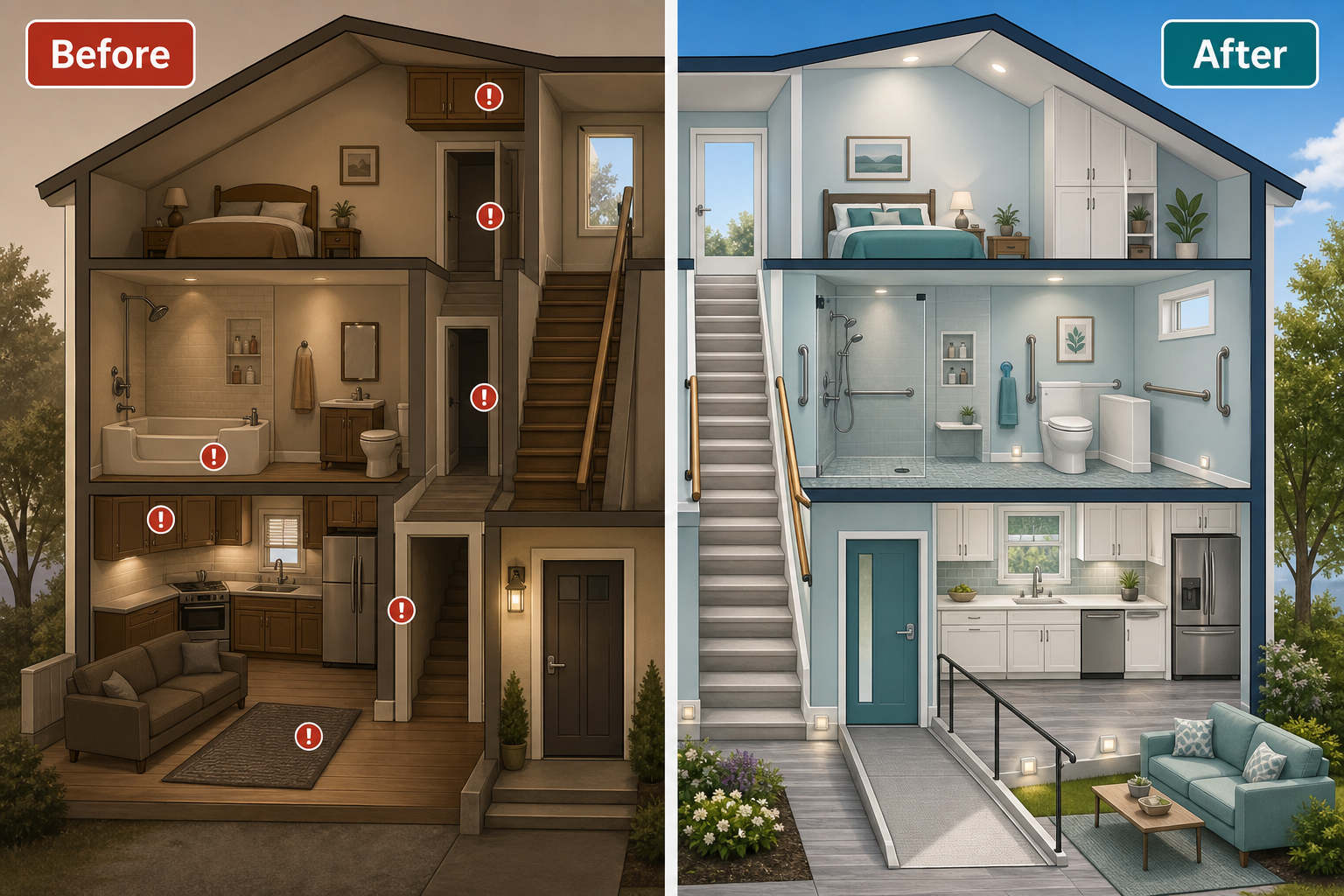
The review identified two modification categories that appeared in every single study: mobility and accessibility improvements, and bathroom safety enhancements. Within those categories, four specific modifications were consistently cited as the highest-impact interventions: grab bars, non-slip flooring, improved lighting, and stair railings. These are not exotic or expensive changes. They are the kinds of modifications that can be planned incrementally, starting with the areas of the home where falls most commonly occur.
Specific Outcomes: Fall Reduction, Care Hours, and Emergency Admissions
The review's strength lies not just in its overall conclusion but in the individual studies it synthesized. Three studies in particular provide concrete, actionable effect sizes that families can use to understand what is possible.
| Study | Sample Size | Key Outcome | Effect Size |
|---|---|---|---|
| Stark et al. (2017) — HARP study (RCT) | n = 300 | Fall reduction from home modification intervention | 39% reduction in falls |
| Carnemolla et al. (2019) | n = 157 | Reduction in weekly care hours and informal care | 42% reduction in weekly care hours; 46% reduction in informal care |
| Hollinghurst et al. (2022) | n = 657,536 | Reduction in fall-related emergency admissions | 3% quarterly reduction (OR = 0.97) |
The Stark et al. randomized controlled trial is particularly notable because RCTs are the gold standard in clinical research. A 39% reduction in falls is not a marginal improvement — it is the kind of effect that changes the trajectory of an older adult's health. Falls are the leading cause of fatal and nonfatal injuries among older adults, and a single fall can trigger a cascade of hospitalization, mobility loss, and transition to institutional care.
The Carnemolla findings address a different but equally important dimension: caregiver burden. A 42% reduction in weekly care hours means that a family currently spending 20 hours per week on hands-on assistance could see that drop to roughly 12 hours. For adult children juggling careers and their own families, that difference can be the line between sustainable caregiving and burnout.
The Hollinghurst study, with a sample of more than 650,000 participants, provides population-level evidence that home adaptations reduce emergency admissions. A 3% quarterly reduction may sound modest, but at scale it represents thousands of avoided hospital visits and the associated costs, trauma, and recovery time.
The Highest-Impact Modifications: What 100% of Studies Agree On
When every study in a 20-study review points to the same set of modifications, it is worth paying close attention. The four modifications that appeared across all included studies are:
- Bathroom grab bars
- Non-slip flooring
- Improved lighting (especially motion-sensor night-lights and task lighting)
- Stair railings on both sides of stairs
The evidence for grab bars is particularly strong. A peer-reviewed study (Levine et al., PubMed ID 34963373) found that people using grab bars in their bathrooms were nearly 76% more likely to recover their balance than those who had no grab bars. This finding was independently cited by the Wirecutter aging-in-place guide (updated February 2026) and by Forbes Health, both of which interviewed occupational therapists and aging specialists who confirmed the real-world impact of this simple installation.
The bathroom deserves special attention. The CDC's Morbidity and Mortality Weekly Report found that almost 28% of bathroom injuries among people aged 65 and older were toilet-related. A grab bar near the toilet, combined with a raised toilet seat, addresses one of the most common and dangerous transfer points in the home. For a detailed implementation guide covering exactly what a bathroom safety upgrade should include, see the complete bathroom safety upgrade guide.
Yet despite this evidence, adoption remains low. Only 18% of adults aged 50 and older have made modifications to help them age in place, according to a University of Michigan National Poll on Healthy Aging. And 85% of seniors who plan to stay in their current homes do not believe they will need significant modifications — a perception that the evidence contradicts. For a deeper look at why families delay these changes and how to overcome the barriers, read why 40% of repeat fallers still have no bathroom modifications.
What the Evidence Says About Home Modifications for Cognitive Decline
The 2025 review included studies that examined home modifications for older adults with cognitive impairment, though the evidence base here is thinner than for the general aging population. The review identified a gradual familiar-environment approach as the most supported strategy: rather than making all changes at once, modifications are introduced incrementally to avoid disorienting someone with dementia.
Key modifications that appeared in the cognitive decline studies include improved lighting to reduce shadows and glare (which can be misinterpreted by someone with dementia as holes or obstacles), contrasting colors on stair edges and grab bars to improve depth perception, and simplified layouts that reduce the number of choices at decision points like hallways and doorways. The review also noted that bathroom modifications — particularly grab bars and non-slip flooring — are equally important for this population, as the risk of falls increases significantly as cognitive function declines.
Cost-Effectiveness: $5,480 Per QALY and When Modifications Save Money
The question of whether home modifications are worth the cost is not just a financial one — it is a question about value. The 2025 review included a cost-effectiveness modeling study by Wilson et al. (2017) that calculated the incremental cost-effectiveness ratio (ICER) for home modifications at $5,480 per quality-adjusted life year (QALY) gained. To put that number in context, the commonly accepted threshold for cost-effectiveness in the United States is $50,000 to $100,000 per QALY. At $5,480, home modifications are not just cost-effective — they are among the most efficient health interventions available.
The Wilson model found that the greatest cost savings occurred for adults aged 75 and older who had already experienced a fall. For this group, the cost of modifications was offset by avoided hospitalizations, emergency department visits, and downstream care needs. This is a critical point for families who are considering modifications after a fall has already happened: the evidence suggests that post-fall is precisely when the investment delivers the highest return.
| Population | Cost-Effectiveness Finding | Source |
|---|---|---|
| General older adult population | $5,480 per QALY gained | Wilson et al. (2017) modeling study |
| Adults 75+ with prior falls | Greatest cost savings; modifications offset hospital and care costs | Wilson et al. (2017) |
| All older adults (context) | A $200 grab bar installation can prevent a fall leading to $50,000+ in hospital costs | ElderLife Financial (2026) |
It is also worth noting that only 10% of U.S. homes are adequately designed for aging populations, according to U.S. Census Bureau data (Vespa et al., 2020) cited in the review. And 77% of home modifications are self-funded by families, according to Kim et al. (2024) using 2019 American Housing Survey data. While a full exploration of funding sources is beyond the scope of this article, the cost-effectiveness data makes a strong case that even when families bear the full cost, the investment is justified by the outcomes.
For families trying to decide who should perform the work — a CAPS-certified contractor, an occupational therapist, or a general contractor — the CAPS vs. OT vs. contractor guide explains how each professional fits into a successful modification project.
What the Evidence Is Still Missing — and Why That Matters
A responsible review of the evidence must also acknowledge its gaps. The 2025 systematic review identified three significant limitations in the current research landscape:
- Limited research on smart home technologies. Only a handful of studies examined how passive sensors, automated lighting, voice-activated controls, and remote monitoring systems interact with traditional structural modifications. The review recommends personalized, technology-driven, and long-term adaptable home modifications, but the evidence to support specific technology combinations is not yet robust.
- Insufficient long-term follow-up. Most studies tracked outcomes for 12 to 24 months. The review notes that the durability of modification benefits over five or ten years — and whether modifications need to be updated as a person's functional status changes — remains largely unstudied.
- Lack of personalized intervention studies. The review found that few studies examined how to match specific modification packages to individual risk profiles, home layouts, and personal preferences. Most studies applied a standardized set of modifications rather than tailoring them.
These gaps matter for families making decisions today because they highlight the difference between what the evidence supports with confidence and where clinical judgment and common sense must fill the void. The evidence strongly supports starting with bathroom grab bars, non-slip flooring, improved lighting, and stair railings. It does not yet tell us with precision whether adding a $2,000 smart home sensor system to those modifications produces a proportional benefit. That does not mean smart home technology is useless — it means families should approach it with realistic expectations and prioritize the four evidence-backed modifications first.
How to Apply These Findings: Next Steps for Families
The evidence from the 2025 systematic review and supporting clinical studies points to a clear, actionable path for families. Here is how to apply it:
- Start with the four modifications that 100% of studies agree on: bathroom grab bars, non-slip flooring, improved lighting (especially motion-sensor night-lights and task lighting), and stair railings on both sides. These are the highest-impact, lowest-regret interventions.
- Prioritize the bathroom. With 28% of bathroom injuries in older adults being toilet-related and grab bars improving balance recovery by 76%, the bathroom is the single most important room to address. The complete bathroom safety upgrade guide provides a room-by-room implementation plan.
- If a fall has already occurred, act now. The cost-effectiveness data shows that modifications deliver the greatest savings for adults 75+ who have already fallen. Waiting for a second fall is not a strategy — it is a risk. The post-fall coordination playbook can help you coordinate home care, occupational therapy, contractors, and monitoring technology after a fall event.
- Choose the right professional. Not all contractors are trained to work with aging adults. The CAPS vs. OT vs. contractor guide explains the difference between a Certified Aging-in-Place Specialist, an occupational therapist, and a general contractor — and why the best projects often involve all three.
- Do not let the gaps in the evidence paralyze you. The research on smart home technologies and long-term follow-up is still developing, but the core evidence for grab bars, non-slip flooring, lighting, and railings is strong enough to act on today. Start with those four modifications, evaluate the results, and add enhancements over time.
The evidence is clear: home modifications work. They reduce falls, they reduce care hours, they reduce emergency admissions, and they deliver exceptional value for the money. The question is no longer whether to modify a parent's home — it is where to start.
Related reading
Need a professional assessment?
Find a CAPS-credentialed professional or local aging services through our outbound resource list — we never name or rank individual contractors.
Find Local HelpNoticed something outdated or inaccurate on this page? Flag a correction. We review every report against CDC, NIA, and AARP HomeFit guidance before updating a page.