What Is a Certified Aging in Place Specialist (CAPS) and Should You Hire One for Your Parent?
~Grab bars $150–$400, stair lifts $2,500–$18,000, full home remodel $15,000–$60,000Reviewed: 2026-06-23
What Is a Certified Aging in Place Specialist (CAPS) and Should You Hire One for Your Parent?
This guide helps adult children understand what a CAPS certification involves—the three-course NAHB/AARP curriculum—and provides a decision framework to determine when hiring a CAPS is worth the investment versus relying on a general contractor or occupational therapist.
Estimated cost range: Grab bars $150–$400, stair lifts $2,500–$18,000, full home remodel $15,000–$60,000
Potential funding: IRS medical expense deduction (over 7.5% AGI), VA HISA/SAH grants, Medicaid HCBS waivers, USDA Section 504 loans/grants
Cost ranges are estimates. Verify eligibility directly with each program.
By Editorial Team
The acronym sounds official. CAPS. Certified Aging in Place Specialist. It comes up in contractor quotes, forwarded AARP articles, and the occupational therapist’s bathroom evaluation. It sounds like a license, maybe a government credential, something with teeth. So here is what it actually is: a three-course certificate offered jointly by the National Association of Home Builders and AARP, with no prerequisites required to enroll. No industry experience, no license, no clinical background. Anyone can take the three courses.
That is the thing I want you to hold onto as you read the rest. The credential signals specialized training in aging-in-place design and communication – but it does not guarantee the person holding it can build a wall, run a drain line, or install a stair lift safely. The three courses are:
CAPS I – Marketing and Communicating with the Aging in Place Client
CAPS II – Design Concepts and Methods for Livable Homes and Aging in Place
CAPS III – Details and Solutions for Livable Homes and Aging in Place
A good general contractor executes a plan. A CAPS is supposed to help create the plan in the first place. According to the NAHB, the CAPS workflow includes assessing a home's accessibility, obtaining contractor quotes, hiring contractors, and following up with the homeowner after renovations. That assessment is a concrete deliverable: a personalized home evaluation with a full report and visuals, typically for about $500. For that money you get a room-by-room breakdown of what needs to change and what is optional. A general contractor typically only quotes the work you already know you want. The CAPS helps you figure out what you should want.
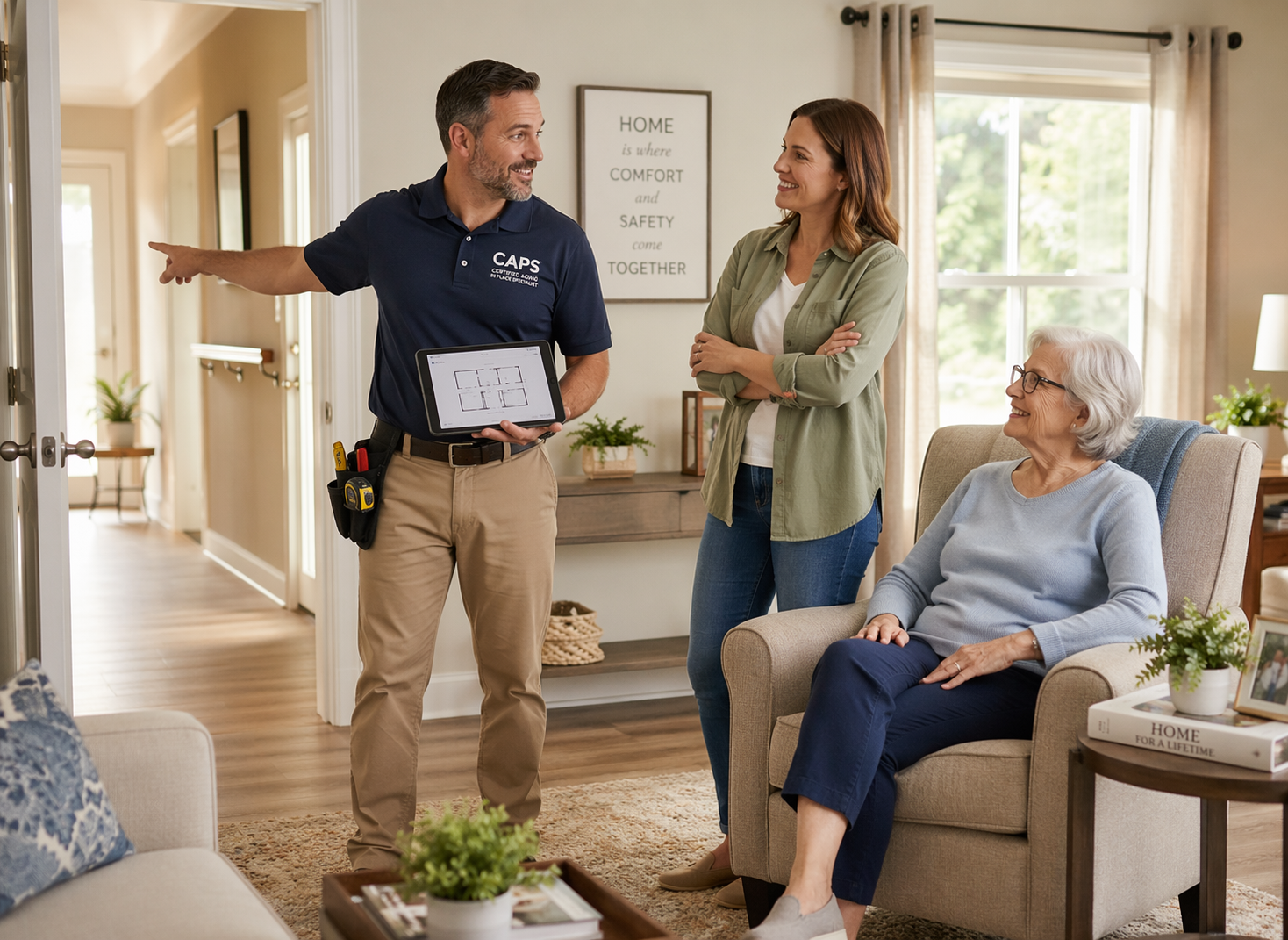
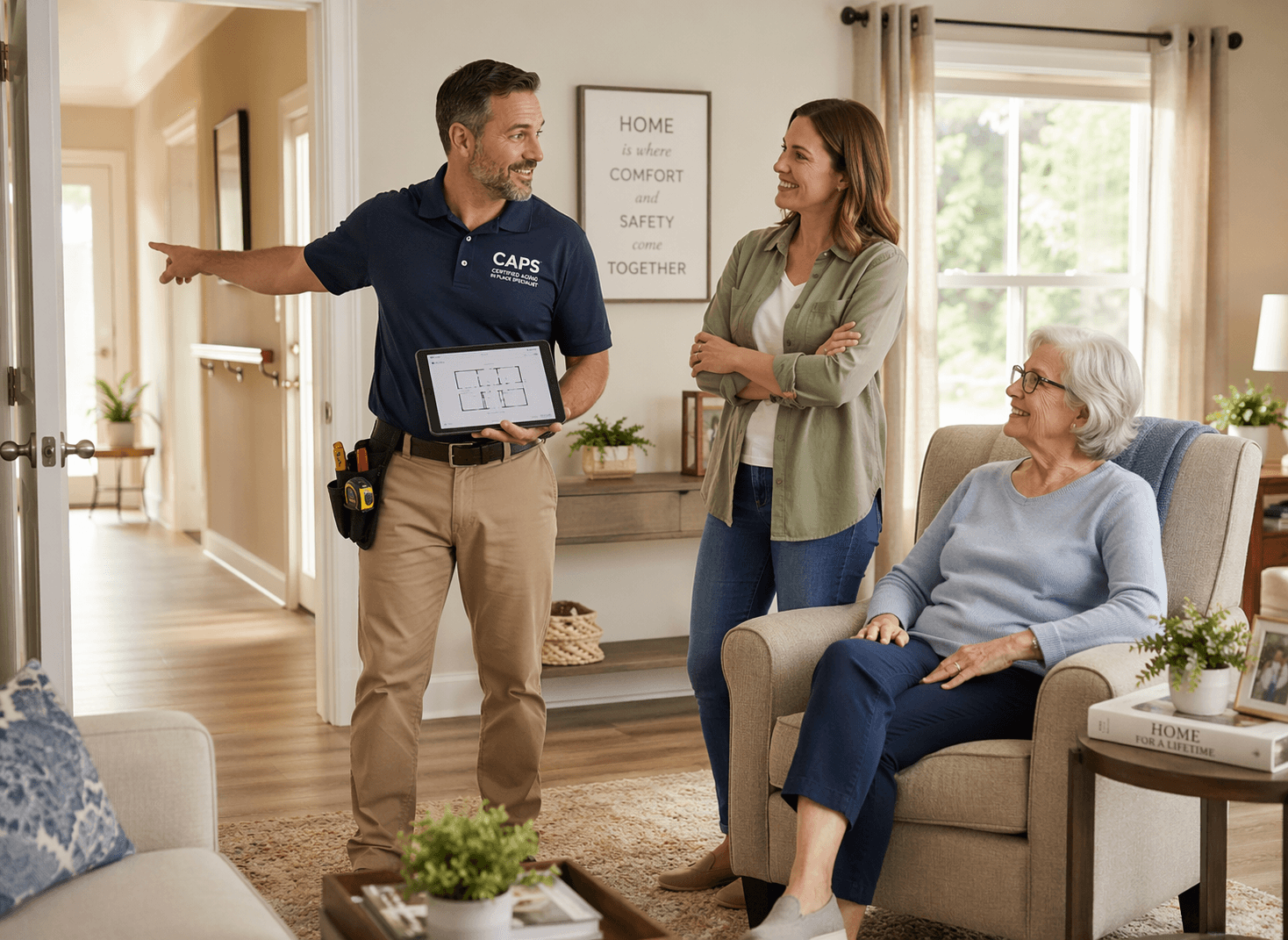
A CAPS professional during a home assessment — the first step in many aging-in-place projects.
The $500 is small compared with the cost of a mistake. A full home aging-in-place remodel runs $15,000 to $60,000. A stair lift costs $2,500 to $18,000. Grab bars are $150 to $400 each. Getting the design wrong – placing a grab bar where it is not weight-bearing, specifying a stair lift that does not fit the curve of the stairs – can easily cost more than the evaluation fee.
When Is a CAPS Worth the Cost?
The question is not should I hire a CAPS. It is when does the CAPS expertise justify the premium over a good general contractor or an occupational therapist? Here is a framework based on three questions:
Is your parent’s condition stable or progressive? If it’s progressive (Parkinson’s, MS, dementia), a CAPS with an OT background can plan for future mobility needs. A GC can install a grab bar today, but might put it in the wrong spot for how the condition will evolve.
Is the modification simple equipment installation or a structural change? Grab bars and shower chairs are simple – a licensed GC can handle it. Widening doorways, redoing a bathroom layout, or adding a ramp needs design thinking that a CAPS is trained for.
Do you need someone to manage the whole project? If multiple trades are involved (plumber, electrician, carpenter), a CAPS who is also a licensed contractor can coordinate everything. Otherwise you become the project manager, which may be exactly what you do not have time for.
A detailed comparison of CAPS, general contractors, and occupational therapists – including which professional to hire first – is covered in our dedicated guide. For this article, the core takeaway is: hire a CAPS when the modification is complex, the condition is changing, or you need someone to own the whole project from start to finish.
How to Find a CAPS and What to Ask
The NAHB directory is the closest thing to a national database. Once you have a name, ask these five questions:
Are you a licensed contractor in this state? (If not, who will do the construction work?)
Can you provide proof of liability insurance and workers' compensation?
What did the CAPS curriculum teach you that changed how you approach a bathroom remodel?
Can you provide three references from similar aging-in-place projects?
Do you offer a separate home evaluation, and what does it include?
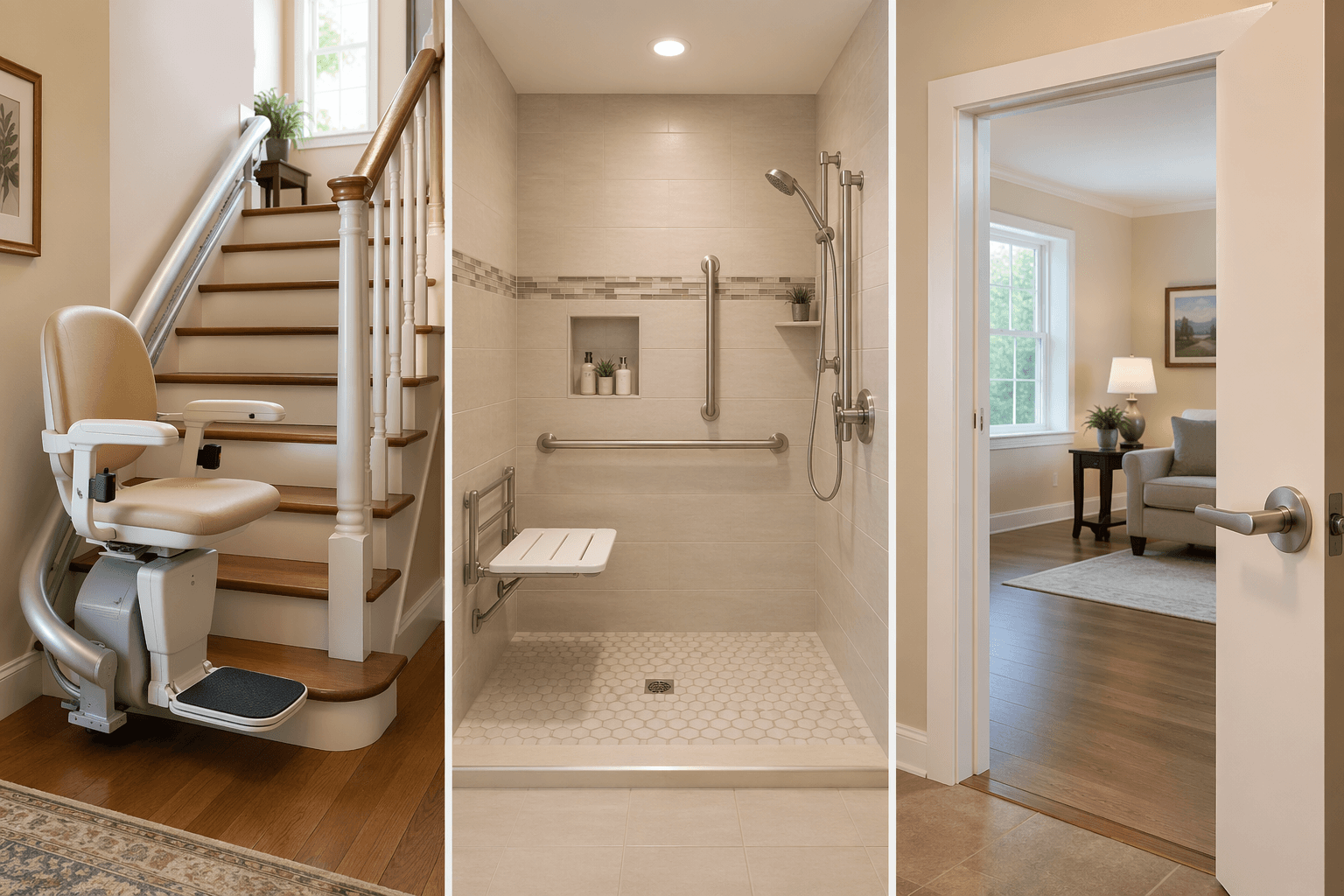
Common modifications that a CAPS can help evaluate and coordinate: stair lift, accessible shower, and widened doorway.
The Tax Deduction Most Articles Miss
If the modifications are medically necessary, they may qualify as a deductible medical expense under IRS Publication 502. You can deduct the amount that exceeds 7.5% of your adjusted gross income. That includes ramps, widened doorways, bathroom modifications, railings, and other changes that accommodate a disability. A CAPS who documents medical necessity in their report makes this deduction easier to claim – they produce the clinical rationale on paper.
Other funding sources include VA HISA/SAH grants for eligible veterans, Medicaid HCBS waivers (state-dependent), and USDA Section 504 loans and grants for very-low-income homeowners. A full breakdown is in our funding guide.
The CAPS credential is a useful signal, but it is not the whole story. The three courses give real design and communication training. The lack of prerequisites means you have to look beyond the letters. The $500 evaluation is a reasonable upfront cost for most projects. The tax deduction is a real, quantifiable benefit that makes the CAPS investment more attractive. None of this changes the core question: How complex is the change? How fast is the condition changing? Do you need someone to manage the whole process? Answer those, and you will know whether the CAPS is the right piece of the puzzle.

Comments
Join the discussion with an anonymous comment.