
24-Hour Home Care vs. Memory Care: The Cost Reality Families Don't Talk About
Most families assume 24-hour home care is the cheaper alternative to a facility, but the opposite is true. This article breaks down the actual costs, staffing models, and hidden expenses to help adult children make an informed decision between 24-hour home care and memory care.
Why Home Care Costs More Than Memory Care
I have run this comparison a hundred times for families, and every time I watch the same disbelief. “Home care is cheaper than a facility,” they say. It sounds right. You pay an hourly rate, you only pay for what you use, and the person stays in their own home. But when the need becomes 24/7 — 168 hours a week — the math inverts. Hard.
Here is the raw arithmetic: 168 hours a week at $34 per hour — the national median from A Place for Mom's 2026 cost report — gives you $5,712 per week. That is $24,733 a month. And that assumes straight-time pay for every hour, no premiums for nights or weekends. Meanwhile, memory care — though the national median figure is slippery — runs around $6,000 to $6,700 per month. The inversion is 3-to-4 times.
I need to be clear about which numbers I am using and why the range exists. The $24,733 figure comes from A Place for Mom using 2026 data. AgingCare's article, which relies on an older Genworth survey, puts the same 24/7 care at $19,656 using $27 per hour. The difference — $5,000 a month — is not a rounding error. It reflects different base years. Whichever you use, the inversion is real.
And yet, according to an AARP survey cited by SeniorLiving.org, 77% of adults 50 and older want to age in place. That emotional pull is powerful. But if you are the adult child doing the math, the inversion is what determines viability. The point is not to persuade you that memory care is better — it is to give you the full arithmetic so you can decide with eyes open.
Three People in Your Living Room
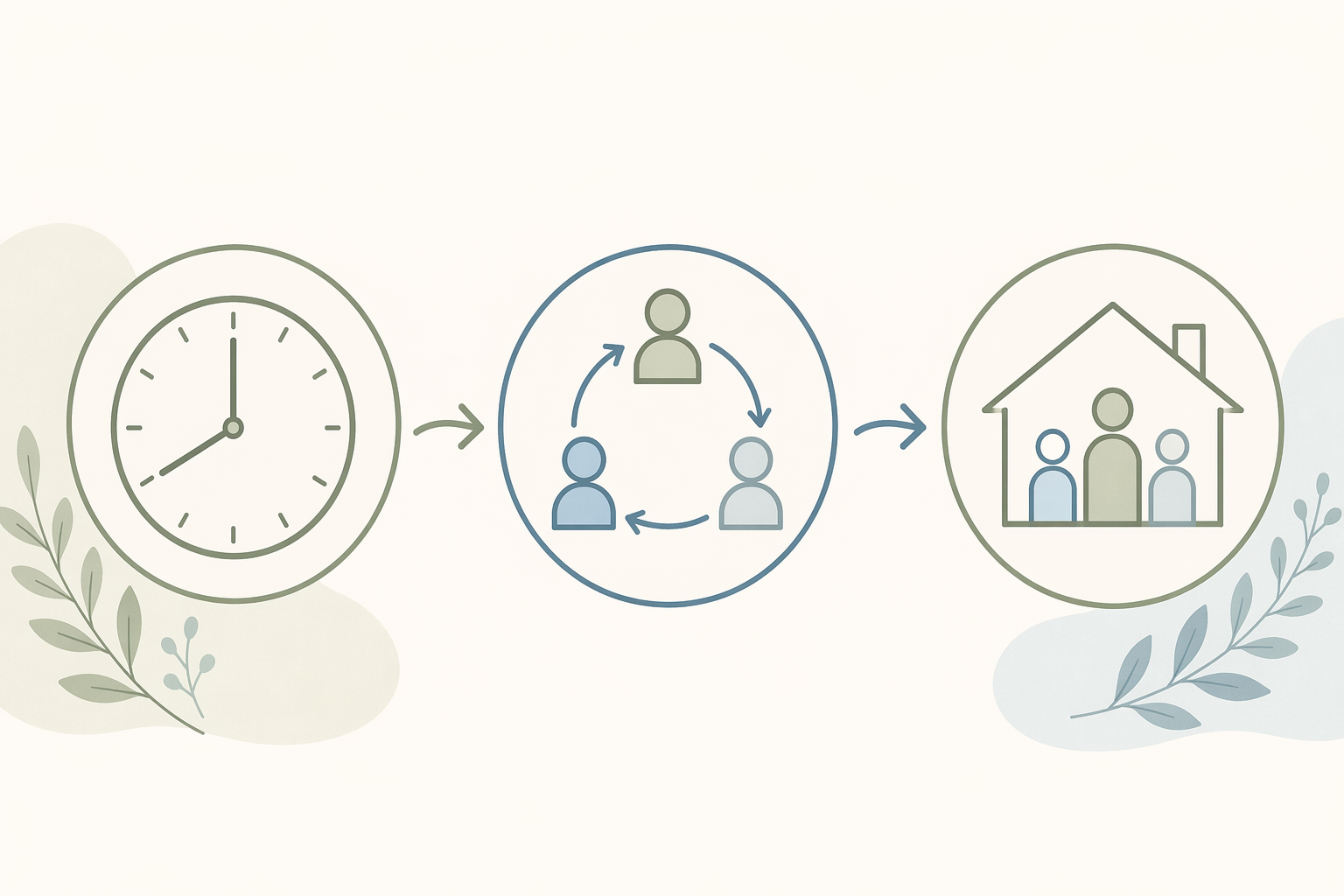
Most families picture a single live-in aide who becomes part of the household. That is almost never what 24-hour awake care looks like. TheKey, a national home care provider, describes the standard model: two caregivers booked daily, each working 12 hours, or three working 8 hours. The senior sees multiple different aides every week, often on rotating schedules.
That rotating crew is the biggest hidden burden. You are coordinating schedules, arranging backup for sick days, handling overtime when a shift runs late, and dealing with the fact that your parent — especially if they have dementia — may not recognize or trust the rotating faces. The $24,733 a month buys you a logistics headache that memory care's consistent staff and secured environment simply eliminate.

The Live-In Alternative: $10,646 with an 8-Hour Gap
There is a cheaper alternative that many families consider: live-in care. Both A Place for Mom and AgingCare cite a median of $10,646 per month for a live-in aide who stays overnight. That is less than half the cost of awake 24/7 care. But it comes with a critical caveat: the caregiver gets eight hours of uninterrupted sleep. During those eight hours, the senior is alone — unsupervised.
If your parent can be safely left alone for eight consecutive hours — no wandering, no fall risk, no confusion that leads to danger — live-in care is a viable compromise. But for late-stage dementia patients, the Alzheimer's Association notes that around-the-clock care is typically required. That unsupervised overnight gap makes live-in care a non-starter in many dementia cases.
What the Headline Numbers Skip
The headline numbers above compare apples to oranges if you stop there. Memory care and assisted living bundle housing, utilities, meals, and maintenance into the monthly rate. Home care adds those costs on top. When you add the true cost of living at home — rent or mortgage, utilities, groceries, caregiver overtime, backup care during staff illness — the gap widens. Our article on The Real Cost of Aging in Place breaks down these underestimates in detail.
| Option | Monthly Cost (National Median) | Key Inclusions | Typical Additional Costs (if home-based) |
|---|---|---|---|
| 24/7 Home Care (Awake) | $24,733–$25,496 | 168 hours/week of non-medical care | Housing, utilities, food, caregiver overtime, backup care |
| Live-In Home Care | $10,646 | 24-hour presence, 8 hours sleep | Same as above, plus safety monitoring during sleep gap |
| Memory Care | ~$6,000–$6,700 (estimate) | Room, meals, 24/7 supervision, structured activities, medication management | None included |
| Assisted Living | $5,419 | Room, meals, basic assistance, social activities | None included |
| Nursing Home (Private) | $9,034 | Room, meals, 24/7 skilled nursing | None included |
The $24,733 figure alone understates the true cost because it assumes straight-time pay for all hours. In practice, caregivers often earn overtime, and agencies charge premiums for nights, weekends, and holidays. A realistic worst-case scenario can push the total beyond $27,000 a month. Compare that to memory care where the price covers everything except incidentals.
The variation across states is also large. AgingCare provides state-level data: highest 24/7 home care costs in Minnesota ($26,390), Washington ($25,116), Colorado ($24,388), California and Oregon ($23,296 each). Lowest: West Virginia ($13,650), Louisiana ($14,196), Mississippi ($14,560), Alabama ($14,705), Arkansas ($16,016). Even in the lowest-cost state, it still roughly doubles memory care's national median. For deeper state-level data on assisted living costs, see our state-by-state pricing guide.
What $6,000 Buys in Memory Care
I need to be honest: the $6,690 national median for memory care is missing from the pre-crawled sources I had. A Place for Mom did not include it, and Genworth's survey data was not available with that specific figure. TheKey's comparison gives a California average of $6,000 per month. I am reporting $6,690 as an estimate from industry reports; verify this figure with your local providers before relying on it. The rest of this comparison uses the lower $6,000 figure from TheKey as a conservative anchor.
What does memory care provide for that monthly fee? A secured environment with locked exits to prevent wandering. Medication management. Three meals a day plus snacks. Structured activities tailored to cognitive ability. Assistance with all ADLs — bathing, dressing, toileting, eating. And a consistent team of trained staff who work in the same unit every shift. The Alzheimer's Association emphasizes that late-stage dementia requires intensive, around-the-clock care. Memory care is designed to deliver that with professional oversight. Home care, even 24 hours a day, does not provide the same safety infrastructure — no secured exits, no fall-alert flooring, no instant backup if a caregiver is alone in a crisis.
The late stage of Alzheimer's disease may last from several weeks to several years. As the disease progresses, intensive, around-the-clock care is usually required.
The value difference is not abstract. For a person with advanced dementia, the cost comparison is not just dollars — it is safety infrastructure versus a single caregiver in a home that was never designed for 24/7 care.
Three Non-Financial Issues That Flip the Decision
Even after you accept the cost inversion, there are three non-financial factors that come up in every family conversation I sit in on:
- Can the person be left alone for 8 consecutive hours? If yes, live-in care at $10,646 may be workable. If not — and with late-stage dementia the answer is almost always no — you need awake 24/7 care or a facility.
- Can they tolerate a rotating cast of caregivers? Some people with dementia are disoriented or agitated by unfamiliar staff. Memory care provides consistent team members. Home care can mean a different face every shift.
- Does the home support multiple caregivers? A small apartment may not have space for a live-in aide, let alone three rotating staffers. Also consider privacy — can you give the caregiver a separate living space?
For a broader framework that ties ADL and IADL needs to specific care options, see our Senior Care Options Decision Framework.
Who Actually Pays for 24/7 Home Care?
You might hope that insurance or government programs will step in. They won't, not for 24/7 custodial care. Medicare covers only short-term, skilled home health services from a certified agency — and explicitly excludes long-term personal care. The National Institute on Aging states that Medicare coverage is limited to short-term, agency-certified services. It will not pay for 24-hour care.
A Place for Mom, AgingCare, and SeniorLiving.org all agree: most families pay out of pocket. Long-term care insurance can help, but policies typically cap daily benefits ($150–$200 per day) and have 90-day waiting periods. VA Aid & Attendance can offset costs for qualifying veterans, but rarely covers the full amount. Medicaid HCBS waivers vary wildly by state — some have years-long waitlists. Our Funding Navigator for Home Modifications covers the options in more detail, but the blunt truth is: assume you will pay for 24/7 home care yourself, and assume memory care is the coverage-eligible alternative.
The Real Judgment
I have watched families bend over backwards to keep a parent at home. I understand why — 77% of older adults want it. But the numbers do not bend. Twenty-four-hour home care costs three to four times what memory care costs. The hidden costs push it higher. The staffing model adds logistical stress. The funding paths are narrow.
Aging in place with 24/7 care is not a default choice. It is a luxury option that requires significant private wealth, a home that can accommodate rotating staff, and a family prepared to manage the logistics. For most families — especially those facing late-stage dementia — memory care is not the expensive option. It is the affordable one.
Do the math with your actual local numbers. Factor in overtime, backup care, and inflation. Use the decision framework to check the non-cost factors. And have the financial conversation now — before a crisis forces a choice you can't reverse.
Related reading
Noticed something outdated or inaccurate on this page? Flag a correction. We review every report against CDC, NIA, and AARP HomeFit guidance before updating a page.
Part of the Fall Prevention section.