
How to Compare Senior Care Options: A Family Decision Framework
This guide helps overwhelmed adult children understand the full spectrum of senior care options — from in-home companion care to memory care and skilled nursing — and provides a structured framework to compare options within the same care level, avoiding the most common and costly mistake families make.
Most families do not begin a senior care search with a clean question. They begin with too many browser tabs, a parent who is no longer managing safely, and a private worry that the promise to keep Dad at home may be colliding with the facts on the ground. The first mistake is usually innocent: comparing every option at once.
That is how a family ends up comparing an assisted living dining room against a memory care staff schedule, or a $30 hourly home-care quote against a facility's monthly fee, or an independent living apartment against a parent who now needs help bathing. Those are not fair comparisons. They are different care levels.
Start by naming the care level. Then compare providers inside that level. That one correction will not remove the grief from the decision, but it can save weeks of touring, arguing, and pricing options that were never built for the parent's actual needs.

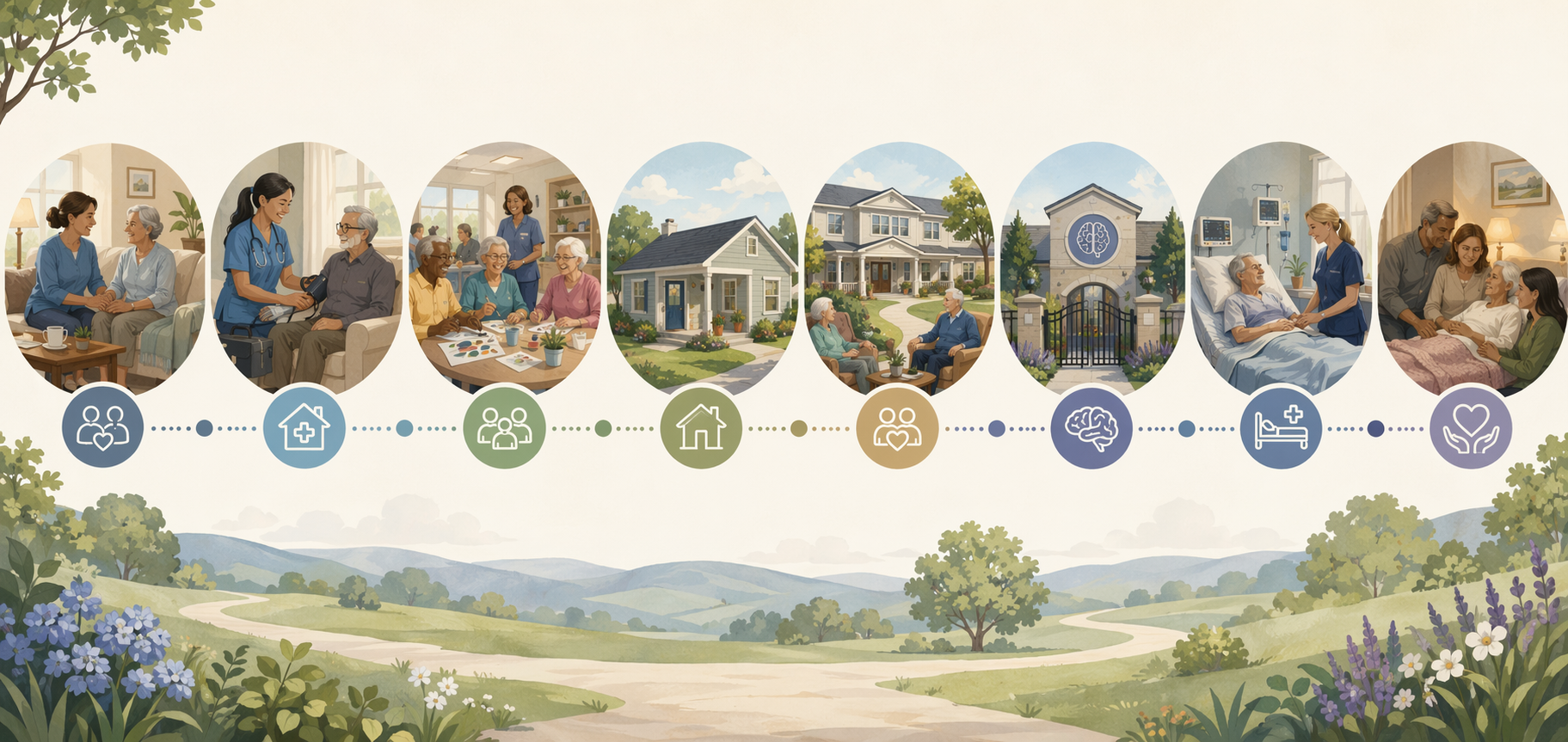
The Care Spectrum Is a Routing Map
About 70% of adults who reach age 65 will need some form of long-term care, but many families still start looking only after a fall, hospitalization, dementia diagnosis, or caregiver breaking point.[1] In crisis mode, the goal is not to master every term in eldercare. The goal is to route the parent to the right lane quickly enough that the next comparison is meaningful.
| Care option | What it is mainly built for | When it is usually the wrong lane |
|---|---|---|
| In-home companion care | Nonmedical help at home: meals, errands, light housekeeping, reminders, supervision, and companionship. | When the parent needs skilled nursing, frequent hands-on transfers, reliable overnight coverage, or dementia-secure supervision. |
| Home health | Short-term or intermittent medical care at home, often after illness, surgery, or hospitalization. | When the main need is ongoing custodial help rather than skilled clinical services. |
| Adult day services | Daytime supervision, activities, meals, and caregiver respite while the parent continues living at home. | When evenings, nights, or weekends are the unsafe periods. |
| Independent living | A senior housing setting with lifestyle features, meals, maintenance, and social access. | When the parent needs regular help with activities of daily living. |
| Assisted living | Residential support with meals, personal care, medication help, and some supervision. | When dementia behaviors, exit-seeking, or medical complexity exceed what the setting can safely manage. |
| Memory care | A dementia-focused residential setting with secured access, structured routines, and staff trained for cognitive impairment. | When the need is primarily short-term rehabilitation or round-the-clock skilled nursing. |
| Skilled nursing | A medical setting for rehabilitation, complex nursing needs, or higher clinical supervision. | When the parent mainly needs social support or light personal care. |
| Hospice | Comfort-focused care for serious illness near end of life, delivered at home or in a facility depending on the situation. | When the family is still pursuing curative or rehabilitative treatment as the main goal. |
The spectrum is useful only if it changes the search. A parent who is lonely and no longer driving may belong in a very different conversation than a parent who is wandering at 2 a.m., refusing medications, and leaving the stove on. Both families may search for "senior care," but they should not be touring the same places first.
Name the Functional Need Before You Price Anything
Families often ask, "What is the best senior care option?" The better first question is, "What has to be safely covered every day and every night?" Price, amenities, location, and preference all matter. They just matter after the care level is clear.
Begin with activities of daily living: bathing, dressing, toileting, transferring, eating, and walking. If a parent only needs meals, transportation, and housekeeping, the search may still sit in the in-home support, adult day, or independent living lane. If bathing is unsafe, transfers require hands-on help, or toileting accidents are increasing, the search has moved into personal care. That may mean assisted living, more intensive home care, or another arrangement depending on supervision and medical needs.
Then look at instrumental activities of daily living: medications, finances, cooking, shopping, phone use, transportation, and appointment management. Medication trouble is especially important. A pillbox missed once is a warning. Repeated missed doses, double dosing, insulin confusion, or refusal of needed medication changes the level of risk.
For dementia, the question is not only memory loss. It is supervision. Is the parent leaving the house unsafely, getting lost, becoming frightened at night, resisting hygiene, calling repeatedly, accusing family members of theft, or needing cueing through basic routines? The Alzheimer's Association describes dementia care options across home care, adult day services, assisted living, memory care, nursing homes, and hospice, but the practical dividing line for many families is whether ordinary support can still keep the person safe.[2]
Do not skip the near future. A parent recovering from a hip fracture may need short-term skilled rehabilitation before returning home. A parent with progressing dementia may be marginally safe this month and unsafe by winter. A parent with heart failure, diabetes, COPD, or several chronic conditions may need a setting that can handle more than companionship. Residential care residents are rarely medically uncomplicated; CDC data reports that only 14% have never been diagnosed with a chronic condition.[3]
A simple working sort helps:
- Mostly independent, lonely, or tired of home maintenance: independent living or added in-home support may be enough.
- Needs help with bathing, dressing, meals, medication reminders, or predictable personal care: compare assisted living against a realistic home-care schedule.
- Has dementia with wandering, exit-seeking, unsafe cooking, overnight confusion, or resistance to care: compare memory care and dementia-capable home care, not generic assisted living.
- Needs wound care, injections, rehabilitation, complex monitoring, or post-hospital therapy: skilled nursing or home health may be part of the plan.
- Has a serious illness where comfort, symptom control, and family support are now the priority: ask about hospice eligibility and where hospice can be provided.
For a fuller ADL and IADL walk-through, the ADL/IADL decision framework can help families turn vague concern into a more specific care-level discussion.
The Comparisons That Waste the Most Time
The wrong comparison usually feels productive. Families are gathering brochures, taking tours, making spreadsheets, and asking about costs. The problem is that the columns do not match.

Assisted Living Amenities vs. Memory Care Staffing
A beautiful assisted living community can still be the wrong setting for a parent with dementia. The question is not whether the lobby is pleasant or the activities calendar is full. The question is whether staff can safely manage wandering, sundowning, exit-seeking, agitation, cueing, bathing resistance, and medication complexity.
This matters because dementia-capable supply is not the same as senior housing supply. AHCA/NCAL statistics report that only 18% of residential care communities offer dedicated dementia wings, while CDC NPALS data reports that more than 42% of residential care patients have Alzheimer's disease or related dementias.[3][4] That gap is exactly why a family should ask about memory care early, locally, and specifically.
If the parent has dementia and supervision risk, ask assisted living communities a direct question: "At what point would you require a transfer to memory care or discharge?" A vague answer is not enough. You need to know whether the community can manage the next stage, not only the move-in stage.
Hourly Home Care vs. the Real Monthly Schedule
In-home companion care often looks less expensive at first glance. Senioridy's 2026 guide places in-home companion care around $25 to $34 per hour.[5] That may be exactly right for a parent who needs a few afternoons of errands, meals, light housekeeping, and companionship.
The math changes when the family quietly needs coverage every day, every evening, or overnight. A Place for Mom's dementia home-care comparison notes that 24/7 home care can reach $10,000 to $15,000 or more per month.[6] At that point, the question is not whether an hourly rate is lower than a facility fee. The question is how many hours are actually required to keep the parent safe, and who covers the gaps when the paid caregiver leaves.
For families caught in that calculation, a dedicated 24-hour home care versus memory care cost comparison is the better next step than another general facility tour.
Independent Living Lifestyle vs. Actual Assistance
Independent living solves isolation, meals, transportation, and home maintenance. It does not usually solve hands-on bathing help, toileting help, medication administration, fall recovery, or dementia supervision. A parent may love the apartment and still be in the wrong care level.
This is where the older adult's preference deserves respect and clarity at the same time. If Mom wants privacy, familiar furniture, and social meals, those preferences matter. They do not erase the need to ask who helps if she cannot get out of bed safely, forgets morning medication, or becomes confused after dinner.
Use Cost Ranges Without Letting Them Choose for You
Cost matters. It can decide whether a plan survives six months or three years. But cost figures should support care-level matching, not replace it.
Memory care is a good example. SeniorLiving.org reports a 2026 national median memory care cost of $8,019 per month and describes memory care as typically 20% to 30% more expensive than standard assisted living.[7] A Place for Mom reports a lower $6,450 monthly memory care figure for 2025.[6] That discrepancy is not something a family can resolve by choosing the more comforting number. It means the family needs source-aware ranges, state and county quotes, and a written list of what each quoted fee includes.
Ask whether the base fee includes bathing help, dressing help, incontinence care, medication management, escorting to meals, laundry, supplies, transportation, activities, and dementia programming. Then ask what triggers a higher care level charge. A monthly price that excludes the care your parent already needs is not the real monthly price.
Payment path matters too. Medicaid acceptance varies by state, program, and provider type, and families should not assume that an assisted living or memory care community will accept Medicaid after private funds are spent. For deeper payment planning, use a focused guide to senior health care costs or paying for home help before relying on a hopeful payment assumption.
The Standard Questions That Make Comparisons Fair
Once the care level is clear, compare only providers that claim to serve that level. Ask every provider the same questions and write down the answers in the same format. This sounds plain, but it changes the room. Families stop reacting to tour energy and start seeing whether the provider can actually carry the care plan.
- Staffing: How many direct-care staff are scheduled on days, evenings, and overnight? Ask for typical staffing by shift, not just a general staffing philosophy.
- Care fit: Which ADLs and IADLs are included at the quoted price, and which trigger added charges?
- Medication support: Are staff reminding, assisting, administering, or coordinating with nurses? Those are different levels of responsibility.
- Dementia training: What training do staff receive, how often is it refreshed, and how does the provider handle wandering, exit-seeking, aggression, refusal of care, and nighttime confusion?
- Overnight coverage: Who is awake, who is on call, and how are falls, wandering, toileting, and agitation handled after midnight?
- Inspection history: What recent deficiencies, complaints, or enforcement actions appear in state inspection records, and what changed afterward?
- Fee escalation: What causes the monthly price to rise, how much notice is given, and how often are care levels reassessed?
- Medicaid and payment continuity: Does the provider accept Medicaid or waiver payment, under what circumstances, and is there a private-pay period requirement?
- Transfer and discharge rules: What needs, behaviors, or medical changes would require the parent to move elsewhere?
- Family communication: Who calls the family after a fall, medication change, behavior change, hospital transfer, or care-plan update?
For home care agencies, translate the same questions into the home setting: who supervises the aides, what happens when an aide calls out, whether dementia training is required, how nights are staffed, whether the agency can increase hours quickly, and which tasks aides are not allowed to perform. Companion care and home health are not interchangeable. One may help with meals and supervision; the other may provide skilled clinical care under a medical plan.
For a facility tour, bring the questions with you. The senior care facility tour checklist is useful after the family has already narrowed the care level. Before that, even a good tour can pull attention toward the wrong details.
When Dementia Is Part of the Decision
Dementia changes the senior care comparison because risk does not always look dramatic in the afternoon. A parent may sound pleasant on the phone, dress neatly for a tour, and insist everything is fine. The same parent may be leaving the house at dawn, refusing showers, misusing appliances, or panicking when a familiar caregiver steps away.
Memory care should enter the discussion when supervision, safety, and behavioral support become central. It does not have to mean an immediate move. It does mean the family should stop comparing generic senior housing as if dementia were a side issue.
The stakes are broader than one household budget. A USC Schaeffer study published June 24, 2026 projected that dementia will cost the United States $818 billion in 2026, including $320 billion attributed to quality-of-life losses.[8] A national estimate cannot tell one family where Mom should live, but it does underline why dementia care is not just a housing choice with memory loss attached. Poor fit can show up as preventable crises, repeated moves, exhausted caregivers, and care that gets more expensive because it was delayed or mismatched.
If dementia is progressing, compare memory care communities with the same seriousness families often reserve for hospitals. Ask about secured access, outdoor space, staff training, bathing approaches, activities for different stages, fall response, antipsychotic medication practices, family meetings, and what happens when the resident needs more hands-on care. A cheerful activity room is a plus. It is not the whole answer.
A Practical Sequence for the Family Meeting
When siblings, spouses, and the older adult are all involved, the conversation can scatter quickly. One person wants home care. One wants the closest facility. One wants the least expensive option. One is still trying to preserve how things used to be. Use the meeting to settle the care level before debating providers.
- List what help is needed on a normal day: bathing, dressing, meals, mobility, toileting, medications, transportation, and household tasks.
- List what happens on the worst days: falls, confusion, wandering, agitation, missed medication, unsafe cooking, nighttime calls, or caregiver absence.
- Identify who is currently covering each risk and whether that person can continue doing it.
- Name the likely care level for the next six to twelve months, not only the most hopeful version of today.
- Compare only options that can serve that level, using the same questions and the same cost categories.
In a crisis after a fall, diagnosis, or hospitalization, the timeline may be too short for a full comparison. In that case, the family still needs the same sequence, just compressed. The crisis-to-clarity guide is a better fit when discharge planning or immediate safety is driving the clock.
The older adult's voice belongs in the process. Preferences about home, privacy, food, faith community, pets, language, neighborhood, and daily rhythm are not decorations. They are part of whether a plan can actually work. But preference has to sit beside risk. If the parent wants to stay home and the only available caregiver is already missing work, sleeping in fragments, and handling unsafe nights alone, the family has to count that cost too.
The Point Where You Are Ready to Compare
A family is ready to compare senior care options when it can say, plainly, what level of help the parent needs now, what is likely to increase soon, and which options are no longer fair comparisons. That may mean comparing three memory care communities, two dementia-capable home-care agencies, or assisted living against a realistic home-care schedule. It does not mean comparing every attractive brochure within driving distance.
Once the care level is named, the noise drops. The family can tour with sharper eyes, price the actual services needed, ask about staffing and discharge rules, and decide with fewer avoidable regrets.
References
- 50 Long-Term Care Statistics: The Real Cost of Aging in 2026, Amplify/CDC.
- Alzheimer's & Dementia Care Options, Alzheimer's Association.
- Residential care patient comorbidity statistics, CDC NCHS NPALS data brief.
- Facility statistics on dementia-wing availability, AHCA/NCAL.
- Comparing Senior Care Options: Your 2026 Guide, Senioridy, 2026.
- Memory Care vs. Home Care for Dementia: 5 Key Differences, A Place for Mom, 2026.
- 2026 Average Memory Care Costs by State, SeniorLiving.org, 2026.
- Dementia Will Cost the U.S. $818 Billion in 2026, USC Schaeffer, June 24, 2026.
Related reading
Noticed something outdated or inaccurate on this page? Flag a correction. We review every report against CDC, NIA, and AARP HomeFit guidance before updating a page.
Part of the Fall Prevention section.