
When Is It Time for a Senior Citizen Home? A Stage-Based Guide for Dementia Caregivers
This guide helps spousal and adult-child caregivers of a loved one with dementia recognize concrete, stage-based signs that home care is no longer enough. It matches each dementia stage to the right facility type, provides a 6-month planning timeline, and offers a financial reality check to support a timely, informed transition.
Why Timing Matters: The Cost of Waiting Too Long
Most families caring for a loved one with dementia wait until a crisis — a fall that requires an ER visit, a wandering episode where the person is found miles from home, or the caregiver's own health collapsing — before they begin searching for a residential facility. That pattern is understandable. The decision carries emotional weight that makes proactive planning feel almost impossible. But the cost of waiting is measurable, and it is borne by both the person with dementia and the caregiver.
When a transition happens under crisis conditions, the family typically has days, not months, to choose a facility. That means touring only one or two communities, accepting whatever bed is available, and paying out of pocket because there was no time to apply for Medicaid or VA benefits. The result is often a poor fit — a facility that cannot manage the person's behavioral symptoms, leading to a second move within months.
There is also a direct safety cost. According to the Alzheimer's Association, six in ten people with dementia will wander at some point, and if they are not found within 24 hours, up to half will suffer serious injury or death. A home environment, even with alarms and locks, cannot match the security infrastructure of a dedicated memory care community.
Eight Concrete Signs It's Time for a Senior Citizen Home
The signs below are not abstract warnings. They are observable, measurable changes that indicate the current care arrangement is no longer sufficient. Each sign is tied to a specific dementia stage where possible, because the same behavior means different things at different points in the disease.
- Unsafe wandering or getting lost. This is the most dangerous dementia behavior and the single strongest signal that home care is no longer adequate. In middle-stage dementia, wandering becomes common. If the person has left the house and been unable to find their way back, or if you have installed locks and alarms and they still manage to leave, a secure memory care environment is likely necessary. Approximately 88% of memory care communities are secure facilities with alarmed exits and keypad entries.
- Complete dependence on others for activities of daily living (ADLs). When the person can no longer bathe, dress, toilet, or eat without full physical assistance, the demands on a single family caregiver become unsustainable. In late-stage dementia, this level of dependence is expected, and a skilled nursing or memory care setting with 24-hour awake staff is typically required.
- Caregiver burnout or health decline. If you are experiencing disrupted sleep, anxiety, depression, or physical exhaustion to the point where your own health is suffering, that is not a personal failure — it is a structural problem with the care arrangement. Caregiver stress is one of the most common reasons families cite for transitioning to a facility, and it is a valid one.
- Aggression or agitation that is unsafe for the caregiver. In middle and late-stage dementia, some individuals develop physical aggression, hitting, kicking, or biting during care tasks like bathing or dressing. If you are being injured, or if you are afraid of the person you are caring for, that is a clear sign that the environment needs to change.
- Significant weight loss or decline in hygiene. Unintended weight loss can indicate that the person is not eating enough, possibly because they forget to eat, cannot use utensils, or have difficulty swallowing. Poor hygiene — unwashed hair, soiled clothing, body odor — suggests that bathing and toileting assistance is being resisted or missed. Both are signs that the level of supervision at home is insufficient.
- Social isolation and withdrawal. Dementia can shrink a person's world dramatically. If the person no longer engages with visitors, refuses to leave the house, or spends most of the day sleeping or staring, a memory care community with structured activity programming may provide the social stimulation that home care cannot.
- Unsanitary or unsafe home conditions. If the home has become cluttered with soiled linens, spoiled food, or hoarded items, or if the person is leaving the stove on, flooding the bathroom, or falling repeatedly, the environment itself has become a hazard. This is a sign that the caregiver cannot keep up with the demands of maintaining a safe home.
- A persistent 'gut feeling' that something is wrong. Caregivers who live with the person every day often sense the decline before it becomes measurable. If you find yourself constantly anxious, checking on the person multiple times a night, or feeling that the situation is unsustainable, trust that instinct. It is usually correct.
Matching Dementia Stage to Facility Type
Not all senior living communities are equipped to care for someone with dementia. The key is matching the facility type to the person's current stage of the disease. The table below provides a stage-based framework for choosing the right setting.
| Dementia Stage | Characteristics | Appropriate Facility Type | Key Considerations |
|---|---|---|---|
| Early stage | Mild cognitive impairment; independent with ADLs; may need reminders for medications or appointments | Independent living or assisted living with basic support | Look for communities that offer medication management and can accommodate future decline. Some assisted living communities allow residents to age in place with added services. |
| Middle stage | Needs assistance with multiple ADLs; wandering, agitation, or sundowning may be present; requires supervision | Memory care (dedicated unit or stand-alone) or assisted living with memory care on-site | About 80% of assisted living communities offer memory care on-site, allowing residents to transition levels without moving to a new campus. |
| Late stage | Complete dependence for all ADLs; may be bed-bound; needs 24/7 nursing care; difficulty swallowing | Skilled nursing facility or memory care with 24/7 licensed nursing | Memory care communities typically have a registered nurse or licensed nurse on the floor 24/7. Skilled nursing is appropriate when medical needs exceed what memory care can provide. |
For a deeper comparison of assisted living and memory care, see our guide Assisted Living vs. Memory Care: A Decision Framework for Dementia Caregivers. If you are currently in assisted living and wondering whether it is time to move to a memory care unit, read When to Move From Assisted Living to Memory Care: 10 Signs It's Time.
The 6-Month Planning Timeline: From Research to Move-In
One of the most common regrets families express is that they did not start the process sooner. Finding and touring memory care residences, finalizing legal documents, and overseeing the move can take an average of at least 2 months, with 3 to 4 months being more typical. Arranging Medicaid or VA benefits can take 6 months or longer. The timeline below is designed to help you start early enough to make informed decisions.
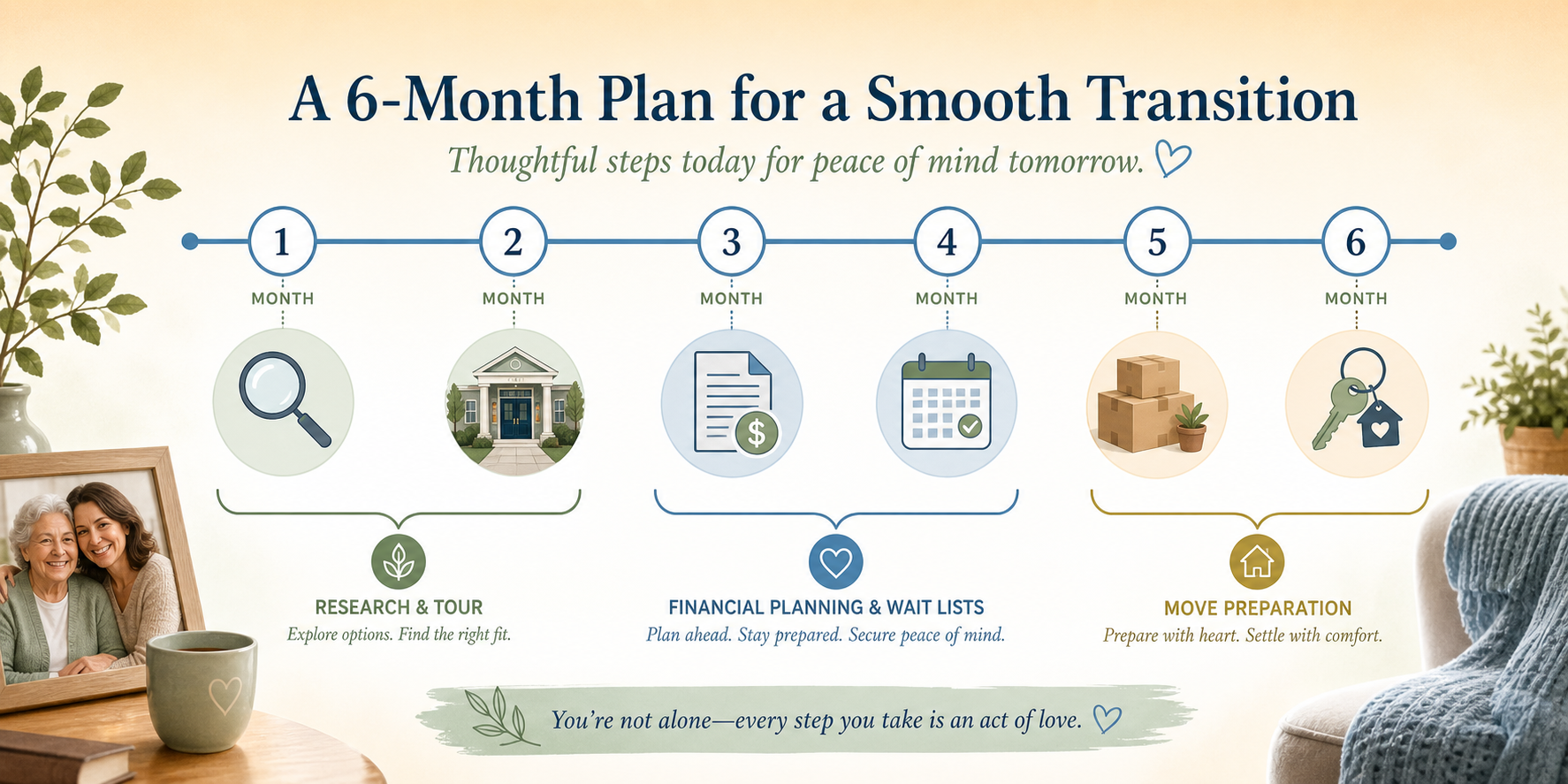
Months 1–2: Research and Tour
- Identify all potential facilities within a reasonable radius. Include memory care communities, assisted living with memory care on-site, and skilled nursing facilities.
- Call each facility and ask about availability, wait lists, and whether they accept Medicaid. Some memory care communities have wait lists that are several months long.
- Schedule tours. Visit at least three facilities. Make at least one unannounced visit to see the community during a typical day, not a scheduled tour.
- Use the tour checklist in the next section to evaluate each facility consistently.
Months 3–4: Financial Planning and Wait Lists
- Gather financial documents: bank statements, retirement accounts, property deeds, and income records.
- If the person may qualify for Medicaid, begin the application process. This can take 3 to 6 months depending on the state. Consult an elder law attorney if the situation is complex.
- If the person is a veteran or surviving spouse, apply for VA Aid and Attendance benefits. The VA application process can take 6 months or longer.
- Place the person's name on wait lists for the top one or two facilities. Ask about deposit requirements and refund policies.
Months 5–6: Move Preparation
- Notify the current home care agency, if applicable, and arrange for the discontinuation of services.
- Pack a small number of familiar items: photographs, a favorite blanket, familiar clothing. Too many belongings can be disorienting.
- Plan the move day carefully. People with dementia often experience significant distress during transitions. Consider moving during the person's best time of day, and have a familiar family member present throughout.
- Prepare yourself emotionally. The first few weeks in a new facility are often difficult. It is normal for the person to resist, ask to go home, or show increased confusion. Give the adjustment at least 30 days before evaluating whether the facility is a good fit.
What to Look for on Tours: A Memory Care Checklist
Touring a memory care community is not the same as touring an assisted living facility. You are evaluating whether the environment, staff, and programming are specifically designed for people with dementia. Use the checklist below to assess each facility consistently.
Staffing and Training
- What is the staff-to-resident ratio? A common ratio in memory care is one caregiver to five or six residents. Lower ratios (1:4 or better) indicate more individualized attention.
- Do staff members receive specialized dementia care training? Ask whether training covers managing behaviors like distress, anger, and aggression. According to A Place for Mom, 79% of memory care communities provide specialized memory care training for staff.
- Is there a registered nurse or licensed nurse on the floor 24/7? Most memory care communities have nursing coverage around the clock.
- What is the staff turnover rate? High turnover is a red flag. It means residents are constantly adjusting to new caregivers, which is particularly difficult for someone with dementia.
Security and Environment
- Are the exits alarmed and secured with keypad entries? Approximately 88% of memory care communities are secure facilities. If the community is not secure, it is not appropriate for someone who wanders.
- Is there an enclosed courtyard or outdoor space that residents can access safely? About 78% of memory care communities offer an enclosed courtyard.
- Is the design dementia-appropriate? Look for circular hallways (which prevent dead ends and reduce confusion), color-coded walls or doors (to help residents find their rooms), and memory boxes outside each room with personal items.
- Is the facility clean and free of strong odors? Odor is a common issue in memory care communities that are understaffed for toileting assistance.
Programming and Engagement
- What types of activities are offered? Look for structured daily programming that includes reminiscence therapy (62% of memory care communities offer this), art classes (76%), and fitness classes (80%).
- Are activities designed for the cognitive level of the residents? A person in middle-stage dementia cannot participate in the same activities as someone in early stage. Ask how activities are adapted.
- Are residents engaged during your visit? If you see residents sitting alone in hallways or staring at walls with no staff interaction, that is a warning sign.
Meals and Medical Care
- Can the facility accommodate special diets, pureed foods, or assisted feeding? In late-stage dementia, swallowing difficulties are common, and the facility must have staff trained to handle this.
- How are medical needs managed? Ask whether a physician visits regularly, how medication is administered, and how the facility handles emergencies.
- What is the policy on family involvement? Can you visit at any time? Are family members encouraged to participate in care planning?
| Evaluation Area | Key Questions to Ask | What to Look For |
|---|---|---|
| Staff training | Do staff receive dementia-specific training? What is the staff-to-resident ratio? | 1:5 or 1:6 ratio; evidence of ongoing training in behavior management |
| Security | Are exits alarmed? Is the community secure? Is there an enclosed outdoor area? | Alarmed exits, keypad entries, secure courtyard (88% of memory care communities) |
| Activities | What types of activities are offered daily? Are they adapted for different cognitive levels? | Reminiscence programs, art classes, fitness classes; residents actively engaged |
| Medical care | Is a nurse on-site 24/7? How are medications managed? Can the facility handle swallowing difficulties? | 24/7 licensed nursing; clear medication administration protocol |
| Environment | Is the facility clean? Is the design dementia-appropriate? | Circular hallways, color-coded walls, memory boxes, no strong odors |
Financial Reality Check: Comparing Home Care, Memory Care, and Nursing Home Costs
One of the most surprising findings for families is that memory care is often more affordable than round-the-clock home care. When a person with dementia needs 24-hour supervision, the cost of home care adds up quickly because it requires multiple shifts of paid caregivers. The table below compares 2026 national median costs across care settings.
| Care Setting | National Median Monthly Cost (2026) | Source |
|---|---|---|
| 24/7 home care (168 hours/week) | ~$23,839 | A Place for Mom (2025 data) |
| Memory care | $6,690 – $8,019 | A Place for Mom ($6,690); SeniorLiving.org ($8,019) |
| Assisted living | $5,419 – $6,313 | A Place for Mom ($5,419); SeniorLiving.org ($6,313) |
| Nursing home (semi-private room) | $9,277 – $9,581 | A Place for Mom ($9,277); U.S. News ($9,581) |
| Nursing home (private room) | $10,646 – $10,798 | A Place for Mom ($10,646); U.S. News ($10,798) |
The key takeaway: if the person with dementia needs 24-hour supervision, memory care at $6,690 to $8,019 per month is significantly less expensive than 24/7 home care at approximately $23,839 per month. Even standard full-time home care (44 hours per week) costs about $6,292 per month, which is comparable to memory care — but 44 hours per week is not enough for someone who cannot be left alone.
Payment Sources: What Covers What
Understanding how to pay for care is one of the most complex parts of the transition. Here is a brief overview of the major payment sources:
- Medicare does not cover the cost of residential care in assisted living, memory care, or nursing homes. It only covers short-term skilled nursing care after a hospital stay (up to 100 days).
- Medicaid covers nursing home care for those who qualify financially. Coverage for assisted living and memory care varies significantly by state. Some states offer Medicaid waivers that cover memory care costs, but wait lists can be long. Check your state's Medicaid website for specific eligibility rules.
- VA benefits. Veterans and surviving spouses may qualify for VA Aid and Attendance benefits, which can be used toward memory care costs. The application process can take 6 months or longer.
- Private pay. Most families initially pay out of pocket, often by selling a home or using retirement savings. Long-term care insurance, if the person has a policy, may cover some memory care costs.
For a detailed breakdown of payment options, see our guide How to Pay for Senior Care in 2026: A Guide to Medicare, Medicaid, and Other Funding Sources. For a deeper dive into long-term care costs and planning, read The Real Cost of Long-Term Senior Care: Why Most Families Get It Wrong and How to Plan.
Emotional Preparation: From Caregiver to Family Member
The decision to move a loved one with dementia into a facility is one of the most emotionally difficult choices a caregiver will make. It is common to feel guilt, grief, and a sense of failure — even when the decision is clearly the right one for everyone's safety and wellbeing.
It may help to reframe the transition. You are not abandoning your role as a caregiver. You are changing the nature of that role. Before the move, you were a hands-on caregiver responsible for 24-hour supervision, personal care, medication management, and safety. After the move, you become a family member who visits, advocates, and provides emotional connection. That is still a vital role — and one that is sustainable over the long term.
Here are a few strategies that can help with the emotional transition:
- Involve the person early, if possible. In early-stage dementia, the person may still be able to participate in touring facilities and expressing preferences. This can reduce feelings of betrayal later.
- Acknowledge the guilt without letting it drive decisions. Guilt is a natural response, but it should not prevent you from making a decision that keeps your loved one safe. Talk to other caregivers who have been through this process. You are not alone.
- Give yourself and your loved one time to adjust. The first month in a new facility is often the hardest. The person may resist, ask to go home, or show increased confusion. This does not necessarily mean the facility is wrong. Give the adjustment time.
- Plan for your own recovery. Caregiver burnout is real, and it does not disappear the day the move happens. Use the first few weeks after the transition to rest, attend to your own health, and reconnect with parts of your life that caregiving may have pushed aside.
For more on managing the emotional side of caregiving, explore our Caregiver Wellbeing section, which covers burnout, guilt, and difficult conversations. If you are weighing home care against facility care, our guide Home Care, Assisted Living, or Memory Care? A Staged Decision Guide for Dementia Caregivers may help clarify your options.
Related reading
Noticed something outdated or inaccurate on this page? Flag a correction. We review every report against CDC, NIA, and AARP HomeFit guidance before updating a page.
Part of the Fall Prevention section.