
Caregiver decision guide
Is blood flow restriction training safe and effective for seniors?
This article helps family caregivers evaluate whether blood flow restriction training (BFRT) is a safe, effective option for an aging parent who needs to build strength but cannot tolerate heavy weights. It explains the evidence for muscle and functional gains, safety considerations including fall risk, and the importance of professional supervision.
The hard part is not convincing an older parent that strength matters. Most families learn that quickly after a knee replacement, a painful arthritis flare, a slow walk across a parking lot, or the first time getting out of a chair takes two tries. The harder part is finding a way to build strength when heavy weights are unrealistic.
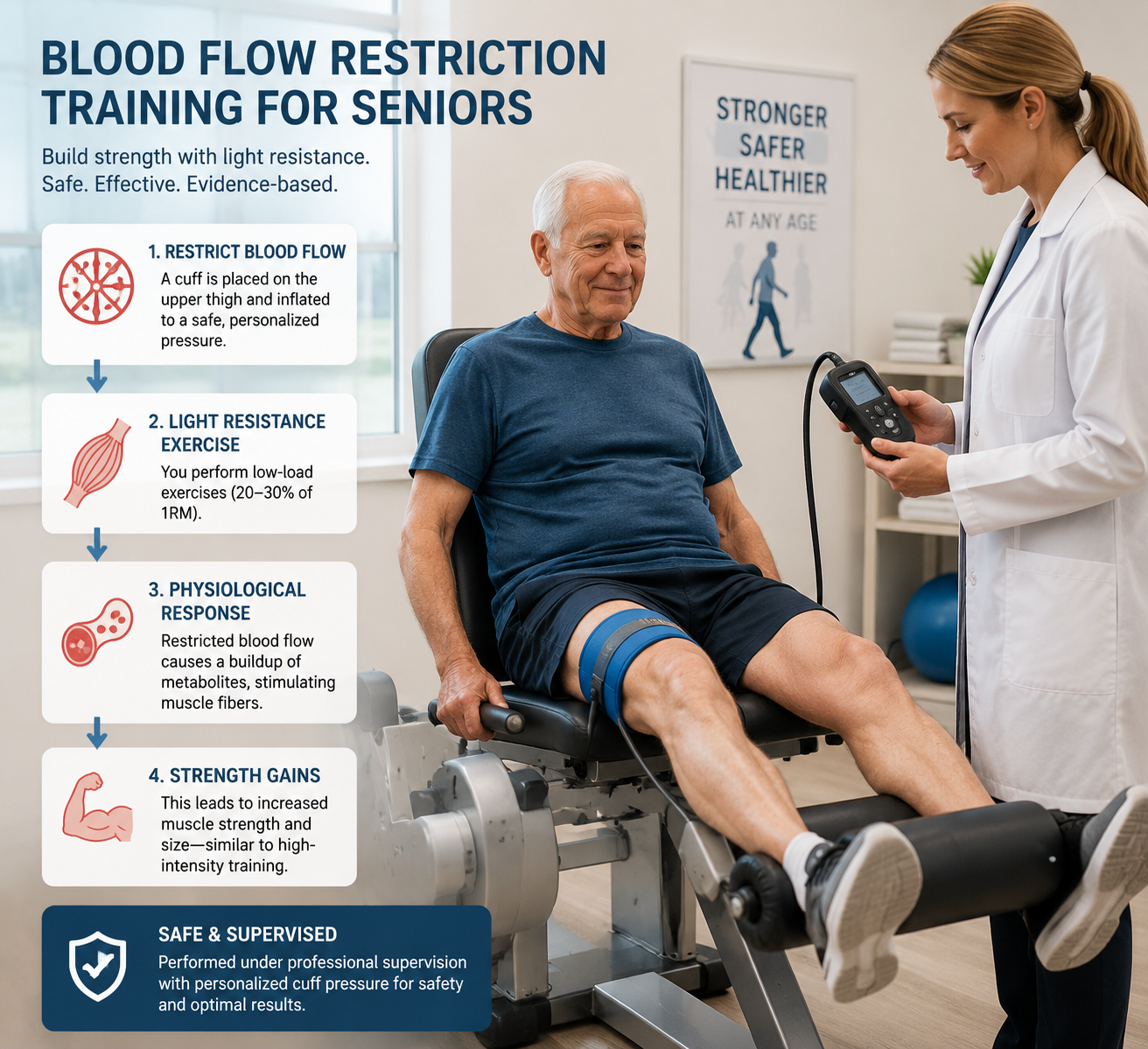
That is where blood flow restriction training for seniors has started to get attention. It is not a magic shortcut, and it is not something to improvise at home with a strap. In supervised settings, BFRT usually means doing very light exercise while a specialized cuff is placed high on the arm or leg to partially restrict blood flow. Many older-adult protocols use loads around 20–40% of one-repetition maximum, far below the 70–80% loads often used in traditional heavy resistance training studies.[1][2]
The practical appeal is obvious: if a parent needs stronger legs but cannot tolerate heavy joint loading, BFRT may let the muscle work hard while the knee, hip, back, or surgical area deals with a lighter load. The evidence supports that possibility. The safety question is just as real. BFRT can be effective for some older adults, but it belongs in a screened, supervised, individualized rehab plan—not in a shopping cart.
Why light loads can still matter
A normal strength plan often asks the body to lift enough weight to challenge the muscle. For an older adult with pain, frailty, fear of falling, or a recent operation, that demand can become the barrier. BFRT changes the tradeoff: the external load stays low, but the restricted blood flow helps create a muscle-building stimulus that would otherwise usually require heavier work.
Several reviews report that low-load BFRT can produce strength gains in older adults that are comparable to high-load resistance training, while using much lighter loads.[1][2][3] That does not mean every senior gets the same result, and it does not mean light movement with a cuff is automatically enough. It means BFRT is a legitimate clinical option when heavy resistance is the thing the person cannot do.
The numbers are meaningful because they connect to everyday function. A review on BFRT in older adults reported quadriceps cross-sectional area increases of about 5–8% and leg press one-repetition maximum improvements of about 15–35% over 6–12 weeks.[1] For a caregiver, stronger quadriceps are not an abstract outcome. They show up in sit-to-stand transfers, stairs, safer walking, and less reliance on someone’s arm when getting up from a low chair.
Walking-based BFRT has also been studied. Older adults using BFRT walking showed thigh muscle volume increases of roughly 3–4%, isokinetic strength improvement around 22%, and aerobic capacity gains.[1] Functional test improvements have also been reported, including 9–21% gains in Timed Up and Go and 6-minute walk performance in systematic review findings.[3]
Those measures matter because fall prevention is not only about balance drills. Strength, walking capacity, reaction, and confidence all feed into whether a parent can move safely through the day. BFRT should not replace a broader fall prevention plan, but for a senior who cannot load heavily, it may help fill a difficult strength gap.
The best candidates are usually the ones who cannot simply lift heavier
The strongest case for BFRT is not a healthy older adult who could already tolerate a normal progressive resistance program. It is the parent whose therapist wants strength work but has to respect pain, joint irritation, surgical precautions, or low tolerance for heavy loads.
A knee replacement waiting room is one example. AAOS Now reported in 2023 that preoperative BFRT in older adults awaiting total knee replacement produced gains in quadriceps strength, physical function, and quality of life, with benefits that carried over after surgery.[4] That kind of use makes clinical sense: the goal is not to turn a patient into an athlete, but to preserve or improve enough strength to enter surgery and recovery in better condition.
A case report is a smaller kind of evidence, but it can still make the situation easier to picture. One report described a 91-year-old patient with sarcopenia who trained with BFRT at 30% of one-repetition maximum and had a 17.9% grip strength increase and a 4.6% isokinetic knee extension increase over 3 months.[1] That is not proof that BFRT works for every very old adult. It is a reminder that advanced age alone is not the whole decision.
For many families, the more useful question is not “Is my parent too old?” It is “Has someone qualified screened the risks, chosen the pressure, selected the exercise, and watched how my parent responds?”
Safety depends on screening before the cuff ever goes on
BFRT sounds simple from the outside: cuff, light exercise, repeat. In older adults, the safety work starts earlier. A clinician should ask about clotting history, vascular disease, blood pressure, cardiovascular disease, medications, recent surgery, neurological symptoms, skin integrity, and the reason the parent is weak in the first place.
Reviews identify a history of thrombosis or deep vein thrombosis, severe uncontrolled hypertension, and serious cardiovascular conditions as major contraindications or reasons for medical caution.[2][3] These are not small details. A parent who “just needs to get stronger” may also be the parent with atrial fibrillation, prior clotting, uncontrolled blood pressure, vascular disease, or a complicated medication list.
Reported adverse event rates are low in the broader BFRT literature, with one meta-analysis reporting an adverse event rate around 0.05%, but that figure should be read carefully because underreporting is possible and older adults with sarcopenia or multiple chronic conditions are not always well represented.[2] Low risk in published studies is reassuring; it is not permission to skip screening.
| Situation | What it means for a caregiver |
|---|---|
| Parent cannot tolerate heavy strengthening because of knee, hip, back, arthritis, frailty, or post-surgical limits | BFRT may be worth discussing with a physical therapist if medical screening is appropriate. |
| Parent has a history of thrombosis, DVT, severe uncontrolled hypertension, or serious cardiovascular disease | Do not treat BFRT as a routine exercise choice; ask the clinician whether it should be avoided or medically cleared first. |
| Parent has recently fallen or has major balance problems | Address fall risk and supervision first; BFRT may still be possible, but the environment matters. |
| Parent is interested in buying cuffs for home use | Pause. The key safety features are assessment, pressure individualization, exercise selection, and monitoring. |
The fall-risk question deserves a careful answer
Families are right to be sensitive about balance. A strength tool that makes walking shakier during the session could create exactly the problem everyone is trying to avoid.
In December 2025, Murdoch University reported a small study of 10 older adults, average age 73, finding that blood flow restriction cuffs worsened acute walking balance.[5] The result should not be inflated into “BFRT causes falls,” because the study was very small and measured immediate balance effects, not long-term fall outcomes. The lead author also noted that long-term training may enhance balance.[5]
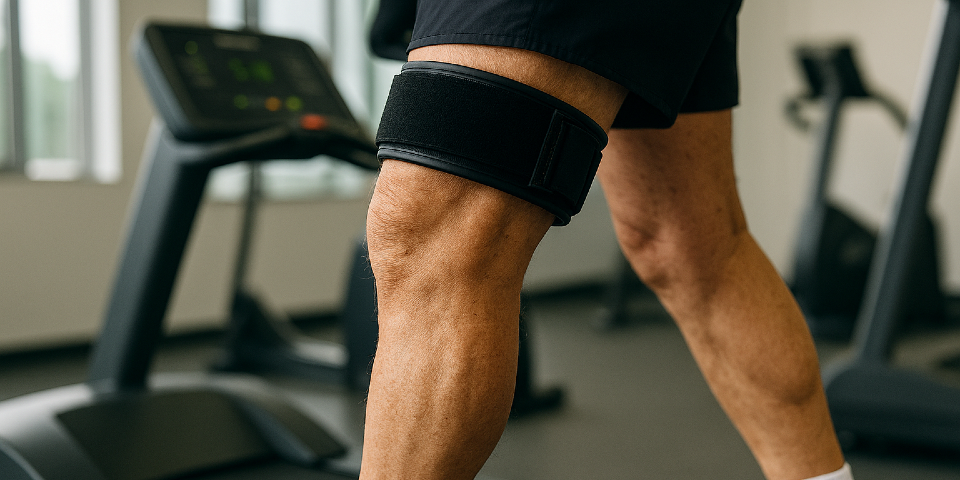
Still, it names a practical concern: the session itself has to be set up so a moment of unsteadiness does not become a fall. That means close supervision, stable surfaces, appropriate exercise choice, and no casual walking around a clinic with cuffs inflated unless the therapist has decided it is safe.
If a parent has already fallen, BFRT should not be the first isolated question. It belongs inside a broader recovery and risk review that looks at injuries, medications, vision, footwear, home hazards, confidence, and assistive devices. Families in that situation may need a wider post-fall care plan before adding a new training method.
Pressure settings are not a minor technical detail
One of the easiest ways to misunderstand BFRT is to think the cuff pressure is just a preset number. It should not be. The same pressure can affect different people differently depending on limb size, cuff width, blood pressure, vascular status, and the exact device being used.
A scoping review of BFRT protocols for elderly populations describes individualized cuff pressure based on arterial occlusion pressure as the gold-standard approach, commonly using about 40–80% of arterial occlusion pressure rather than a one-size-fits-all setting.[6] That distinction is one of the main reasons home experimentation is a bad fit for older adults, especially those with complex health histories.
A good session should look more like a clinical intervention than a fitness hack. The professional should explain why BFRT is being considered, check contraindications, measure or estimate the appropriate occlusion pressure with the right equipment, choose low-load exercises that match the parent’s goals, watch symptoms during the session, and stop or adjust if pain, numbness, unusual shortness of breath, dizziness, skin changes, or concerning discomfort appears.
For a parent with balance problems, the setup matters as much as the cuff. Seated or supported exercises may be safer than standing work at first. If walking is part of the plan, the therapist should decide whether a gait belt, parallel bars, close guarding, or a mobility aid is needed. Families unsure whether a walker or rollator fits the situation can use a mobility aid comparison for balance problems as background, but the device decision should still be individualized.
What to ask before agreeing to BFRT
A caregiver does not need to become a BFRT technician. The useful role is to ask enough questions to know whether the clinic is treating it with the care it deserves.
- What is the specific goal: quadriceps strength, walking tolerance, sit-to-stand ability, surgical preparation, or general conditioning?
- What medical screening has been done for clotting risk, blood pressure, cardiovascular disease, vascular disease, and recent health changes?
- How will cuff pressure be individualized, and will arterial occlusion pressure be used?
- Will the first sessions be closely supervised, and what symptoms would make the therapist stop?
- How will progress be measured: strength, pain, walking distance, Timed Up and Go, 6-minute walk, transfers, or daily function?
- How does BFRT fit with balance training, home safety, and ordinary strengthening exercises?
That last question keeps BFRT in its proper place. A parent who improves leg strength still needs a safe home setup, appropriate footwear, vision care, medication review when indicated, and exercises that match their actual fall risks. For families working on home safety alongside rehab, a CDC STEADI-style fall prevention checklist can help organize the non-gym parts of the problem.
For seniors who are medically cleared and able to do conventional movement, BFRT may sit beside other progressive balance and strengthening work rather than replace it. A structured balance and strength progression can give families a clearer picture of what broader fall-prevention exercise often includes.
A reasonable bottom line
Blood flow restriction training is not fringe, and it is not automatically safe. The best evidence supports it as a useful way for some older adults to gain strength and muscle using low loads, especially when heavy resistance training is limited by pain, joint disease, frailty, or surgical recovery. The same evidence also points toward the conditions that make it responsible: screening, supervision, individualized cuff pressure, and a plan that measures function rather than just completing sessions.
If a parent is medically complex, has a clotting history, has severe cardiovascular or blood pressure concerns, recently fell, or has significant balance problems, the next step is not buying cuffs. It is asking a physical therapist or clinician whether BFRT is appropriate, what risks apply to that parent, and how the session would be performed safely.
References
- Application and progress of blood flow restriction training in improving muscle mass and strength in the elderly
- Blood flow restriction training: a new approach for preventing and treating sarcopenia in older adults, Frontiers in Physiology, 2025
- Does Blood Flow Restriction Therapy in Patients Older Than Age 50 Result in Muscle Hypertrophy, Increased Strength, or Greater Physical Function? A Systematic Review
- Study Explores Benefits of Blood-flow Restriction Training in Older Patients Awaiting Knee Replacement, AAOS Now, 2023
- Blood flow restriction cuffs a fall risk for older adults, Murdoch University, December 2025
- Exploring Blood Flow Restriction Exercise Protocols for Elderly Populations: A Scoping Review
Questions to bring to a clinician or OT
This is not medical, legal, or a family's final decision — only a framework. Bring these questions to a clinician, occupational therapist, or your local Area Agency on Aging.
Find Local HelpRelated reading
Noticed something outdated or inaccurate on this page? Flag a correction. We review every report against CDC, NIA, and AARP HomeFit guidance before updating a page.