
Caregiver decision guide
Passive Monitoring vs. Wearable PERS: What Family Caregivers Need to Know About the Technology Gap
For long-distance caregivers whose aging parent resists wearing a medical alert pendant, passive monitoring offers a compelling alternative. This article compares the two approaches — explaining the compliance gap, how passive sensors work, what they detect that pendants miss, and a decision framework for choosing the right system.
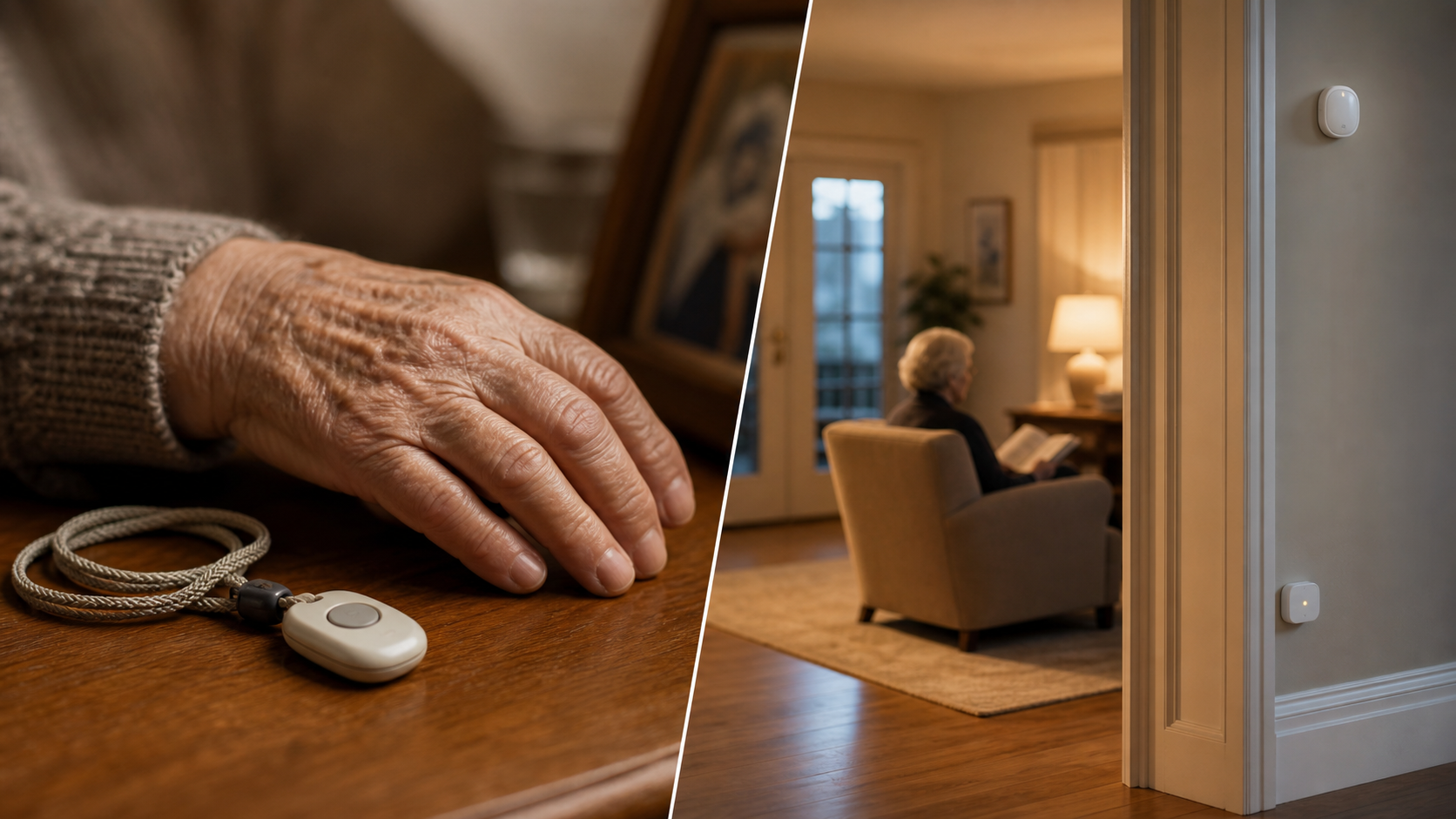
The Compliance Gap: Why Wearable PERS Buttons Often Fail
The traditional medical alert pendant — the button worn around the neck or on the wrist — has been the standard for decades. Its premise is simple: press the button, get help. But in practice, the system breaks down at the most critical moment because the person is not wearing it.
Emergency rooms regularly treat patients who, when asked why they did not call for help, explain that they thought they would be fine for a quick trip to the bathroom or to make a cup of coffee before getting dressed. These are not isolated incidents — they represent a structural flaw in the wearable model. The device only works if it is worn, charged, and within reach at the exact moment of an incident.
Research on personal remote monitoring (PRM) technologies, including a 2025 study in JMIR Aging, has begun to document this gap systematically. The clinical evidence suggests that the effectiveness of any wearable system depends less on the device's technical specifications and more on whether the older adult actually uses it consistently. For a growing number of families, the answer to that question is no.
This compliance gap is the reason passive monitoring has moved from a niche alternative to a mainstream consideration. Before evaluating any system, families need to confront an uncomfortable question: if your parent had a fall right now, would they be wearing the pendant?
How Passive Monitoring Works — and What It Detects That Pendants Miss
Passive monitoring systems take a fundamentally different approach. Instead of requiring the older adult to take an action — pressing a button, wearing a device, charging a battery — these systems use a network of small sensors placed throughout the home to detect movement, occupancy, and changes in daily patterns. The senior does nothing. The system observes.
A typical passive setup includes:
- Motion sensors in hallways and common areas to track movement patterns
- Door sensors on exterior doors to detect unexpected departures or night wandering
- Bed and chair occupancy sensors to monitor sleep quality and time spent immobile
- Behavior-pattern AI that learns the individual's routines and flags deviations
No cameras, no microphones, and no wearables are involved. The system builds a baseline of normal activity — when the person wakes, how often they visit the bathroom, when meals typically occur, how much time they spend in the living room versus the bedroom — and alerts a caregiver or monitoring center when the pattern breaks.
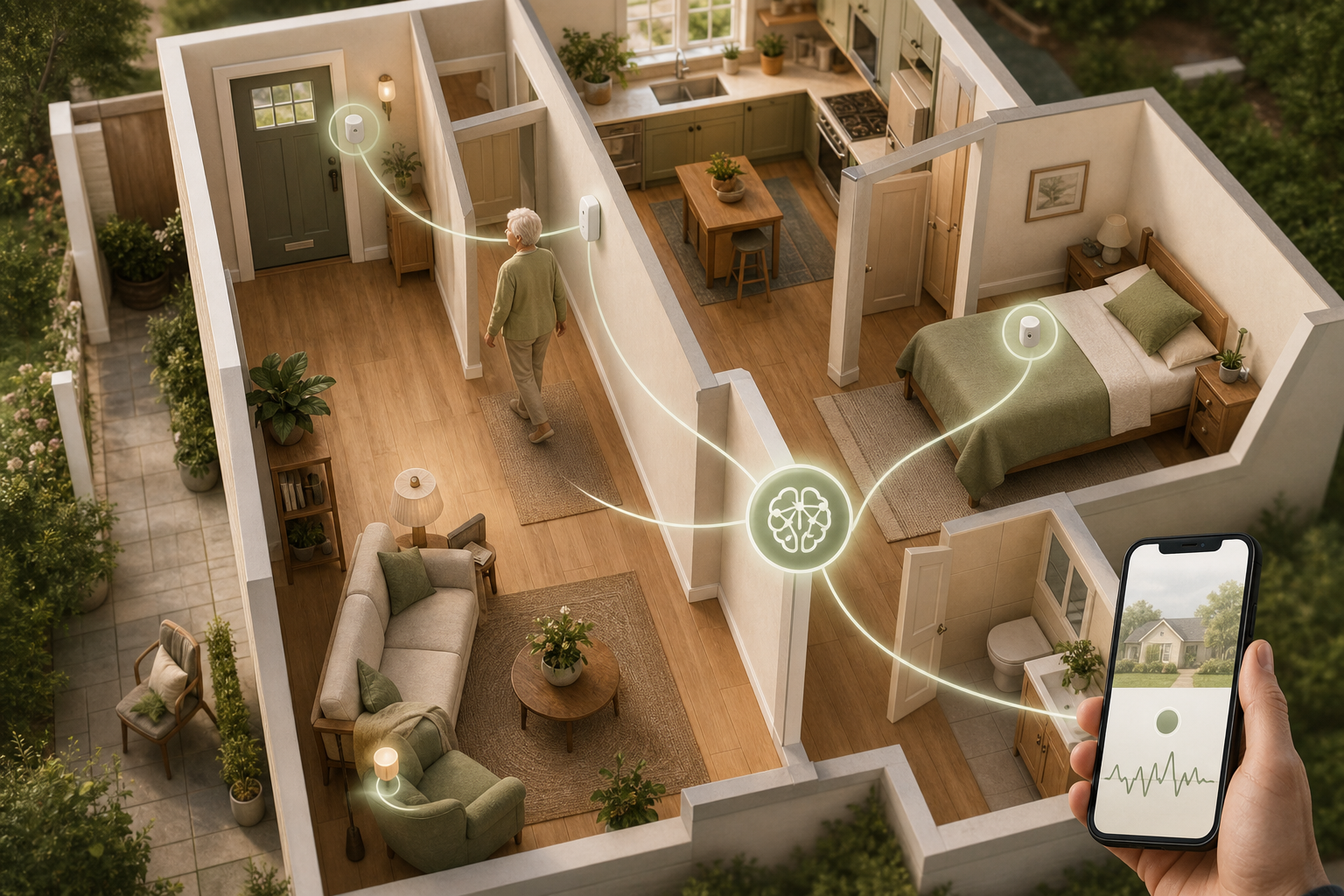
This approach detects things a pendant simply cannot. A wearable button only activates when the person presses it or when a fall sensor triggers. A passive system can identify:
- Early mobility changes that signal rising fall risk — slower movement through the house, longer periods of inactivity, or unusual hesitation at thresholds
- Nocturia patterns — two or more bathroom trips per night are associated with higher risks of falls, sleep disturbance, and cognitive decline, according to research cited by ScienceDirect
- Skipped meals or changes in kitchen activity that may indicate appetite loss, depression, or difficulty preparing food
- Night wandering or unexpected departures from the home, particularly relevant for individuals with dementia
- Medication routine changes — missed doses or unusual timing that could signal confusion or side effects
The clinical value of this approach is supported by evidence. A meta-analysis of remote patient monitoring found that it reduced hospital readmissions by 25%. For long-distance caregivers, this kind of early-warning data can be the difference between a minor intervention and a full-blown crisis.
For a deeper look at how sensor-based monitoring works under the hood, see our guide on passive, sensor-based monitoring for elderly safety.
What Passive Monitoring Cannot Do
For all its advantages, passive monitoring is not a complete replacement for every situation. Being honest about its limitations is essential for making the right choice.
- No real-time two-way communication. If the system detects a fall or an anomaly, it alerts a caregiver or monitoring center — but the older adult cannot speak to anyone through the sensors. There is no voice channel unless the system is integrated with a separate communication device.
- No out-of-home protection. Passive sensors only cover the interior of the home. If the older adult falls in the garden, at the grocery store, or while walking the dog, the system will not detect it.
- No direct emergency dispatch by default. Many passive systems alert a family caregiver first, not a monitoring center. If the caregiver is unavailable, the response chain can be delayed unless the system is connected to a professional monitoring service.
- Dependence on power and internet. Sensors require batteries or a power source, and the system relies on a stable Wi-Fi or cellular connection. A power outage or network failure can disable the entire setup.
These limitations do not make passive monitoring a bad choice — but they do mean that for some families, a hybrid approach combining passive sensors with a wearable or voice-activated device may be the most complete solution.
The Emerging Middle Ground: Smart Speakers and Smartwatches
Between the traditional pendant and a full passive sensor network lies a growing category of hybrid devices that many older adults find more acceptable. These are mainstream consumer products — not medical devices — that happen to include safety features.
Two options have gained particular traction, as documented by Wirecutter's 2026 review of smart home devices for aging in place:
| Device Category | Example Service | Monthly Cost | Key Safety Features | Best For |
|---|---|---|---|---|
| Smart speaker | Alexa Emergency Assist | $8/month (or $6/month with annual plan) | Voice-activated call to live operator; notifies up to 25 emergency contacts; fastest response time in Wirecutter testing | Seniors comfortable with voice commands who resist wearing anything |
| Smartwatch | Apple Watch (SE 3 or later) | No subscription (watch cost only) | Built-in fall detection and crash detection; automatic alert to emergency contacts or 911 | Seniors who already use smartphones and are willing to wear a watch |
These devices are not perfect. A smartwatch still requires charging and wearing. A smart speaker only works within earshot. But for the large segment of older adults who resist a medical pendant yet are comfortable with mainstream technology, these options can close the compliance gap without requiring a full passive sensor installation.
Decision Framework: 5 Factors Every Family Should Evaluate
Choosing between a wearable PERS, a passive monitoring system, or a hybrid setup depends on five key factors. No single solution is right for every family.
| Factor | What to Assess | If This Is the Case |
|---|---|---|
| Cognitive status | Does your parent understand what the device is for and remember to use it? | If yes: a wearable may work. If no: passive monitoring or voice-activated devices are more reliable. |
| Willingness to wear a device | Has your parent refused to wear a pendant or watch in the past? | If yes: passive monitoring removes the burden entirely. A smart speaker is a possible compromise. |
| Privacy preferences | Is your parent uncomfortable with sensors tracking their movements? | If yes: a wearable or voice-only device may feel less intrusive. Discuss what data is collected and who sees it. |
| Budget | What is the monthly and upfront cost you can sustain? | Passive systems typically cost $99/month with a $399 equipment fee. Wearables range from $20–$80/month. Smart speakers are the lowest-cost entry point. |
| Living situation | Does your parent live alone, with a spouse, or in a facility? | Living alone increases the need for automatic detection. A spouse can provide backup response, making a simpler system viable. |
For a more detailed product-neutral evaluation framework, see our decision guide for choosing an elderly monitoring system, which covers evaluation dimensions like sensor types, alert responsiveness, data privacy models, installation complexity, and caregiver app quality.
Cost is often a deciding factor. For a full breakdown of how monitoring technology can affect overall care expenses, read our cost-benefit analysis for in-home senior monitoring.
Red Flags: When to Reconsider the Button Approach Entirely
There comes a point when a wearable pendant is no longer a viable solution. The warning signs are specific and observable. If any of the following apply, it is time to move on.
- Your parent no longer understands when or how to use the button. If they press it accidentally, or fail to press it during a genuine emergency, the device has lost its purpose.
- They do not wear it consistently. The pendant is found on the nightstand, in a drawer, or still in its box — not around the neck or wrist.
- They have had a fall without activating the device. This is the clearest signal that the system failed when it was needed most.
- They have not used the device correctly in the past — pressing it for non-emergencies, failing to respond to test calls, or letting the battery die repeatedly.
- Cognitive decline has progressed to the point where the person cannot reliably follow a two-step instruction like "press the button and speak into the speaker."
For families navigating cognitive decline, the stakes are even higher. Our guide on monitoring systems for dementia and cognitive decline covers what works and what does not when memory and judgment are compromised.
Making the Decision: A Step-by-Step Path Forward
Choosing the right monitoring approach is not a one-time purchase decision. It is an ongoing assessment that should evolve as your parent's needs change. Here is a practical path forward.
- Assess the current situation honestly. Ask yourself the hard questions: Is the pendant being worn? Has it ever been used in a real emergency? Does your parent understand its purpose? If the answer to any of these is no, the current system is not working.
- Evaluate the options against the five factors above. Use the table in the previous section to map your parent's cognitive status, willingness, privacy preferences, budget, and living situation to the most suitable category.
- Involve your parent in the conversation. Frame it around their autonomy and safety, not around your worry. Explain that the goal is to help them stay at home longer — which aligns with the fact that 75% of Americans aged 50 and older plan to age in place, according to an AARP 2024 report.
- Start with a trial if possible. Many passive monitoring services offer a trial period. A smart speaker can be set up in minutes with no commitment. Let your parent experience the system before making a long-term decision.
- Revisit the decision regularly. As health, cognition, and living arrangements change, the right monitoring solution may change too. Set a reminder to reassess every six months or after any significant health event.
The technology landscape is shifting rapidly. What was once a binary choice — pendant or nothing — has expanded into a spectrum of options that can be tailored to each individual's needs and preferences. The goal is not to find the most advanced system. It is to find the system that will actually be used.
Questions to bring to a clinician or OT
This is not medical, legal, or a family's final decision — only a framework. Bring these questions to a clinician, occupational therapist, or your local Area Agency on Aging.
Find Local HelpRelated reading
- Passive vs. Active Elderly Monitoring Systems: What the Research Says About Real-World Adoption
- When Is 24/7 Care Actually Necessary? A Decision Framework for Using Monitoring Technology as a Safe Alternative
- Passive vs. Wearable Elderly Monitoring: What Dementia Caregivers Need to Know About the Trade-Offs
Noticed something outdated or inaccurate on this page? Flag a correction. We review every report against CDC, NIA, and AARP HomeFit guidance before updating a page.