2026 Senior Living Reality Check: What the Data Says About Where Seniors Live, How They're Monitored, and What Families Get Wrong
Most families plan for assisted living as a permanent solution, but the data tells a different story. This article presents six evidence-based reality checks — from average stays of 22 months to 41.1% staff turnover — to help family caregivers make decisions based on facts, not fear.
Features Covered in This Explainer
fall detection, battery life, range, response time, privacy implications
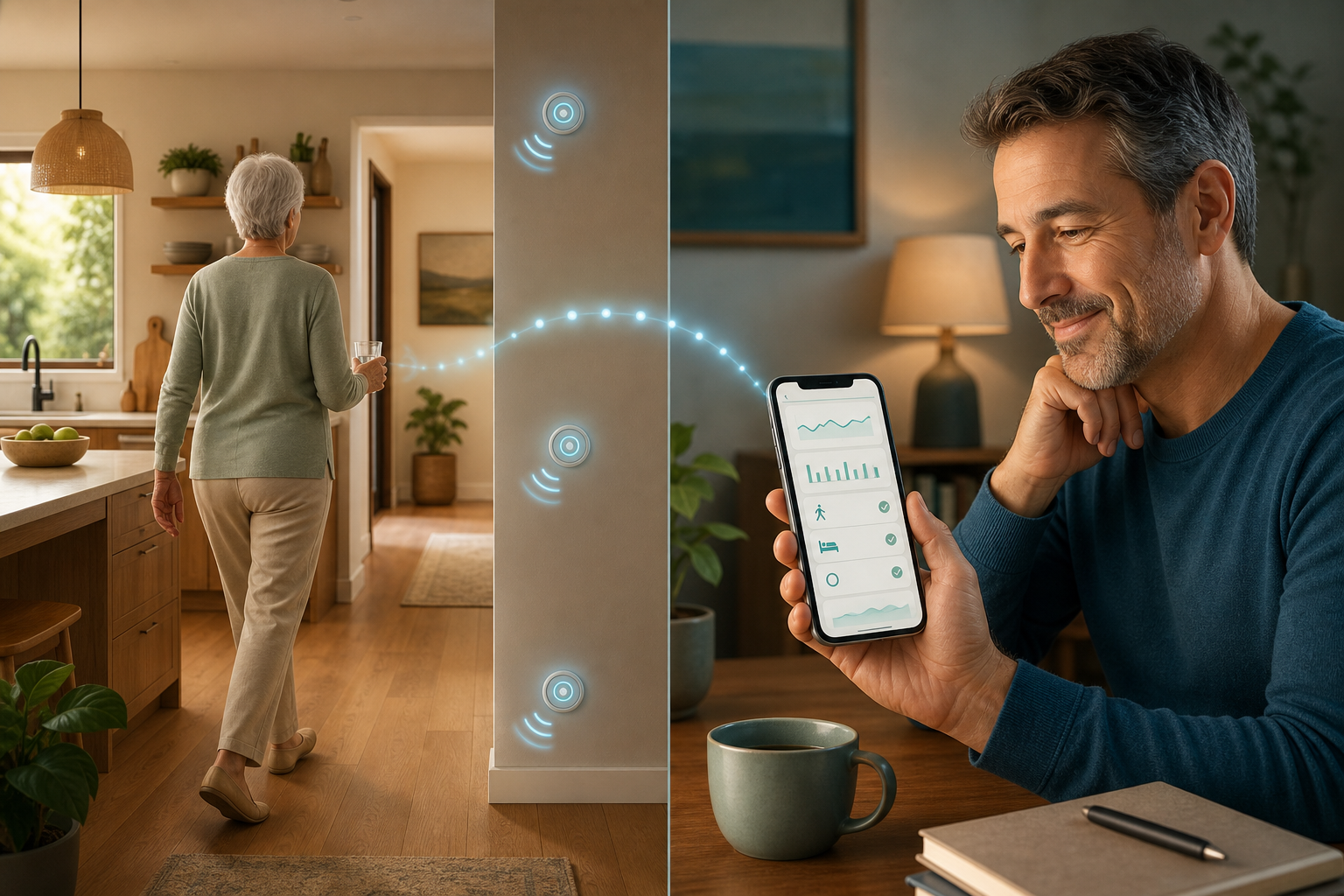
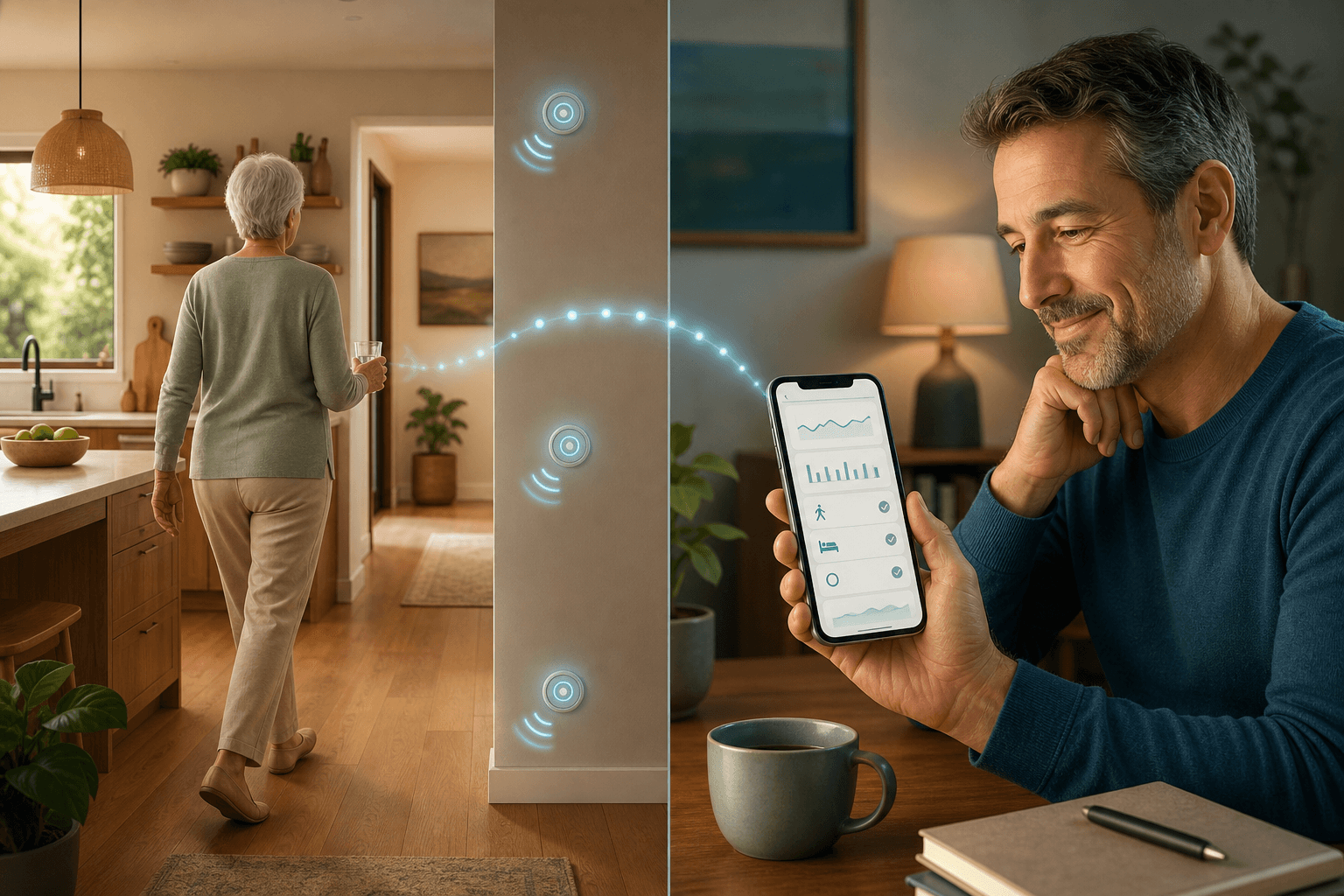
Technology as an invisible safety net — connecting the senior at home with the caregiver who needs real-time awareness.
Introduction: The Gap Between Perception and Data in Senior Care Living
When a family begins exploring senior care living options, the conversation is almost always driven by emotion — a recent fall, a new dementia diagnosis, a late-night call from a worried parent. In that state, it is natural to reach for the most familiar solution: a clean, well-lit assisted living facility where professionals handle the daily tasks that have become too difficult. The assumption is that this will be a permanent, stable home.
The data tells a different story. The average assisted living stay is just 22 months. Within two years, 60% of residents transition to a skilled nursing facility. Staff turnover in assisted living exceeds 41%, and nearly two-thirds of facilities report chronic staffing shortages. Meanwhile, the average senior housing property in the U.S. was built 24 years ago — long before the current generation of older adults began expecting modern, tech-enabled living spaces.
This article is not a facility selection guide. It is a data-driven reality check — six evidence-based corrections to the most common family assumptions about senior care living. Each section draws on the most current industry data available as of mid-2026, sourced from the CDC, NIC MAP, AHCA/NCAL, AARP, and peer-reviewed research. The goal is not to steer you toward one option over another, but to ensure that whatever decision you make is grounded in facts, not fear.
Reality Check #1: The 22-Month Stay — Assisted Living Is Not a Permanent Solution
The most consequential statistic in senior living is also the one families most frequently overlook. According to data compiled by The Senior List, the average length of stay in an assisted living community is 22 months. After roughly two years, 60% of residents transition to a skilled nursing facility, as confirmed by SeniorLiving.org.
This is not a reflection of poor care quality. It is a reflection of the natural progression of chronic conditions. Assisted living is designed for people who need help with activities of daily living — bathing, dressing, medication management — but who do not require round-the-clock skilled nursing care. As health needs intensify, the facility's model of care may no longer be adequate, and a move becomes medically necessary.
The planning implication is significant. Families who treat assisted living as a "final home" may find themselves financially and emotionally unprepared for a second transition within two years. The national median cost of assisted living is approximately $6,200 per month ($74,000 annually), according to AHCA/NCAL data. A skilled nursing facility costs substantially more. If a family has liquidated a home or spent down savings to afford the first move, the resources for the second may not be there.
This reality also reframes the cost comparison between facility living and aging in place with monitoring technology. If the average assisted living stay is less than two years, the total cost of that stay — roughly $136,000 at current median rates — may be better understood as a short-term care bridge rather than a long-term housing investment. For families weighing whether to remodel a home for accessibility or move to a facility, the 22-month statistic is a critical data point. Our aging-in-place remodel decision framework explores this trade-off in detail.
The typical assisted living journey is not a single destination — it is a waypoint on a longer care continuum.
Reality Check #2: Who Actually Lives in Assisted Living — Demographics That Change the Decision
When families picture an assisted living resident, they often imagine someone in their late 70s who needs help with mobility and light housekeeping. The actual demographic profile is more specific — and more instructive for decision-making.
Key demographic characteristics of assisted living residents in 2025-2026.
Demographic Factor
Data Point
Source
Residents aged 85 or older
50%
SeniorLiving.org / The Senior List
Female residents
76%
The Senior List
Residents with Alzheimer's or other dementia
42%
The Senior List / SeniorLiving.org
Typical move-in age
Approximately 80
Multi-Housing News / NIC MAP
These numbers carry practical consequences. A facility where half the residents are over 85 and more than two in five have some form of cognitive impairment will have a very different social environment, activity programming, and care focus than one serving a younger, more independent population. Families evaluating a facility should ask not just "what services do you offer?" but "who are the people living here?"
The high proportion of female residents — 76% — also matters for technology planning. Women live longer on average and are more likely to spend their final years alone, which means the monitoring technology that supports aging in place (fall detection, passive activity sensors, medication reminders) is disproportionately serving a female population. Product-neutral evaluation criteria should account for differences in grip strength, hand size, and comfort with wearable devices, which can vary across demographic groups.
Reality Check #3: Health Complexity — It's Not Just a 'Physical Care' Decision
Families often focus on the visible signs of aging — unsteady gait, difficulty climbing stairs, forgetting to take medication — when deciding whether a parent needs assisted living. But the health profile of the average resident is far more complex than mobility and memory alone.
34% of assisted living residents have heart disease (The Senior List)
31% have depression (The Senior List)
47.9% have high blood pressure (The Senior List)
42% have Alzheimer's or another dementia (The Senior List / SeniorLiving.org)
These comorbidities mean that a facility's ability to manage chronic disease and provide mental health support is as important as its physical plant and dining program. A facility that excels at fall prevention but lacks adequate depression screening or cardiac monitoring may not be the right fit for a resident with complex health needs.
For families considering aging in place with monitoring technology, this comorbidity data is equally relevant. A passive motion sensor that detects a fall is valuable, but it does not monitor blood pressure trends, detect early signs of depression-related withdrawal, or track medication adherence for heart disease. A comprehensive monitoring strategy must account for the full range of health conditions the older adult actually has — not just the ones that prompted the initial search for senior care living.
Reality Check #4: The Staffing Crisis — 41.1% Turnover and What It Means for Care Quality
The assisted living workforce is in a state of chronic instability. According to The Senior List, the staff turnover rate in assisted living was 41.1% in 2022 — the most recent year for which comprehensive national data is available. The AHCA/NCAL reports that 63% of assisted living facilities are experiencing staff shortages, and 87% report difficulty hiring qualified workers.
These are not abstract operational metrics. They have direct, measurable consequences for residents and families:
Inconsistent caregiver relationships. A resident who sees a different aide every few weeks loses the continuity that builds trust and enables early detection of health changes.
Delayed response times. When a facility is understaffed, call buttons go unanswered longer, and the time between a fall and staff arrival can stretch dangerously.
Gaps in supervision. Residents with dementia who wander, or those who are at high fall risk, may not receive the level of monitoring they need during understaffed shifts.
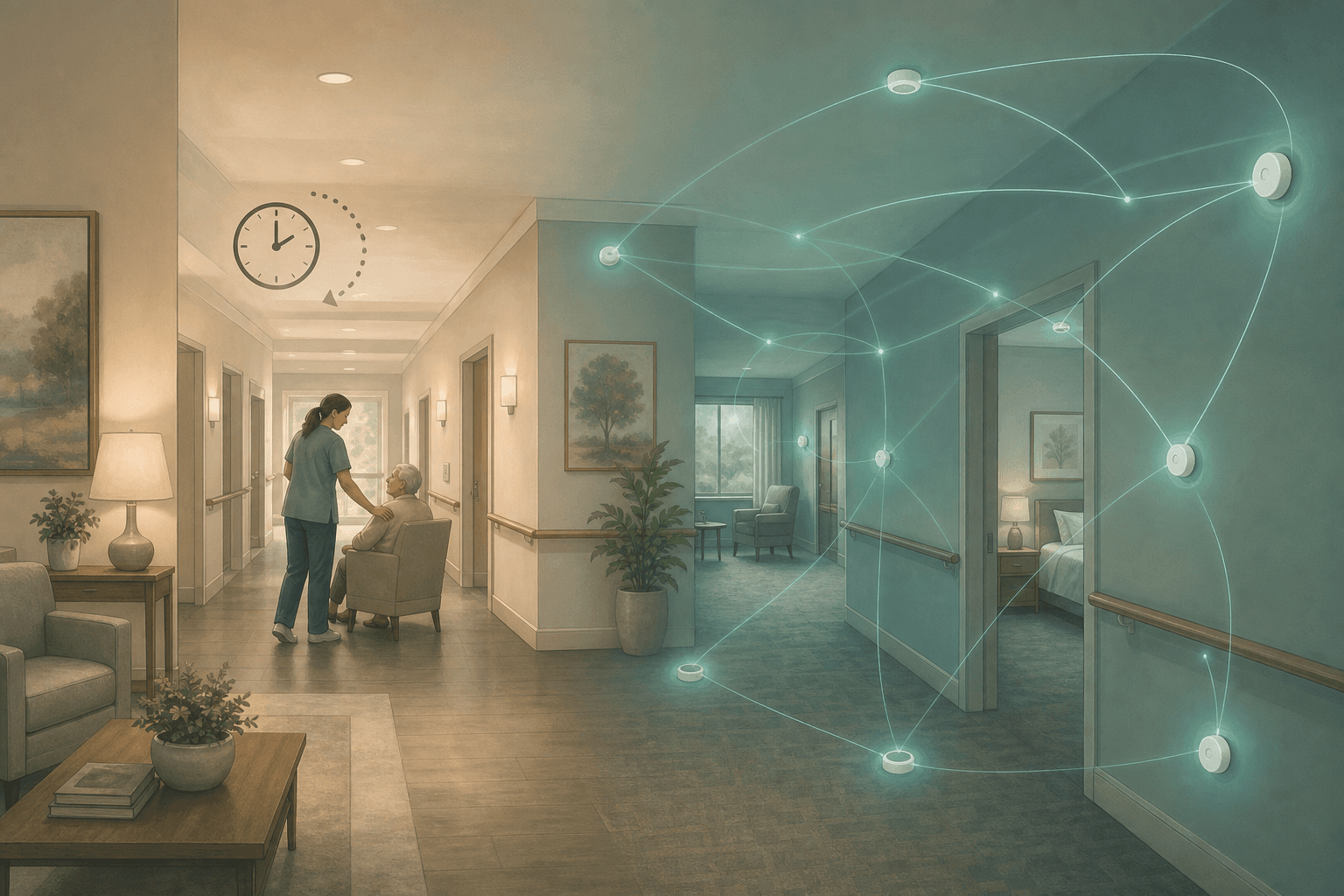
This is where monitoring technology enters the picture not as a replacement for human care, but as a vigilance layer that can operate continuously regardless of staffing levels. A passive fall detection sensor in a resident's room does not take breaks. A GPS tracker on a resident with wandering risk does not change shifts. A motion sensor that detects no movement for an unusual period can alert staff even when no one is physically present to observe.
In understaffed facilities, sensor networks can extend the reach of a limited care team — but they are a supplement, not a substitute.
Reality Check #5: Why Remote Monitoring Is Becoming Essential, Not Optional
The staffing crisis is not a temporary problem. With the U.S. population aged 65 and older reaching 61.2 million in 2026 — 18% of the total population — the demand for senior care services is accelerating faster than the workforce can grow. The NIC MAP data projects that the industry would need to develop nearly twice its historical maximum pace of new construction each year for the next two decades just to maintain 90% occupancy, requiring over $1 trillion in investment by 2041.
Against this backdrop, remote monitoring technology is shifting from a convenience to a necessity — both for facilities trying to stretch their care teams and for families choosing to age in place. The AARP's 2025 Tech Trends survey found that 55% of caregivers already use technology to coordinate caregiving, and 50% of adults aged 50 and older use at least one smart home device. Among those aged 80 and older, the share who agree that technology enables a healthy life rose from 39% in 2024 to 46% in 2025.
But the evidence base for these technologies is still maturing. A systematic review published in PMC found that of 91 peer-reviewed studies on remote monitoring technologies for older adults, only 6% (5 studies) were randomized controlled trials meeting Level I evidence standards. The majority of the research (49%) was Level IV evidence — case series or expert opinion. The review did find that home telemonitoring can significantly decrease hospital readmissions and that continuous monitoring of daily activities might prevent medical emergencies, but the overall quality of evidence is lower than most families assume.
Major remote monitoring technology categories and their current evidence status as of 2026.
Technology Category
Primary Function
Key Evidence Consideration
Fall detection sensors (radar, passive)
Detect falls without requiring the user to press a button
Radar-based systems (camera-less) offer privacy-preserving monitoring; CES 2026 showcased wall-mounted units tracking 25 data points per person
Passive activity monitors (motion, door, stove)
Track daily patterns and alert caregivers to deviations
Can detect early signs of functional decline; limited Level I evidence for emergency prevention
GPS trackers
Monitor location for individuals with wandering risk
Effective for safety but raise consent and dignity concerns, especially for cognitively impaired users
Wearable health monitors
Track vital signs, activity levels, and sleep patterns
Consumer-grade devices lack clinical validation for many metrics; consult a physician before relying on data for medical decisions
Telehealth platforms
Enable remote consultations with healthcare providers
Strong evidence for reducing hospital readmissions; requires reliable internet access and user comfort with video calls
For families, the implication is not to avoid technology, but to adopt it with realistic expectations. A fall detection sensor can alert you or a facility's staff within seconds of a fall — but it cannot prevent the fall from happening. A passive activity monitor can detect that your parent has not left their bedroom by 10 a.m., which may signal a problem — but it cannot interpret why. Technology is a tool for vigilance, not a guarantee of safety.
For a deeper look at how monitoring technology can reduce the need for round-the-clock human care while maintaining safety, see our guide on 24-hour care at home with a hybrid technology model. For a full cost comparison between home care, assisted living, and nursing homes, the 2026 financial roadmap for families provides a comprehensive breakdown.
Reality Check #6: The 24-Year-Old Building — Why Baby Boomers Expect More From Senior Housing
The average senior housing property in the United States was built 24 years ago, according to Multi-Housing News. That means the typical assisted living facility was constructed around the year 2002 — before the iPhone, before widespread residential Wi-Fi, and before smart home technology was a consumer expectation.
This matters because the Baby Boomer generation — the cohort now entering their late 70s and 80s — has fundamentally different expectations for living spaces than the Silent Generation that preceded them. AARP's 2025 Tech Trends survey found that 66% of adults aged 50 and older view technology positively, and AI usage among this group nearly doubled from 18% in 2024 to 30% in 2025. These are not people who are afraid of technology; they are people who expect their living environment to include it.
Yet many existing facilities lack the infrastructure to support modern monitoring systems. Older buildings may not have the wiring for networked sensors, the Wi-Fi bandwidth for telehealth video calls, or the electrical capacity for smart home devices. Families evaluating a facility should ask:
Does the facility have reliable, high-speed Wi-Fi throughout the building — including in resident rooms?
Are there policies about installing personal monitoring devices (motion sensors, cameras, GPS trackers) in a resident's room?
Does the facility itself use any monitoring technology — fall detection, passive activity tracking, wander management — and if so, what are the privacy and consent protocols?
Has the building been renovated or retrofitted to support modern technology, or is it operating on its original infrastructure?
The construction pipeline is not keeping pace with demand. Inventory growth hit a record low of 0.7% in Q3 2025, and the average construction cycle has stretched to 29 months. Nearly 60% of the 140 markets tracked by NIC MAP have no new senior housing development underway. This means that for the foreseeable future, families will be choosing between aging facilities — and the technology infrastructure of those facilities will be a critical factor in whether they can support the level of monitoring and connectivity that modern senior care requires.
Putting the Data to Work: A Decision Framework for Families
These six reality checks are not meant to discourage families from considering assisted living. For many older adults, a well-run facility with appropriate staffing and programming is the best option. But the data makes clear that the decision should be made with open eyes — not with the comforting but inaccurate assumption that assisted living is a permanent, stable, fully staffed solution.
The following questions, grounded in the evidence presented above, can help families evaluate any senior living option — or decide whether aging in place with monitoring technology is a viable alternative.
What is the plan for the next transition? If the average stay is 22 months, what happens when care needs exceed what this facility can provide? Is there a continuing care agreement or a skilled nursing wing on campus?
Who actually lives here? With 50% of residents over 85 and 42% living with dementia, does the facility's programming and staffing match the demographic reality of its resident population?
How is chronic disease managed? With 34% of residents having heart disease and 31% experiencing depression, does the facility have the clinical capacity to manage these conditions — or is it primarily a hospitality model with minimal healthcare oversight?
What is the actual staffing situation? Ask for the current staff-to-resident ratio, not the advertised one. Ask about turnover rates. Ask what technology the facility uses to compensate for staffing gaps.
What is the technology infrastructure? Does the building have the wiring, bandwidth, and policies to support modern monitoring? Can you install your own devices if needed?
What does the evidence say about the technology being used? Whether it is a facility's fall detection system or a home monitoring device you are considering for aging in place, ask whether the technology has been studied in peer-reviewed trials — and be realistic about what the evidence actually supports.
For a broader understanding of the full spectrum of senior care services and how they relate to each other, our complete taxonomy and decision framework for family caregivers provides a structured overview. And if you are weighing the financial trade-off between home modifications and a facility move, the 40-hour cost threshold analysis offers a practical framework for comparing the two paths.
For individualized recommendations:An occupational therapist or your primary care provider can assess your specific situation and recommend the monitoring category and feature set that best fits the person's functional level, living environment, and caregiver availability. This explainer provides educational context, not a personalized recommendation.


Comments
Join the discussion with an anonymous comment.