
Caregiver decision guide
From Crisis to Control: What to Do in the First 24 Hours After Your Elderly Parent Falls
A parent's fall is the most common entry point into caregiving — but most families are unprepared for the aftermath. This minute-by-minute, hour-by-hour guide covers immediate medical response, when to call 911, what to do at the ER, the first day home, and how to prevent the next fall.

Why the First 24 Hours Matter
Falls are the leading cause of injury for adults 65 and older in the United States. Each year, one in four older adults falls, and the consequences are rarely isolated: a single fall doubles the risk of falling again. For many families, that first fall is also the moment caregiving begins — often without warning, without a plan, and in a state of adrenaline and confusion.
The hours immediately following a fall are not just about treating the injury. They shape the entire recovery trajectory. Decisions made in the first five minutes — whether to move the person, whether to call 911, what information to take to the hospital — can determine whether a minor incident stays minor or becomes a cascade of complications. The choices made in the first 24 hours — how you manage pain, assess mobility, and secure the home — set the foundation for whether your parent regains independence or enters a cycle of fear, reduced activity, and further falls.
Immediate Response: The First 5 Minutes
Your brain will want to rush in. Don't. The first five minutes are about assessment, not action. A calm, methodical approach prevents you from causing additional harm and gives you the information you need to make the next decision.
Step 1: Stay Calm and Assess Consciousness
Kneel beside your parent. Speak in a steady, reassuring voice. Ask two questions: "Can you hear me?" and "Can you tell me what happened?" If they respond coherently, they are conscious and oriented. If they are confused, slurring words, or unable to respond, assume a head injury or stroke and call 911 immediately.
Step 2: Check for Visible Injury Before Moving
Look for these signs before attempting any movement:
- Bleeding or visible wound on the head, arm, or leg
- Limb that appears bent or positioned abnormally (possible fracture)
- Bruising or swelling, especially around the hip, wrist, or ankle
- Inability to move an arm or leg without significant pain
- Complaint of severe pain in the hip, back, or neck
Step 3: Getting Up Safely (If No Injury Is Suspected)
If your parent is alert, has no visible injury, and reports only mild discomfort, you can guide them to get up. Do not lift them yourself — you risk injuring your own back and losing control of the movement. Instead, guide them through this sequence:
- Roll onto their side. From a lying position, have them bend the knee on top and roll toward that side.
- Push up onto hands and knees. From the side-lying position, have them use their arms to push their torso up until they are on all fours.
- Crawl to a sturdy chair. Have them move on hands and knees to a stable, heavy chair that will not slide.
- Use the chair to stand. Place both hands on the seat of the chair. Have them lift one knee, place that foot flat on the floor, and push up using their leg strength and the chair for support. Guide them to turn and sit down slowly.
Once they are seated, stay with them for at least 15 minutes. Offer water. Check for delayed pain or dizziness. Even if they feel fine, do not leave them alone for the next several hours.
When to Call 911 vs. Manage at Home
This is the most consequential decision you will make in the first hour. The table below provides a clear framework based on the symptoms and circumstances of the fall.
| Situation | Action | Why |
|---|---|---|
| Loss of consciousness, even briefly | Call 911 immediately | Possible head injury or concussion; requires CT scan and neurological assessment |
| Suspected hip, wrist, or spinal fracture | Call 911 immediately | Moving a fracture can cause additional tissue damage; paramedics have immobilization equipment |
| Head hit the floor or furniture | Call 911 immediately | Older adults on blood thinners (warfarin, apixaban, rivaroxaban) are at high risk for intracranial bleeding |
| Unable to stand even with assistance | Call 911 immediately | Prolonged time on the floor can lead to dehydration, pressure injuries, and hypothermia |
| Severe pain in any limb or joint | Call 911 immediately | Severe pain often indicates fracture or dislocation requiring X-ray and immobilization |
| Bleeding that does not stop with direct pressure | Call 911 immediately | May require sutures or wound closure; older skin is fragile and heals slowly |
| Alert, no visible injury, able to stand with guidance | Monitor at home; call primary care within 24 hours | Delayed symptoms (dizziness, bruising, stiffness) can appear hours later |
| Minor scrape or bruise, no pain when moving | Monitor at home; call primary care within 48 hours | Even minor falls should be reported to the doctor for fall risk assessment |
At the ER: What to Bring, What to Ask, and the Discharge Planning Checklist
If you end up in the emergency department, you are the critical link between your parent and the medical team. Hospital staff will be managing multiple patients; they rely on family caregivers to provide accurate medical history and medication lists. Your job is to be the organized advocate.
What to Bring to the ER
- Complete medication list: Include all prescription drugs, over-the-counter medicines, vitamins, and supplements. Include dosages and how often each is taken. The NIA provides a free medication management worksheet you can use to organize this information in advance.
- Medical history summary: List chronic conditions (diabetes, hypertension, heart disease, dementia), allergies, and previous surgeries.
- Insurance card and identification: Medicare card, supplemental insurance card, and photo ID.
- Emergency contact list: Names and phone numbers of primary care physician, specialists, and family members.
- Phone charger: You may be in the ER for hours. A fully charged phone is essential for communication and taking notes.
- List of questions: Write down what you want to ask before you get there — adrenaline makes it easy to forget.
Key Questions to Ask the ER Doctor
- What caused this fall? Was it a slip, a trip, a loss of balance, or a medical event like a drop in blood pressure or a heart rhythm problem?
- What is the specific injury? Ask for the medical name and what it means for recovery.
- What are the mobility restrictions? Can they bear weight? Do they need a walker, crutches, or a wheelchair temporarily?
- What follow-up care is needed? Do they need to see an orthopedist, neurologist, or physical therapist? When?
- What medications are being prescribed or changed? Get the name, dosage, frequency, and purpose of every new medication.
- Are there any signs of a head injury? If they hit their head, ask specifically about the need for a CT scan and follow-up monitoring.
Discharge Planning Checklist
Hospital discharge planning begins at admission, not at discharge. The earlier you start thinking about what happens when your parent leaves the hospital, the smoother the transition will be. Use this checklist before the discharge order is written.
| Category | Checklist Item | Status |
|---|---|---|
| Medications | Obtain written discharge medication list with dosages and schedule | ☐ |
| Medications | Compare discharge meds to pre-fall meds — identify changes, new drugs, and discontinued drugs | ☐ |
| Mobility | Confirm weight-bearing status (full, partial, non-weight-bearing) | ☐ |
| Mobility | Arrange for assistive device (walker, crutches, cane) before leaving the hospital | ☐ |
| Pain Management | Get clear instructions on pain medication: what to take, how often, and for how long | ☐ |
| Follow-up Appointments | Schedule follow-up with primary care physician within 7 days | ☐ |
| Follow-up Appointments | Schedule specialist appointments (orthopedist, neurologist, physical therapist) | ☐ |
| Home Setup | Identify fall hazards in the home that need to be addressed before discharge | ☐ |
| Home Setup | Arrange for someone to stay with your parent for at least the first 24–48 hours home | ☐ |
| Home Health Services | Ask if your parent qualifies for Medicare-covered home health services (skilled nursing, PT, OT) | ☐ |
| Emergency Plan | Know which symptoms warrant a return to the ER (worsening pain, confusion, fever, bleeding) | ☐ |
The First 24 Hours Home: Medication, Mobility, and Monitoring
Bringing your parent home from the ER is not the end of the crisis — it is the beginning of the recovery phase. The first 24 hours at home are critical for catching complications early and establishing a safe routine.
Medication Reconciliation
Medication errors are one of the most common post-discharge complications. The discharge paperwork may list new medications, changed dosages, or discontinued drugs. Do not assume the list is complete or accurate. Use the NIA's medication management worksheet to create a single, updated list that includes:
- All prescription medications (new and existing)
- Over-the-counter medications and supplements
- Dosage, frequency, and time of day for each
- Which medications are new, which were stopped, and which changed dosage
Share this updated list with every healthcare provider involved in your parent's care. Keep a copy on the refrigerator and one in your bag for future appointments.
Mobility Assessment
Within the first few hours of being home, assess your parent's ability to move safely. The key question is: can they get to the bathroom independently? If the answer is no, you need a plan before nightfall.
- Observe them walking from the bed to the bathroom. Do they seem steady or unsteady? Do they reach for walls or furniture for support?
- Check if they can get on and off the toilet without assistance. If not, a raised toilet seat or bedside commode may be needed immediately.
- Test their ability to get in and out of bed. A bed rail or transfer pole can make this safer.
- Ensure the walker or cane provided by the hospital is the correct height and that your parent knows how to use it correctly.
Pain Monitoring and Delayed Injury Signs
Some injuries do not show symptoms immediately. Monitor your parent closely for the first 24 hours and watch for these warning signs that warrant a call to the doctor or a return to the ER:
- Worsening pain, especially in the hip, back, or head
- New confusion, drowsiness, or difficulty waking
- Vomiting
- Numbness or tingling in an arm or leg
- Inability to urinate or move bowels
- Fever or chills (may indicate infection, especially after a fracture)
Home Safety Sweep: Room-by-Room Fall Hazard Check
Once your parent is stable and resting, take 30 minutes to walk through the house with a critical eye. The National Institute on Aging provides a free room-by-room home safety checklist that covers every area of the home. Use this guide to identify and fix the most common hazards immediately.
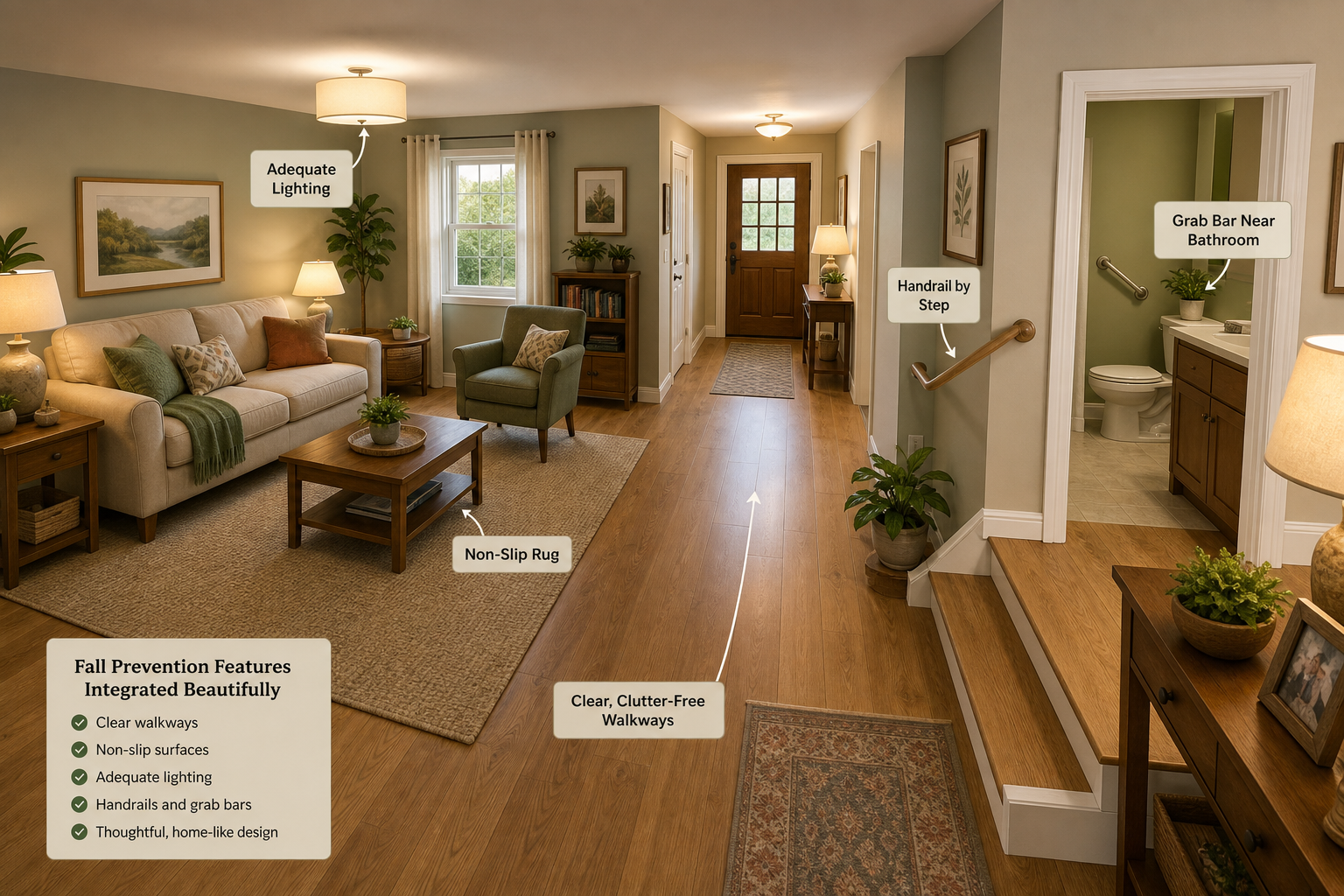
| Room | Hazard to Fix Now | Action |
|---|---|---|
| Bathroom | No grab bars near toilet or in tub/shower | Install grab bars (temporary suction models available for immediate use; permanent installation follows) |
| Bathroom | Slippery tub or shower floor | Place non-slip mats or adhesive strips in the tub and on the bathroom floor |
| Bathroom | Poor lighting at night | Install a night light or motion-activated light between the bedroom and bathroom |
| Bedroom | Cluttered path from bed to bathroom | Clear all cords, shoes, and clutter from the walking path |
| Bedroom | Bed is too high or too low | Adjust bed height so feet touch the floor when sitting on the edge; add a bed rail if needed |
| Living Room | Throw rugs or loose carpet edges | Remove all throw rugs or secure them with double-sided carpet tape |
| Living Room | Electrical cords across walkways | Tape cords to the baseboard or reroute them along walls |
| Kitchen | Frequently used items on high shelves | Move everyday items (plates, glasses, food) to waist-level cabinets |
| Stairs | No handrails or only one handrail | Install handrails on both sides of the stairway; ensure they are sturdy and easy to grip |
| Stairs | Poor lighting at top and bottom | Install light switches at both ends of the stairs; use motion-activated lights |
| Entryway | Uneven steps or lack of non-slip surface | Add non-slip material to outdoor steps; mark the edge of each step with contrasting tape |
For a deeper dive into permanent home modifications — including grab bar installation, stair lifts, walk-in tubs, and funding sources like Medicaid waivers and VA grants — see our Aging in Place Remodel: Room-by-Room Safety Checklist and Priority Guide. For a broader readiness assessment that includes financial and emotional preparedness, see our Aging in Place Readiness Checklist: Is Your Parent's Home Ready — and Are You?.
The Next Steps Conversation: How to Talk to Your Parent About What Happened
The hardest part of the first 24 hours is often not the medical response — it is the conversation that follows. Your parent may be frightened, embarrassed, or defensive. They may insist they are fine and resist any suggestion that things need to change. How you handle this conversation determines whether they become a partner in their own safety or an adversary you have to work around.
Principles for a Productive Conversation
- Start with concern, not criticism. "I was so scared when you fell. I don't want that to happen again. Can we talk about how to make sure you stay safe?"
- Frame changes as partnership, not control. "Let's figure this out together" is very different from "You need to let me handle this."
- Focus on independence, not limitation. Grab bars are not a sign of decline — they are a tool that lets your parent bathe safely without needing help. A medical alert system is not surveillance — it is a way for them to get help immediately if they fall again.
- Pick the right time. Do not have this conversation in the ER or while they are in pain. Wait until they are rested, comfortable, and in a familiar setting.
- Listen more than you talk. Ask what worries them most about their safety and what they are willing to consider. Their answers will tell you where to start.
If the fall raises questions about whether your parent can continue living independently, the conversation may need to address larger decisions. Our When Is It Time for Assisted Living? A Decision Framework for Families provides a structured approach to evaluating care options without rushing to conclusions. For a comprehensive framework of home-based interventions that fall between "do nothing" and "move to assisted living," see Beyond the Binary Choice: The Layered Home Intervention Path to Senior Care.
Building a Long-Term Fall Prevention Plan
The first 24 hours are about crisis management. The next 30 days are about prevention. The CDC's STEADI framework (Stopping Elderly Accidents, Deaths & Injuries) provides a clinical model for fall risk assessment that family caregivers can use as a reference for building a long-term plan.
The STEADI Model for Families
| STEADI Step | What It Means for Your Parent | Action Items |
|---|---|---|
| Screen | Identify fall risk factors during routine medical visits | Ask the doctor to perform a fall risk assessment at the next visit; Medicare's "Welcome to Medicare" preventive visit includes this |
| Assess | Evaluate specific risk factors: muscle weakness, balance problems, medication side effects, vision issues, home hazards | Schedule a physical therapy evaluation for balance and gait; request a medication review from the primary care physician; get an eye exam |
| Intervene | Address identified risks through exercise, medication adjustment, vision correction, home modification, and assistive devices | Start a balance exercise program (Tai Chi, Otago Exercise Program); install home modifications; consider a personal emergency response system (PERS) |
Key Components of a Long-Term Plan
- Balance and strength exercises: Programs like Tai Chi or the Otago Exercise Program have been shown to reduce fall risk by improving strength and balance. A physical therapist can design a program specific to your parent's abilities.
- Medication review: At least once a year, have a pharmacist or doctor review all medications — including over-the-counter drugs and supplements — for side effects that increase fall risk, such as dizziness, drowsiness, or orthostatic hypotension.
- Vision check: Annual eye exams are essential. Conditions like cataracts and glaucoma can significantly increase fall risk. Ensure eyeglass prescriptions are current.
- Monitoring technology: A personal emergency response system (PERS) — either wearable or home-based — can provide immediate access to help after a fall. For a comparison of passive monitoring vs. wearable options, see our guide: Passive Monitoring vs. Wearable PERS: What Family Caregivers Need to Know About the Technology Gap.
- Home modification: Beyond the immediate fixes, consider permanent modifications like stair lifts, walk-in tubs, widened doorways, and ramp installation. Our Aging in Place Remodel: Room-by-Room Safety Checklist and Priority Guide covers cost ranges and funding sources.
- Care coordination: As your parent's needs evolve, you may need to coordinate between multiple providers and services. Our Senior Health Services by Care Need: Matching Services to Your Parent's Actual Situation helps match post-fall care needs to the appropriate services.
The first 24 hours after a fall are overwhelming. You will make mistakes. You will forget things. That is normal. What matters is that you showed up, you acted, and you are now building a foundation for safety that did not exist before. One step at a time — starting with the next five minutes.
Questions to bring to a clinician or OT
This is not medical, legal, or a family's final decision — only a framework. Bring these questions to a clinician, occupational therapist, or your local Area Agency on Aging.
Find Local HelpRelated reading
Noticed something outdated or inaccurate on this page? Flag a correction. We review every report against CDC, NIA, and AARP HomeFit guidance before updating a page.