
Clinical term
Navigating Senior Health Care: A Decision Framework for Adult Children Managing a Parent's Care
Why Senior Health Care Feels Unmanageable — and How a Decision Framework Helps
If you are an adult child in your 40s or 50s who has recently taken on responsibility for a parent's health care, you already know the problem is not a lack of options. It is the opposite. There are too many options — home care agencies, geriatricians, Medicare plans, assisted living facilities, care managers, adult day centers — and no clear process for deciding which combination fits your parent's specific situation. The result is paralysis, rushed decisions during a crisis, or both.
You are far from alone in this. According to the America's Health Rankings 2026 Senior Report, approximately 63 million Americans served as family caregivers in 2025, providing an estimated $600 billion in unpaid care annually. That is a staggering amount of labor happening outside any formal system, often without a structured plan.
This article offers a different way to approach the problem. Instead of trying to master every service category and payment source at once, you can organize your decisions into four domains: clinical needs, daily living support, insurance and funding, and care coordination. Working through these domains one at a time reduces overwhelm and leads to clearer, more confident choices — whether you are planning ahead or responding to a sudden change in your parent's health.

Domain 1: Clinical Needs — Choosing Providers and Coordinating Care
The clinical domain is where most families start, but it is also where many get stuck. The first question is whether your parent's primary care physician is the right provider for their current needs or whether a geriatrician would be more appropriate.
Geriatricians are physicians with specialized training in the complex, multi-condition health profiles common among older adults. They are more likely to consider how medications interact, how cognitive decline affects treatment adherence, and how social factors influence health outcomes. The supply of these specialists is growing — the America's Health Rankings report documents a 4% increase in geriatric clinicians between September 2024 and September 2025, reaching a new high. But demand still outpaces supply, particularly in rural areas. If a geriatrician is not available within a reasonable distance, a primary care physician who is willing to coordinate with specialists can serve a similar role.
Once the primary provider is established, the next step is understanding when specialist coordination is needed. Common specialists for older adults include:
- Cardiology — for heart failure, hypertension, and arrhythmia management
- Neurology — for stroke recovery, Parkinson's disease, and dementia diagnosis and management
- Orthopedics — for fall-related fractures, joint replacement, and mobility-limiting arthritis
- Geriatric psychiatry — for depression, anxiety, and behavioral symptoms of dementia
The challenge is not finding these specialists — it is making sure they communicate with each other and with the primary provider. Medication errors and conflicting treatment plans are real risks when multiple providers are involved without a central coordinator. If your parent sees three or more specialists, ask the primary care physician's office to serve as the hub for all medication and treatment decisions.
Domain 2: Daily Living Support — Home Care, Community Services, and Facility Transition Points
The daily living support domain covers the practical help your parent needs to eat, bathe, dress, move around, and manage their household. This is where the cost differences between options become most visible — and where many families discover that the most intuitive choice (keeping Mom at home with paid help) is not always the most affordable or sustainable one.
The table below shows the national median costs for the most common care settings, based on the CareScout 2025 Cost of Care Survey (fielded July–November 2025). These are national medians; your local costs may be significantly higher or lower.
| Care Setting | National Median Cost | Annual Cost (Estimated) | Year-Over-Year Change |
|---|---|---|---|
| Home care (non-medical, 44 hrs/wk) | $35/hr | $80,080 | +3% |
| Assisted living | $6,200/mo | $74,400 | +5% |
| Nursing home (semi-private room) | $9,581/mo | $114,972 | +3% |
| Nursing home (private room) | $10,798/mo | $129,576 | +1% |
| Adult day health care | $95/day | $24,700 (5 days/wk) | -5% |
| Memory care | $7,645/mo | $91,740 | Not specified |
The most striking insight from this data is that home care at 44 hours per week costs more than assisted living. This does not mean home care is the wrong choice — many older adults strongly prefer to remain at home, and the emotional and health benefits of familiar surroundings are real. But it does mean the decision should be intentional. If your parent needs 44 or more hours of paid care per week, the cost argument for assisted living becomes strong, and the decision should factor in quality of life, social engagement, and safety, not just cost.
For families who are not yet at that level of need, adult day services offer a middle ground. At a national median of $95 per eight-hour day, five days per week of adult day care costs roughly $24,700 per year — far less than home care or assisted living. The National Institute on Aging notes that adult day care costs are less than in-home or nursing home care, though Medicare does not cover it. Medicaid may cover it in some states.
A key decision point arrives when home care is no longer sufficient. Signs include: your parent needs assistance during overnight hours, they are unsafe when left alone for even short periods, or the caregiver (you or a paid aide) is experiencing physical strain from transfers and lifting. At this point, the conversation should shift from "how do we add more hours" to "what setting best meets the current level of need." Our guide on Signs Your Aging Parent Needs Home Help walks through this assessment in more detail.
Domain 3: Insurance and Funding — Medicare, Medicaid, Medigap, and VA Benefits
The funding domain is where many caregivers feel the most lost, and for good reason. The U.S. health care financing system for older adults is a patchwork of federal programs, state programs, private insurance, and out-of-pocket spending. No single program covers everything, and the gaps are where families get into financial trouble.
Here is a breakdown of the major funding sources and what they actually cover:
| Program | What It Covers | What It Does NOT Cover | Eligibility Notes |
|---|---|---|---|
| Medicare Part A | Hospital stays, skilled nursing facility care (limited), hospice, some home health | Custodial care (help with bathing, dressing, eating), long-term nursing home stays, room and board | Available at 65+ or with certain disabilities; no income limit |
| Medicare Part B | Doctor visits, outpatient care, preventive services, some home health | Most prescription drugs (covered by Part D), long-term care, dental, vision, hearing | Monthly premium; available to all Medicare enrollees |
| Medicare Part D | Prescription drug coverage | No coverage for drugs not on plan formulary | Private plans; costs and formularies vary |
| Medigap (Medicare Supplement) | Fills gaps in Original Medicare (copays, coinsurance, deductibles) | Does not cover long-term care, dental, vision, hearing, or private-duty nursing | Standardized plans (A–N); must enroll during Medigap Open Enrollment Period |
| Medicare Advantage (Part C) | Combines Part A, Part B, and often Part D; may include extra benefits (dental, vision, hearing) | Network restrictions; may require prior authorization for services | Private plans; must still pay Part B premium |
| Medicaid | Long-term services and supports (nursing home, some assisted living, home-based services) | Coverage varies significantly by state; not all providers accept Medicaid | Needs-based; strict income and asset limits; primary funder of LTSS (61% of spending) |
| VA Aid & Attendance | Monthly pension supplement for veterans and surviving spouses who need help with daily activities | Does not cover specific services; provides cash benefit that can be used for any care need | Single veteran: up to $2,424/mo; married veteran: up to $2,874/mo; surviving spouse: up to $1,558/mo |
The single most important thing to understand is that Medicare does not cover custodial care — the kind of daily help with bathing, dressing, eating, and using the bathroom that most older adults eventually need. Medicare covers skilled nursing care only for a short time after a qualifying hospital stay, and it covers limited home health care (part-time, intermittent skilled care from a Medicare-certified agency). But if your parent needs someone to help them bathe and dress every day, Medicare will not pay for it. Our detailed FAQ on Does Medicare Cover Short-Term Care for Elderly? breaks down exactly what is and is not covered in 2026.
Medicaid fills many of the gaps that Medicare leaves, but it is needs-based. To qualify, your parent must meet strict income and asset limits, which vary by state. According to USAging's 2026 Aging Policy Priorities report, Medicaid is the primary funder of long-term services and supports (LTSS), covering 61% of spending. The average home and community-based services (HCBS) cost per person is $38,275 per year, compared to $53,666 per year for institutional care. Many families do not explore HCBS options until a crisis hits, which limits their choices.
For veterans and surviving spouses, the VA Aid & Attendance benefit can provide up to $2,424 per month for a single veteran, $2,874 per month for a married veteran, and $1,558 per month for a surviving spouse. This is a cash benefit — it can be used to pay for home care, assisted living, or any other care arrangement. It is not automatic; it requires an application and documentation of medical and financial need.
For a more detailed comparison of payment options across different care scenarios, see our guide on How to Pay for Short-Term Elder Care.
Domain 4: Coordination — Geriatric Care Managers, Care Plans, and Family Communication
The fourth domain is the one that most families overlook until they are deep in a crisis. Coordination is the work of making sure the clinical care, daily support, and funding all fit together — and that everyone involved (family members, providers, aides, and your parent) has the same understanding of what the plan is.
A geriatric care manager (also called an aging life care professional) can be invaluable here. According to the National Institute on Aging, geriatric care managers are licensed nurses or social workers who assess needs, create care plans, coordinate services, and refer to other specialists. They charge by the hour, and Medicare and Medicaid do not pay for this service. However, for families who are managing care from a distance or who feel overwhelmed by the complexity, the cost of a few hours of a care manager's time can save far more in avoided mistakes and unnecessary services.
Even without a professional care manager, families can improve coordination by:
- Creating a shared care plan document that lists all providers, medications, diagnoses, and contact information — and keeping it updated
- Designating one family member as the primary point of contact for all providers, to reduce confusion and conflicting instructions
- Scheduling regular family check-ins (weekly or biweekly) to review how the plan is working and adjust as needed
- Using a shared digital tool (a simple shared document or a care coordination app) so all family members can see the latest information
One of the most common coordination pitfalls is assuming that "someone else is handling it." A specialist assumes the primary care physician is managing medications. The home care agency assumes the family is handling transportation to appointments. The adult child in another state assumes the sibling who lives nearby is monitoring the situation daily. These assumptions create gaps that lead to missed medications, untreated symptoms, and preventable hospitalizations.
For a deeper look at how to build a care coordination system before a crisis forces one, read our guide on The Preparedness Gap: How to Start Caring for Aging Parents Before a Crisis Hits.
Decision Trees for Common Scenarios: Post-Hospitalization, New Dementia Diagnosis, and a Fall Event
The four-domain framework becomes most useful when applied to a specific situation. Below are three common scenarios that trigger a caregiving crisis. For each, the key questions in each domain are laid out to guide your next steps.
Scenario 1: Post-Hospitalization
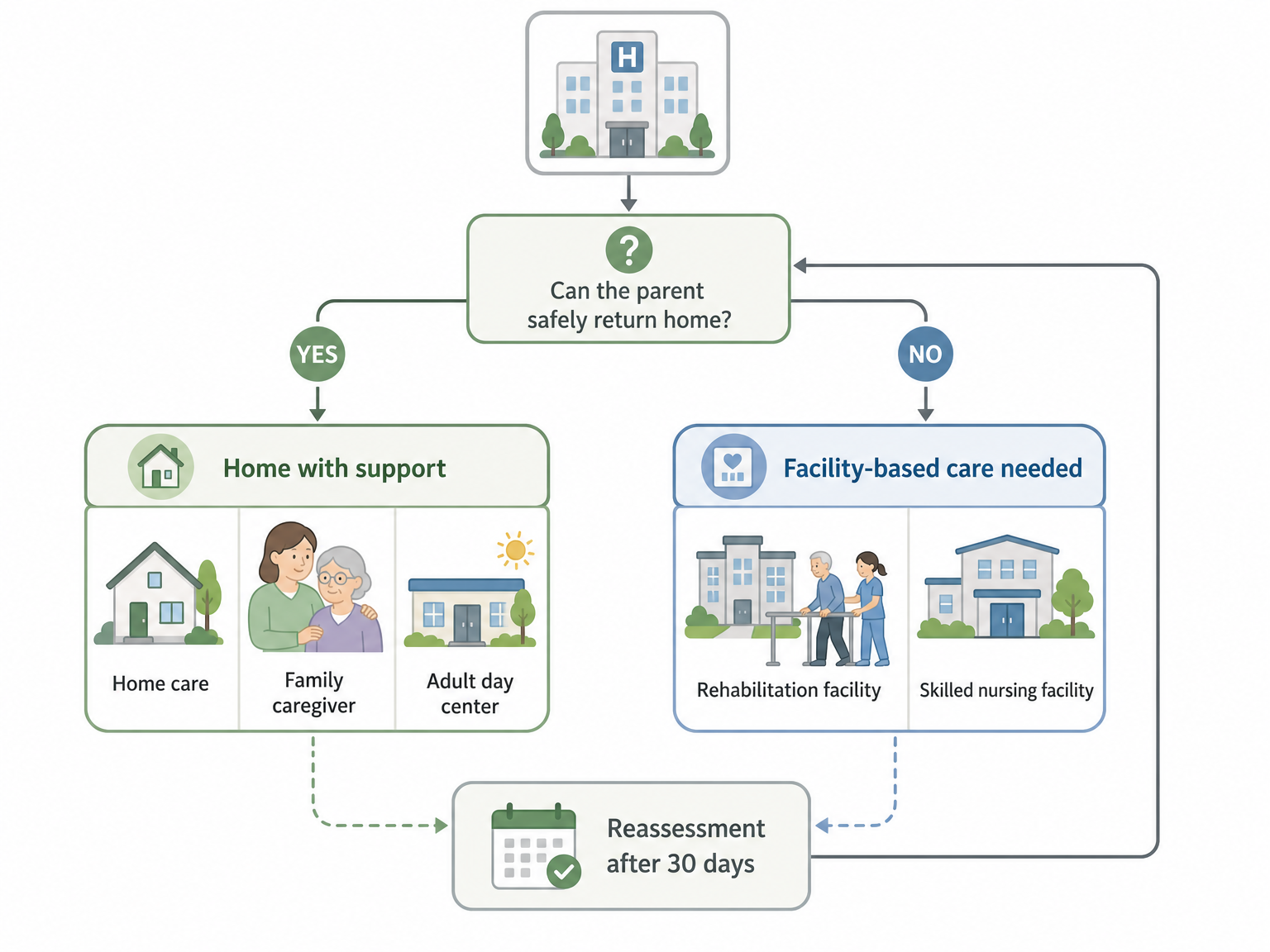
Your parent has been discharged from the hospital after a surgery or serious illness. The immediate question is whether they can safely return home or need a short-term stay in a skilled nursing facility for rehabilitation.
- Clinical: Does your parent need skilled nursing care (wound care, IV medications, physical therapy)? If yes, Medicare Part A may cover a stay in a skilled nursing facility for up to 100 days, but only if the stay follows a qualifying hospital stay of at least three days.
- Daily living: Can your parent safely perform basic activities like getting to the bathroom, preparing food, and taking medications? If not, how many hours of help will they need each day?
- Funding: If your parent needs home care, Medicare will not pay for custodial help. Medicaid may cover home-based services if your parent qualifies. Private insurance or out-of-pocket funds may be needed.
- Coordination: Who will communicate with the hospital discharge planner? Who will set up home care or arrange the skilled nursing facility transfer? This should be decided before discharge.
For a step-by-step guide to this exact scenario, see our Short-Term Care for Elderly: A Crisis Decision Guide.
Scenario 2: New Dementia Diagnosis
A new dementia diagnosis changes everything. The disease is progressive, which means the care plan will need to evolve over time. The four-domain framework helps you plan for the current stage while anticipating future needs.
- Clinical: Has your parent seen a neurologist or geriatrician for a full diagnostic workup? Are there treatable conditions (like depression or vitamin deficiencies) that could be contributing to cognitive symptoms?
- Daily living: In early-stage dementia, your parent may need only reminders and supervision. In middle-stage, they will likely need help with bathing, dressing, and medication management. In late-stage, they will need 24-hour care.
- Funding: Memory care (specialized assisted living for dementia) averages $7,645 per month nationally. Medicare covers very little dementia-related care outside of doctor visits and diagnostic tests. Medicaid may cover memory care in some states.
- Coordination: A geriatric care manager with dementia expertise can be invaluable for navigating the progression and anticipating when higher levels of care will be needed.
Our Senior Care Assistance Options: A Stage-Aware Decision Guide for Families Caring for a Parent with Dementia provides a more detailed, stage-by-stage approach to this scenario.
Scenario 3: A Fall Event
A fall is often the event that reveals how fragile the current care arrangement is. Even if the physical injury is minor, a fall signals that something in the environment or the care plan needs to change.
- Clinical: Was the fall caused by a medical issue (low blood pressure, medication side effect, vision problem, muscle weakness)? A geriatric assessment can identify and address underlying causes.
- Daily living: Does your parent need more supervision or assistance than they are currently receiving? Would a personal emergency response system (PERS) or home modifications (grab bars, better lighting) reduce fall risk?
- Funding: Medicare covers fall risk assessments and physical therapy. It does not cover home modifications or PERS devices. Medicaid and some private plans may cover PERS.
- Coordination: The hospital or emergency department discharge planner should provide a fall prevention plan. Follow up with the primary care physician to ensure the plan is implemented.
Cost Comparison Across Care Settings: Making the Trade-Offs Visible
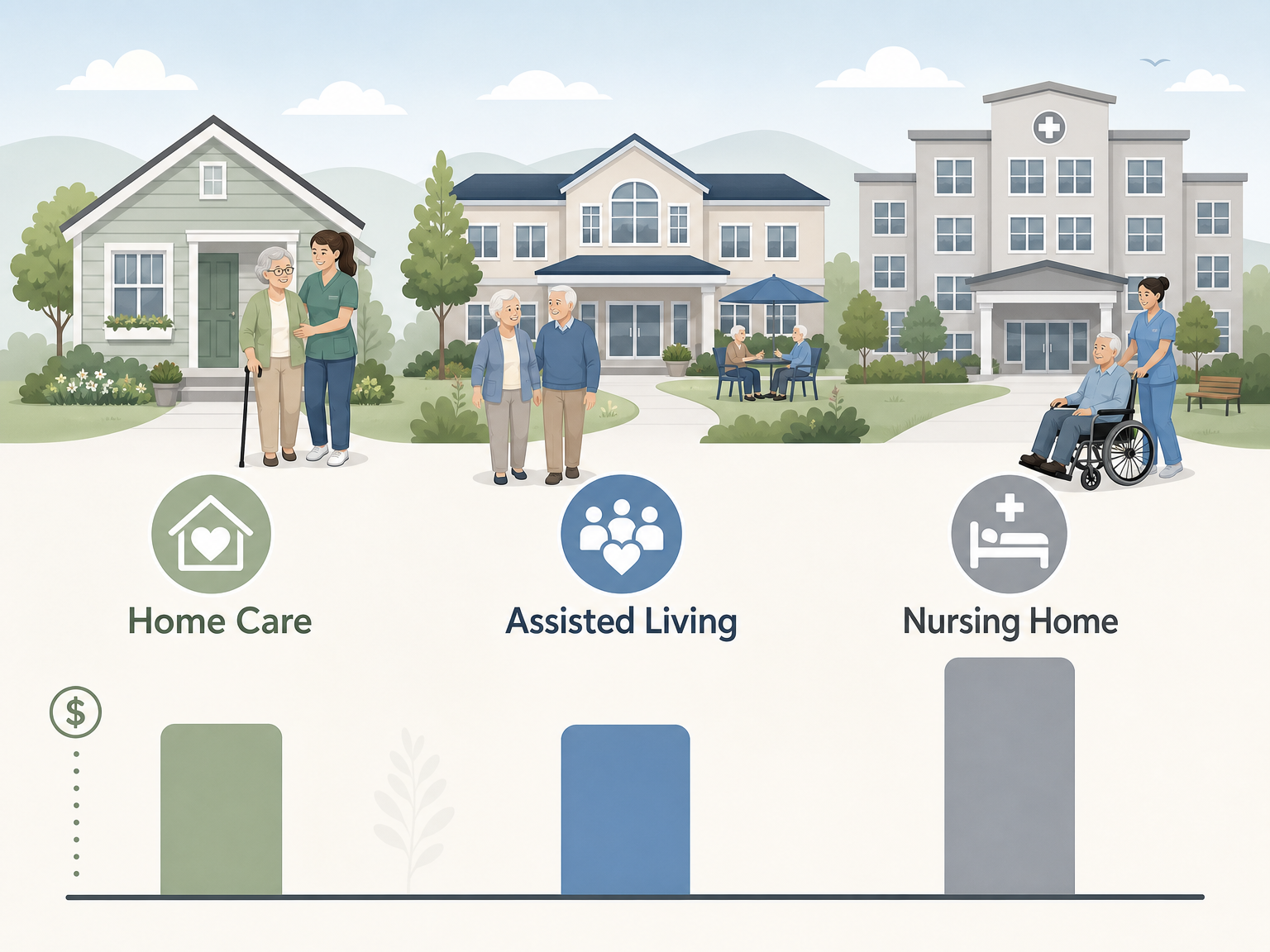
Cost is one of the most important factors in care decisions, but it is rarely the only factor. The table below brings together the national median costs for the most common care settings, so you can see the trade-offs side by side.
| Care Setting | Monthly Cost (Median) | Annual Cost (Median) | Key Trade-Off |
|---|---|---|---|
| Adult day health care (5 days/wk) | $2,058 | $24,700 | Lowest cost option; does not include overnight or weekend care |
| Home care (44 hrs/wk) | $6,673 | $80,080 | Allows aging in place; costs more than assisted living at this level of care |
| Assisted living | $6,200 | $74,400 | Includes room, board, and some personal care; less expensive than home care at high hours |
| Memory care | $7,645 | $91,740 | Specialized dementia care; higher cost than standard assisted living |
| Nursing home (semi-private) | $9,581 | $114,972 | 24-hour skilled nursing; highest level of medical care outside a hospital |
| Nursing home (private) | $10,798 | $129,576 | Private room; highest cost option for facility-based care |
The most important takeaway from this comparison is that home care at 44 hours per week costs more than assisted living. This does not mean home care is always the wrong choice — many older adults and their families strongly prefer it. But it does mean the decision should be made with full awareness of the financial trade-off. If your parent needs 44 or more hours of paid care per week, the annual cost of home care ($80,080) exceeds the annual cost of assisted living ($74,400). At that point, the question becomes whether the benefits of staying at home are worth the additional cost.
Red Flags and When to Escalate: Knowing When the Current Plan Isn't Working
No care plan is perfect from the start, and most need adjustment over time. But some warning signs indicate that the current arrangement is failing and needs a fundamental reassessment, not just a tweak.
Watch for these red flags:
- Repeated hospitalizations or emergency room visits within a short period (three or more in six months)
- Rapid functional decline — your parent loses the ability to walk, transfer, or feed themselves faster than expected
- Caregiver burnout — you or another family caregiver are experiencing exhaustion, irritability, sleep problems, or health issues of your own
- Financial strain — care costs are depleting savings faster than planned, or you are unsure whether you can sustain the current level of care
- Medication errors — missed doses, wrong doses, or conflicting medications from multiple providers
- Safety incidents — falls, wandering, burns, or other accidents that suggest the environment or supervision level is inadequate
When you see one or more of these red flags, it is time to run through the four-domain framework again. Ask: Has the clinical picture changed? Does my parent need more daily support than we are providing? Are we using the right funding sources? Do we need a professional coordinator to help us sort through the options?
If the situation feels overwhelming or you are not sure where to start, a geriatric care manager can provide an objective assessment and a structured care plan. The cost of a few hours of their time is often far less than the cost of a preventable hospitalization or a rushed move to a facility that does not meet your parent's needs.
The goal of this framework is not to eliminate difficult decisions — it is to make them more deliberate. By organizing the complexity into four domains and applying them to your specific situation, you can move from feeling overwhelmed to feeling prepared. And that is the best gift you can give both your parent and yourself.
Browse more in the Glossary.