
Caregiver decision guide
Help at Home Senior Care: A Complete Guide to Services, Costs, and Choosing a Provider in 2026
A comprehensive guide for adult children whose parent needs help at home. Learn how to assess care needs using ADLs/IADLs, understand the full spectrum of in-home services, compare 2026 costs by state, navigate funding sources (Medicare, Medicaid, VA, insurance), and vet providers with a 25-question interview checklist.

What Is In-Home Care? Understanding the Full Spectrum of Services
When a parent or spouse begins to struggle with tasks they once handled easily, the term "home care" gets thrown around as if it describes a single service. In reality, in-home care in 2026 covers a wide spectrum — from a volunteer stopping by for a weekly chat to a registered nurse managing complex wound care. Knowing what each category involves is the foundation of every other decision you will make.
Companion Care
Companion care is the entry point on the spectrum. A companion caregiver provides socialization, light conversation, and supervision — not hands-on physical assistance. They might play cards, accompany your parent on a walk, remind them about appointments, or drive them to the grocery store. Companion care is appropriate for an older adult who is still physically independent but socially isolated or mildly forgetful. The National Institute on Aging notes that volunteer-based "friendly visitor" services are available at no cost in many communities, though paid companion care through an agency typically runs at the lower end of the hourly rate scale.
Personal Care (Non-Medical Home Care)
This is what most families mean when they say "home care." Personal care aides help with the Activities of Daily Living (ADLs) — bathing, dressing, toileting, transferring from bed to chair, eating, and managing continence. They do not perform medical tasks like administering injections or changing wound dressings. Personal care is the most common type of paid in-home support, and it is almost always paid for out of pocket or through Medicaid Home and Community-Based Services (HCBS) waivers, not by Medicare.
Home Health Care (Skilled Care)
Home health care is a medical service. It includes skilled nursing, physical therapy, occupational therapy, speech-language pathology, and medical social services. According to the National Institute on Aging, these services are provided by Medicare-certified agencies and are covered by Medicare only when they are short-term, medically necessary, and ordered by a physician for a homebound patient. Medicare does not pay for 24/7 care, homemaker services like shopping and cleaning, or custodial personal care when that is the only service needed. The distinction between home care and home health care is one of the most common sources of confusion and financial surprise for families.
Live-In Care and 24/7 Care
For seniors who need frequent assistance throughout the night — for toileting, repositioning, or dementia-related wandering — live-in care or 24/7 shift care may be necessary. Live-in care typically involves a caregiver who stays overnight and sleeps for a period, while 24/7 care uses rotating shifts to ensure someone is awake and available at all times. These options are significantly more expensive than hourly care and are rarely covered by insurance or Medicare. Medicaid HCBS waivers typically cap in-home care at 8 to 16 hours per day depending on the state.
Respite Care and Adult Day Care
Respite care provides short-term relief for family caregivers, ranging from a few hours to several weeks. Medicare covers up to 5 consecutive days of respite care in a facility for hospice patients. Adult day care is a less expensive alternative to in-home or nursing home care, though Medicare does not pay for it. Both options can be critical for preventing caregiver burnout while ensuring your parent is supervised and engaged.
| Service Type | What It Includes | Who Provides It | Typical Cost Driver |
|---|---|---|---|
| Companion Care | Socialization, supervision, light errands | Companion or volunteer | Lowest hourly rate |
| Personal Care | Bathing, dressing, toileting, transferring | Home care aide or CNA | Moderate hourly rate |
| Home Health Care | Skilled nursing, PT, OT, speech therapy | RN, LPN, therapist | Higher hourly rate; often Medicare-covered short-term |
| Live-In / 24/7 Care | Continuous assistance day and night | Rotating aides or live-in caregiver | Highest cost; rarely covered by insurance |
| Respite Care | Short-term relief for family caregivers | Agency or facility | Varies by setting; Medicare covers 5 days for hospice |
| Adult Day Care | Supervision, activities, meals in a group setting | Day center staff | Lower than in-home care; not Medicare-covered |
Assessing What Your Parent Actually Needs: The ADL/IADL Framework
Before you call a single agency, you need a clear picture of what your parent can and cannot do safely. The most reliable tool for this is the Activities of Daily Living (ADL) and Instrumental Activities of Daily Living (IADL) framework. It is the same framework that healthcare professionals, Medicaid eligibility reviewers, and long-term care insurance assessors use to determine the level of care a person requires.
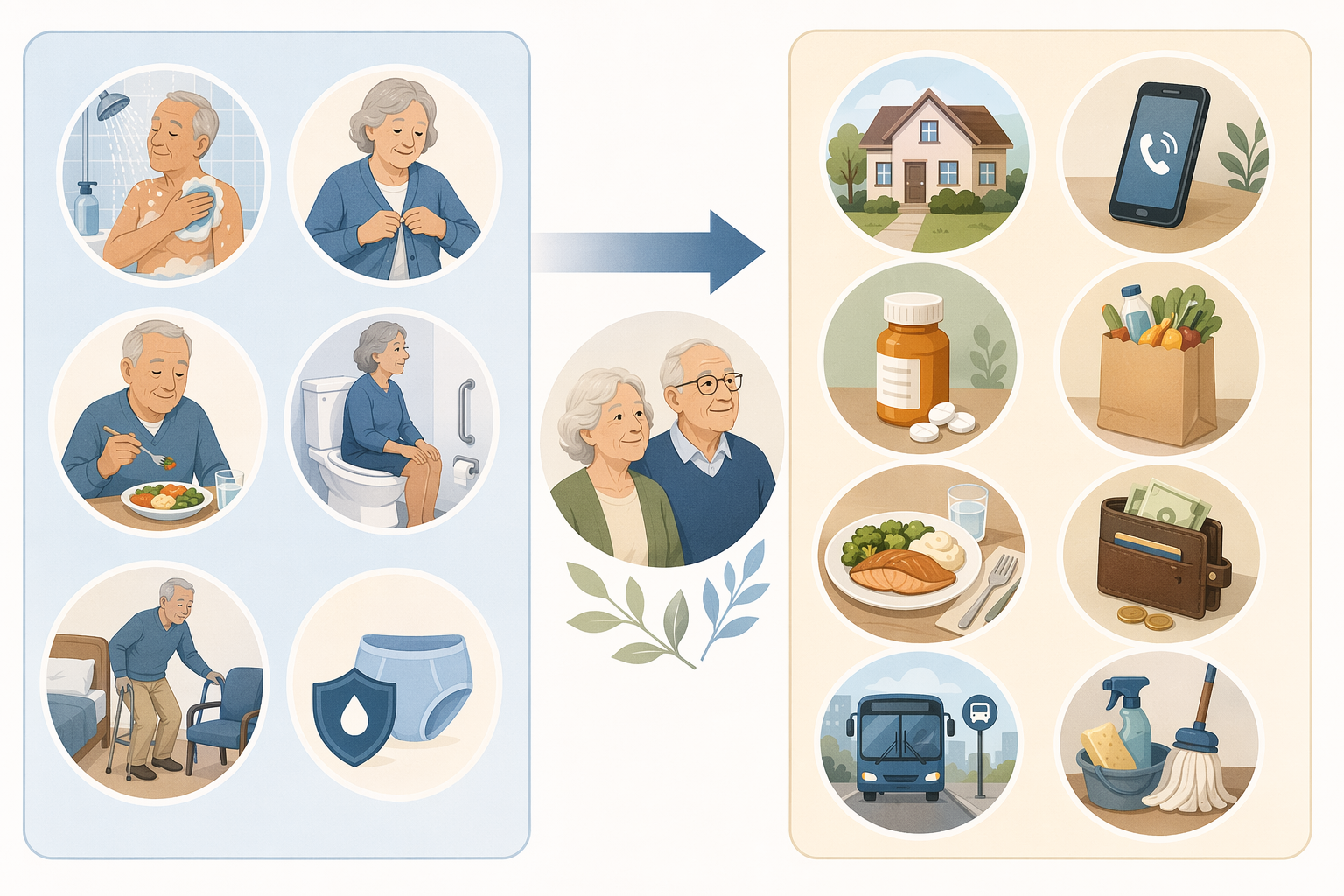
The Six Activities of Daily Living (ADLs)
ADLs are the fundamental self-care tasks that a person must be able to perform to live independently. They are:
- Bathing — getting in and out of the tub or shower, washing all body parts
- Dressing — selecting appropriate clothing, putting it on, fastening buttons and zippers
- Eating — getting food from plate to mouth, chewing, swallowing
- Toileting — getting to and from the toilet, using it, cleaning oneself
- Transferring — moving between bed, chair, and standing position
- Continence — controlling bladder and bowel function
If your parent needs help with one or two ADLs, they likely need personal care assistance for a few hours each day. If they need help with three or more ADLs, they may qualify for Medicaid HCBS waivers — many states use the 3+ ADL threshold as a functional eligibility criterion. If they need help with all or most ADLs, live-in or 24/7 care may be necessary.
The Eight Instrumental Activities of Daily Living (IADLs)
IADLs are more complex tasks that support independent living in the community. Difficulty with IADLs often appears before difficulty with ADLs and can signal the need for companion care or light personal care:
- Housekeeping — cleaning, laundry, maintaining a safe home environment
- Meal preparation — planning, cooking, and safely storing food
- Medication management — obtaining, organizing, and taking medications correctly
- Transportation — driving, using public transit, or arranging rides
- Shopping — buying groceries, household supplies, and personal items
- Financial management — paying bills, managing bank accounts, avoiding scams
- Communication — using the phone, writing, managing mail
- Cleaning and home maintenance — beyond basic housekeeping
A practical self-assessment works like this: go through each ADL and IADL with your parent (or observe them over a few days) and note which tasks they can do safely, which they struggle with, and which they cannot do at all. The pattern of dependencies will tell you what level of care is appropriate. A senior who only needs help with IADLs — meal prep, transportation, housekeeping — may do well with companion care or a few hours of personal care per week. A senior who needs help with multiple ADLs likely requires daily personal care or a higher level of support.
2026 Cost Breakdown: What Help at Home Senior Care Actually Costs
Cost is often the first question families ask, and the answer in 2026 is that it varies dramatically by location, care type, and hours needed. According to A Place for Mom's 2026 report, the national median cost for nonmedical in-home care is $34 per hour, while SeniorLiving.org reports a median of $35 per hour for a home health aide (data from CareScout). The difference reflects slight methodological variation between sources, but the practical range is consistent.
| State | Median Hourly Rate (2026) | Monthly Cost (44 hrs/week) |
|---|---|---|
| Mississippi | $25 | $4,767 |
| Louisiana | $23 | $4,389 |
| Texas | $30 | $5,720 |
| Florida | $31 | $5,913 |
| Michigan | $33 | $6,293 |
| California | $38.50 | $7,341 |
| Colorado | $40 | $7,627 |
| Minnesota | $42 | $8,008 |
| Washington | $42 | $8,008 |
| Vermont | $43 | $8,199 |
| South Dakota | $44 | $8,390 |
To put these numbers in perspective, here is what different care schedules cost at the national median of $34/hour:
| Care Schedule | Hours per Week | Estimated Monthly Cost |
|---|---|---|
| Companion care (light) | 10 hours | $1,473 |
| Part-time personal care | 20 hours | $2,947 |
| Full-time personal care | 40 hours | $5,893 |
| Full-time + overnight | ~60 hours | $8,840 |
| 24/7 shift care | 168 hours | $24,752 |
Home Care vs. Home Health vs. Assisted Living: When Does Each Make Sense?
Many families assume that home care is always cheaper than assisted living. That is true at lower levels of need, but the equation flips once a senior requires 40 or more hours of personal care per week. Understanding where each option fits on the cost-and-care curve helps you make a decision that is both financially sustainable and appropriate for your parent's needs.
| Option | Typical Monthly Cost (2026) | Best For | Key Limitation |
|---|---|---|---|
| Companion care (10-20 hrs/wk) | $1,500 - $3,000 | Socially isolated, independent seniors | No hands-on personal care |
| Personal care (20-40 hrs/wk) | $3,000 - $6,000 | Seniors needing ADL help but not 24/7 | Cost rises steeply with hours |
| Home health care (skilled) | Medicare-covered short-term | Post-hospital recovery, PT/OT | Limited to homebound, time-limited |
| Assisted living | $4,500 - $6,500 (median) | Seniors needing 24/7 supervision | Less privacy, less flexibility |
| 24/7 home care | $20,000+ | High-need seniors who want to stay home | Prohibitively expensive for most |
The cost tipping point typically occurs between 35 and 45 hours per week of paid care. Below that threshold, home care is generally more cost-effective than assisted living. Above it, assisted living or a family care home may be more affordable — and may provide better socialization and supervision. This is not a one-size-fits-all calculation, but it is a crucial one to run with your specific numbers before making a long-term commitment.
How to Pay for Help at Home: Funding Sources Every Family Should Know
Most families pay for home care out of pocket, but several funding sources can reduce or cover the cost. The key is knowing which ones apply to your parent's situation and how to combine them. Here are the major options available in 2026.
Private Pay
Private pay — paying directly from savings, retirement income, or family contributions — is the most common funding source for home care. Unreimbursed medical expenses exceeding 7.5% of adjusted gross income may be tax-deductible, so keep detailed records of all payments to care providers.
Medicare
Medicare covers home health services only when they are medically necessary, ordered by a physician, and provided by a Medicare-certified agency to a homebound patient. Covered services include part-time skilled nursing, physical therapy, occupational therapy, and speech-language pathology. Medicare does not pay for 24/7 care, homemaker services, or custodial personal care when that is the only care needed. Skilled care is limited to a combined maximum of 8 hours per day and 28 hours per week, with possible short-term increases to 35 hours per week.
Medicaid Home and Community-Based Services (HCBS) Waivers
Medicaid HCBS waivers are the single largest public funding source for in-home personal care. According to U.S. News, over 86% of Medicaid long-term support beneficiaries received care at home through waiver programs in 2021 (Medicaid.gov data). These waivers allow states to use Medicaid funds to pay for non-medical in-home care — including personal care, homemaker services, and respite care — for seniors who would otherwise need nursing home care.
Eligibility varies significantly by state. In 2026, the typical asset cap for an individual is around $2,000, though some states like California allow up to $130,000. The income limit in many states is up to three times the federal SSI amount ($994 in 2026), totaling up to $2,982 per month. Functional eligibility often requires assistance with 3 or more ADLs. Many states also offer self-directed care, which allows family members to be paid as caregivers.
VA Aid and Attendance
The Department of Veterans Affairs provides Aid and Attendance benefits as a monthly payment added to a VA pension for qualified veterans and their surviving spouses who need help with daily activities. The benefit is available to those who require assistance with bathing, feeding, or dressing; are bedridden; are in a nursing home due to disability; or have limited eyesight. In 2026, the maximum monthly benefit for a married veteran is up to $2,874, with lower amounts for single veterans and surviving spouses. The VA also offers a Housebound Allowance for those who spend most of their time at home due to a permanent disability, though veterans cannot receive both benefits simultaneously.
Long-Term Care Insurance
Long-term care insurance can cover in-home personal care, but the coverage gap is stark. According to a February 2026 Pew Research Center survey of 8,750 U.S. adults 65 and older, only 21% have long-term care insurance. For the 79% who do not, home care costs must be covered by other means. If your parent does have a policy, review it carefully: most policies have a waiting period (typically 30 to 90 days) before benefits begin, and they may cap daily or lifetime benefits.
How to Find and Vet Providers: Agency vs. Independent Caregivers
Once you know what level of care your parent needs and how you will pay for it, the next decision is whether to hire through a home care agency or find an independent caregiver directly. Each path has distinct trade-offs in cost, liability, and convenience.
| Factor | Agency | Independent Caregiver |
|---|---|---|
| Cost | Higher (20-30% more than independent) | Lower; no agency markup |
| Screening and training | Agency handles background checks, certifications, training | You are responsible for vetting |
| Backup coverage | Agency provides substitute if caregiver is unavailable | You must find and manage substitutes |
| Payroll and taxes | Agency handles all payroll, taxes, and insurance | You become the employer (withholding, workers' comp) |
| Liability and insurance | Agency carries liability and workers' comp insurance | Not required in all states; you may be exposed |
| Caregiver consistency | May send different caregivers; less consistency | More consistent relationship; one person |
| Supervision | Agency conducts supervisory visits and evaluations | You manage performance and scheduling |
Agencies typically charge 20-30% more than independent caregivers, according to SeniorLiving.org. That premium buys you screening, training, backup coverage, and liability protection. Independent caregivers are less expensive and offer more choice and consistency, but you take on the responsibilities of being an employer — conducting background checks, managing payroll and tax withholding, and finding substitutes when the caregiver is unavailable. Private caregivers are not required to carry insurance in all states, which can create significant liability exposure.
25 Questions to Ask Before Hiring a Home Care Agency
When you interview home care agencies, you are not just evaluating their services — you are evaluating whether they will be a reliable partner in your parent's care. Use this checklist, adapted from AgingCare's 25-question framework, to ensure you cover every critical area.
Business Qualifications
- Is the agency licensed, bonded, and insured in our state?
- Do you carry workers' compensation insurance for your employees?
- How long have you been operating in this area?
- Can you provide references from current clients with similar care needs?
- Are you accredited by any national organizations (e.g., The Joint Commission, CHAP)?
Care Management
- How do you create a personalized care plan? Who is involved in the assessment?
- How often is the care plan reviewed and updated?
- Do you have experience caring for clients with dementia, Parkinson's, or other specific conditions?
- How do you communicate with the family about changes in my parent's condition?
- Who is my primary point of contact, and how do I reach them after hours?
Caregiver Selection and Training
- What background checks do you run on caregivers (criminal, driving, professional reference)?
- What training do caregivers receive before being assigned to a client?
- Do you provide ongoing training for dementia care, fall prevention, or medication management?
- How do you match caregivers to clients? Can we meet the caregiver before they start?
- How often does a supervisor visit the home to evaluate the caregiver's performance?
Company Policies
- What is your backup plan if the regular caregiver is sick or unavailable?
- How do you handle emergencies? What is your protocol if a caregiver does not show up?
- Can we request a different caregiver if the match is not working?
- What is your policy on caregiver cancellations and last-minute schedule changes?
- Do you allow family members to be present during care? Do you have a privacy policy?
Billing and Contracts
- What is your hourly rate? Are there different rates for weekends, holidays, or overnight shifts?
- Is there a minimum number of hours per visit or per week?
- Do you offer a free in-home consultation to assess our needs?
- Do you accept long-term care insurance, Medicare, or Medicaid? How does billing work?
- What is your cancellation policy? Is there a termination fee if we decide to stop services?
Planning for Escalating Needs: How to Adapt as Care Requirements Change
The care plan you put in place today will not be the same care plan your parent needs a year from now. Chronic conditions progress, mobility declines, and cognitive changes create new challenges. The families who navigate this transition most successfully are the ones who build flexibility into their plan from the start.
When to Reassess
Revisit the ADL/IADL assessment every three to six months, or immediately after any significant event — a hospitalization, a fall, a medication change, or a noticeable decline in function. The number and type of dependencies will tell you whether your current care level is still appropriate. A parent who needed only companion care six months ago may now need help with bathing and dressing, which shifts them from the companion care category to personal care.
How to Adjust Your Care Plan
- Increase hours gradually — If your parent needs more help, start by adding a few hours per week before jumping to full-time care. This gives everyone time to adjust.
- Upgrade the service type — Move from companion care to personal care, or from personal care to home health care if skilled needs arise.
- Revisit funding sources — A new ADL dependency may qualify your parent for Medicaid HCBS waivers or a higher VA Aid and Attendance benefit. Reapply if circumstances change.
- Consider a different provider — Some agencies specialize in high-need or dementia care. If your current agency cannot meet escalating needs, it may be time to switch.
- Evaluate the cost tipping point — As hours increase, model the cost of home care versus assisted living or a family care home. The right answer may change over time.
The most important thing you can do is plan for change before it happens. Build relationships with multiple agencies, keep your parent's ADL/IADL documentation current, and revisit your funding strategy annually. Home care is not a single decision — it is an ongoing process of assessment, adjustment, and advocacy. You do not have to get it perfect on day one. You just have to start.
Questions to bring to a clinician or OT
This is not medical, legal, or a family's final decision — only a framework. Bring these questions to a clinician, occupational therapist, or your local Area Agency on Aging.
Find Local HelpRelated reading
Noticed something outdated or inaccurate on this page? Flag a correction. We review every report against CDC, NIA, and AARP HomeFit guidance before updating a page.