
Clinical term
Room-by-Room Aging-in-Place Checklist: A Home Safety Guide for Families
You are about to walk through a parent’s home, and the whole house feels like too much. Start with the rooms where a missed hazard is most likely to matter tonight: the bathroom, the path from bed to bathroom, the stairs and hallways, and the entry. Mark each item as either a quick fix, a professional fix, or a question for an occupational therapist or CAPS-certified contractor.
The urgency is real, but it does not require panic. The CDC reports that 1 in 4 older adults in the U.S. falls each year, about 14 million people, and that falls are the leading cause of fatal and nonfatal injuries among adults 65 and older.[1] NCOA puts the national health care cost of falls at $80 billion annually in 2020, with projected costs exceeding $101 billion by 2030.[2] Those numbers are only useful if they help you decide where to stand with the clipboard first.
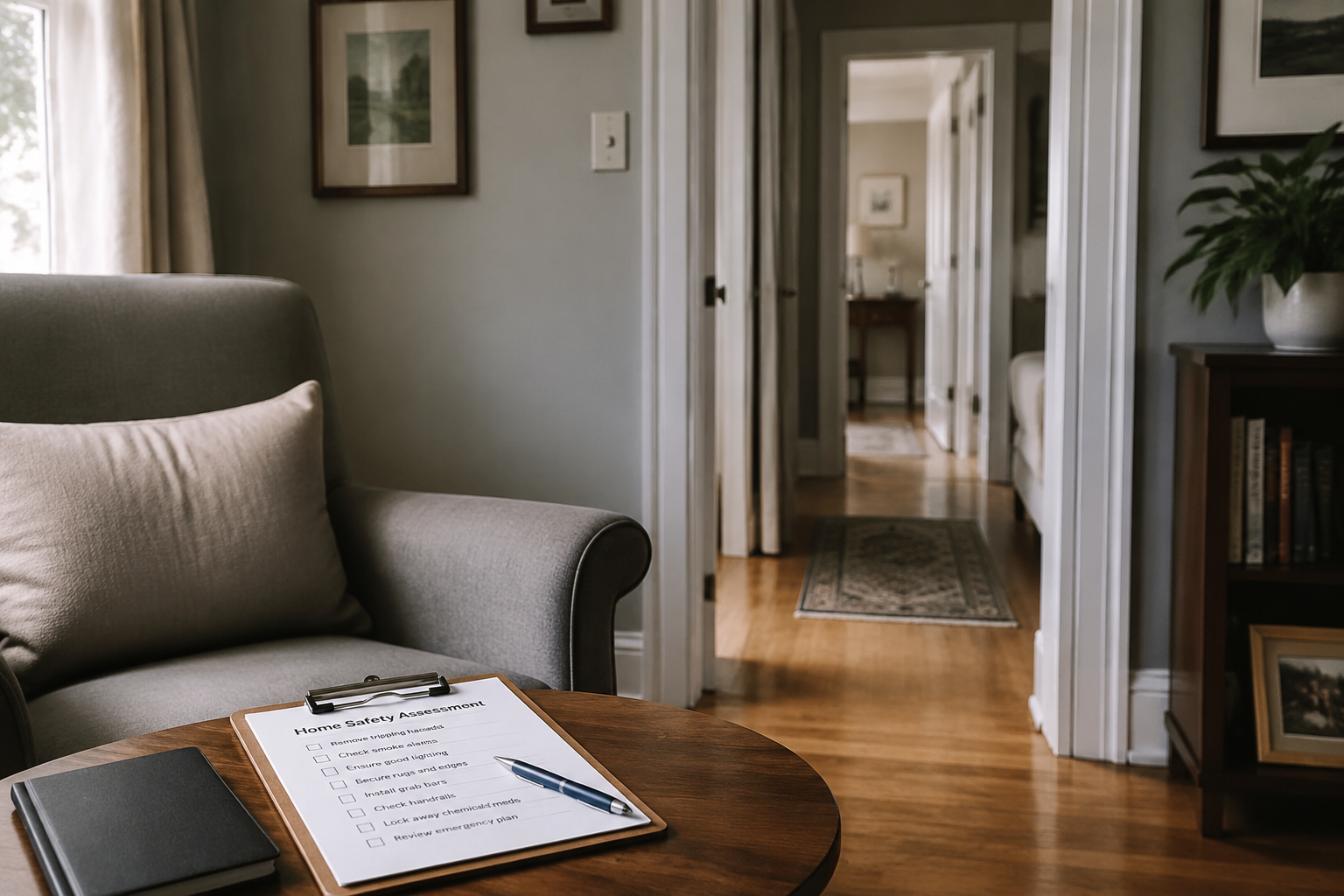
How to Use This Aging in Place Checklist
Walk the home in the same order an older adult uses it: entering the house, moving through halls and stairs, getting to the bathroom, cooking, sleeping, sitting, and doing laundry. Do not try to price everything during the first pass. The first job is to see what is there.
| Mark | Use it for | Examples |
|---|---|---|
| Quick fix | A hazard the family can usually correct without altering the structure | Loose cord, missing nightlight, unstable bath mat, cluttered path |
| Professional fix | Work that affects plumbing, electrical, anchoring, stairs, doors, or mounted safety equipment | Grab bars, anti-scald valve, stair rail, widened doorway |
| Assessment needed | A change that depends on mobility, transfer ability, diagnosis, or home layout | Shower conversion, ramp design, wheelchair turning space, post-fall care plan |
This is a screening checklist, not a clinical home assessment. If a parent has fallen, is being discharged from the hospital, has new weakness, or needs help transferring, bring in an occupational therapist, a CAPS-certified professional, or the appropriate clinician before treating the checklist as a construction plan.
Bathroom: Start Where Wet Floors and Transfers Meet
The bathroom deserves the slowest pass. It is where a person turns, reaches, lowers, stands, steps over edges, and often does it on a wet surface. A pretty grab bar that is not anchored is not a safety feature; it is a future repair bill with worse timing.
Toilet Area
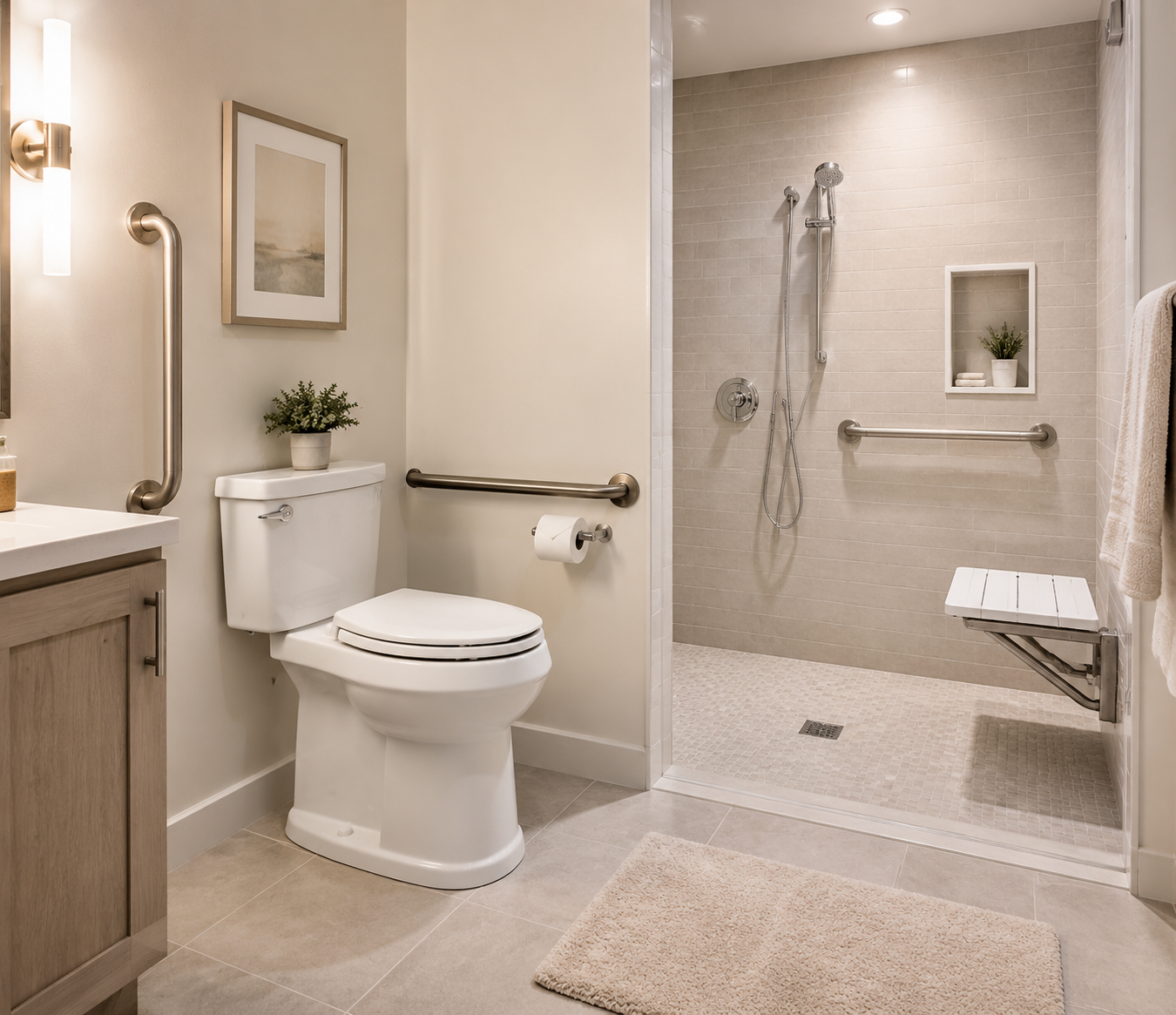
- Measure toilet seat height. NAHB CAPS guidance lists a 17–19 inch toilet height as the target range for easier sitting and standing.[3]
- Check whether the person pushes off the sink, towel bar, tank lid, or wall when standing. Mark that as a transfer support problem, not as “normal aging.”
- Look for grab bars beside and, when useful, behind the toilet. NAHB CAPS specifies that grab bars should be anchored into studs or blocking and support 250–300 pounds.[3]
- Do not count a suction grab bar as a substitute for a properly mounted bar. It may help with balance cues in limited situations, but it should not be treated as load-bearing support.
- Confirm there is enough side clearance for the person’s current mobility device and for a caregiver if hands-on help is already needed.
Tub, Shower, and Bathing Surface
- Watch the threshold. A tub wall or raised shower lip becomes a bigger problem when someone is tired, wet, medicated, or rushing.
- Check for a non-slip bathing surface, not just a decorative mat. Mats should lie flat, grip firmly, and be easy to remove for cleaning.
- Look for a stable shower chair or built-in seat if standing through a full shower is difficult. Wobbling, rust, and incorrect height are reasons to replace it.
- Confirm that soap, shampoo, towels, and the handheld shower are reachable without bending low, twisting hard, or stepping away from support.
- Mark any shower or tub grab bar that is mounted through tile but not verified as anchored into framing or blocking. That is a professional fix, not a family guess.
Water Temperature and Night Use
- Check whether the faucet can swing suddenly from warm to hot. Age Safe America recommends anti-scald protection set to 120°F.[4]
- Add a nightlight that shows the toilet, threshold, and sink edge without forcing the person to turn on a glaring overhead light.
- Remove loose bath rugs unless they have reliable non-slip backing and do not bunch under a walker, cane, or foot.
- Make sure the bathroom door can be unlocked from the outside in an emergency.
If the bathroom produces more than one professional-fix mark, pause before buying equipment online. A raised toilet seat, toilet safety frame, wall-mounted grab bar, shower chair, and shower conversion all solve different problems. The right choice depends on how the person transfers, how much arm strength they have, and whether another person helps.
Entry, Doors, Hallways, and Stairs: Follow the Daily Route
Now stand at the main entrance and walk the route to the bedroom, bathroom, kitchen, and favorite chair. This is where the home either supports normal movement or turns every errand into a negotiation with thresholds, narrow doors, dim corners, and stairs.
Entry
- Check for at least one entry that does not require a step. AARP recommends at least one no-step entry for aging in place.[5]
- Look at the landing. There should be room to stand, set down a bag, unlock the door, and open it without backing toward a step.
- Replace round doorknobs with lever-style handles where grip strength, arthritis, or carrying items makes twisting difficult. AARP includes lever-style handles in its home checklist guidance.[5]
- Check exterior lighting from the car, driveway, walkway, and porch. The key moment is not whether a light exists; it is whether it comes on before the person reaches the dark patch.
- Mark cracked walkways, loose railings, uneven pavers, slick porch surfaces, and high thresholds as trip or access hazards.
Doors and Hallways
- Measure clear door width where walkers or wheelchairs may be used. NAHB CAPS lists a minimum 32-inch clear door width for access.[3]
- Measure the narrowest hallway. NAHB CAPS lists 36 inches as the minimum hallway width.[3]
- Remove small tables, baskets, plant stands, shoe racks, and decorative objects that force a person to turn sideways or lift a walker.
- Check whether doors swing into tight spaces where a walker, wheelchair, or caregiver would block movement.
- Add lighting along the full route from bedroom to bathroom, not just at the destination.
Stairs
- Check for handrails on both sides. NAHB CAPS guidance specifies handrails with a 1.25-inch diameter.[3]
- Grip the rail and pull. A loose rail is not a minor defect if someone uses it to recover balance.
- Use contrast tape on stair edges where depth is hard to see, especially on patterned carpet or low-contrast wood.
- Check lighting at the top and bottom of the stairs, with switches reachable before stepping onto the stairs.
- Remove objects stored on steps, including laundry baskets, shoes, pet items, and mail.
Door widening, ramp work, stair rail installation, and stair lift decisions belong in the professional-fix column. If stairs are the only path to a bedroom, bathroom, laundry room, or exit, the issue is not just convenience; it is whether daily life and emergency access depend on a risky route.
Kitchen: Reduce Reaching, Bending, and Fire Risk
The kitchen walkthrough is less about making every cabinet perfect and more about seeing which tasks require unsafe movement. Watch for reaching over heat, bending below the knees, carrying hot liquids across open space, and turning quickly between appliances.
- Move everyday dishes, mugs, cookware, and pantry staples between shoulder and knee height.
- Consider pull-out shelves where deep lower cabinets force kneeling, bending, or rummaging.
- Check whether stove controls are easy to see and reach without leaning across hot burners.
- Add or discuss stove auto-shutoff technology if burners are left on, pans are forgotten, or family members are already checking by phone.
- Replace hard-to-turn faucet handles with lever-style handles where grip is a problem.
- Remove throw rugs near the sink, stove, and refrigerator unless they are flat, secured, and do not catch underfoot.
Do not turn the kitchen into a test of independence while you are standing there. If a parent has a system that works, keep it. Mark the places where the system depends on luck: a step stool, a slippery mat, a heavy pot stored low, or a burner that stays on after the meal is done.
Bedroom: Check the Night Route First
The bedroom is not finished when the bed is safe. The real route is bed to bathroom at 2 a.m., possibly in socks, without glasses, and with medication or sleep still in the body.
- Clear a direct path from bed to door and from door to bathroom.
- Add nightlights or motion lighting that illuminate the floor, doorway, and bathroom entrance.
- Check bed height. A practical target is around knee height for the person using it, so sitting and standing do not require dropping down or climbing up.
- Place a stable surface within reach for glasses, phone, water, hearing aids, and a lamp switch.
- Remove loose rugs, trailing blankets, oxygen tubing slack, charger cords, and low storage bins from the walking path.
- Add a firm chair with arms if dressing while standing has become unsteady.
If the person now sleeps in a recliner because the bed is too hard to enter or exit, mark that as assessment needed. Sometimes the answer is a different bed setup. Sometimes it signals pain, breathing difficulty, weakness, or transfer problems that need clinical attention.
Living Areas: Make the Favorite Chair Safer
In the living room, start with the chair the person actually uses. A beautiful room plan matters less than whether someone can sit, stand, reach the phone, get to the bathroom, and move around without catching a foot or walker.
- Check that the main chair is firm, stable, and has arms for controlled sitting and standing.
- Remove or secure cords across walking paths, including lamp cords, extension cords, charging cables, and power strips.
- Use non-slip rug backing or remove area rugs that curl, slide, bunch, or create a raised edge.
- Keep remote controls, phone, medication reminders, tissues, and lighting controls reachable without leaning far out of the chair.
- Check for enough open floor area to turn with a walker or wheelchair. NAHB CAPS lists a 5-by-5-foot turning space for wheelchair maneuverability.[3]
- Move low coffee tables, ottomans, magazine baskets, and pet beds out of the main path.
This is also the room where families over-negotiate. If one rug is the spot where a walker catches every time, the issue is not whether the rug is expensive or meaningful. The issue is whether the person can cross the room safely on an ordinary afternoon.
Laundry and Utility Areas: Watch the Bending and the Chemicals
Laundry rooms and utility spaces are easy to skip because they are not where guests look. They are also where people carry baskets, step around stored items, bend into machines, and reach cleaning products.
- Raise front-loading machines 12–15 inches if bending into the washer or dryer is difficult.
- Clear the path from bedroom or bathroom to laundry, especially if baskets are carried by hand.
- Add task lighting over machines, sink areas, and storage shelves.
- Store detergent, bleach, pods, solvents, and cleaning products in a locked or controlled location if memory, vision, or judgment is a concern.
- Move heavy supplies between shoulder and knee height.
- Check basement laundry routes carefully. If laundry requires stairs, the stairs belong in the safety plan, not just the laundry room.
What to Do After the Walkthrough
When the walkthrough is done, do not let the list turn into one more family document that sits on the counter. Circle the hazards that affect toileting, bathing, stairs, nighttime movement, and entry first. Those are the items most likely to shape daily safety and whether someone can keep using the home normally.
For a phased repair plan, use a prioritization framework rather than arguing room by room. The next useful step is deciding what must happen now, what can wait, and what requires a contractor or clinical input. A companion guide to prioritizing aging-in-place home modifications can help turn marked hazards into a sequence.
If this walkthrough is happening after a fall, use an after-a-fall triage guide before starting a full renovation wish list. The first 72 hours have different priorities than a planned aging-in-place remodel.
For structural work, especially grab bars through tile, door widening, stair changes, ramps, shower conversions, and major circulation changes, compare a CAPS specialist with a general contractor before hiring. A guide to choosing between a CAPS specialist and a general contractor is the right next read when the checklist reveals work that cannot be solved with a nightlight and a rug pad.
Cost should come after triage, not before it. Once the safety list is sorted, look at funding options for aging-in-place home modifications, and use a broader room-by-room home modification guide if you need cost ranges and priority indicators.
References
- Facts About Falls — CDC
- Get the Facts on Falls Prevention — NCOA
- Aging-In-Place Remodeling Checklist — NAHB CAPS
- Essential Aging in Place Checklist: 50 Safety Tips — Age Safe America
- Your Home Checklist for Aging in Place — AARP
Browse more in the Glossary.