
Room checklist
Aging in Place Home Modifications: A Room-by-Room Walk-Through Guide for Family Caregivers
This practical, printable walk-through guide helps you assess each room in your parent’s home for fall risks and aging-in-place needs, with room-by-room hazard spotting, priority indicators, and cost ranges so you know what to fix first and what it will cost.
If your parent just fell, came home from the hospital, or started holding the wall to get from the sofa to the bathroom, do not start with a whole-house remodel plan. Start with a walk-through. Take photos, mark hazards, and sort each fix into three buckets: do today, buy this week, or get a professional quote.
The urgency is real, but it does not have to turn into panic. More than 1 in 4 adults age 65 and older falls each year, and many homes were not built for weaker balance, slower transfers, walkers, shower chairs, or nighttime bathroom trips.[1] One commercial summary of Census Bureau and National Poll on Healthy Aging findings reports that 90% of U.S. homes lack basic aging-ready features, while only 18% of adults 50 and older have made any home modifications.[2] That gap is why a house can look familiar on Monday and feel unsafe by Friday.
If the fall happened in the last day or two, handle the medical and immediate safety triage first. A bruised hip, new confusion, dizziness, medication change, or sudden weakness changes what you should fix and how fast. Use this walk-through after the immediate questions in an after-a-fall triage guide are addressed.
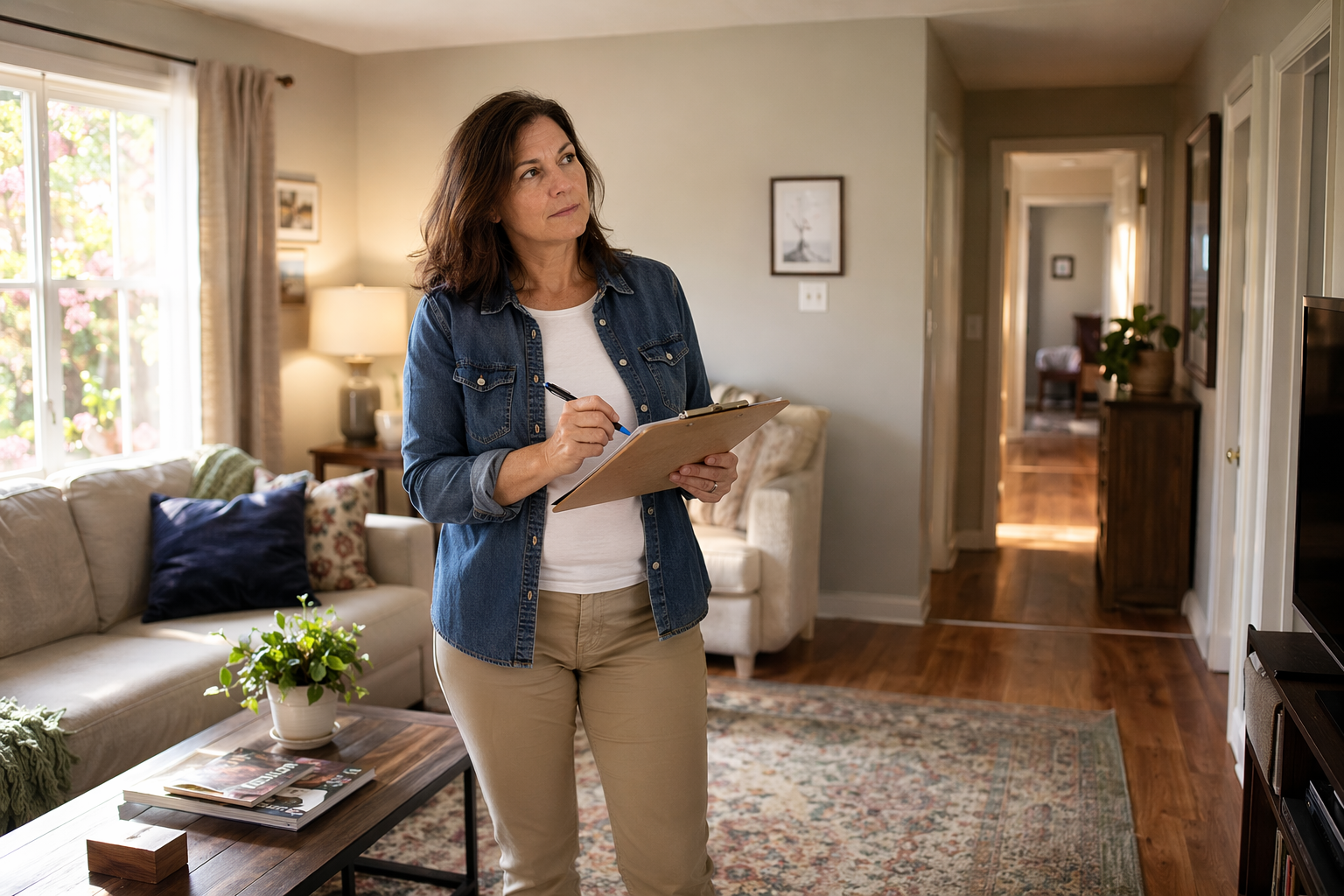
How to Use This Walk-Through Without Getting Overwhelmed
Walk the home in the same order your parent uses it: from the outside approach to the entry, stairs, living room, kitchen, bathroom, and bedroom. Do not try to solve everything as you see it. Your job on the first pass is to notice what could cause a fall, what blocks help from reaching your parent, and what makes toileting, bathing, sleeping, or eating harder than it needs to be.
| Priority | What it means | Examples |
|---|---|---|
| Fix today | No-cost or low-cost hazard removal that reduces immediate fall risk | Remove throw rugs, clear cords, move a lamp within reach, clear the stair landing |
| Buy this week | Safety item usually in the low-cost range, often under $500 before complex installation | Grab bars, night-lights, raised toilet seat, shower chair, non-slip tread strips |
| Get a quote | Work that changes plumbing, structure, electrical service, stair access, or major bathroom layout | Walk-in shower conversion, stair lift, widened doorway, full bathroom renovation |
| Call a professional | Mobility, cognition, transfers, or home conditions make guesswork unsafe | Repeated falls, unsafe shower or toilet transfers, wheelchair access, major stairs, caregiver injury risk |
Use cost as a sorting tool, not as a promise. National cost ranges from 2024-2026 vary by region, labor availability, home age, wall condition, plumbing, and whether a simple purchase turns into installation work. A $40 grab bar is not a $40 safety fix if there is no solid blocking in the wall. A shower conversion in a newer one-story home is a different project from one in an old house with hidden water damage.
As you walk, write the room, hazard, likely fix, and priority. Take a photo of the exact spot. If you later call an occupational therapist, a Certified Aging-in-Place Specialist, or a contractor, those photos save time and reduce the chance that the conversation turns into vague remodeling talk. For complex cases, a specialist assessment can help separate ordinary household fixes from clinical transfer and mobility problems.
Exterior Approach: Can Help Reach the Door Safely?
Start at the curb, driveway, garage, or usual drop-off point. Look for uneven pavement, loose gravel, poor lighting, ice-prone steps, a missing handrail, a heavy storm door, or a long walk with no place to pause. This is not the prettiest part of aging in place home modifications, but it is where paramedics, family members, meal deliveries, and your parent all have to move through the same physical reality.
- Fix today: move planters, hoses, decorative rocks, and loose mats away from the walking path.
- Buy this week: brighter exterior bulbs, motion lights, high-contrast house numbers, non-slip outdoor mats, or a sturdy bench near the door.
- Get a quote: railings for exterior steps, ramp work, threshold changes, or repairs to cracked pavement.
- Call a professional: if your parent uses a wheelchair, cannot manage even one step reliably, or needs hands-on help every time they enter or leave.
Do not let a ramp be the automatic answer. A ramp needs the right slope, landing space, surface, drainage, and railings. If the door area is cramped or the grade is steep, a contractor or accessibility specialist should look before anyone buys materials.
Entry and Stairs: Clear the Landing Before You Price the Stair Lift
At the entry, stand where your parent stands while unlocking the door. Is there a handhold? Is the light switch reachable? Does the door swing into the walker? Is there a step that blends into the floor color? A cleared landing and one reliable handrail can matter more tonight than a catalog of larger upgrades.
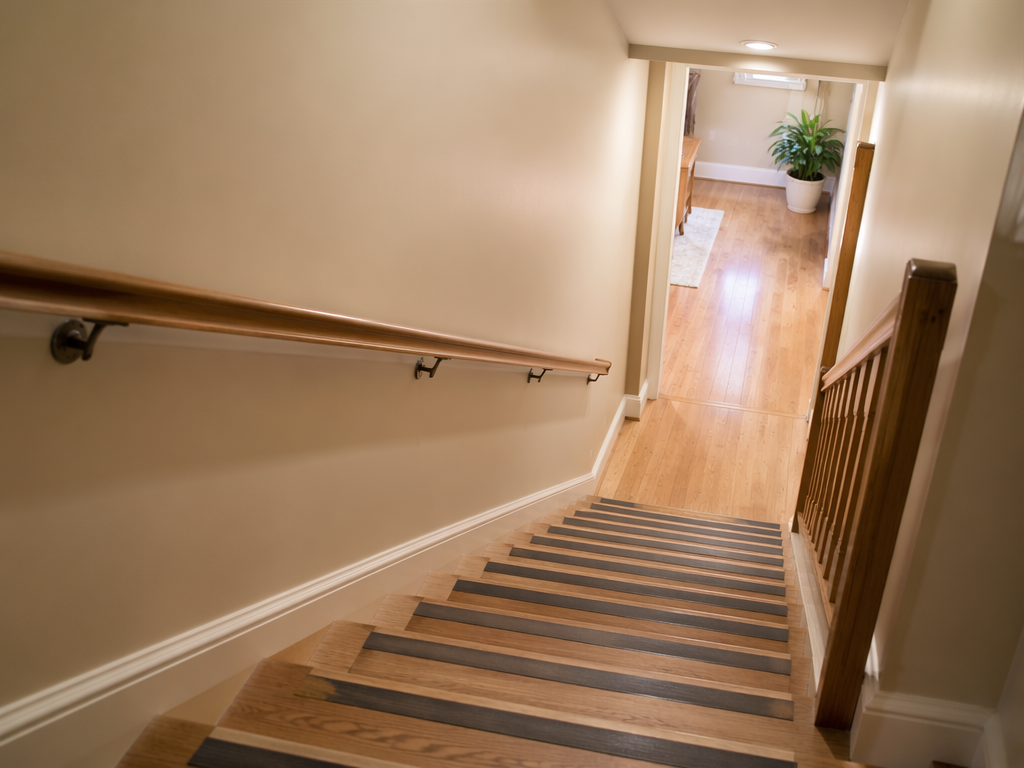
On stairs, check the handrail first. It should be continuous, firmly attached, easy to grasp, and present where the stair run actually begins and ends. Then look at lighting, tread contrast, loose carpet, curled stair runners, clutter on steps, and whether your parent carries laundry, mail, or a drink while climbing.
- Fix today: remove shoes, baskets, pet items, and storage from landings and steps.
- Buy this week: brighter bulbs, plug-in lights, non-slip tread strips, or a second key setup so your parent is not balancing bags while unlocking the door.
- Get a quote: handrail installation, stair repair, threshold modification, or a stair lift if the stairs are unavoidable.
- Call a professional: if your parent has fallen on the stairs, avoids the second floor because of fear, or cannot use both feet and one hand safely.
Forbes Health lists stair lifts in a broad national range of $2,000 to $10,000 or more.[3] That is a reason to get more than one local quote, not a reason to postpone every stair fix. Clear the steps, improve lighting, and repair obvious trip points while the larger decision is being priced.
Living Room: Follow the Actual Walking Path
In the living room, do not assess the room from the doorway. Walk the path your parent uses: favorite chair to bathroom, chair to kitchen, chair to front door, chair to thermostat. Most living room fixes are not glamorous. They are about reducing the number of things a tired person has to step over, reach around, or lean on.
- Look for: throw rugs, extension cords, low coffee tables, unstable side tables, pet beds, footstools, poor lighting, and furniture that forces narrow turns.
- Fix today: remove or secure rugs, reroute cords, widen the main path, and put the phone, remote, water, glasses, and lamp within reach.
- Buy this week: a stable chair with arms, better task lighting, cord covers, or a side table that does not wobble when used for light support.
- Call a professional: if your parent cannot rise from the chair without pulling on furniture or if the walker cannot turn safely through the room.
The chair deserves special attention. If your parent drops into it, rocks several times to stand, or grabs a rolling table for leverage, the problem is not just furniture placement. It may be leg strength, seat height, pain, medication timing, or transfer technique. That is a good point to ask a therapist to watch the movement instead of guessing from across the room.
Kitchen: Reduce Reaching, Carrying, and Turning
The kitchen is where a parent often insists things are fine because they can still make coffee or toast. Watch the sequence, not the pride. Are they reaching overhead for dishes? Carrying hot liquid across a rug? Turning quickly from refrigerator to counter? Using a chair or step stool to reach a cabinet? Those are the hazards to mark.
- Fix today: move daily dishes, mugs, pans, medications, and snacks to waist-to-shoulder height.
- Fix today: remove kitchen rugs that curl, slide, or bunch under a walker.
- Buy this week: brighter under-cabinet or plug-in lighting, a rolling cart only if it locks and is not used as a walker, or easy-grip tools for painful hands.
- Get a quote: electrical work for safer lighting or layout changes if the kitchen cannot be used without repeated unsafe reaching.
Leave major kitchen renovation out of the first week unless the kitchen is the site of repeated falls or the parent cannot prepare food safely. The immediate win is usually a shorter reach, a clearer floor, and a place to set items down before turning.
Bathroom: Start Here If You Can Only Fix One Room
The bathroom gets priority because it combines water, urgency, undressing, turning, sitting, standing, and often poor space. Occupational therapist Cheryl Hall’s plain description is the one I wish every family heard before buying decorative towel bars: the bathroom is hazardous because “you’re naked and wet.”[1]
The toilet area is not a minor detail. CDC data cited by Wirecutter reports that 28% of bathroom injuries among adults 65 and older are toilet-related.[1] If your parent is rushing to the toilet at night, lowering onto a low seat, twisting for toilet paper, or pushing up from a sink or towel bar, that is a high-priority fix.
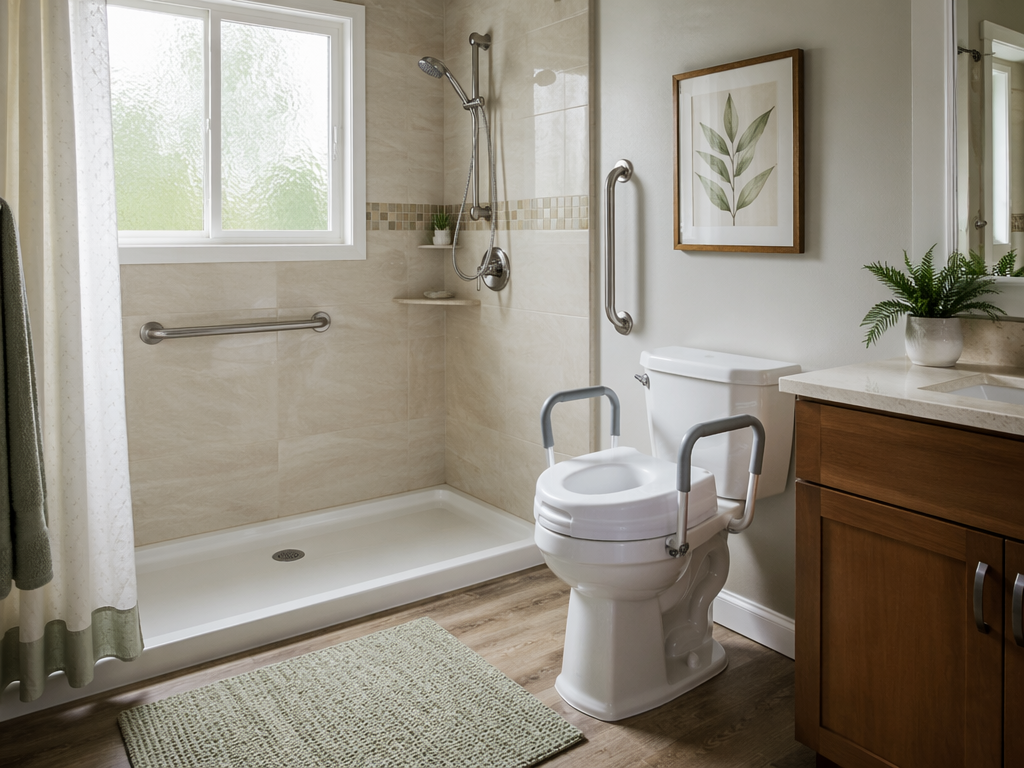
Stand at the doorway and trace the whole bathroom route: doorway threshold, path to toilet, sit-to-stand movement, turn toward sink, entry into tub or shower, reach to soap and towel, exit with wet feet. The towel bar is not a grab bar. The glass shower door is not a support surface. A bathmat that looks tidy can still slide at the exact wrong second.
| Bathroom hazard | Priority fix | Cost context |
|---|---|---|
| No stable support at toilet | Install properly anchored grab bars or add a suitable toilet safety frame | Grab bars are listed by Forbes Health at about $15-$80 before installation complexity.[3] |
| Low toilet seat or hard sit-to-stand transfer | Consider a raised toilet seat, toilet safety rails, or therapist-guided transfer setup | Usually a lower-cost purchase, but fit and stability matter more than price. |
| Tub wall step-over | Add shower chair, handheld showerhead, non-slip surface, and grab bars; price a conversion if step-over is unsafe | Forbes Health lists walk-in shower conversions at about $1,500-$3,500 or more.[3] |
| Full bathroom layout is unsafe | Get professional design and contractor input | ElderLife Financial lists full bathroom renovations at $15,000 or more.[4] |
Grab bars are one of the few purchases that deserve strong attention early. A Human Factors study cited by Wirecutter found that grab bars made users 76% more likely to recover balance during a slip.[1] That does not mean a grab bar prevents every fall, and it does not mean suction-cup bars are a safe substitute for proper installation. It means a correctly placed, correctly anchored bar can change what happens in the seconds after a foot slides. For more on which home changes have evidence behind them, see this guide to fall-prevention modifications that actually prevent falls.
Call an occupational therapist or qualified aging-in-place professional when the transfer itself looks unsafe: your parent plops onto the toilet, cannot rise without pulling hard, freezes at the tub edge, needs physical lifting, or has dementia and cannot follow safe sequencing. Family members often buy equipment before they know whether the person needs a raised seat, a different grab bar angle, a tub transfer bench, cueing, or hands-on caregiver training. Transfer safety is its own skill set; a transfer aids and techniques guide can help you use the right words when asking for help.
A walk-in shower, curbless shower, or full bathroom renovation may be the right answer, but it is not automatically the first answer. If the parent is coming home tomorrow, start with the safest temporary setup that a clinician approves: grab bars, a stable shower chair or tub bench, handheld showerhead, non-slip surface, clear floor space, and supervised bathing if needed. If the bathroom needs design work, use a detailed elderly bathroom remodel guide for specifications and a universal design bathroom guide for choices that do not make the room feel clinical.
Bedroom: Solve the Nighttime Route
The bedroom is less about furniture style and more about what happens at 2 a.m. Put yourself in that moment: your parent wakes up groggy, maybe wearing socks, maybe using a cane, maybe trying not to turn on a bright overhead light. The route from bed to bathroom should be short, lit, uncluttered, and predictable.
- Look for: loose rugs, bedding that drags on the floor, low bed height, unstable nightstand, blocked walker path, oxygen tubing, charging cords, and poor lighting.
- Fix today: clear the bed-to-bathroom route, move the lamp within reach, place glasses and phone consistently, and remove anything at ankle height.
- Buy this week: motion night-lights, a bed rail only if appropriate, a firmer chair for dressing, or a bedside commode if the bathroom route is temporarily unsafe.
- Call a professional: if your parent slides out of bed, cannot stand without help, gets tangled in tubing, or has fallen during nighttime toileting.
Be careful with bed rails. They can help some people reposition or sit up, but they can also create entrapment or climbing risks when cognition, restlessness, or poor fit is involved. If the bed transfer looks hard, watch the movement once, write down exactly where it fails, and ask for therapy input rather than buying the tallest rail online.
When the Fix Moves Beyond a Cart Purchase
Some aging in place home modifications belong in a shopping cart. Others belong in a quote. Once a project affects structure, stairs, plumbing, electrical work, exterior access, or waterproofing, the risk of a cheap mistake rises quickly. Forbes Health lists walk-in shower conversions at $1,500-$3,500 or more and stair lifts at $2,000-$10,000 or more; ElderLife Financial lists home elevators at $20,000-$50,000 and full bathroom renovations at $15,000 or more.[3][4]
Those numbers should not scare you into doing nothing. They should keep you from treating every recommendation as equal. A grab bar, night-light, cleared path, raised toilet seat, shower chair, and better stair lighting may reduce immediate hazards while you decide whether a larger project is justified. If the quote starts to approach the cost of major care changes, compare the remodeling decision with the broader cost picture, including the kind of annual assisted living figures some families use for context. ElderLife Financial lists assisted living at $64,200 per year, but actual costs vary by location and care level.[4] A remodel cost versus assisted living guide can help frame that decision.
Funding is worth checking, but it should not hold up the no-cost fixes. Medicaid waiver programs, Area Agency on Aging grants, veterans programs, and local nonprofit help vary by state, county, eligibility, and annual funding. Use a home modification funding navigator while you collect local quotes. For installation work, especially grab bars, stair projects, ramps, and bathroom changes, use a contractor screening guide before hiring.
Turn the Walk-Through Into Tonight’s Action Plan
After the walk-through, do not rewrite your notes into a perfect spreadsheet before anything changes. Pick the hazards that could cause a fall tonight: bathroom transfer problems, dark stairs, loose rugs, cluttered paths, unsafe bed-to-bathroom route, and missing support where your parent already reaches for walls or furniture.
| Action bucket | What goes here | Do next |
|---|---|---|
| Immediate no-cost removals | Rugs, cords, clutter, unstable furniture, blocked landings, poor item placement | Fix before you leave the house today |
| Under-$500 safety purchases | Grab bars, raised toilet seat, shower chair, night-lights, tread strips, better lamps | Buy only what matches the actual hazard and install correctly |
| Contractor-needed projects | Railings, ramps, shower conversions, stair lifts, electrical changes, full bath work | Get local quotes and check references |
| Professional-assessment triggers | Repeated falls, unsafe transfers, cognitive impairment, wheelchair access, caregiver lifting | Call an occupational therapist, CAPS professional, or appropriate clinician |
The home does not have to be solved all at once. The safest next step is usually visible once you sort the hazards by room, fall risk, and cost: clear the path, light the route, stabilize the toilet and shower, make transfers observable, and get help when the body mechanics are beyond common-sense fixes.
References
- The Best Gear for Aging in Place, Wirecutter, The New York Times, https://www.nytimes.com/wirecutter/reviews/aging-in-place/
- Aging in Place Statistics, Choice Mutual, https://choicemutual.com/original-research/aging-in-place-statistics/
- Aging In Place Remodeling: A Guide To Aging In Place Home Modifications, Forbes Health, https://www.forbes.com/health/healthy-aging/aging-in-place-remodeling/
- How Much Do Home Modifications Cost for Aging in Place?, ElderLife Financial, https://www.elderlifefinancial.com/resources/how-much-do-home-modifications-cost-for-aging-in-place/
Related reading
Need a professional assessment?
Find a CAPS-credentialed professional or local aging services through our outbound resource list — we never name or rank individual contractors.
Find Local HelpNoticed something outdated or inaccurate on this page? Flag a correction. We review every report against CDC, NIA, and AARP HomeFit guidance before updating a page.