
What Is a CAPS? A Family Caregiver's Guide to Certified Aging-in-Place Specialists (CAPS)
credentialThis guide explains what a Certified Aging-in-Place Specialist (CAPS) is, the training they receive, the services they provide, and how hiring one can help you make your parent's home safer and more accessible for the long term.
What Does CAPS Stand For?
CAPS is an acronym for Certified Aging-in-Place Specialist. It is a professional designation developed jointly by the National Association of Home Builders (NAHB) and AARP, first introduced around 2001–2002. The credential was created to address a growing need: as the population ages, more families want to modify existing homes so that older adults can live safely and independently for as long as possible.
The CAPS program is administered by the NAHB and is recognized across the United States, Canada, and several other countries. It remains the only nationally recognized credential specifically focused on the design and construction of aging-in-place home modifications.
What Training Does a CAPS Complete?
Earning the CAPS designation is not a weekend workshop. Candidates must complete a three-course curriculum that covers the technical, business, and interpersonal skills needed to serve older adults and their families. The three courses are:
- CAPS I: Marketing and Communicating with the Aging in Place Client — Focuses on understanding the aging process, communicating effectively with older adults and their families, and marketing services to this demographic.
- CAPS II: Design Concepts for Livable Homes and Aging in Place — Covers universal design principles, barrier-free living concepts, and how to plan modifications that work for a range of abilities.
- CAPS III: Details and Solutions for Livable Homes and Aging in Place — Delves into specific construction details, product selections, and installation solutions for common aging-in-place modifications.
After completing the three courses, candidates must submit an online graduation application, sign a code of ethics pledge, and pay applicable fees. Contractors and remodelers must also provide proof of liability insurance, workers' compensation insurance, and a valid business license where required by their state. The credential must be renewed annually with 4 hours of continuing education, and the NAHB may audit credential holders for proof of compliance.
Who Becomes a CAPS?
One of the most common misconceptions about CAPS professionals is that they are all general contractors. In reality, the credential attracts a wide range of professionals, each bringing a different perspective to home modifications. The diversity of backgrounds is one of the credential's strengths — it means families can find a specialist whose expertise matches their specific needs.
- General contractors and remodelers — The most common background. These professionals handle the full scope of construction and renovation.
- Occupational therapists (OTs) — OTs assess a person's functional abilities and recommend modifications that support daily activities safely.
- Interior designers — Designers focus on aesthetics and usability, ensuring that modifications feel like home improvements, not hospital installations.
- Architects — Architects bring expertise in structural planning, building codes, and universal design principles.
- Real estate agents — Some agents earn the CAPS to help clients understand the value of accessible features when buying or selling a home.
If you are working with a contractor who holds the CAPS credential, you can be confident they have completed the same core training as an OT or designer who holds it. The difference lies in what they do with that training — a contractor builds the modifications, while an OT evaluates how the person interacts with their environment. For many families, the best approach is to involve both.
What Does a CAPS Actually Do?
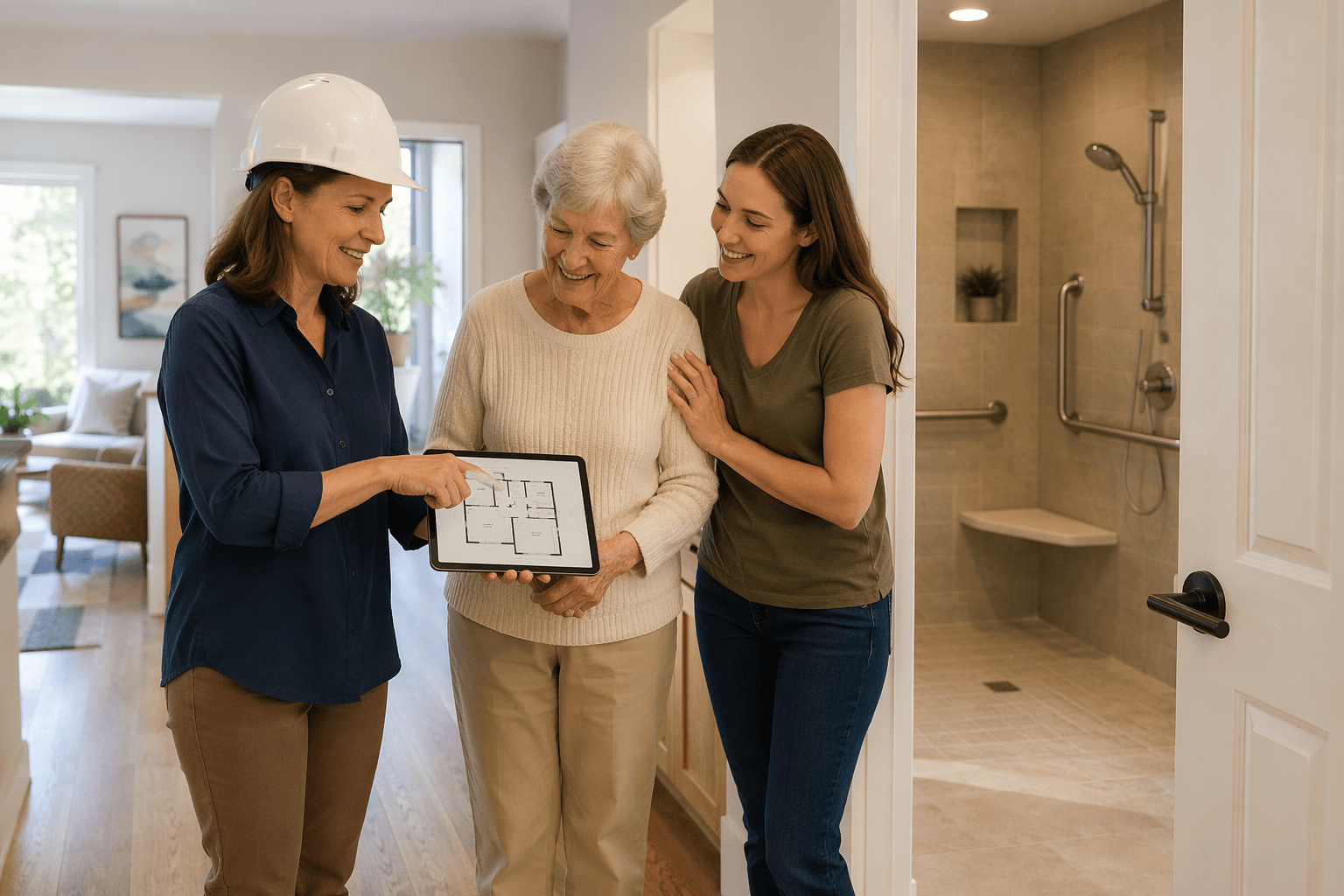
A CAPS professional's role extends far beyond installing grab bars. The typical engagement follows a structured process designed to ensure that modifications are safe, functional, and aligned with the older adult's current and future needs.
- Home assessment — The CAPS visits the home to evaluate the existing layout, identify hazards, and discuss the older adult's mobility, balance, and daily routines. This assessment typically takes 1–2 hours.
- Written recommendations with visuals — After the assessment, the CAPS provides a detailed report that includes specific modification recommendations, often accompanied by sketches, floor plans, or product photos. This report serves as a roadmap for the entire project.
- Cost estimates — The CAPS prepares itemized cost estimates for each recommended modification, helping families understand the budget required before any work begins.
- Contractor coordination — If the CAPS is not performing the work themselves, they can help obtain quotes from qualified contractors, review bids, and oversee the installation to ensure it meets the design specifications.
- Follow-up and adjustment — After modifications are installed, a good CAPS will follow up to confirm that the changes are working as intended and make any necessary adjustments.
This end-to-end service is what distinguishes a CAPS from a general contractor who simply installs what you ask for. A CAPS thinks ahead — considering how the older adult's needs may change over the next 3, 5, or 10 years — and designs modifications that remain useful as mobility or cognition evolves.
Common Modifications a CAPS Might Recommend
While every home and every older adult is different, certain modifications appear frequently in CAPS recommendations. The table below lists common modifications along with estimated cost ranges. Note that these figures are based on industry data from 2019 and may be higher in 2026 due to inflation and material cost increases.
| Modification | Typical Cost Range (2019 est.) | Primary Benefit |
|---|---|---|
| Grab bars (set of 3) | $150 | Fall prevention in bathrooms and hallways |
| Walk-in shower (curbless) | $1,500 – $2,000 | Eliminates step-over hazard; wheelchair accessible |
| Walk-in tub | $5,000 – $7,000 | Safe bathing for those with limited mobility |
| Outdoor ramp (per linear foot) | $100 – $250 | Wheelchair and walker access to the home |
| Widened doorways (per door) | $500 – $1,500 | Wheelchair and walker clearance |
| Lever-style door handles (per handle) | $20 – $60 | Easier operation for arthritic hands |
| Touchless faucet | $150 – $275 | Reduces cross-contamination; easy to use |
| Non-slip flooring (per sq. ft.) | $1 – $4 | Reduces fall risk on hard surfaces |
| Kitchen modifications (full) | $15,000+ | Accessible counters, pull-out shelves, lowered cabinets |
For a deeper look at which modifications have the strongest evidence for preventing falls and improving independence, see our evidence-based guide to home modifications that actually work.
How Much Does It Cost to Hire a CAPS?
The cost of hiring a CAPS varies depending on the scope of work and the professional's background. For a standalone home evaluation — where the CAPS visits your home, assesses the space, and provides a written report with visuals — the typical cost is approximately $500, according to Gina Knight, a CAPS professional cited by Care.com. This evaluation fee is often applied toward the overall project cost if you hire the same CAPS to manage the modifications.
If the CAPS is also managing the construction or renovation, their fees may be included in the contractor's overhead or charged as a separate project management fee. Always ask upfront how the CAPS charges — whether it is a flat fee for the assessment, an hourly rate for consultation, or a percentage of the total project cost.
How to Find and Vet a CAPS Near You
The most reliable way to find a CAPS professional is through the NAHB's official CAPS directory. This directory lists credentialed professionals by location and is the only way to verify that someone currently holds the CAPS designation.
Once you have identified a few candidates, use these vetting questions to narrow your choice:
- How long have you held your CAPS credential? — More experienced CAPS professionals are likely to have encountered a wider range of home layouts and client needs.
- Have you worked on homes similar to ours? — A CAPS who has experience with older homes, split-level layouts, or specific architectural styles will be better prepared for your project.
- Can you provide references from past clients? — Speaking with other families who have worked with the CAPS can give you insight into their communication style, reliability, and quality of work.
- Do you carry liability insurance and workers' compensation? — This is a requirement for contractors seeking the CAPS credential, but it is worth confirming directly.
- What is included in your home evaluation fee? — Clarify whether the fee covers a written report, visuals, and a follow-up consultation.
Why This Matters for Family Caregivers
The gap between what families want and what homes are ready for is staggering. According to a 2026 Pew Research Center survey, 93% of U.S. adults aged 65 and older live in their own home or apartment, and the vast majority want to stay there as they age. Yet fewer than 4% of homes in the U.S. housing market are considered aging-in-place ready, according to Amy Roberts, a CAPS professional cited by Care.com. And despite this readiness gap, only 18% of adults aged 50 and older have made any home modifications, according to Choice Mutual.
For family caregivers, this data translates into a clear message: waiting until after a fall or a crisis to modify a parent's home is far more expensive and stressful than planning ahead. Emergency renovations — done in a rush, often without a comprehensive plan — tend to cost more, take longer, and result in modifications that may not address the full range of needs.
A CAPS professional helps bridge this gap. By conducting a thorough assessment and creating a phased plan, a CAPS can help families prioritize the most critical modifications first — often starting with bathroom safety and entryway access — while deferring less urgent changes to a later budget cycle. This phased approach makes the project more manageable financially and logistically, while ensuring that the most dangerous hazards are addressed immediately.
For a broader framework on how to approach home modification decisions as a family caregiver, see our decision framework for aging-in-place home modifications. And if you are concerned about how to pay for modifications, our guide to grants, loans, and assistance programs for senior bathroom remodels in 2026 covers the most common funding sources.
See This Term in Context
- Senior Health Services by Care Need: Matching Services to Your Parent's Actual Situation
A scenario-based guide for crisis-driven caregivers. Instead of organizing services by facility type, this guide helps you match the right service — home health, adult day care, respite, PACE, or memory care — to your parent's specific situation, whether it's a recent fall, a dementia diagnosis, or caregiver burnout.
- The Medicare DME Prevention Paradox: What Won't Medicare Pay For and How to Plan for the Gap
Family caregivers often discover that Medicare covers hospital beds and wheelchairs but not the grab bars, shower chairs, or stair lifts that prevent falls. This article explains the coverage gap, lists what is excluded, and provides actionable strategies to bridge the out-of-pocket costs.
- How to Choose Senior Care: A Step-by-Step Guide for First-Time Family Caregivers
A structured, five-step action plan for adult children who need to make a senior care decision after a crisis. Learn how to assess functional ability, match needs to the right care level, determine your budget, evaluate facilities, and plan a smooth transition.
Comments
Join the discussion with an anonymous comment.